Sitecore CMS
Sitecore GEO, AEO and AI Digital Marketing Services
PPrem M.6 Min Read
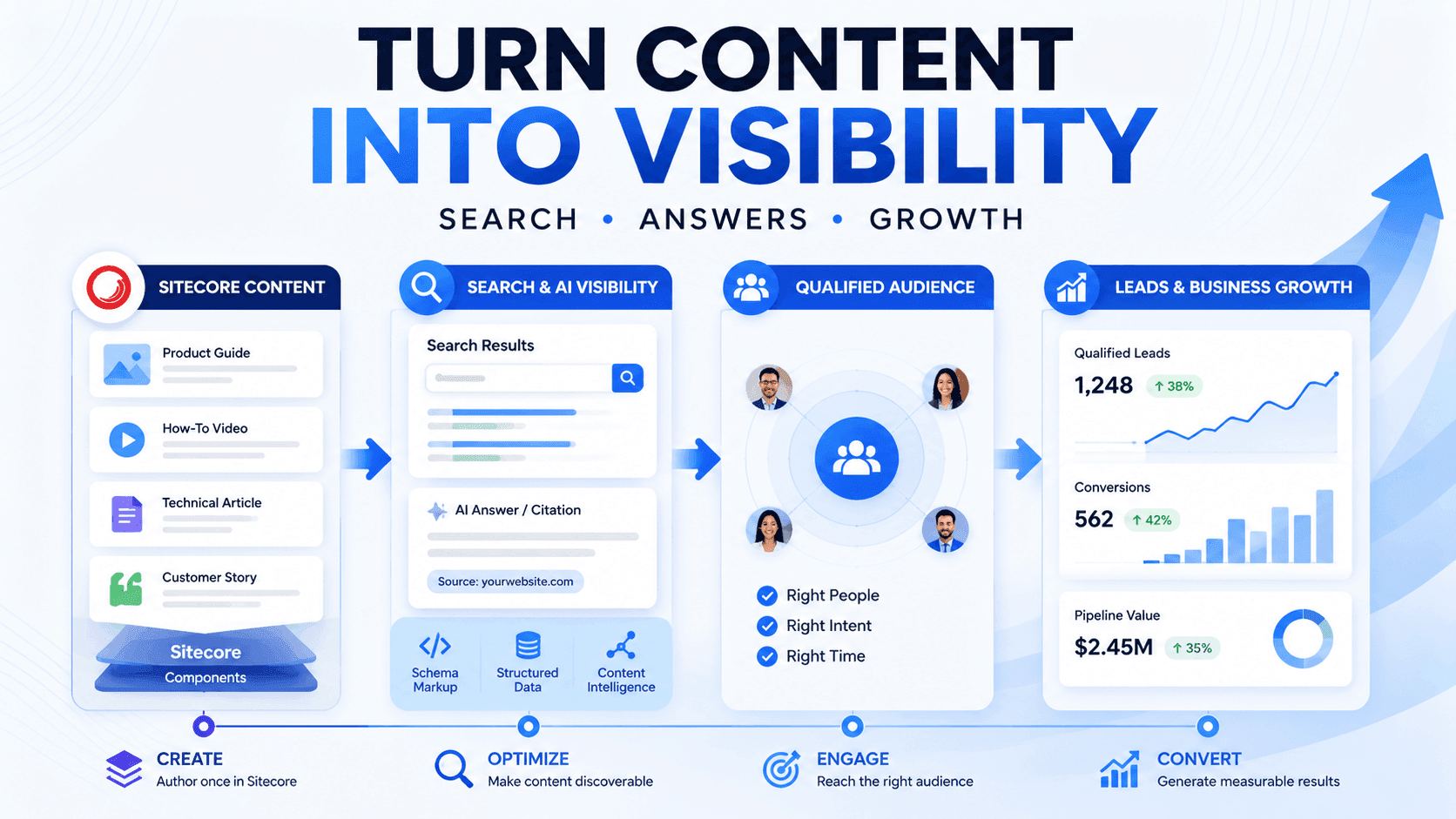
Enterprise content discovery has changed.
Your customers, partners and decision-makers no longer rely only on traditional Google or Bing results. They also ask questions, compare providers and research solutions through ChatGPT, Gemini, Perplexity, Grok, DeepSeek and AI-powered search experiences.
Your organization may be publishing valuable content in Sitecore, but search engines and AI platforms may not be able to discover, understand or accurately represent it.
Traditional SEO remains essential. Google confirms that its existing SEO principles crawlability, technical structure, valuable content and authority continue to support visibility in generative search. However, enterprise teams must now combine SEO with Answer Engine Optimization and Generative Engine Optimization.

Transform your Sitecore content with SEO, AEO, GEO, and AI strategies built for search, answers, visibility, and growth.
SEO helps pages become discoverable and competitive across Google, Bing and other traditional search engines.
For a Sitecore or XM Cloud website, this includes:
SEO continues to be the foundation because AI-powered search systems frequently retrieve information from existing search indexes and accessible web content.
AEO helps platforms extract a clear answer from your content.
A page explaining “What is Sitecore XM Cloud migration?” should not hide the answer inside several paragraphs of marketing copy. It should provide a concise answer, followed by evidence, details, related questions and a relevant next step.
AEO-friendly Sitecore templates can include dedicated fields for:
This enables the same approved information to support visible FAQs, search results, structured data, APIs and conversational interfaces.
GEO improves the ability of generative AI systems to understand your organization, services, expertise and content.
It depends on more than keywords. AI platforms need consistent entities, strong topic coverage, credible authorship, original experience, reliable references, structured information and third-party authority.
Sitecore’s own AI-optimization guidance recommends crawlable HTML, reusable structured components, answer-led sections, schema-driven templates, content hubs, author credentials, case studies, internal linking and regular measurement.
An enterprise may have thousands of high-quality pages, product documents, service descriptions, reports and case studies in Sitecore. That does not mean those assets are optimized for retrieval.
Common problems include:
Sitecore recommends server-side rendering, static generation or incremental regeneration so bots receive complete HTML. It also recommends storing headings, FAQs, metadata and answers in structured fields instead of placing everything inside unstructured rich text.
Without this foundation, your content team may publish frequently while the organization remains difficult to discover across search and AI-assisted research.
SitecoreAI combines content management, digital assets, audience insights, personalization, testing and AI-assisted workflows within a connected platform. Sitecore currently promotes native assistance for copy, translation, metadata, schema, SEO, AEO and GEO activities.
However, purchasing or upgrading the platform does not automatically create a complete search strategy.
Your organization still needs the right content architecture, component templates, rendering approach, governance, integrations, analytics and training. This is where a specialized Sitecore development and AI digital marketing service becomes important.
The implementation should cover:
For XM Cloud projects, the frontend should deliver meaningful server-rendered or pre-rendered HTML instead of depending entirely on browser-side rendering.
Reusable Sitecore templates should provide fields for:
This turns AEO and GEO into a repeatable publishing capability rather than a manual SEO task completed after every page is written.
Our detailed Sitecore GEO and AEO optimization guide explains how these structured fields can support search, AI APIs, internal discovery and answer-ready content.
AI systems and search engines need evidence that supports your claims.
Sitecore templates should therefore surface:
Google prioritizes helpful, reliable, people-first content rather than pages created primarily to manipulate rankings.
Isolated articles rarely create meaningful authority.
An enterprise Sitecore strategy should connect cornerstone pages with related service pages, FAQs, case studies, videos, industry content and technical guides.
For example, an XM Cloud topic hub could connect:
Explore Murmu Software Infotech ‘s Sitecore XM Cloud development services and its enterprise healthcare XM Cloud and AI Search case study for examples of connected platform and content capabilities.
Sitecore Search can index articles, services, FAQs, documents, locations and resource metadata. Search analytics can reveal unanswered questions and content gaps.
Localization can adapt content for different countries, regions and languages, while personalization can surface more relevant content for specific audiences. Essential information should still remain accessible in the default, crawlable page experience. Sitecore positions personalization as a way to deliver more relevant experiences and improve engagement across customer journeys.
The organization should track more than keyword rankings.
SEO metrics: impressions, rankings, clicks, organic conversions and Core Web Vitals.
AEO metrics: question coverage, extracted answers, AI Overview appearances and answer accuracy.
GEO metrics: AI brand mentions, cited pages, citation accuracy, referral traffic, topic visibility and AI-assisted conversions.
AI referrals and recognized crawlers can also be analyzed through GA4, CDN logs and server logs.
Some SEO tools promote mass directory submissions, automated profile links and rapid ranking promises. These tactics should not become the foundation of an enterprise search program.
Google’s spam policies apply to attempts to manipulate both traditional rankings and generative AI responses. Policy violations can result in reduced visibility or removal from search results. Sustainable authority comes from valuable content, relevant editorial backlinks, customer proof, expertise and a technically sound platform not bulk link creation.
A complete Sitecore SEO, AEO and GEO program can help organizations:
Murmu Software Infotech can assess your Sitecore XP, XM Cloud or Sitecore AI implementation; build the required technical and structured-content foundation; configure search and analytics; and train your content and digital marketing teams to publish optimized content independently.
Review our enterprise CMS and Sitecore delivery portfolio or request a Sitecore SEO, AEO and GEO readiness assessment.
Your enterprise content should not only be published. It should be discoverable, understandable, trusted and ready to influence decisions everywhere your audience searches.
Sitecore SEO, AEO, GEO and AI digital marketing services combine technical SEO, structured content, answer optimization and generative AI visibility strategies to help enterprise websites become more discoverable across search engines, answer engines and AI platforms.
AEO, or Answer Engine Optimization, structures Sitecore content around clear questions and concise direct answers. It helps search engines, AI assistants and answer-based platforms understand and extract useful information.
GEO, or Generative Engine Optimization, helps generative AI platforms understand an organization's expertise, services, products and content through structured entities, factual summaries, authoritative content and trustworthy digital signals.



SEO focuses on improving search visibility and organic traffic, AEO focuses on making content easy to extract as direct answers, and GEO focuses on improving how generative AI systems understand, reference and represent content and organizations.
Sitecore content can become AI-ready by using structured fields for AI summaries, key facts, questions, direct answers, primary entities, authors, sources, target audiences, service areas and review dates.
Sitecore content can be improved for AI discovery by making important information accessible, structured, accurate, authoritative and easy to understand. SEO, AEO, GEO, technical accessibility and strong entity information work together to support AI discovery.
Answer-first components provide a clear response before detailed explanation. This improves user experience and helps search engines and AI systems identify the most important information on a page.
Structured data helps search engines and other systems better understand page meaning, entities and relationships. However, it does not guarantee rankings or AI citations, so content must also be accurate, useful, accessible and trustworthy.
Yes. Sitecore XM Cloud can support structured content, metadata, schema markup, answer-first components, AI-ready fields, technical SEO, Next.js optimization and content workflows designed for modern search and AI discovery.
AI search and GEO performance can be measured through brand mentions, cited URLs, topic coverage, visibility across AI platforms, AI referral traffic, answer coverage, engagement and conversions influenced by AI discovery.