Sitecore XM Cloud Development Services
In This Article
- SitecoreAI, Next.js and Migration
- Planning an XM Cloud or SitecoreAI Project?
- What Do XM Cloud Development Services Include?
- Sitecore XM Cloud vs Traditional Sitecore XP/XM
- XP/XM to XM Cloud Migration
- XM Cloud Pricing and Engagement Models
- Dedicated XM Cloud Developer
- Project-Based Delivery
- Offshore Team Extension
- Ongoing Support
- Why Content SDK, Next.js and Experience Edge Matter
- Related Sitecore Services
- Build XM Cloud for the Next Stage of Your Digital Platform
- Ready to Modernize Your Sitecore Platform?
SitecoreAI, Next.js and Migration
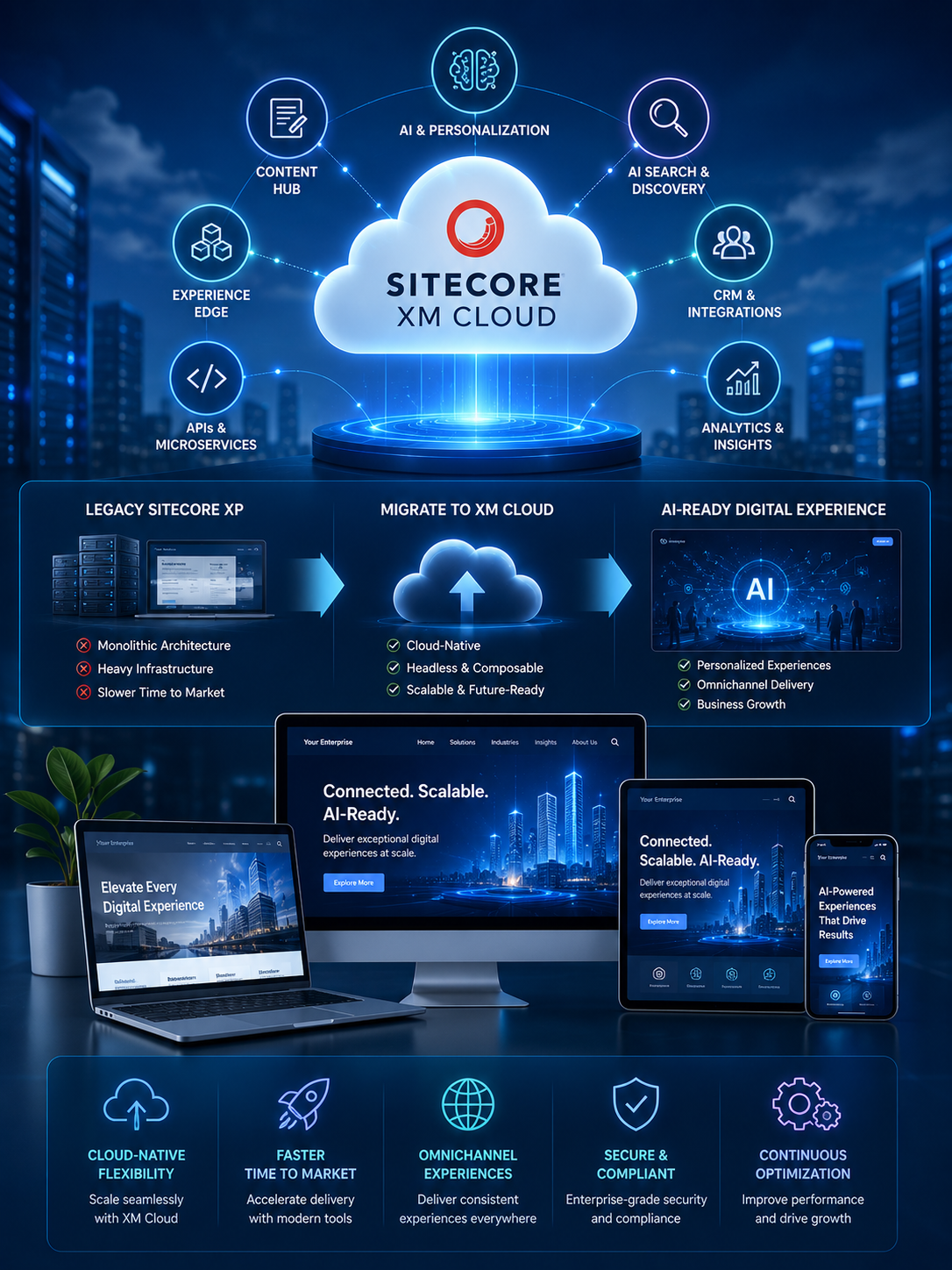
Sitecore XM Cloud development services help enterprises build, migrate and modernize cloud-native, headless digital experiences using SitecoreAI/XM Cloud, Content SDK, Next.js, GraphQL, Experience Edge and enterprise integrations. Services can include architecture, component development, content modeling, XP/XM migration, DevOps, testing, performance optimization and ongoing support.
For enterprises modernizing legacy Sitecore XP or building a composable experience, the goal is not simply moving the CMS to the cloud. Content, frontend architecture, integrations and authoring should be designed together.
Murmu Software Infotech provides Sitecore XM Cloud Development Services for enterprises and digital agencies that need implementation, migration, modernization and ongoing engineering support.
Modernize Faster with XM Cloud
Migrate, build and scale SitecoreAI and XM Cloud experiences with Next.js, Content SDK, integrations and enterprise-ready engineering support.
Planning an XM Cloud or SitecoreAI Project?
Get help with architecture, migration planning, Next.js development, reusable components, Experience Edge, integrations and deployment.
Discuss Your XM Cloud Project →
What Do XM Cloud Development Services Include?
A complete engagement can cover the full development lifecycle rather than only frontend coding.
Typical capabilities include:
- SitecoreAI/XM Cloud solution architecture
- Content modeling and information architecture
- Content SDK and Next.js development
- Reusable components and page layouts
- GraphQL and Experience Edge integration
- Multisite and multilingual implementation
- Visual editing and authoring configuration
- API, CRM, DAM, PIM and commerce integrations
- Content and media migration
- CI/CD and frontend hosting
- Performance, SEO and accessibility improvements
- Testing, deployment and post-launch support
For organizations that also maintain XP, XM, SXA or mixed Sitecore environments, broader Sitecore CMS Development Services can support both legacy and cloud modernization requirements.
Sitecore XM Cloud vs Traditional Sitecore XP/XM
| Area | Traditional Sitecore XP/XM | SitecoreAI / XM Cloud |
|---|---|---|
| Platform model | Self-managed or hosted infrastructure | SaaS-oriented managed platform |
| Frontend | MVC, SXA or headless | Modern headless frontend |
| Content delivery | Sitecore delivery infrastructure | Experience Edge |
| Frontend stack | .NET/MVC or JSS | Content SDK, Next.js and modern frameworks |
| Scaling | Infrastructure planning required | Cloud-managed content delivery |
| Deployment | Platform and app deployment responsibilities | Decoupled frontend and managed CMS |
| Modernization focus | Maintain or upgrade existing estate | Composable, cloud-native delivery |
The decision should not be based only on hosting. Existing customizations, personalization, search, forms, integrations, content structure and MVC components must be assessed because not every XP capability maps directly into the cloud architecture.
XP/XM to XM Cloud Migration
Migration is usually the most complex part of an XM Cloud program.
A structured migration should evaluate:
- Current templates, content and media
- MVC/SXA components and presentation
- Custom modules and integrations
- Search and personalization dependencies
- Multisite and multilingual requirements
- SEO-critical URLs, metadata and redirects
- DevOps and deployment architecture
Legacy presentation may need to be rebuilt as modern frontend components instead of simply copied.
The goal is a cleaner content model, reusable components and a frontend that can evolve independently.
XM Cloud Pricing and Engagement Models
Development cost depends on the existing Sitecore estate, migration scope, number of sites, frontend complexity, integrations, content volume, QA requirements and delivery responsibility.
Dedicated XM Cloud Developer
Current dedicated Sitecore engagements can range around $20–$40/hour or from $2,500/month.
This model works well for ongoing components, sprint delivery, integrations, migration work and team extension. Businesses can Hire Sitecore Developers when internal technical leadership already owns the overall roadmap.
Project-Based Delivery
Best for defined outcomes such as:
- New XM Cloud/SitecoreAI implementation
- XP/XM to cloud migration
- Headless frontend redevelopment
- Multisite implementation
- Enterprise integration program
Pricing should follow discovery and architecture assessment rather than a generic package price.
Offshore Team Extension
Enterprises and agencies can add Sitecore, frontend, QA and DevOps capacity as workload changes. An Offshore Sitecore Development Partner can be useful where the client or agency wants to retain product or client ownership while scaling delivery.
Ongoing Support
After launch, continuous work may include component enhancements, deployments, integration maintenance, performance improvement and production troubleshooting. A structured Sitecore Development Support model is better suited to that ongoing operational workload.
Why Content SDK, Next.js and Experience Edge Matter
Modern Sitecore delivery separates content management from frontend presentation.
Content SDK can connect modern applications to SitecoreAI while supporting visual editing, personalization, analytics, multisite implementation and GraphQL-based content access. Experience Edge provides a managed GraphQL delivery layer for published content and media.
This supports independently deployed frontends, reusable components and modern workflows while preserving visual authoring and flexible page composition.
Related Sitecore Services
- Sitecore XM Cloud Development Services - Implementation, migration, headless development and modernization.
- Sitecore CMS Development Services - XP, XM, SXA, SitecoreAI and enterprise development.
- Hire Sitecore Developers - Dedicated engineering capacity for ongoing delivery.
- Sitecore Development Support - Maintenance, troubleshooting and continuous improvements.
- Offshore Sitecore Development Partner - Scalable Sitecore capacity for enterprises and agencies.
- Sitecore SEO Services - Technical SEO, structured data and search visibility for Sitecore platforms.
Build XM Cloud for the Next Stage of Your Digital Platform
A successful XM Cloud program should improve more than infrastructure. It should create faster development cycles, reusable digital components, clearer content architecture, reliable integrations and an authoring experience that supports continuous change.
Murmu Software Infotech supports SitecoreAI/XM Cloud architecture, Content SDK, Next.js, Experience Edge, migration, integrations, DevOps and ongoing enterprise development from India.
Ready to Modernize Your Sitecore Platform?
Start with an architecture and migration discussion before committing to implementation. We can assess your current Sitecore environment, identify migration complexity and define the right team and delivery model.
Plan Your XM Cloud Development →
Frequently Asked Questions
What are Sitecore XM Cloud development services?
Sitecore XM Cloud development services include architecture, content modeling, Content SDK and Next.js development, reusable components, GraphQL, Experience Edge, integrations, migration, DevOps, testing, deployment and ongoing support.
Is Sitecore XM Cloud now called SitecoreAI?
Sitecore's current platform documentation identifies XM Cloud as SitecoreAI, although XM Cloud terminology can still appear in existing projects, documentation, engineering assets and enterprise modernization discussions.
Can Sitecore XP migrate to XM Cloud?
Yes. Migration can include architecture assessment, content mapping, MVC or SXA component redevelopment, content migration, integration modernization, SEO preservation, testing, deployment and authoring validation.
How much does XM Cloud development cost?
Cost depends on architecture, migration scope, frontend complexity, integrations, content volume and delivery model. Dedicated Sitecore developers can range around $20–$40 per hour or start near $2,500 per month.
What technologies are used for XM Cloud development?
Modern XM Cloud and SitecoreAI implementations commonly use Content SDK, Next.js, React, TypeScript, GraphQL, Experience Edge, APIs, Git-based source control and CI/CD pipelines.
What is Sitecore Experience Edge?
Experience Edge is Sitecore's managed GraphQL-based content delivery service for published layout, content and media, supporting scalable headless delivery to websites and other digital channels.
Can XM Cloud support multilingual and multisite websites?
Yes. XM Cloud and SitecoreAI implementations can support multiple websites, languages, reusable components, shared content structures and centralized enterprise content operations when the architecture is designed appropriately.
Can XM Cloud integrate with enterprise systems?
Yes. Sitecore can integrate with CRM, ERP, DAM, PIM, commerce, search, identity, analytics and custom business applications through APIs and composable integration patterns.
Can I hire dedicated XM Cloud developers?
Yes. Dedicated Sitecore developers can support components, Next.js development, GraphQL, integrations, migration, DevOps, testing and ongoing sprint delivery through hourly or monthly engagement models.
Do you provide post-launch XM Cloud support?
Yes. Post-launch support can cover production troubleshooting, component enhancements, deployments, integrations, performance optimization, technical debt reduction and continuous platform improvement.