Sitecore XM Cloud vs Sitecore XP
In This Article
Which Platform Should Enterprises Choose in 2026?
Choosing between Sitecore XM Cloud and Sitecore XP is not simply a cloud-versus-on-premises decision. It affects platform architecture, personalization, infrastructure responsibility, development skills, operating costs and how quickly marketing teams can launch digital experiences.
Competitor comparisons consistently identify the same distinction: Sitecore XP remains valuable for enterprises requiring extensive control and built-in marketing capabilities, while XM Cloud is designed for SaaS operations, headless delivery, composable integrations and modern frontend development.

Choose the Right Sitecore Future
Compare XM Cloud and Sitecore XP to choose the right architecture, modernization strategy, and digital platform for enterprise growth.
What Is Sitecore XP?
Sitecore Experience Platform is an integrated DXP combining content management with analytics, xConnect and xDB customer data, personalization and marketing automation.
It supports traditional .NET MVC development and can also deliver headless experiences through Sitecore Headless Services and JSS. Because organizations manage or commission the infrastructure, XP offers greater control over hosting, databases, search, deployment schedules and custom server-side functionality.
Sitecore XP may remain suitable when an enterprise:
- Depends heavily on xDB and multi-session personalization
- Uses complex .NET MVC components
- Has extensive custom modules and integrations
- Requires direct infrastructure or data-hosting control
- Has recently invested substantially in an XP implementation
Choose the Right Sitecore Platform for Enterprise Growth
What Is Sitecore XM Cloud?
Sitecore XM Cloud introduced a managed, SaaS-based and headless CMS model. Sitecore manages the core CMS infrastructure and platform updates, while content is delivered through APIs to a separately hosted frontend, commonly built with Next.js and React.
Its architecture supports visual page building, reusable components, GraphQL delivery, Experience Edge and composable connections to products such as Sitecore Search, Personalize, CDP and Content Hub.
In 2026, the decision also sits within Sitecore’s broader SitecoreAI direction. SitecoreAI is positioned as a cloud-native, SaaS and hybrid-headless DXP connecting content, data, personalization and AI-powered workflows.
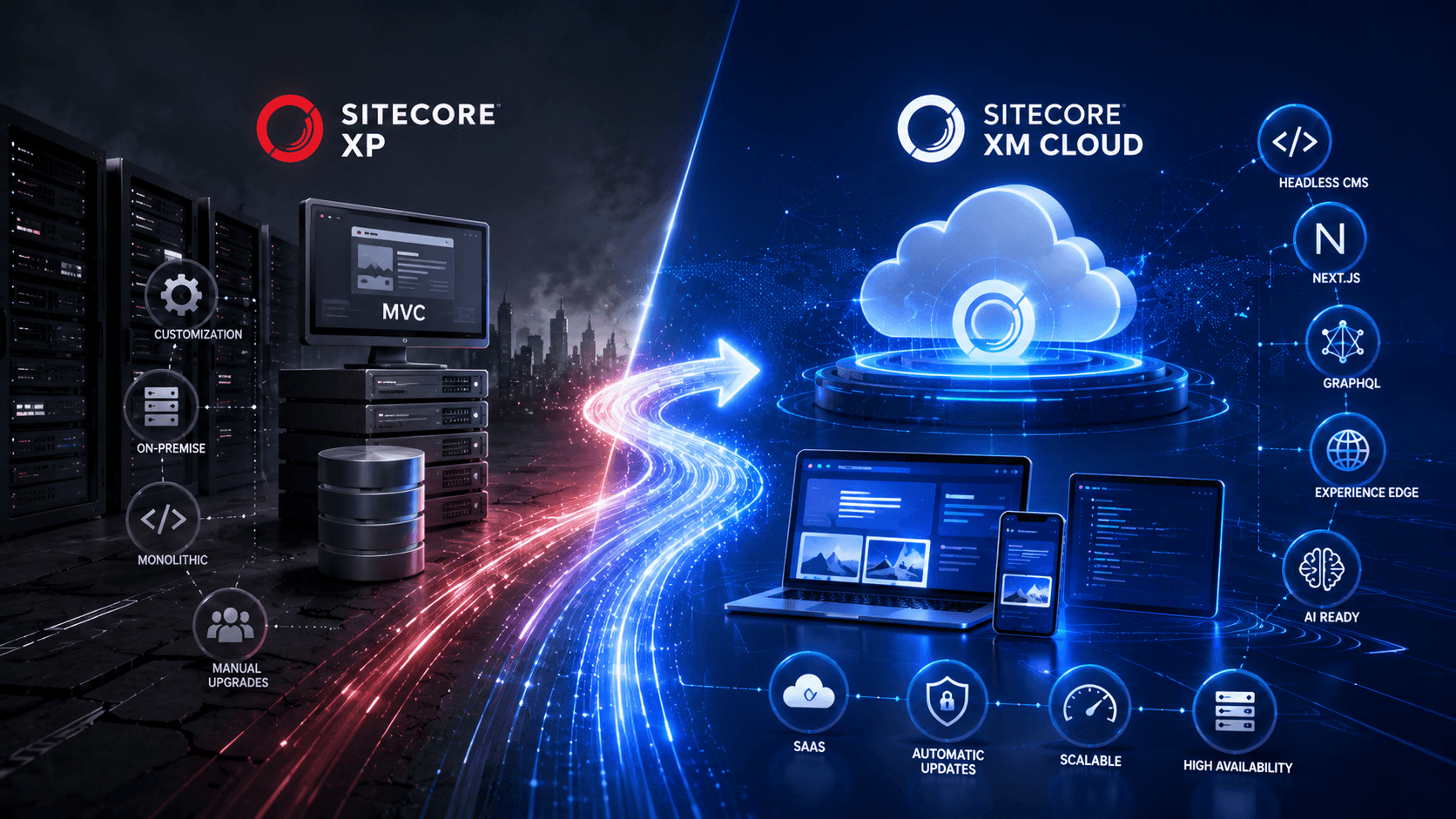
Sitecore XM Cloud vs Sitecore XP
Area
Sitecore XP
Sitecore XM Cloud
Hosting
Customer-controlled or managed environment
Sitecore-managed SaaS CMS
Architecture
Integrated DXP with optional headless delivery
Headless-first and composable
Frontend
.NET MVC, SXA or JSS
Next.js, React and modern frameworks
Personalization
Multi-session data through xDB and xConnect
Built-in session-based options plus composable personalization
Updates
Planned and managed by the customer or partner
Continuous platform updates managed by Sitecore
Infrastructure
Databases, Solr, scaling and operations require management
Core CMS infrastructure managed by Sitecore
Best suited for
Complex ecosystems requiring direct control
Modern, scalable and composable platforms
XM Cloud does not eliminate every hosting cost. Although Sitecore manages the CMS, the rendering application still requires frontend hosting. Next.js hosting, integrations, monitoring and support should therefore be included when calculating total cost of ownership.
When Should You Stay on Sitecore XP?
Remaining on XP can be practical when the platform is stable, actively used and closely connected to critical business systems.
Organizations may first optimize performance, upgrade their supported version, modernize selected components and create a phased migration roadmap rather than forcing an immediate replatforming.
Explore our Sitecore healthcare platform modernization case study and healthcare event platform developed with Sitecore SXA.
When Should You Choose XM Cloud?
XM Cloud is generally the stronger direction for new websites, redesigns, global multisite programs and enterprises seeking faster releases with less CMS infrastructure management.
It is especially relevant when organizations want:
- Next.js and modern frontend development
- API-first enterprise integrations
- Global headless content delivery
- Composable search and personalization
- Faster platform innovation
- Alignment with SitecoreAI
See our healthcare XM Cloud and AI Search case study, airport marketing platform built with XM Cloud and XM Cloud travel platform using Next.js.
Plan Your Sitecore XP to XM Cloud Future
XM Cloud Migration Is a Replatforming Project
Moving from XP to XM Cloud is generally not an in-place upgrade.
Content and media can be migrated, but MVC renderings, controllers, custom modules, xDB dependencies and direct database integrations normally require assessment, replacement or redevelopment. Existing JSS or headless applications may follow a simpler path because more frontend code may be reusable.
Watch our technical showcases:
- Enterprise Healthcare Migration to XM Cloud and AI Search
- Sitecore XM Cloud Templates, Renderings and GraphQL Demo
- Sitecore AI and MCP Server Demo
Which Sitecore Platform Should You Choose?
Choose Sitecore XP when infrastructure control, existing investment and deeply integrated marketing capabilities outweigh the operational burden.
Choose XM Cloud when SaaS management, headless architecture, scalability, frontend agility and composable integration are strategic priorities.
Murmu Software Infotech provides Sitecore CMS and XM Cloud development services from Ranchi, Jharkhand, India.
Explore our CMS website development portfolio, Sitecore cost guide for 2026 and guide to choosing a Sitecore XM Cloud development company.
The best platform decision comes from evaluating your current architecture, personalization strategy, migration effort, operating costs and five-year digital roadmap - not simply choosing the newest product.
Frequently Asked Questions
What is the main difference between Sitecore XP and XM Cloud?
Sitecore XP is an integrated digital experience platform that can combine CMS, analytics, customer data and personalization in a customer-managed environment. XM Cloud is a fully managed SaaS headless CMS designed for API-first content delivery and independently hosted frontend applications.
Which platform is better for a new Sitecore implementation?
XM Cloud is generally the stronger option for a new implementation when the organization wants SaaS operations, Next.js development, headless architecture, composable integrations and less responsibility for CMS infrastructure and upgrades.
When should an enterprise remain on Sitecore XP?
Remaining on Sitecore XP may be practical when the platform is stable, heavily customized, closely integrated with business systems or dependent on xDB, xConnect, MVC components and integrated multi-session personalization.
Can Sitecore XP migrate to XM Cloud?
Yes. Sitecore XP can transition to XM Cloud through readiness assessment, content migration, component redevelopment, Next.js implementation, integration modernization, testing, deployment and post-migration optimization.
Is XP to XM Cloud migration a normal Sitecore upgrade?
No. It is generally a replatforming initiative because XM Cloud uses a SaaS-based headless architecture. Content may be migrated, but legacy presentation code, custom modules and XP-specific capabilities must be assessed and redesigned.
Does XM Cloud support Sitecore MVC websites?
XM Cloud supports headless implementations rather than traditional Sitecore MVC website solutions. MVC renderings normally need to be mapped and rebuilt as modern frontend components.
Which frontend technology is used with XM Cloud?
Next.js and React are commonly used with XM Cloud. Frontend applications retrieve Sitecore-managed content, layout and media through headless services and GraphQL-based Experience Edge delivery.
Can Sitecore XP support headless development?
Yes. Supported Sitecore XP versions can use Sitecore Headless Services, JSS, Headless SXA and JavaScript frameworks. This can also provide an incremental modernization path before a complete XM Cloud migration.
How does personalization differ between XP and XM Cloud?
Sitecore XP can provide integrated personalization using xDB and xConnect. XM Cloud solutions commonly use headless CMS capabilities with composable customer-data and personalization products such as Sitecore Personalize and CDP.
Does XM Cloud eliminate infrastructure costs?
XM Cloud reduces responsibility for core CMS servers, databases, search infrastructure and platform upgrades. Separate costs may remain for frontend hosting, integrations, monitoring, implementation, migration and support.
Is XM Cloud part of Sitecore's AI strategy?
XM Cloud's cloud-native headless capabilities align with Sitecore's broader SitecoreAI direction, which connects content, data, personalization, assets and AI-enabled digital experience workflows.
What should be assessed before migrating from XP?
The assessment should cover Sitecore version, templates, content, media, MVC renderings, custom modules, xDB dependencies, personalization, search, forms, integrations, deployment workflows, SEO and frontend architecture.
How should enterprises compare Sitecore costs?
Compare licensing, implementation, migration, frontend hosting, infrastructure, upgrades, integrations, support, internal operations and future enhancements over a three-to-five-year period.
Who provides Sitecore XP and XM Cloud consulting in India?
Murmu Software Infotech provides Sitecore XP modernization, XM Cloud architecture, migration assessment, Next.js headless development, integrations, performance optimization and managed support from India.