Top 12 Sitecore Consulting Services in 2026: Costs and Best Firms
In This Article
- Quick Answer: Sitecore Consulting Services at a Glance
- What Are Sitecore Consulting Services?
- What Does a Sitecore Consultant Do?
- Sitecore Consulting vs. Sitecore Development: What Is the Difference?
- 7 Signs Your Business Needs Sitecore Consulting Services
- Top 12 Sitecore Consulting Services for Enterprises
- 1. Sitecore Strategy and Roadmap Consulting
- 2. Platform and License Advisory: XP, XM, or SitecoreAI
- 3. Sitecore Technical Audit and Health Check
- 4. Solution Architecture and Implementation Planning
- 5. Upgrade Planning for Sitecore XP and XM
- 6. SitecoreAI Migration Consulting (Formerly XM Cloud)
- 7. Headless and Next.js Architecture Consulting
- 8. Integration and API Consulting
- 9. Personalization and Customer Data Consulting
- 10. Content Hub, Search, and Commerce Consulting
- 11. Performance, Security, and Compliance Reviews
- 12. Managed Support and Continuous Optimization Advisory
- How Does a Sitecore Consulting Engagement Work? 7 Steps
- Step 1: Discovery and Stakeholder Workshops
- Step 2: Platform Audit and Gap Analysis
- Step 3: Strategy, Roadmap, and Business Case
- Step 4: Architecture and Implementation Guidance
- Step 5: Testing and Quality Assurance Oversight
- Step 6: Training and Knowledge Transfer
- Step 7: Ongoing Optimization and Support
- How Much Do Sitecore Consulting Services Cost?
- 1. Sitecore Consulting Cost by Engagement Type
- 2. Sitecore Consultant Hourly Rates by Region
- 3. 5 Factors That Drive Sitecore Consulting Cost
- Freelance Consultant vs In-House Team vs Consulting Firm: Which Fits?
- Top 5 Sitecore Consulting Firms Compared
- 1. Murmu Software Infotech
- 2. XCentium
- 3. Remarkable (Formerly Sagittarius)
- 4. Infinity Group
- 5. TechGuilds
- How to Choose a Sitecore Consulting Firm: 12-Point Checklist
- Why Choose Murmu Software Infotech for Sitecore Consulting?
- Conclusion: Choose the Service First, Then the Firm
- Frequently Asked Questions
- 1. What are Sitecore consulting services?
- 2. How much do Sitecore consulting services cost?
- 3. What does a Sitecore consultant charge per hour?
- 4. How long does a Sitecore consulting engagement take?
- 5. What is the difference between Sitecore consulting and development?
- 6. Do I need consulting to move from XP or XM to SitecoreAI?
- 7. Should I hire a freelance Sitecore consultant or a consulting firm?
- 8. Is offshore Sitecore consulting reliable for US and UK enterprises?
This guide breaks down 12 Sitecore consulting services, their typical costs and timelines, and the differences between freelancers, in-house teams, and consulting firms. It also covers what to check before hiring, from Sitecore expertise and deliverables to pricing, references, support, and the right fit for your platform.
Your Sitecore platform may be powerful, but that doesn’t mean it’s easy to manage.
From technical issues and slow performance to upgrades, migrations, and complex integrations, the wrong decisions can quickly become expensive. That’s where Sitecore consulting services can help.
But choosing the right consultant is not just about hourly rates or technical expertise. The right service depends on your Sitecore setup, business goals, technical challenges, and long-term plans.
In this guide, you will learn:
- What Sitecore consulting covers
- The 12 key consulting services and when you need them
- How a typical consulting engagement works
- What Sitecore consulting costs
- The 5 best firms to consider
- How to choose the right consulting partner
By the end of this guide, you will know which service fits your needs, what budget to expect, and how to choose the right Sitecore partner.
Build a Smarter Sitecore Roadmap
Identify technical risks, modernization priorities and migration opportunities before committing budget to your next Sitecore development initiative.
Quick Answer: Sitecore Consulting Services at a Glance
If you need the numbers first, here is the quick view of what Sitecore consulting typically includes, costs, and how long engagements take.
| Question | Quick Answer |
|---|---|
| What you buy | Strategy, audits, architecture, upgrades, migration, integrations, and optimization |
| Who buys it | CTOs, Heads of Digital, and agencies using Sitecore XP, XM, or SitecoreAI |
| Hourly rates | $25 to $199 per hour based on published agency rates |
| Engagement cost | $1,000 to $16,000 for an audit, up to $48,000 for onshore architecture planning |
| Typical duration | 1-2 weeks for an audit and 3-6 weeks for architecture planning |
| Who delivers it | Freelance consultants, in-house architects, or specialist consulting firms |
These are market ranges based on public agency directories and our planning assumptions, not Murmu Software pricing.
What Are Sitecore Consulting Services?
Sitecore consulting services help businesses decide what to build, fix, upgrade, or migrate before investing in development. A consultant reviews your Sitecore platform, business goals, and technical needs, then creates a clear plan for your team.
The result can be an audit, recommendation, architecture plan, or migration roadmap. Development comes after the plan, helping you avoid costly technical decisions and reduce implementation risks.
What Does a Sitecore Consultant Do?
A Sitecore consultant helps your team make complex platform decisions. Their work usually includes:
- Assess: Review the current Sitecore setup and find technical gaps.
- Define: Set goals and KPIs based on business needs.
- Design: Plan the architecture, content structure, and integrations.
- Personalize: Plan audience segments, rules, and testing.
- Secure: Review security, privacy, and compliance needs.
- Optimize: Improve performance and prepare for growth.
- Enable: Train your team and document important decisions.
Sitecore Consulting vs. Sitecore Development: What Is the Difference?
| Aspect | Sitecore Consulting | Sitecore Development |
|---|---|---|
| Main goal | Decide what to build, fix, upgrade, or migrate | Turn the plan into a working Sitecore solution |
| Focus | Strategy, audits, architecture, and roadmap | Components, templates, integrations, and configuration |
| Key question | What is the right approach for your business? | How do we build and implement it? |
| Typical work | XP vs. SitecoreAI, technical audits, architecture planning | Development, customization, integrations, and releases |
| Best for | Making the right technical and business decisions | Building, improving, or maintaining the platform |
| Outcome | Recommendations, roadmap, and implementation plan | Working features and Sitecore solutions |
Many businesses need both Sitecore consulting and Sitecore development. A good partner keeps the consulting team involved during development, so the original plan stays on track.
7 Signs Your Business Needs Sitecore Consulting Services
You need outside advice when the platform costs more each year and delivers less. These seven signals appear most often in enterprise Sitecore estates:
- Rising costs: License, hosting, and support bills grow while new features slow down.
- Slow pages: Core Web Vitals slip, and nobody can name the root cause.
- Aging version: Your XP or XM version is close to the end of mainstream support.
- Unclear path: Leadership cannot agree on staying with XP or moving to SitecoreAI.
- Unused features: You pay for personalization and analytics that marketing never switched on.
- Fragile releases: Deployments depend on one or two developers and often roll back.
- Thin talent: Hiring Sitecore specialists takes months, and key knowledge sits with a past partner.
If two or more of these apply, an audit is usually the lowest-cost place to start.
Find Sitecore Risks Before They Become Expensive Problems
Top 12 Sitecore Consulting Services for Enterprises
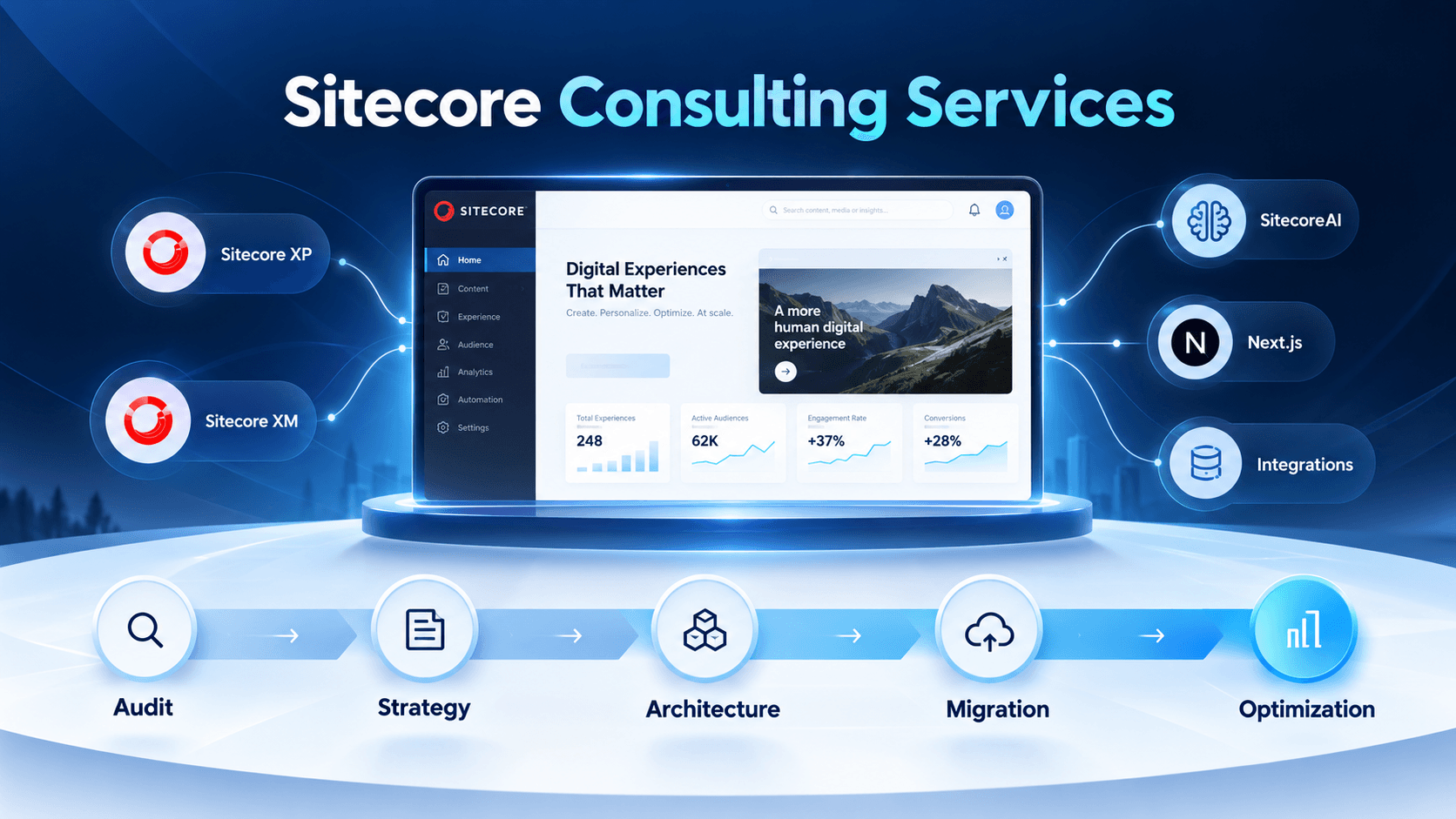
The 12 Sitecore consulting services below cover the main stages of a Sitecore platform, from planning and audits to migration, optimization, and support. Choose the services that match your current platform, goals, and challenges.
1. Sitecore Strategy and Roadmap Consulting
Start here when your Sitecore platform lacks a clear direction. A consultant works with your digital, marketing, and IT teams to connect business goals with platform capabilities. You get a prioritized roadmap, key milestones, and a clear budget plan for the next stage.
2. Platform and License Advisory: XP, XM, or SitecoreAI
Sitecore offers SitecoreAI as its SaaS platform alongside XP and XM. A consultant compares these options based on personalization needs, hosting, integrations, and team skills, as explained in our XM Cloud vs XP comparison. Since Sitecore pricing is quote-based, usage and requirements should be reviewed before negotiation.
3. Sitecore Technical Audit and Health Check
A Sitecore technical audit reviews architecture, code quality, Helix compliance, performance, security, and publishing practices. Sitecore's Website Solution Review can take up to five days and excludes code review, while partner audits may go deeper. The final report ranks issues by risk and recommends the fixes that matter most.
4. Solution Architecture and Implementation Planning
Before development starts, your team needs a clear plan for sites, languages, components, and environments. An architect defines the content model, multisite structure, component library, and deployment approach. You then have clear timelines, milestones, and resource requirements for implementation.
5. Upgrade Planning for Sitecore XP and XM
Upgrading Sitecore XP or XM requires more than moving to a newer version. A consultant reviews version paths, custom code, modules, search, and analytics data to identify compatibility issues. Sitecore also lists an upgrade readiness assessment in its consulting packages.
6. SitecoreAI Migration Consulting (Formerly XM Cloud)
Moving from XP or XM to SitecoreAI requires changes to the platform architecture because the SaaS model is headless. A consultant reviews content, components, personalization, and integrations, then creates a migration plan that protects SEO and uptime. Our XP and XM to XM Cloud migration strategy guide covers this process in more detail.
7. Headless and Next.js Architecture Consulting
Headless Sitecore separates content management from the front end, often using Next.js. This creates important decisions around rendering, GraphQL, hosting, caching, and SEO. A consultant helps your team choose an architecture that developers can maintain while keeping pages fast and search-friendly.
8. Integration and API Consulting
Sitecore often connects with CRM, ERP, PIM, identity, and marketing platforms. Integration consulting maps these data flows, selects the right integration approach, and identifies risks that could affect revenue or customer data. The result is a clear integration blueprint for keeping connected systems in sync.
9. Personalization and Customer Data Consulting
Personalization delivers value when marketers can use it consistently and measure the results. A consultant defines audience segments, selects practical use cases, and creates a testing approach. For SitecoreAI, this can include customer data and personalization capabilities, while XP uses its existing rules engine.
10. Content Hub, Search, and Commerce Consulting
Enterprise teams often need more than a CMS to manage content and customer experiences. Consultants can plan Content Hub for digital assets, Sitecore Search for site discovery, and OrderCloud for commerce. The focus is on taxonomy, workflows, and integrations so these products work together effectively.
11. Performance, Security, and Compliance Reviews
Performance and security issues can affect both customer experience and compliance. A review covers caching, CDN setup, Core Web Vitals, security hardening, patching, and access controls. For regulated businesses, the consultant can also identify privacy and accessibility gaps and prioritize the most important fixes.
12. Managed Support and Continuous Optimization Advisory
Sitecore needs ongoing attention after launch to maintain performance and support business growth. A consultant can help define SLAs, monitoring, release schedules, and a regular improvement backlog. Our guide to Sitecore support and maintenance services explains what a strong support model should include.
Also Read: When Sitecore XM Cloud Is the Right Modernization Path
How Does a Sitecore Consulting Engagement Work? 7 Steps
Most Sitecore consulting services follow seven steps, from discovery to ongoing optimization. Knowing the process helps you understand what to expect from a consulting partner.
Step 1: Discovery and Stakeholder Workshops
The engagement starts with the right people in the room. The consultant talks with digital, marketing, IT, and content teams to understand your goals, challenges, and platform needs.
These sessions define the scope, goals, and success criteria. Be open about your pain points because the rest of the engagement depends on this information.
Step 2: Platform Audit and Gap Analysis
The consultant then reviews your Sitecore platform, including architecture, code, configuration, integrations, and performance. They compare the current setup with your business and technical requirements.
You receive a list of gaps ranked by risk and effort. Ask for supporting evidence so your development team can review and confirm the findings.
Step 3: Strategy, Roadmap, and Business Case
The findings are turned into a practical roadmap. The consultant groups improvements into phases, estimates the required cost and effort, and recommends the right platform direction.
The roadmap should make priorities clear. It should show what needs to happen first, what can wait, and how each phase supports your business goals.
Step 4: Architecture and Implementation Guidance
Once the roadmap is approved, the consultant defines the target architecture. This can include the content model, components, integrations, environments, and deployment process.
Your development team then builds against this plan. Regular consultant reviews help ensure the implementation stays aligned with the agreed architecture.
Step 5: Testing and Quality Assurance Oversight
Before launch, the consultant checks whether the implementation meets the plan. They can oversee functional, performance, security, and usability testing and review issues that need to be fixed.
This extra review helps catch problems before they affect users. It also gives your team a senior perspective before the platform goes live.
Step 6: Training and Knowledge Transfer
A good consulting engagement should leave your team with the knowledge to manage the platform. Consultants can train content authors, marketers, and developers and document important decisions.
Ask for written documentation, runbooks, and recorded sessions where possible. This makes future work easier and reduces dependence on one partner.
Step 7: Ongoing Optimization and Support
The work does not have to end after launch. Consultants can review performance and usage data, recommend improvements, and help plan the next quarter.
Regular optimization keeps the platform aligned with business goals. It can also help prevent small issues from becoming expensive projects later.
Now that you know how a Sitecore consulting engagement works, the next question is how much it costs.
How Much Do Sitecore Consulting Services Cost?
Sitecore consulting services typically cost $25 to $199 per hour. A focused audit can cost $1,000 to $16,000, while onshore architecture planning can reach $48,000.
These are market ranges from public directories and planning assumptions, not Murmu pricing. Sitecore license fees are separate. For those costs, see our Sitecore license and implementation costs.
1. Sitecore Consulting Cost by Engagement Type
The cost depends on the type and size of the engagement. The table below uses typical effort estimates and published market rates to show the possible range.
| Engagement type | Typical effort | Offshore delivery at $25 to $49 per hour | US onshore delivery at $50 to $199 per hour |
|---|---|---|---|
| Ad hoc advisory hours | 10 to 40 hours | $250 to $2,000 | $500 to $8,000 |
| Technical audit and health check | 40 to 80 hours | $1,000 to $4,000 | $2,000 to $16,000 |
| Upgrade or migration readiness assessment | 60 to 120 hours | $1,500 to $6,000 | $3,000 to $24,000 |
| Strategy and roadmap | 80 to 160 hours | $2,000 to $8,000 | $4,000 to $32,000 |
| Architecture and implementation planning | 120 to 240 hours | $3,000 to $12,000 | $6,000 to $48,000 |
| Monthly advisory retainer | 20 to 40 hours a month | $500 to $2,000 a month | $1,000 to $8,000 a month |
These effort estimates assume a mid-size Sitecore environment. Sitecore caps its own solution review at five days, making 40 hours a reasonable planning floor for a technical audit
2. Sitecore Consultant Hourly Rates by Region
Location can make a major difference in Sitecore consulting rates. US and UK agencies generally publish higher ranges, while many Indian agencies fall into lower rate bands.
| Region | Published rate band (market range) | Source and sample |
|---|---|---|
| United States | $25 to $199 per hour, most often $50 to $99 | SuperbCompanies, 10 listed firms |
| United Kingdom | $25 to $149 per hour | SuperbCompanies, 3 listed firms |
| India | $25 to $49 per hour at four of five firms | SuperbCompanies, 5 listed firms |
| Global median | $37 per hour | GoodFirms, Sitecore development category |
These are general agency rates for Sitecore work, not fixed consultant prices. Senior architects and strategy leads usually sit toward the higher end, and the available samples are limited.
3. 5 Factors That Drive Sitecore Consulting Cost
Several factors can change the final cost of Sitecore consulting services. The biggest ones are:
- Scope: An audit costs less than a full roadmap and architecture plan.
- Platform complexity: More sites, languages, integrations, and custom code require more hours.
- Seniority: Architects and strategy consultants charge more, but may be needed for fewer hours.
- Delivery location: Onshore, nearshore, and offshore teams have different rate ranges.
- Engagement model: Hourly work suits smaller needs, fixed scope works well for audits, and retainers fit ongoing advice.
Also Read: Sitecore Pricing and Cost Guide for US Companies
Freelance Consultant vs In-House Team vs Consulting Firm: Which Fits?
The right option depends on your Sitecore workload, budget, and expertise needs. Freelancers suit focused work, in-house teams suit ongoing work, and consulting firms suit broader enterprise needs.
| Criteria | Freelance Consultant | In-House Team | Consulting Firm |
|---|---|---|---|
| Best for | One-off reviews and second opinions | Continuous Sitecore work | Audits, roadmaps, migrations, and ongoing advice |
| Cost profile | Lowest total cost, paid hourly | Highest fixed cost with salaries and benefits | Mid-range, paid by scope or retainer |
| Breadth of skills | One person's experience | Depends on your team | Architects, developers, QA, and DevOps together |
| Continuity risk | High if the consultant leaves | Medium, based on team retention | Low, since knowledge stays with the team |
| Speed to start | Days | Months to hire | Days to weeks |
| Accountability | Informal | Internal | Contract, SLA, and named lead |
In short,
- A freelance Sitecore consultant is ideal for focused, short-term needs such as audits or architecture reviews, but availability can be a concern.
- An in-house team offers long-term control for ongoing Sitecore work, but hiring takes time and adds fixed costs.
- A consulting firm gives you access to architects, developers, QA, and DevOps without the cost of building a full-time team.
Build a Clear Sitecore Roadmap Before You Invest
Top 5 Sitecore Consulting Firms Compared
The five firms below are mid-size Sitecore specialists selected for their Sitecore focus, consulting expertise, regional coverage, and published positioning.
| Firm | Base | Sitecore-certified leadership | Best For |
|---|---|---|---|
| Murmu Software Infotech | India, global delivery | Sitecore-certified leadership | Cost-effective, senior-led consulting and white-label delivery |
| XCentium | United States | Platinum Partner | Large multi-product programs |
| Remarkable | UK, UAE, and US | Gold Partner | Conversion-focused optimization |
| Infinity Group | Poland | Official Sitecore Partner | Multi-country European estates |
| TechGuilds | Canada | Sitecore Silver Partner | Platform selection and AI-assisted migration |
Let’s understand each company in detail.
1. Murmu Software Infotech
Murmu Software Infotech combines Sitecore-certified leadership with India-based global delivery. It works with enterprises and digital agencies across the US, UK, Europe, and UAE throughout the Sitecore lifecycle.
The team also supports headless architecture, GraphQL, integrations, and migration planning. Engagement options include hourly or monthly dedicated Sitecore developers and white-label delivery for agencies.
Key strengths:
- Sitecore expertise: Sitecore-certified leadership for enterprise platform requirements.
- Sitecore Rescue Mission: Reviews troubled implementations and provides a prioritized fix plan through the Sitecore Rescue Mission.
- Headless and integrations: Next.js, GraphQL, integrations, and migration planning.
- Flexible engagement: Hourly or monthly dedicated developers and white-label delivery.
- Cost and proof: $15 to $40 per hour for developers, administrators, and content authors, with experience in a healthcare enterprise migration from Sitecore XP to XM Cloud headless.
Best for: Enterprises and digital agencies looking for senior-led Sitecore consulting services with cost-effective global delivery.
2. XCentium
XCentium is a US-based consultancy and Platinum Sitecore partner, with more than 500 Sitecore solutions delivered across five Sitecore products. Its work includes strategy workshops and SitecoreAI adoption assessments, supported by industry accelerators and pre-built integrations.
Key strengths:
- Platinum partner: Listed in Sitecore's official partner finder.
- 500+ solutions: Experience across five Sitecore products.
- Faster delivery: Industry accelerators and pre-built integrations.
Best for: Enterprises using multiple Sitecore products, including commerce.
3. Remarkable (Formerly Sagittarius)
Remarkable, formerly known as Sagittarius, is a UK-rooted Sitecore-focused agency with more than 75 specialists across the UK, US, and Middle East. Its offering combines Sitecore optimization consulting, engineering expertise, and training for client teams.
Key strengths:
- 75+ specialists: Teams across the UK, US, and Middle East.
- Optimization consulting: Focuses on improving Sitecore experiences.
- Training academy: Helps client teams build Sitecore skills.
Best for: UK and Gulf brands seeking measurable conversion gains from Sitecore.
4. Infinity Group
Infinity Group is a Polish digital firm and official Sitecore partner with more than ten years of Sitecore experience. Its consulting practice covers business analysis, solution design, license choices, implementation audits, requirements, architecture, and upgrade preparation.
Key strengths:
- 10+ years of experience: Long-standing Sitecore expertise.
- License and architecture advice: Supports platform and solution decisions.
- 25+ country sites: Published cases include large multi-country rollouts.
Best for: European companies managing content across multiple countries and languages.
5. TechGuilds
TechGuilds is a Toronto studio that describes itself as an AI-native DXP agency and Sitecore Silver Partner. Its services span DXP audits, platform selection, digital roadmaps, design, implementation, support, and AI across Sitecore and other DXPs.
Key strengths:
- Platform-neutral strategy: Supports DXP audits, selection, and roadmaps.
- AI delivery platform: Uses a proprietary AI delivery platform.
- SitecoreAI migration: Offers a fixed-price guarantee for migrations.
Best for: North American enterprises seeking platform-neutral selection advice.
Each firm suits a different situation, so match the best-for line to your own priority before you request proposals.
Now that you have seen who delivers this work, let's take a look at how to choose between them.
How to Choose a Sitecore Consulting Firm: 12-Point Checklist
Choose a Sitecore consulting partner based on relevant experience, senior expertise, clear deliverables, and sustainable pricing. Use these 12 checks to compare proposals side by side:
- Sitecore focus: Confirm that Sitecore is a core practice with dedicated specialists.
- Current platform knowledge: Ask how the firm handles both SitecoreAI and older XP estates.
- Named consultants: Meet the people who will do the work, not just the sales team.
- Sample deliverables: Request a redacted audit report or roadmap before signing.
- Industry experience: Look for experience in your sector, especially where compliance requirements apply.
- Client references: Speak with two past clients about results and working style.
- Method and milestones: Make sure the proposal clearly covers steps, deliverables, and dates.
- Knowledge transfer: Include documentation and training as part of the contract.
- Pricing clarity: Get the rate card, effort estimate, and rules for change requests.
- Support after delivery: Ask what support is available after the report or roadmap is delivered.
- Time zone overlap: Agree on working hours, response times, and one clear point of contact.
- Independence: Prefer advice that remains useful even if the firm does not win the development work.
Also Read: How to Choose a Sitecore Development Company
Why Choose Murmu Software Infotech for Sitecore Consulting?
Murmu Software Infotech combines Sitecore-certified leadership, experienced developers, and India-based global delivery. Our Sitecore consulting services give enterprises and agencies practical advice backed by a team that can execute it.
- Full lifecycle coverage: Audit, plan, build, migrate, and support Sitecore CMS, XP, XM, and SitecoreAI platforms.
- Senior-led advice: Sitecore-certified leadership guides recommendations before delivery begins.
- Flexible engagement: Choose hourly advice, fixed-scope audits, dedicated developers, or white-label delivery.
- Cost clarity: Use our project cost calculator to estimate your budget before the first call.
- Long-term support: AMC and managed support plans keep your Sitecore platform healthy after launch.
Need experts' help? Connect with our Sitecore experts to review your platform and plan your next step.
Conclusion: Choose the Service First, Then the Firm
The right Sitecore consulting services start with the problem you need to solve, whether it is cost, performance, an aging platform, or a move to SitecoreAI.
Match that need to the right service, set a realistic budget, and compare two or three firms based on experience, approach, and fit.
We hope this guide helps you understand what Sitecore consulting covers, what it costs, and how to choose the right partner.
Frequently Asked Questions
1. What are Sitecore consulting services?
They cover strategy, audits, architecture, upgrades, migration, integrations, and optimization. A consultant reviews your needs and provides a practical plan, report, or roadmap.
2. How much do Sitecore consulting services cost?
Published rates range from $25 to $199 per hour. Audits typically cost $1,000 to $16,000, while onshore architecture planning can reach $48,000.
3. What does a Sitecore consultant charge per hour?
Most listed India-based firms charge $25 to $49/hour, while many US firms charge $50 to $99/hour. Published US rates can reach $150 to $199/hour, with a $37 global median reported by GoodFirms.
4. How long does a Sitecore consulting engagement take?
Audits usually take 1-2 weeks, strategy and roadmaps 2-4 weeks, and architecture planning 3-6 weeks, depending on project complexity.
5. What is the difference between Sitecore consulting and development?
Consulting decides what to build, fix, or migrate. Development turns those recommendations into working code and configuration.
6. Do I need consulting to move from XP or XM to SitecoreAI?
XM Cloud customers mainly need adoption guidance. XP and XM customers face a headless re-architecture, making a readiness assessment useful for reducing cost and risk.
7. Should I hire a freelance Sitecore consultant or a consulting firm?
Choose a freelancer for a focused, short-term need. Choose a firm when you need broader expertise across audits, architecture, delivery, and ongoing support.
8. Is offshore Sitecore consulting reliable for US and UK enterprises?
Yes, when the firm provides senior Sitecore expertise, clear documentation, and overlapping working hours. A small paid audit is a practical way to assess quality before a larger engagement.
Frequently Asked Questions
What are Sitecore consulting services?
Sitecore consulting services help businesses decide what to build, fix, upgrade, migrate or optimize. Typical work includes strategy, audits, architecture, migration planning, integrations, performance reviews and long-term platform roadmaps.
How much do Sitecore consulting services cost in 2026?
The article cites published market rates of roughly $25 to $199 per hour. Focused audits may range from about $1,000 to $16,000, while onshore architecture planning can reach around $48,000. These are market planning ranges, not Murmu Software pricing.
What does a Sitecore consultant do?
A Sitecore consultant assesses the current platform, defines business and technical goals, plans architecture and integrations, reviews personalization and security, and creates a roadmap for implementation or optimization.
What is the difference between Sitecore consulting and Sitecore development?
Consulting determines what should be built, fixed, upgraded or migrated. Development turns that plan into working Sitecore components, integrations, configurations and releases.
When does a business need a Sitecore technical audit?
An audit is useful when costs are rising, performance is declining, the platform is aging, releases are fragile, Sitecore features are underused or leadership lacks a clear modernization path.
Do I need consulting before moving from Sitecore XP to SitecoreAI?
A readiness assessment is useful because moving from XP or XM to SitecoreAI changes the architecture to a headless SaaS model and requires planning for content, components, integrations, SEO and uptime.
How long does Sitecore consulting usually take?
The article indicates that audits may take around one to two weeks, strategy and roadmap engagements around two to four weeks, and architecture planning roughly three to six weeks depending on complexity.
Should I hire a freelancer or a Sitecore consulting firm?
A freelancer can suit focused short-term reviews, while a consulting firm is usually better when you need broader expertise across architecture, migration, QA, DevOps, implementation guidance and ongoing support.
What should I check before hiring a Sitecore consulting company?
Check Sitecore expertise, current platform knowledge, named consultants, sample deliverables, industry experience, references, methodology, knowledge transfer, pricing clarity, post-delivery support and time-zone overlap.
What Sitecore consulting services does Murmu Software Infotech provide?
The article describes coverage across audits, strategy, architecture, migrations, SitecoreAI, headless and Next.js planning, integrations, optimization, dedicated developers, white-label delivery and ongoing support.