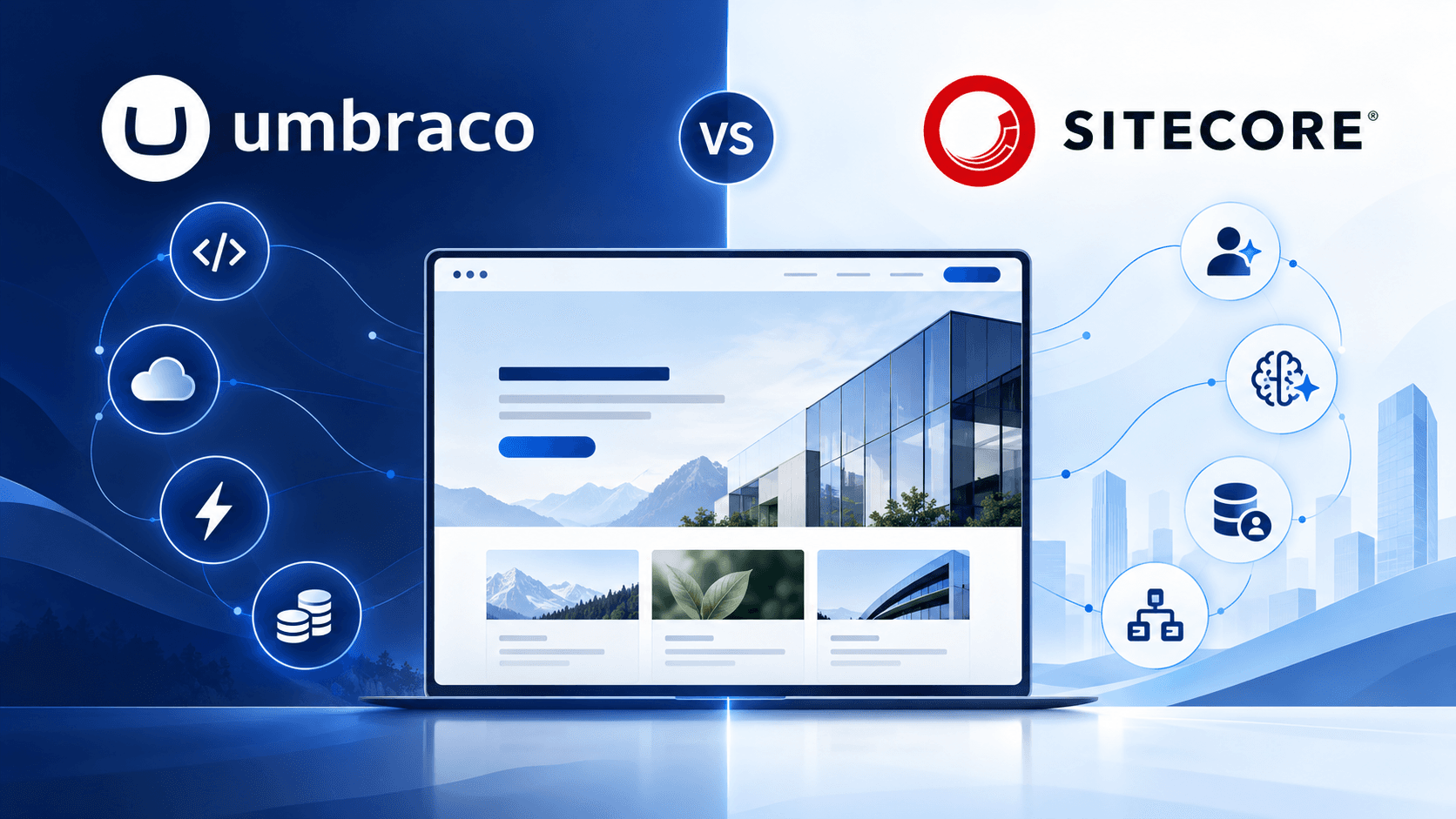
Umbraco vs Sitecore: Which CMS Is Right for Your Business in 2026
In This Article
- Umbraco vs Sitecore: The Quick Verdict
- Umbraco and Sitecore Today: What Are You Actually Comparing?
- What Is Umbraco?
- What Is Sitecore?
- Where Do Umbraco and Sitecore Overlap?
- Umbraco vs Sitecore: Side-by-Side Comparison
- Umbraco vs Sitecore: 10 Key Differences That Decide the Choice
- 1. Platform Approach: Open-Source CMS vs All-in-One DXP
- 2. Architecture and Tech Stack
- 3. Hosting and Deployment Model
- 4. Headless and Composable Capability
- 5. Authoring and Editor Experience
- 6. Personalization, Testing and Analytics
- 7. AI Capabilities
- 8. Integrations and Ecosystem
- 9. Scalability, Multisite and Multilingual Governance
- 10. Security, Compliance and Vendor Support
- How Much Do Umbraco and Sitecore Cost? License, Implementation and TCO
- 1. Licensing and Pricing Model
- 2. Implementation Cost and Time to Launch
- 3. Developer Rates and Talent Availability
- 4. Upgrades, Support and Ongoing Maintenance
- 5. Five-Year Total Cost of Ownership Compared
- What Are the Pros and Cons of Umbraco and Sitecore?
- Umbraco Pros and Cons
- Sitecore Pros and Cons
- Which Platform Fits Your Use Case?
- 1. Enterprise and Multi-Brand Websites
- 2. B2B Companies
- 3. Ecommerce
- 4. Marketing-Led Teams
- 5. Regulated Industries
- Who Should Choose Umbraco and Who Should Choose Sitecore?
- Choose Umbraco If
- Choose Sitecore If
- Switching Platforms: Should You Stay, Modernize or Migrate?
- 1. Already on Sitecore: When Does Modernizing Make More Sense?
- 2. When Is Moving From Sitecore to Umbraco the Right Call?
- 3. When Should Umbraco Users Move to Sitecore?
- 4. What Does a Migration Cost?
- 5. Which Migration Risks Should You Plan For?
- 7 Questions to Answer Before You Choose Between Umbraco and Sitecore
- Why Trust Murmu Software Infotech for Your CMS Decision and Delivery
- Conclusion: Choose the Platform Your Team Will Actually Use
- Frequently Asked Questions
- 1. Is Umbraco better than Sitecore?
- 2. Does Umbraco cost less than Sitecore?
- 3. Is Umbraco suitable for enterprise websites?
- 4. Can Umbraco match Sitecore’s personalization?
- 5. Which is better for headless delivery?
- 6. How long does implementation take?
- 7. How much does it cost to migrate from Sitecore to Umbraco?
- 8. Is Sitecore XM Cloud the same as SitecoreAI?
Umbraco is a strong choice for content-led businesses that want flexibility, lower costs, and mainstream .NET skills, while Sitecore fits larger enterprises that need deeper personalization, customer data, AI, and multi-brand governance. Compare implementation, hosting, integrations, team skills, and five-year total cost of ownership before choosing between Umbraco vs Sitecore for your roadmap.
Choosing a CMS is easy when you only look at features. The real challenge is choosing one that fits your budget, team, and long-term growth.
Umbraco and Sitecore are both powerful .NET CMS platforms, but they are built for different needs. Umbraco keeps things flexible and cost-effective, while Sitecore goes deeper into personalization, customer data, AI, and enterprise-level digital experiences.
But the decision is not just about features or license costs. Implementation, hosting, team skills, integrations, and long-term ownership all affect which platform makes more sense.
So, which one makes more sense for your business?
In this guide, you will learn:
- What each platform offers today
- The key differences that matter
- Licensing, implementation, and ownership costs
- The best fit for different use cases
- When to stay, modernize, or migrate
By the end of this guide, you will know which CMS fits your budget, team, and long-term roadmap.
Umbraco vs Sitecore: The Quick Verdict
The right CMS depends on what you need to run, how much control your team needs, and what you can invest long term. Use this quick comparison to see which platform fits your situation.
| Your situation | Better fit | Why |
|---|---|---|
| Content-led corporate or B2B site on a fixed budget | Umbraco | No license fee and a shorter build |
| Mainstream .NET team that wants hosting freedom | Umbraco | Runs on modern .NET, self-hosted or on Umbraco Cloud |
| Personalization and testing drive revenue | Sitecore | Customer data, testing, and personalization are built into the platform |
| Many brands, regions, and languages under central control | Sitecore | Built for large, governed multisite estates |
| Already on Sitecore XP with rising costs | Audit first | Optimizing or moving to SitecoreAI may cost less than a full rebuild |
Umbraco and Sitecore Today: What Are You Actually Comparing?
Both names now cover more than one product, so the first step is knowing what each proposal actually includes. This matters because pricing, hosting, personalization, and support can vary by product.
Before comparing features, confirm whether you are looking at the current Umbraco platform, Umbraco Cloud, SitecoreAI, or the Sitecore XP/XM line.
What Is Umbraco?
Umbraco is an open-source CMS built on Microsoft .NET, with no license fee for the core product. Umbraco 17 is the current long-term support release, runs on .NET 10, and receives three years of support.
You can add products based on your needs. Umbraco Cloud provides managed Azure hosting, while Engage adds personalization and testing. Commerce, Workflow, and Forms cover e-commerce, approvals, and data capture.
What Is Sitecore?
Sitecore now has two main product lines. SitecoreAI is its cloud-native SaaS platform built on XM Cloud, bringing content, digital assets, audience insights, search, personalization, and Agentic Studio together.
Sitecore XP and XM remain the on-premises line, with version 10.5 as the current release. If you run XP, our Sitecore XM Cloud vs Sitecore XP comparison explains the key differences.
Where Do Umbraco and Sitecore Overlap?
Both platforms fit the Microsoft ecosystem and support multisite, multilingual delivery, headless front ends, role-based permissions, and enterprise integrations. That makes both relevant for teams looking for a .NET CMS for enterprise websites.
The main difference is scope and cost. Umbraco provides a strong content foundation that you can extend, while Sitecore brings a broader experience stack into one platform. For a wider shortlist, read our comparison of Sitecore, Optimizely, Contentful, Sanity and Umbraco.
Also Read: What is Sitecore XM Cloud? Enterprise Benefits, Cost & Migration Strategy
Umbraco vs Sitecore: Side-by-Side Comparison
The table below compares the two platforms across the factors that matter most when evaluating an enterprise CMS.
Choose Your CMS With Confidence
Compare Umbraco and Sitecore across cost, personalization, AI, hosting, talent and scalability before committing to your next CMS strategy.
| Criteria | Umbraco | Sitecore |
|---|---|---|
| Platform type | Open-source CMS with optional paid add-ons | Commercial digital experience platform (DXP) |
| Architecture and tech stack | Modern .NET, with Umbraco 17 on .NET 10 | SitecoreAI: SaaS CMS with Next.js front ends. XP 10.5: .NET Framework 4.8.1 |
| Hosting model | Self-hosted, any cloud, or Umbraco Cloud on Azure | SitecoreAI as SaaS on Azure. XP on-premises, in containers, or on managed cloud |
| Licensing and pricing | No license fee. Cloud plans have public pricing | Quote-based subscription or license |
| Total cost of ownership | Lower for content-led websites | Higher, but justified when the full platform is used |
| Time to launch | Typically shorter | Typically longer due to more architecture work |
| Headless capability | Content Delivery API with traditional, headless, or hybrid delivery | SitecoreAI is headless by design. XP supports both models |
| Authoring experience | Clean back office with a short learning curve | Visual page building with a longer learning curve |
| Personalization and AI | Added through Umbraco Engage and AI integrations | Built-in, with AI agents through Agentic Studio |
| Integrations | Open APIs, packages, and custom .NET development | Connected Sitecore modules and enterprise connectors |
| Talent availability | Broad .NET talent pool | Specialist skills and a smaller talent pool |
| Best fit | Mid-market, B2B, and content-led enterprise sites | Large, multi-brand, personalization-led programs |
Umbraco vs Sitecore: 10 Key Differences That Decide the Choice
The biggest differences appear in architecture, cost, authoring, personalization, integrations, and governance. These areas show where each platform fits and what your team gains or gives up.
1. Platform Approach: Open-Source CMS vs All-in-One DXP
Umbraco focuses on content management with a free, open core. You can add separate tools for search, analytics, marketing, and data based on your needs.
Sitecore takes a broader approach with content, assets, customer insights, and optimization in one connected platform. You get more capabilities, but also more complexity and cost.
2. Architecture and Tech Stack
Umbraco follows a modern .NET approach, with version 17 running on .NET 10. Developers can use familiar Microsoft tools without learning a proprietary framework first.
Sitecore depends on the product line. SitecoreAI uses a SaaS architecture with Next.js, while Sitecore XP 10.5 uses .NET Framework 4.8.1.
3. Hosting and Deployment Model
Umbraco gives teams more hosting freedom. You can self-host, use a major cloud provider, or choose Umbraco Cloud on Microsoft Azure.
Protect SEO Before Switching Between Sitecore and Umbraco
SitecoreAI runs as SaaS on Azure, reducing platform operations and upgrade work. Your front end still needs separate hosting, which adds to the overall budget.
4. Headless and Composable Capability
SitecoreAI is headless by design. Editors manage content in the cloud, while Experience Edge delivers it through GraphQL to a front end such as Next.js.
Umbraco supports traditional, headless, and hybrid delivery. Its Content Delivery API lets teams introduce a decoupled front end when specific business needs require it.
5. Authoring and Editor Experience
Umbraco keeps its back office simple with a clear content tree, familiar fields, and preview tools. This keeps training short and helps editors publish confidently.
Sitecore offers a richer visual editing experience through its Pages editor. Marketers can build layouts and edit content in context, but larger setups need more training.
6. Personalization, Testing and Analytics
Sitecore stands out when personalization drives the digital strategy. SitecoreAI connects audience insights, search, testing, and real-time personalization within the platform.
Umbraco uses optional products such as Umbraco Engage for analytics, A/B testing, profiling, and personalization. Teams can also connect external tools for specific requirements.
7. AI Capabilities
Sitecore builds AI into its platform through Agentic Studio, with prebuilt agents for content generation, research, and other tasks. Teams can also create custom agents.
Umbraco takes an AI-ready approach instead. Teams can connect preferred models and services, gaining provider flexibility while taking on more implementation and management work.
8. Integrations and Ecosystem
Umbraco connects through open APIs, webhooks, and packages. Standard .NET development supports CRM, ERP, identity, and other custom integrations without requiring specialist platform skills.
Sitecore offers a more connected ecosystem, with its modules sharing data and connectors supporting enterprise systems. External integrations remain possible but often need specialist Sitecore expertise.
9. Scalability, Multisite and Multilingual Governance
Sitecore is designed for large estates with multiple brands, regions, and languages. Centralized templates, permissions, and workflows help teams maintain governance across international websites.
Umbraco also supports multisite and multilingual delivery. Umbraco Cloud adds load balancing and dedicated resources, while larger estates require careful governance planning from the start.
10. Security, Compliance and Vendor Support
Sitecore provides a broad compliance profile, including ISO/IEC 27001, SOC 2 Type II, and CSA STAR, plus formal service level agreements.
Umbraco's product organization holds ISO 27001 certification, while Umbraco Cloud provides availability targets. Self-hosted deployments place more compliance responsibility on your team.
Also Read: Enterprise CMS & Headless CMS AI Readiness Assessment
How Much Do Umbraco and Sitecore Cost? License, Implementation and TCO
Umbraco usually costs less to license and build, while Sitecore costs more because it covers a broader experience stack. The actual cost difference depends on which features, services, and infrastructure your business will use.
The figures below are market references, not Murmu pricing. Vendor prices and contract terms can change, so use them as planning benchmarks rather than fixed quotes.
1. Licensing and Pricing Model
Umbraco's core CMS is free to download and use. For managed hosting, Umbraco Cloud lists public prices of €45, €280, and €730 per month, with custom Enterprise terms. Products such as Engage have separate fees.
Sitecore uses quote-based pricing rather than public list prices. As a market reference, Vendr reports a median Sitecore contract of $60,944 a year. Larger multi-brand agreements can cost more, while our Sitecore cost guide breaks down the main cost areas.
2. Implementation Cost and Time to Launch
Umbraco can launch faster because its scope is narrower and the .NET stack is familiar. Umbraco says typical projects go live in about four months, compared with 12 to 18 months for many Sitecore programs.
Sitecore projects often take longer because they involve content models, headless architecture, personalization, and integrations. A phased rollout can bring value sooner, so ask partners how they would structure the first release.
3. Developer Rates and Talent Availability
Umbraco works with the wider .NET developer market, making hiring easier and rates more competitive. Teams can also depend less on a small pool of platform-specific specialists.
Sitecore requires more specialized experience, and SitecoreAI projects may also need Next.js and headless skills. Offshore or white-label delivery can reduce the difference, as explained in our guide to hiring Sitecore developers.
4. Upgrades, Support and Ongoing Maintenance
Umbraco follows long-term support releases aligned with Microsoft's .NET schedule. Umbraco Cloud handles patches automatically, while larger upgrades still need testing and should include a budget for partner support.
SitecoreAI handles platform updates automatically, reducing upgrade work. XP customers still need to plan and fund upgrades, while our Sitecore support and maintenance guide covers the main ongoing support needs.
5. Five-Year Total Cost of Ownership Compared
The five-year view makes the cost difference easier to understand. Umbraco claims 60% to 70% lower total cost of ownership than Sitecore, but this is a vendor figure, and your actual Sitecore total cost of ownership depends on how much of the platform you use.
| Cost driver | Umbraco | Sitecore |
|---|---|---|
| Platform license | $0 for the core CMS | Quote-based. Vendor median contract: $60,944 a year |
| Managed hosting | Umbraco Cloud at €45 to €730 a month, or your own cloud bill | Included in SitecoreAI subscription. XP needs your own infrastructure |
| Front-end hosting | Needed only for headless builds | Required for SitecoreAI front ends |
| Implementation | Lower, with a shorter build | Higher, with more architecture and integration work |
| Personalization and testing | Umbraco Engage or a third-party tool | Part of the platform, scoped in your contract |
| Developers | Mainstream .NET rates | Specialist rates |
| Upgrades | Predictable long-term support releases | Automatic on SitecoreAI. Project-based on XP |
| Exit cost | Lower, with open code and standard .NET | Higher, due to platform-specific architecture |
These figures are market references only. Confirm current vendor pricing, implementation scope, and contract terms before setting your budget.
Also Read: Sitecore Cost and Pricing Guide for UK Companies
Now that you have seen what each platform costs, let's take a look at the strengths and trade-offs behind that price.
What Are the Pros and Cons of Umbraco and Sitecore?
Both platforms have clear strengths, but those strengths come with trade-offs. The right option between Umbraco vs Sitecore depends on how much flexibility, built-in functionality, and enterprise control your business needs.
Umbraco Pros and Cons
Pros
- No license fee: The open-source core removes a major fixed platform cost.
- Easy editor adoption: The simple back office helps content teams publish with less training.
- Hosting freedom: Choose self-hosting, a major cloud provider, or Umbraco Cloud.
- Mainstream .NET skills: Standard .NET developers can build and support the platform.
- Shorter projects: Its focused scope can help teams launch faster.
Cons
- Personalization costs extra: Advanced testing and targeting require Engage or external tools.
- More integration work: Search, customer data, and marketing tools may need separate integration.
- More governance effort: Large, complex estates need careful setup and ongoing management.
- Self-hosted compliance: Your team carries more responsibility for compliance and security.
- Paid support tiers: Higher levels of vendor support come with additional costs.
Sitecore Pros and Cons
Pros
- Built-in personalization: Testing, targeting, and audience insights are part of the platform.
- Connected experience stack: Content, assets, search, and customer data work together.
- Strong enterprise governance: Central control supports multiple brands, regions, and languages.
- Formal assurance: Certifications and service level agreements can support enterprise procurement.
- AI capabilities: Agentic Studio brings AI agents into marketing workflows.
Cons
- Higher cost: Quote-based licensing creates a larger recurring platform investment.
- Longer implementations: More architecture and integrations can extend the launch timeline.
- Specialist talent: The smaller talent pool can increase hiring time and developer rates.
- Steeper learning curve: Editors and developers may need more training.
- Higher exit cost: Platform-specific architecture can make future migration more expensive.
Which Platform Fits Your Use Case?
The right platform depends on what your business needs to manage, not how many features it offers. Match the CMS to your website, team, and growth plans.
1. Enterprise and Multi-Brand Websites
If you compare Umbraco CMS vs Sitecore for enterprise estates, look at governance first. Sitecore suits groups that manage many brands and regions centrally, with shared personalization. Umbraco serves enterprise websites well when content, not customer data, sits at the center.
2. B2B Companies
Most B2B sites need strong content, gated resources, and clean CRM integration. Umbraco delivers that at a sensible cost, and your CRM handles lead scoring. Sitecore makes sense when you run account-based personalization across several markets with a team to manage it.
3. Ecommerce
Umbraco Commerce adds a store to your CMS and suits mid-sized catalogs. Sitecore pairs with OrderCloud, an API-first commerce engine built for complex B2B and B2C models. Let your catalog complexity decide, since a simple store rarely needs enterprise commerce.
4. Marketing-Led Teams
Ask how your marketers actually work each week. A small team that publishes pages and campaigns moves faster on Umbraco. A larger team that tests, segments, and personalizes every journey gets more from Sitecore, provided someone owns that work day-to-day.
5. Regulated Industries
Healthcare, finance, and public sector buyers start with compliance. Sitecore offers audited certifications and formal SLAs, which shorten your vendor review. Umbraco can meet the same bar on Umbraco Cloud or a governed self-hosted build, with more of the evidence coming from you.
Who Should Choose Umbraco and Who Should Choose Sitecore?
Neither platform fits every business. The right choice between Umbraco vs Sitecore depends on your budget, team, content needs, and how much personalization or governance you actually need.
Choose Umbraco If
- Content comes first: Your website focuses on publishing, informing, and generating leads.
- Budget is fixed: You want to avoid a recurring enterprise license.
- Your team knows .NET: You prefer mainstream development skills over platform specialists.
- Speed matters: You want to launch in months and improve over time.
- You want flexibility: You prefer choosing your own hosting, search, and marketing tools.
Choose Sitecore If
- Personalization drives revenue: You have clear journeys to personalize and measure.
- You run many brands: Central governance across regions and languages is essential.
- You want one platform: Content, assets, data, and optimization should work together.
- Compliance is formal: Your procurement team requires audited certifications and SLAs.
- You have the team: Marketing operations is ready to use and manage the platform.
If both lists sound familiar, focus on how much personalization, governance, and platform integration you will actually use. Those needs often determine which option delivers better value.
Now that you know which platform suits which buyer, let's take a look at what changes when you already own one.
Find Migration SEO Risks Before Your CMS Decision
Switching Platforms: Should You Stay, Modernize or Migrate?
Many readers who search Umbraco vs Sitecore already own one of these platforms. In that case, the question shifts from which platform is better to whether a move pays back.
1. Already on Sitecore: When Does Modernizing Make More Sense?
Stay and modernize when Sitecore still fits your needs, and the pain comes from the implementation. Slow pages, risky deployments, and rising support bills often trace back to architecture and code, not the platform.
A focused audit shows what an upgrade to XP 10.5 or a move to SitecoreAI would cost. Our Sitecore Rescue Mission stabilizes troubled builds before you commit to a rebuild. For the cloud route, read our XP to XM Cloud migration strategy guide.
2. When Is Moving From Sitecore to Umbraco the Right Call?
Leave when you pay for a DXP and use it as a CMS. If personalization never moved past a pilot and editors waited on developers, the license no longer earned its place. A Sitecore to Umbraco migration frees the budget for content and front-end work.
3. When Should Umbraco Users Move to Sitecore?
Growth sometimes pushes the other way. You add brands, enter new markets, and need shared customer data across them. Once you stitch several tools together to personalize at scale, a connected platform such as SitecoreAI can cost less than the patchwork.
4. What Does a Migration Cost?
A replatform is a rebuild in either direction, so no fixed price applies. Your cost follows content volume, component count, and the integrations you rebuild. Integration and testing usually cost more than moving content, so request a scoped estimate after an audit.
5. Which Migration Risks Should You Plan For?
Most migration problems come from five predictable areas, so plan for each one before work starts.
- Content remapping: Content models rarely match, so you redesign types and templates.
- Front-end rebuild: Components and page layouts need new code on the target platform.
- Integration rework: CRM, search, identity, and payment connections need rebuilding and retesting.
- SEO protection: Every URL needs a redirect plan to protect your rankings.
- Parallel running: You run both platforms for a period and keep a rollback plan.
7 Questions to Answer Before You Choose Between Umbraco and Sitecore
Work through these questions with your team before you speak to any vendor. Honest answers usually settle the Umbraco vs Sitecore decision faster than another demo.
- What should the website do in three years? Write down the journeys, markets, and channels you expect. Then choose that plan instead of the site you run now.
- Which personalization will you actually run? List the specific experiences and name who manages them. A short list suggests you may not need a full DXP.
- How many sites, brands, and languages will you govern? Count them now and estimate growth, because governance needs change sharply at scale.
- Which skills does your team already have? Check for .NET, Next.js, and Sitecore experience in-house, and then price the gap.
- What does five-year ownership cost? Model license, hosting, build, upgrades, and support for both platforms side by side.
- How much hosting control do you need? Decide between SaaS convenience and the freedom to run your own infrastructure.
- Who builds and supports the platform? Ask each partner for relevant projects, a staged delivery plan, and clear support terms.
Why Trust Murmu Software Infotech for Your CMS Decision and Delivery
Choosing between Umbraco and Sitecore is easier when your delivery partner can explain both options clearly. Murmu Software Infotech brings Sitecore-certified leadership and an India-based global delivery model for enterprises and agencies across the US, UK, Europe, and UAE.
We support the full Sitecore lifecycle and recommend the approach that fits your requirements. Our experience includes:
- Full Sitecore lifecycle: Sitecore CMS, XP, XM, SXA, and SitecoreAI, including Next.js headless front ends.
- Migration experience: We contributed to a healthcare enterprise migration from Sitecore XP to XM Cloud headless, with AI Search and a Next.js rendering host.
- Headless CMS experience: We migrated our own website to headless Sanity and Next.js, giving us firsthand experience with the trade-offs.
- Flexible engagement: Dedicated developers are available on hourly or monthly models, along with white-label delivery for agencies.
- Indicative rates: Sitecore support ranges from $15 to $30 per hour, while developer resources range from $15 to $40 per hour.
Planning a DXP implementation? Schedule a free consultation call with our experts and discuss your requirements and delivery plan.
Conclusion: Choose the Platform Your Team Will Actually Use
Umbraco gives you a flexible, lower-cost content platform, while Sitecore offers a broader experience platform for businesses that need deeper personalization, governance, and integrations.
We hope this guide helps you understand the key differences, costs, use cases, and migration considerations before making your choice.
Review your team’s needs, answer the seven questions, and compare the five-year cost of ownership before you decide.
Ready to validate your shortlist? Connect with our Sitecore experts to discuss your requirements and plan the right next step.
Frequently Asked Questions
1. Is Umbraco better than Sitecore?
Neither is better for every business. Umbraco suits content-led sites needing flexibility and lower costs. Sitecore fits larger programs needing personalization, customer data, and multi-brand governance.
2. Does Umbraco cost less than Sitecore?
Usually. Umbraco’s core CMS has no license fee, while Sitecore uses quote-based enterprise pricing. Compare both over five years to see the real cost.
3. Is Umbraco suitable for enterprise websites?
Yes. Umbraco supports large multisite and multilingual websites. It works best when content and integrations matter more than built-in customer data and personalization.
4. Can Umbraco match Sitecore’s personalization?
Umbraco supports analytics, A/B testing, and personalization through Engage. Sitecore goes further with customer data, search, and optimization in one platform.
5. Which is better for headless delivery?
Both support headless CMS delivery. SitecoreAI is headless by design, while Umbraco supports headless, traditional, and hybrid approaches.
6. How long does implementation take?
Umbraco usually launches faster because its scope is narrower. Sitecore can take longer due to personalization, headless delivery, integrations, and larger implementation requirements.
7. How much does it cost to migrate from Sitecore to Umbraco?
There is no fixed price. Migration cost depends on content, components, integrations, front-end work, and SEO requirements. Get a scoped estimate after an audit.
8. Is Sitecore XM Cloud the same as SitecoreAI?
SitecoreAI is the broader evolution of XM Cloud. It combines content with assets, audience insights, search, personalization, and AI capabilities.
Frequently Asked Questions
Is Umbraco better than Sitecore?
Neither platform is universally better. Umbraco is often a stronger fit for content-led businesses that want flexibility, lower costs and mainstream .NET skills, while Sitecore fits larger enterprises needing deeper personalization, customer data, AI and multi-brand governance.
What is the main difference between Umbraco and Sitecore?
Umbraco is an open-source .NET CMS with optional paid products and flexible hosting. Sitecore is a commercial digital experience platform with broader built-in capabilities for personalization, search, customer data, AI and enterprise governance.
Does Umbraco cost less than Sitecore?
Usually. Umbraco's core CMS has no license fee, while Sitecore uses quote-based enterprise pricing. The real comparison should include implementation, hosting, support, integrations and five-year total cost of ownership.
Is Umbraco suitable for enterprise websites?
Yes. Umbraco supports multisite, multilingual and enterprise integrations. It is especially suitable when content and flexibility matter more than having customer data and advanced personalization built directly into the CMS.
Which CMS is better for personalization?
Sitecore has the stronger built-in personalization proposition because SitecoreAI combines audience insights, search, testing and personalization. Umbraco can add personalization and testing through Umbraco Engage or external tools.
Which is better for headless CMS, Umbraco or Sitecore?
Both support headless delivery. SitecoreAI is headless by design and commonly uses Next.js, while Umbraco supports traditional, headless and hybrid delivery through its Content Delivery API.
Which platform is easier to hire developers for?
Umbraco generally benefits from the broader mainstream .NET talent pool. Sitecore requires more specialized platform knowledge, while SitecoreAI projects may also require Next.js and headless architecture expertise.
When should a Sitecore customer move to Umbraco?
Migration is worth evaluating when an organization is paying for a broader DXP but mostly using Sitecore as a basic CMS, personalization remains underused and lower operating cost or simpler publishing has become the priority.
When should an Umbraco customer move to Sitecore?
Sitecore becomes more compelling when the organization adds brands, markets and languages, needs shared customer data, requires personalization at scale or is stitching together too many separate marketing technologies.
What should businesses compare before choosing Umbraco or Sitecore?
Compare personalization requirements, number of brands and languages, hosting needs, internal .NET and Next.js skills, integrations, compliance requirements, five-year ownership cost and the effort required to migrate later.