OPD Queue Management System Cost in Ranchi: Software, Token Printer, TV Display & Setup Guide
In This Article
- What Does an OPD Queue Management System Cost in Ranchi?
- Who Should Invest in a Hospital Token System?
- Common OPD Software Purchasing Mistakes
- How an OPD Token System Works
- Hospital Queue System Cost: Complete Purchasing Checklist
- OPD Token Printer and TV Display Price Considerations
- Essential OPD Management Software Features
- Watch an OPD Software and Hardware Demo
- Manual OPD Queue vs Digital Queue Management
- Business Benefits and Expected Outcomes
- Real Project Evidence: MSI OPD Queue System
- Implementation, Installation and Support
- Why Choose Murmu Software Infotech?
- Get a Clear OPD System Cost Estimate Before Investing
Planning a digital OPD token system but unsure how much the complete setup will cost?
Hospitals and clinics in Ranchi often struggle to compare software subscriptions, token printers, TV displays, installation charges and maintenance packages. Purchasing incompatible equipment or unnecessary modules can increase expenses without improving patient flow.
Murmu Software Infotech helps healthcare organizations evaluate digital OPD queues, doctor calling, waiting-room displays and integration requirements. This guide explains the components needed, major cost factors and practical questions to ask before investing.
What Does an OPD Queue Management System Cost in Ranchi?
The total OPD token system price in Ranchi depends on the software, number of doctors, registration counters, display screens, printing hardware, integrations and ongoing support.
A small clinic may need only digital tokens and a single display. A multi-specialty hospital may require multiple queues, printers, screens, notifications and HMS connectivity.
There is no reliable universal package price. A complete quotation should separate one-time installation costs from recurring software, messaging and maintenance charges.
Explore OPD Queue Management Software to discuss your requirements.
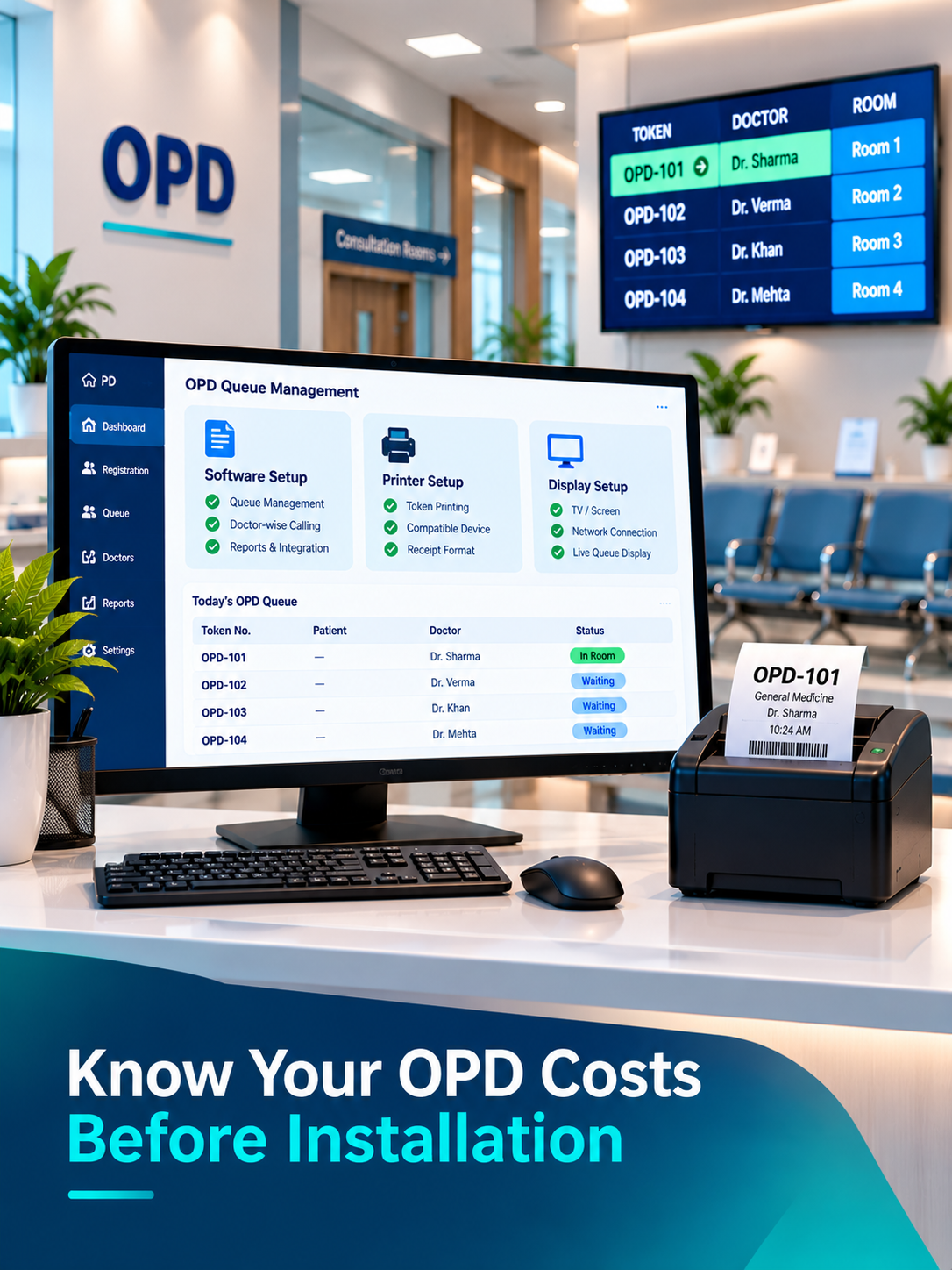
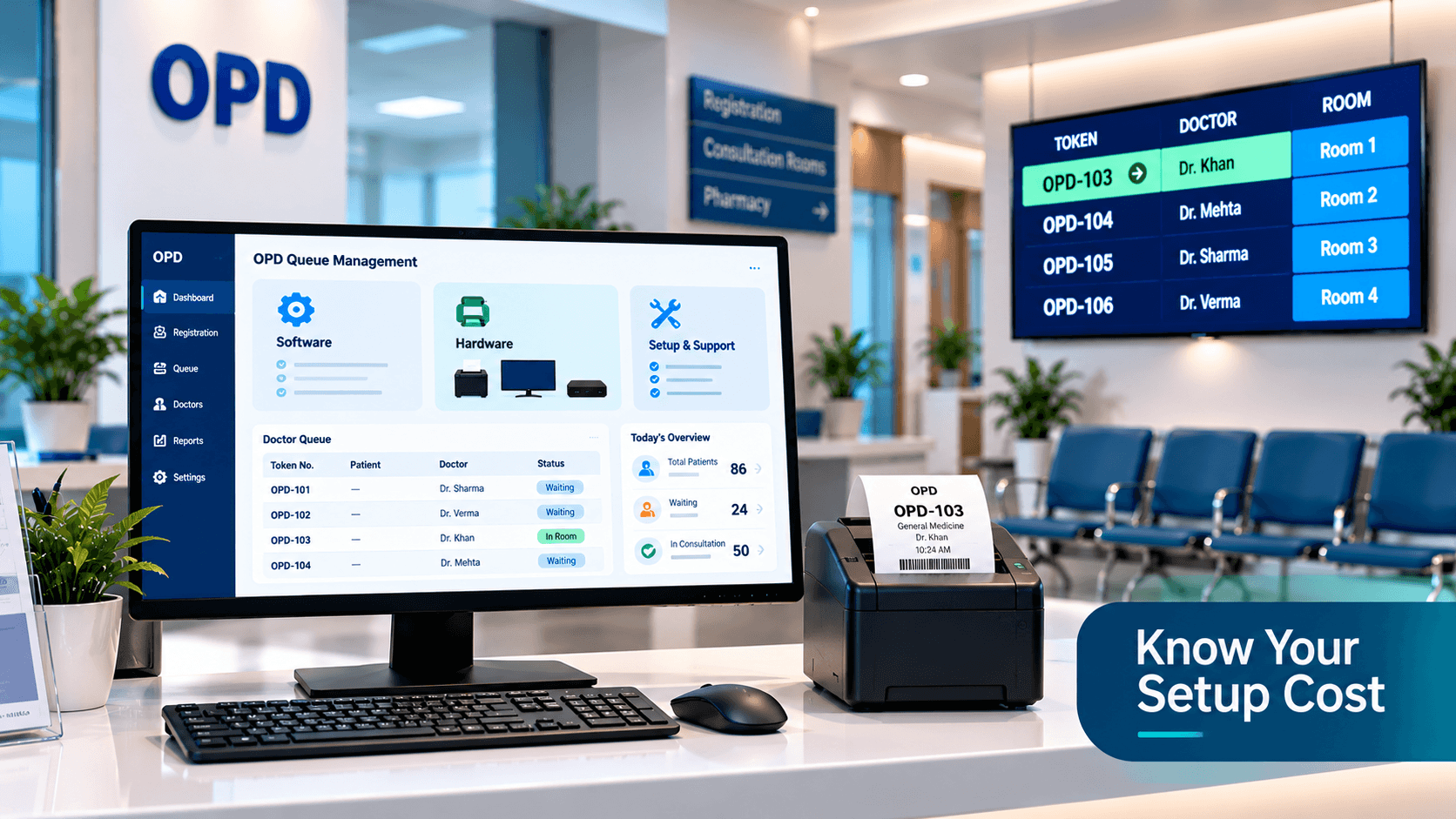
Know Your OPD Costs Before Installation
Plan an OPD token system around your hospital's needs. Compare software, compatible printers, TV displays, installation and support before investing.
Who Should Invest in a Hospital Token System?
| Healthcare facility | Typical requirement |
|---|---|
| Small specialty clinic | One counter and doctor queue |
| Nursing home | Registration, tokens and TV display |
| Multi-specialty hospital | Multiple doctors and departments |
| Diagnostic centre | Department-wise token calling |
| Large outpatient facility | Multiple counters, screens and reporting |
Procurement heads, hospital administrators, clinic owners, finance managers and healthcare IT teams should participate in system selection.
Common OPD Software Purchasing Mistakes
Five mistakes can increase implementation costs:
- Unclear requirements: Purchasing advanced modules before assessing OPD needs.
- Unnecessary hardware: Buying new displays when existing devices may work.
- Printer incompatibility: Selecting hardware without testing its connection.
- Hidden recurring charges: Overlooking hosting, messaging, consumables and AMC.
- Unplanned integrations: Discovering HMS compatibility issues after purchase.
A detailed technical assessment helps reduce these risks.
Plan Your OPD Queue System Without Unnecessary Hardware Costs
How an OPD Token System Works
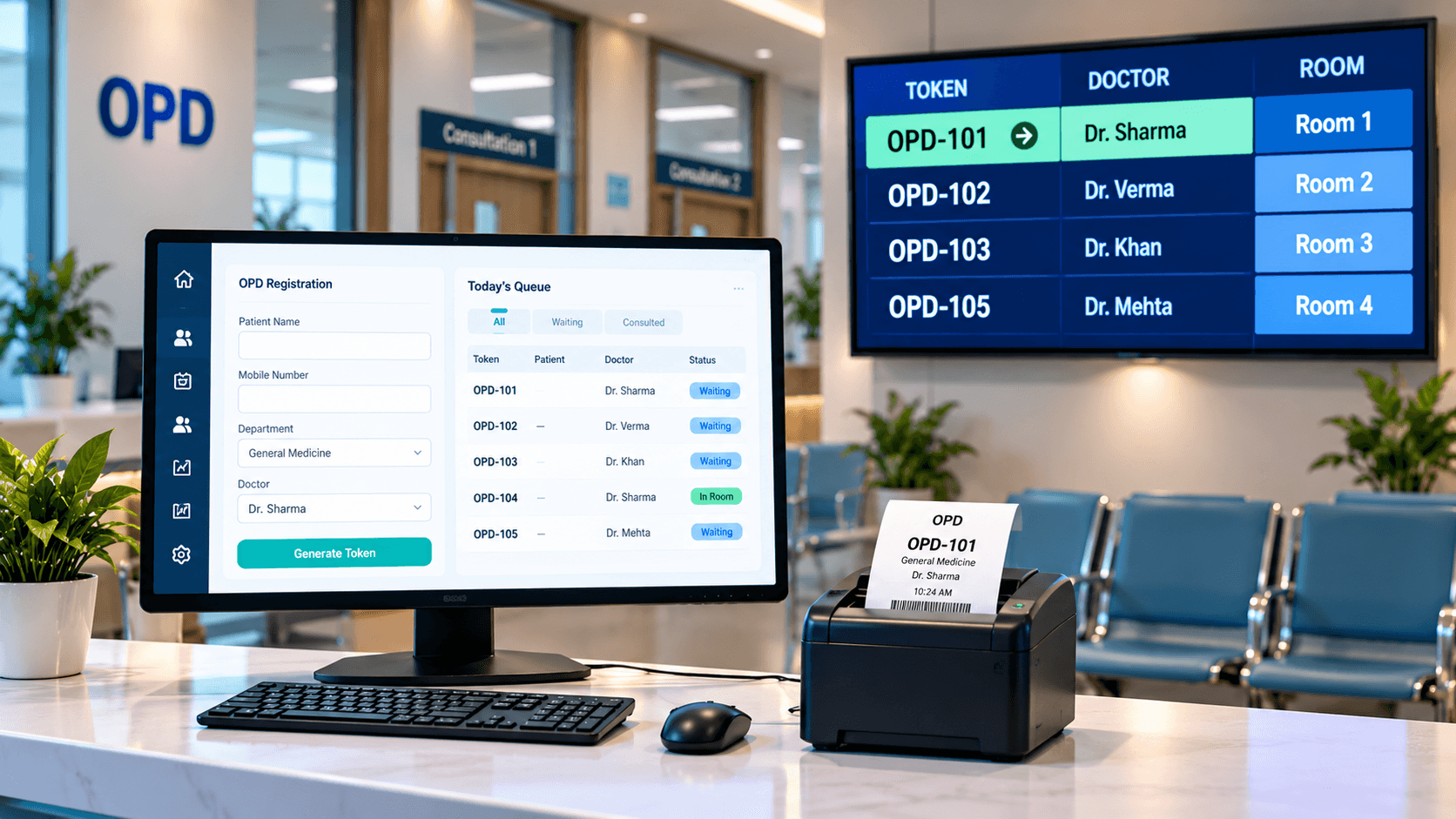
A configured hospital queue workflow typically follows six steps:
- Patient registration: Reception selects the doctor or department.
- Token generation: The system assigns a queue number.
- Optional printing: A compatible printer produces a physical token.
- Queue display: The waiting-room TV shows token and room information.
- Doctor calling: The doctor selects the next patient.
- Status update: Connected reception and display interfaces reflect queue progress.
Register → Generate Token → Print → Display → Call → Update
Printer, TV and network integration must be tested before deployment.
Hospital Queue System Cost: Complete Purchasing Checklist
Ask for an itemized quotation covering the following:
| Cost component | What determines the price |
|---|---|
| Software licence or development | Features, licensing model and customization |
| Doctors and departments | Queue rules and user access |
| Reception counters | Number of registration workstations |
| TV displays | Size, quantity and existing-device compatibility |
| Hospital token printers | Model, connection, paper width and quantity |
| Display controllers | Mini PCs or dedicated controllers, if required |
| Network and power | LAN, Wi-Fi, cabling and backup |
| HMS integration | APIs, data mapping and testing |
| Notifications | SMS/WhatsApp setup and message usage |
| Installation and training | Configuration, testing and staff onboarding |
| AMC and hosting | Support, updates, infrastructure and renewals |
Total Ownership Cost = Software + Hardware + Installation + Integrations + Recurring Charges
Request separate totals for initial deployment and ongoing annual costs.
OPD Token Printer and TV Display Price Considerations
Printer should be compatible with the chosen printing interface.
Look at what connection types are available (USB, LAN, Bluetooth) and what receipt sizes are available. What drivers and supplies are required.
Check if you have a smart TV already, which can be used for the digital queue interface, or if a mini PC will be required.
Any optional kiosks, audio and extra screens in the waiting room should be priced individually.
Do not assume everything will be compatible with everything and that the hardware will be included in the software licence.
Essential OPD Management Software Features
Things to consider:
Digital Tokens, Doctor Queues, Appointment / Walk-in Synchronisation, Live Screen, Reception Dashboard, Patient Alerts, Waiting Times and Admin.
Additional features can include:
Reminders for tokens missed, Priority Rules, VoIP Calling, Kiosk Sign In and HMS Integration.
Ensure what you have is available, can be set up or will need development.
Watch an OPD Software and Hardware Demo
Request a 60–120-second demonstration showing:
- Reception generating a patient token.
- A compatible printer producing a token slip.
- Doctor calling the next patient.
- Waiting-room TV updating the queue.
- Administrator reviewing queue status.
Include approved screenshots of reception, printed token, doctor dashboard, TV display and reporting.
Manual OPD Queue vs Digital Queue Management
| Manual workflow | Connected digital workflow |
|---|---|
| Handwritten token registers | Digital token generation |
| Repeated reception enquiries | Visible queue status |
| Verbal patient calling | Doctor-controlled digital calling |
| Separate status records | Connected queue updates |
| Manual daily summaries | Structured operational reports |
These are potential improvements, not guaranteed waiting-time reductions.
Business Benefits and Expected Outcomes
An appropriate OPD system can improve communication with patients, reduce duplication of administration tasks and make it easier to see what queues there are per doctor.
This can also take advantage of any existing compatible hardware to save on initial costs.
The actual savings and benefits gained will depend on the workload within the hospital, how well the system is implemented and how well staff adapt to it.
Real Project Evidence: MSI OPD Queue System
Murmu Software Infotech developed an OPD token and queue management platform supporting digital tokens, doctor-wise queues, real-time status, reception coordination and patient notifications.
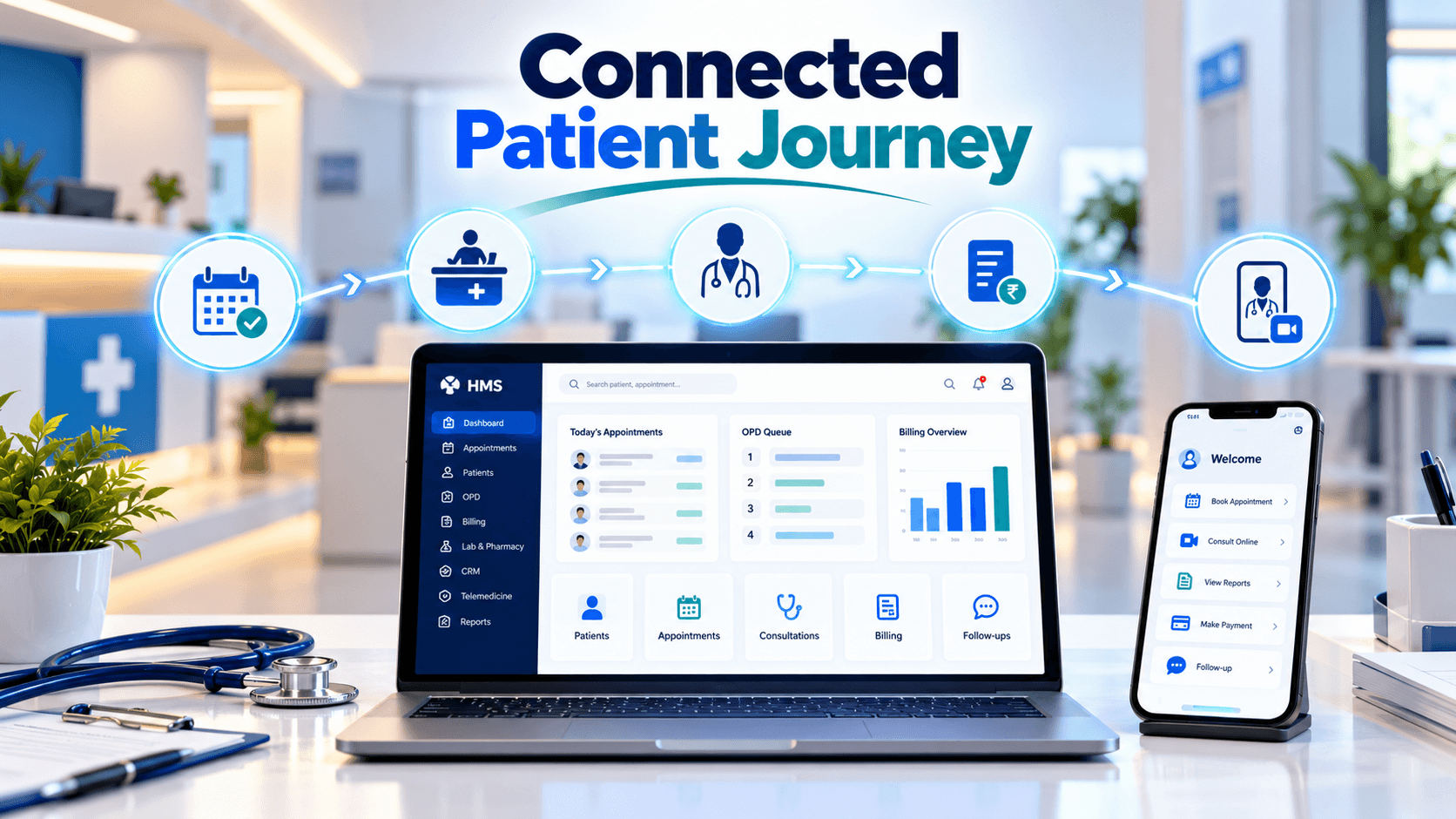
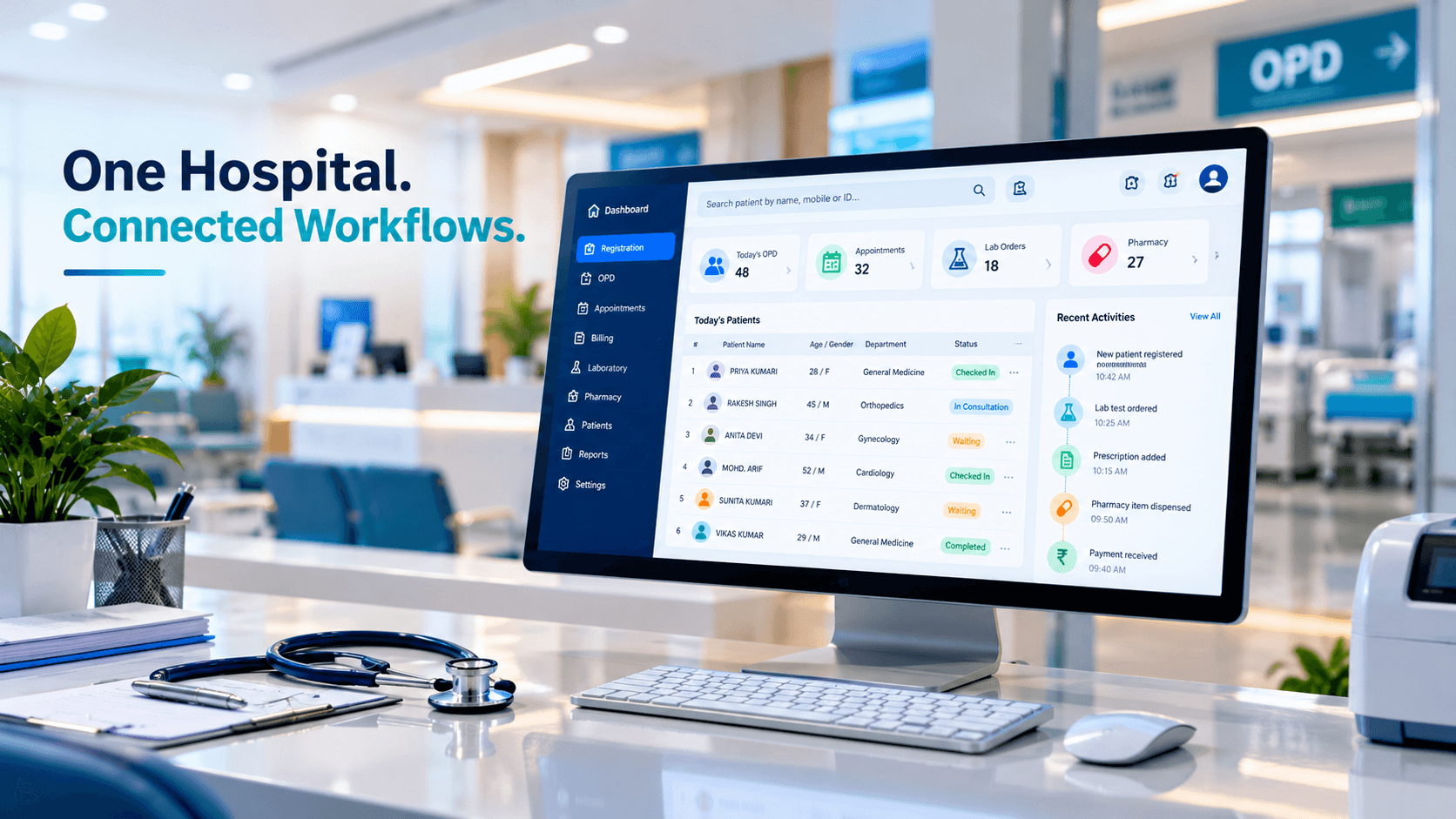
The project demonstrates experience connecting registration with consultation and downstream hospital workflows.
Read OPD Token & Queue Management Case Study
For a detailed feature overview, read the OPD Queue Software Guide.
The project establishes software experience, not universal compatibility with every printer, TV or controller.
Implementation, Installation and Support
Most of the project would involve requirements gathering, ensuring equipment is compatible, configuring queues, integration, staff training and go live checks.
Hospitals should ensure they have plans in place for backup, downtime, warranty, support SLAs and AMC.
Piloting the solution using real reception and doctor processes is recommended.
Get a Customized OPD Software and Hardware Cost Estimate
Why Choose Murmu Software Infotech?
MSI has a business presence in Ranchi and documented experience developing OPD queue and connected healthcare systems.
Its services cover custom hospital workflows, software integration, dashboards and phased implementation.
Explore Hospital Software Solutions in Ranchi.
Get a Clear OPD System Cost Estimate Before Investing
Avoid unnecessary equipment purchases and unexpected implementation expenses.
Start with your hospital's actual patient volume, number of doctors, counters, existing hardware and integration requirements.
Quick Enquiry Form: Hospital Name, Ranchi Location, Contact Number, Number of Doctors, Registration Counters, Daily OPD Patients, Existing Displays, Printer Requirements and HMS Details.
Frequently Asked Questions
What is the OPD token system price in Ranchi?
The OPD token system price in Ranchi depends on the software scope, number of doctors, registration counters, TV displays, token printers, integrations, installation and maintenance. Murmu Software Infotech provides customized estimates based on hospital requirements. Request an itemized quotation showing one-time and recurring costs.
How much does a complete hospital queue management system cost?
A complete hospital queue system budget may include software licensing or development, registration workstations, TV displays, thermal printers, network equipment, installation, staff training, hosting and annual maintenance. Optional SMS, WhatsApp, audio announcements and HMS integrations can add costs. Final pricing requires verified specifications and quotations.
Is a thermal token printer included in OPD management software pricing?
Not necessarily. OPD software and token-printing hardware should be quoted as separate items unless the vendor confirms a tested bundled package. Check printer model, USB or LAN connectivity, driver compatibility, receipt width, paper-roll costs and warranty before purchasing.
Can hospitals use an existing Smart TV for OPD token display?
Possibly. An existing Smart TV may be suitable if its browser or supported application can run the queue display reliably. Some TVs require a mini PC or display controller. Hospitals should test resolution, connectivity, automatic recovery and live queue updates before buying additional hardware.
Which features are included in OPD queue management software?
Core functions commonly include digital token generation, patient registration, doctor-wise queues, appointment and walk-in management, consultation calling, queue status and reception dashboards. MSI documents these capabilities. Features such as printer integration, messaging, kiosks and audio announcements require confirmation for the selected deployment.
How much does OPD queue system installation and AMC cost?
Installation and annual maintenance costs depend on software configuration, doctor and department setup, display devices, printers, networking, training, hosting, upgrades, technical support and service terms. Ask for separate installation and AMC quotations specifying inclusions, exclusions, response times and renewal charges.
Can an OPD token system manage multiple doctors and registration counters?
Yes. A configurable OPD queue system can manage multiple doctors, departments, consultation rooms and registration counters. MSI's documented OPD platform includes doctor-wise and department-wise queues. The number of users, locations and displays should be included in the system requirements and cost estimate.
Can OPD queue software integrate with an existing Hospital Management System?
Integration may be possible when the existing HMS offers compatible APIs, database interfaces or approved data exchange methods. MSI can assess patient registration, appointments, billing and related workflows. Integration costs depend on technical access, data mapping, security requirements, testing and implementation complexity.
Does an OPD queue management system work without internet?
Offline capability depends on the selected deployment architecture. A properly designed local-network or on-premises installation may support internal queue operations without continuous internet access. Cloud hosting, remote access and external messaging services may still require connectivity. Hospitals should request a tested downtime and recovery procedure.
Where can I get an OPD token software and hardware cost estimate in Ranchi?
Visit https://murmusoftwareinfotech.com/opd-queue-management-software to request a customized OPD system estimate, or schedule a consultation at https://murmusoftwareinfotech.com/schedule-appointment. Share doctor count, counters, patient volume, available TVs, printer requirements and existing HMS details to receive a more accurate proposal.