AEM vs Sitecore: Which Fits Your Enterprise in 2026?
In This Article
- AEM vs Sitecore at a Glance: The Quick Verdict
- AEM and Sitecore Today: What Are You Actually Comparing?
- 1. Sitecore Today: SitecoreAI and Sitecore XP 10.5
- 2. AEM Today: AEM as a Cloud Service, Edge Delivery Services, and AEM 6.5 LTS
- How Do AEM and Sitecore Compare Side by Side?
- AEM vs Sitecore: 12 Differences That Decide the Choice
- 1. Architecture and Tech Stack
- 2. Hosting and Deployment Model
- 3. Content Authoring Experience
- 4. Headless and Composable Delivery
- 5. Personalization and Customer Data
- 6. Digital Asset Management
- 7. Analytics and Reporting
- 8. AI, Agents and AI Search Visibility
- 9. Integrations and Ecosystem Fit
- 10. Performance and Scalability
- 11. Security, Governance and Compliance
- 12. Talent, Partners and Support
- What Are the Pros and Cons of Sitecore and AEM?
- Sitecore Pros and Cons
- AEM Pros and Cons
- How Much Do AEM and Sitecore Cost?
- 1. Licensing Models: How Each Vendor Charges
- 2. Implementation and Migration Costs
- 3. Five-Year Total Cost of Ownership: Where the Money Goes
- Already on Sitecore or AEM? When Does Switching Make Sense?
- 1. If You Run Sitecore XP or XM: Upgrade, Move to SitecoreAI or Replatform
- 2. If You Run AEM 6.5: Move to Cloud Service or Replatform
- 3. What a Switch Between AEM and Sitecore Really Involves
- Who Should Choose Sitecore, and Who Should Choose AEM?
- Choose Sitecore If
- Choose AEM If
- When Neither Platform Is the Right Fit
- 5 Questions to Answer Before You Sign Either Contract
- Why Choose Murmu Software Infotech as Your Implementation Partner
- Conclusion: Choose the Ecosystem Your Team Can Run
- Frequently Asked Questions
- 1. Is AEM better than Sitecore?
- 2. What is the main difference between AEM and Sitecore?
- 3. Which costs more, AEM or Sitecore?
- 4. Is Sitecore an Adobe product?
- 5. Which is better for personalization?
- 6. Is Sitecore XP still supported?
- 7. Can you migrate between AEM and Sitecore?
- 8. How long does implementation take?
AEM and Sitecore are both strong enterprise CMS platforms, but the right choice depends on your existing ecosystem, team, budget, and long-term goals. Sitecore fits teams seeking a unified platform with built-in personalization and AI, while AEM is a strong choice for Adobe-focused enterprises that need advanced assets, analytics, and flexible content delivery. Compare implementation, licensing, integrations, talent, and five-year costs before making the final decision.
Choosing the wrong enterprise CMS can lead to higher costs, complex migrations, and difficult-to-find technical talent.
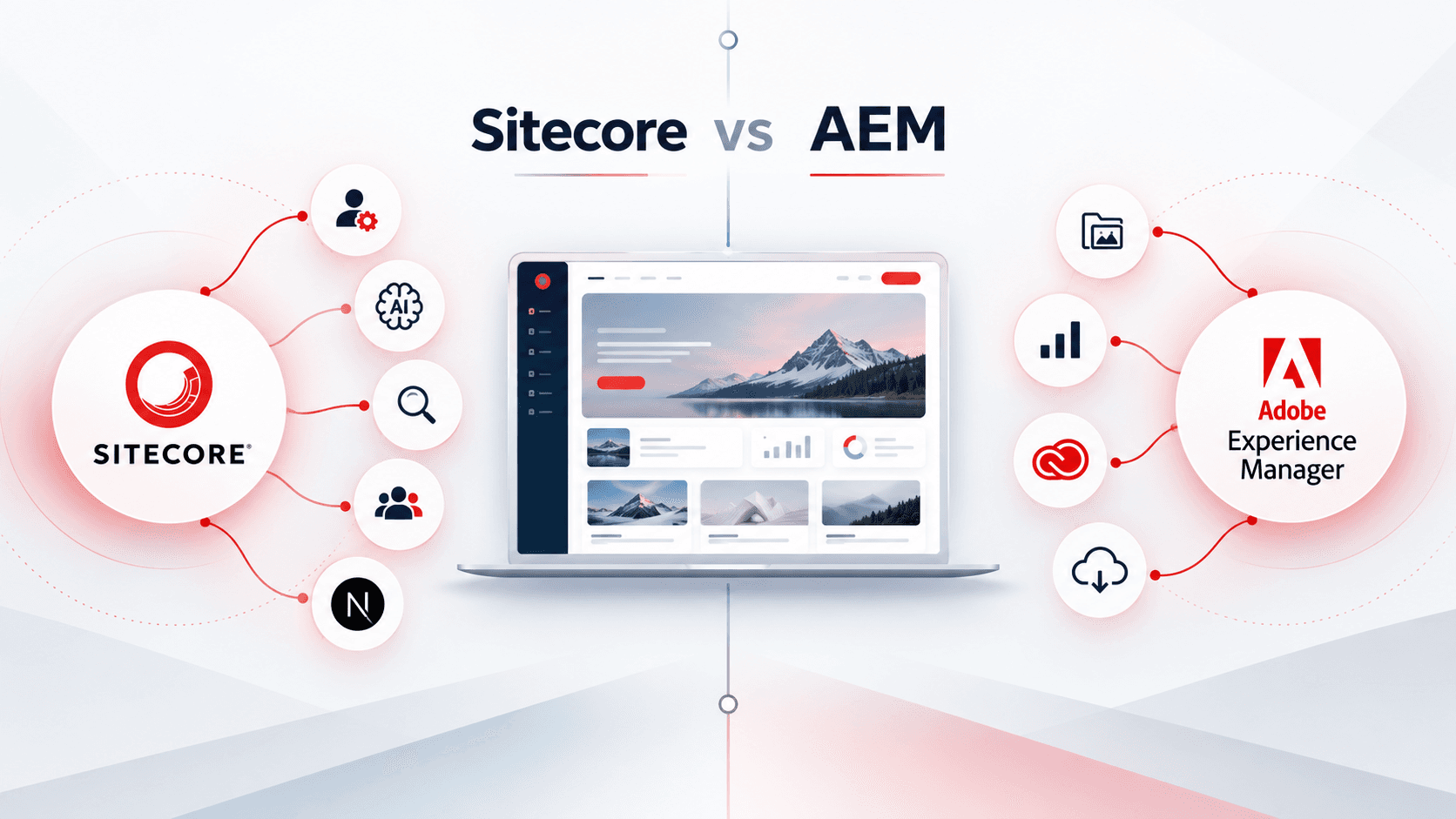
That’s where the right AEM vs Sitecore decision matters. Sitecore fits enterprises looking for content, personalization, and AI in one platform, while Adobe Experience Manager works well for organizations already using Adobe Analytics, Target, or Creative Cloud.
But choosing between these enterprise CMS platforms is not just about features or pricing. SitecoreAI and AEM as a Cloud Service have also changed what enterprises should evaluate today.
In this guide, you will learn:
- What Sitecore and AEM offer today
- How they compare across key requirements
- The 12 differences that matter most
- Pros, cons, and five-year costs
- When migration makes sense
- Which platform fits different business needs
By the end of this guide, you’ll know which platform fits your ecosystem, team, and budget.
AEM vs Sitecore at a Glance: The Quick Verdict
The right platform depends on your existing stack, team, and business needs. Use these quick scenarios to see which option fits your situation.
| Your situation | Better fit | Why it fits |
|---|---|---|
| You want fewer vendors and contracts | Sitecore | SitecoreAI combines CMS, search, customer data, and AI in one platform. |
| Your marketing and creative teams use Adobe tools | AEM | Adobe Experience Manager connects natively with the Adobe products you already use. |
| Your developers work with .NET, React, or Next.js | Sitecore | Existing development skills can carry over to Sitecore XP and SitecoreAI. |
| You manage large image and video libraries | AEM | AEM Assets provides strong enterprise digital asset management. |
| You must self-host for compliance | Either | Sitecore XP 10.5 and AEM 6.5 LTS both support self-hosted deployments. |
AEM and Sitecore Today: What Are You Actually Comparing?
You are comparing two product families, not two single products. Many Sitecore vs AEM discussions mix SaaS and self-hosted editions, which can make the comparison misleading. Start by matching similar deployment models.
1. Sitecore Today: SitecoreAI and Sitecore XP 10.5
SitecoreAI, formerly XM Cloud, is Sitecore’s main SaaS platform. It combines headless CMS, entry-level DAM, customer data, personalization, search, and AI agents in one subscription. Sitecore XP 10.5 remains the separate self-hosted .NET option.
Sitecore XP follows a lifecycle with mainstream, extended, and sustaining support phases. This gives existing teams time to plan their next step, while Sitecore’s product direction increasingly centers on SitecoreAI.
2. AEM Today: AEM as a Cloud Service, Edge Delivery Services, and AEM 6.5 LTS
AEM is now part of Adobe CX Enterprise. Adobe positions AEM as a Cloud Service as its modern cloud offering, while Edge Delivery Services provides a lightweight, performance-focused delivery option.
AEM 6.5 LTS remains available for self-hosted and Adobe Managed Services environments and supports current Java versions. Adobe publishes support end dates for the 6.5 line, so check the timeline before extending an on-premises investment.
A fair Adobe Experience Manager vs Sitecore comparison pairs SitecoreAI with AEM as a Cloud Service, and XP 10.5 with AEM 6.5 LTS.
Also Read: Sitecore XM Cloud vs Sitecore XP
Choose Your Enterprise CMS Confidently
Compare Sitecore and AEM across ecosystem fit, AI, personalization, DAM, implementation and five-year cost before committing to your platform.
How Do AEM and Sitecore Compare Side by Side?
At the SaaS level, Sitecore focuses on unified packaging and personalization, while AEM stands out for assets, analytics, and delivery flexibility. This AEM vs Sitecore comparison puts SitecoreAI against AEM as a Cloud Service across the factors enterprise buyers care about most.
| Criteria | Sitecore (SitecoreAI) | AEM (as a Cloud Service) |
|---|---|---|
| Architecture and tech stack | Headless SaaS CMS with .NET heritage and Next.js front end | Java, Apache Sling, OSGi, and Oak repository |
| Hosting model | Sitecore hosts the CMS, while you host the front end | Adobe hosts and scales the full service |
| Licensing and pricing | Quote-based subscription, mainly sized by traffic | Quote-based, with content requests as a key license metric |
| Total cost of ownership | Lower add-on spend, plus front-end build and hosting | Can increase as Adobe products are added |
| Authoring experience | Visual page builder for marketing teams | Page Editor, Universal Editor, and document authoring |
| Headless capability | Headless-focused | Traditional, headless, or Edge Delivery |
| Personalization | Entry-level personalization included | Basic tools included, with advanced options through Adobe Target and CDP |
| Digital asset management | Content Hub with entry-level access | AEM Assets for enterprise DAM needs |
| AI and agents | Agentic Studio with Sitecore agents | CX Enterprise Coworker and metered generative features |
| Integrations | Open connectors with strong Microsoft compatibility | Deep integration across the Adobe ecosystem |
| Talent availability | .NET and Next.js skills, with senior architects more limited | Specialized Java and AEM talent from a narrower pool |
| Best fit | Marketing-led teams wanting one unified platform | Adobe-invested enterprises with heavy asset needs |
The table gives you a quick Sitecore AEM comparison. The next section breaks down what each difference means for your technology, team, and budget.
AEM vs Sitecore: 12 Differences That Decide the Choice
The decision usually comes down to a few practical differences, not the number of features each platform offers. Compare each one against your technology stack, team, budget, and long-term roadmap.
1. Architecture and Tech Stack
Sitecore grew up on Microsoft .NET, while SitecoreAI uses a separate Next.js front end that connects through APIs. That means XP teams need .NET skills, while SitecoreAI projects also need React or Next.js expertise.
AEM runs on Java, Apache Sling, OSGi, and the Oak content repository. It is powerful but specialized, so a Java background helps, but AEM-specific experience is still important.
2. Hosting and Deployment Model
Adobe hosts and continuously updates AEM as a Cloud Service. Edge Delivery Services offers a lighter option, while AEM 6.5 LTS or Adobe Managed Services supports teams that need more control.
Protect Enterprise SEO Before Choosing AEM or Sitecore
With SitecoreAI, Sitecore hosts the CMS while you host the front end through platforms such as Vercel, Netlify, or Azure. This gives you front-end flexibility but adds another deployment pipeline and hosting cost. Sitecore XP 10.5 remains self-hosted.
3. Content Authoring Experience
SitecoreAI gives marketers a visual page-building experience with structured components and page previews. It also supports field-level permissions, which helps when different teams manage specific content areas.
AEM offers the Page Editor, Universal Editor, and document-based authoring through Word or Google Docs. Its Launches feature helps teams group and publish changes, but the wider toolset can require more author training.
4. Headless and Composable Delivery
AEM supports traditional pages, headless delivery, and Edge Delivery Services. Content Fragments can also be delivered through GraphQL and REST, giving teams more options across websites and digital channels.
SitecoreAI takes a headless-first approach, with content delivered through the Experience Edge API to a separate front-end application. This suits modern web stacks but requires a dedicated front end for every site.
5. Personalization and Customer Data
SitecoreAI includes entry-level customer data and personalization in its base subscription. Teams can segment audiences and run personalization without adding another major platform.
AEM supports basic targeting, while advanced personalization often requires Adobe Target, Real-Time CDP, or Journey Optimizer. For enterprises already invested in Adobe, that wider ecosystem can be a strong advantage.
6. Digital Asset Management
AEM Assets is one of Adobe’s strongest areas. It supports large image and video libraries with features such as smart tagging, smart cropping, and connections to Creative Cloud.
Sitecore uses Content Hub for asset management, with entry-level access included in SitecoreAI. It works well for marketing teams, but large creative operations may prefer the depth of Adobe’s DAM.
7. Analytics and Reporting
Adobe Analytics and Customer Journey Analytics provide advanced enterprise reporting and connect closely with AEM. They require separate licensing and skilled analysts, but they become especially valuable when your organization already uses Adobe analytics.
SitecoreAI provides built-in performance insights for content and personalization. Many teams still connect Google Analytics or another analytics platform, so it is better viewed as integrated visibility rather than a full analytics suite.
8. AI, Agents and AI Search Visibility
SitecoreAI puts AI directly into the platform through Agentic Studio and agents for planning, content, and optimization. Sitecore says these agents are included in the platform license, while Scrunch supports Sitecore SEO, AEO, and GEO work.
Adobe offers CX Enterprise Coworker across AEM and other Adobe products, along with tools for generative AI and AI search visibility. Some generative features use metered allowances, so review usage terms before budgeting.
9. Integrations and Ecosystem Fit
AEM is strongest when your business already uses Adobe products such as Analytics, Target, Creative Cloud, Workfront, or Adobe Commerce. Integrating outside systems is possible, but may require more API and engineering work.
Sitecore offers open connectors, a marketplace, and strong Microsoft compatibility. It fits well with Dynamics and Azure, while Salesforce, ERP, and commerce integrations still need careful planning.
10. Performance and Scalability
With SitecoreAI, the separate front end plays a major role in performance. A well-built Next.js application on a modern edge platform can scale efficiently, while self-hosted XP requires your team to manage infrastructure capacity.
AEM as a Cloud Service scales automatically as traffic changes. Edge Delivery Services is also designed for fast delivery and strong Core Web Vitals, while scaling AEM 6.5 remains the customer’s responsibility.
11. Security, Governance and Compliance
Adobe provides a consistent cloud security and compliance model across its services, with audit capabilities for content, publishing, and assets. This can simplify governance for regulated enterprises.
Sitecore provides detailed item-level and field-level permissions with customizable workflows. For older XP versions, check the support status carefully because security updates during Extended Support can add to long-term costs.
12. Talent, Partners and Support
AEM has a broad partner network, Experience League resources, and a large ecosystem. However, experienced AEM developers are specialized, so hiring can take time and may require a higher budget.
Sitecore has a smaller but active community, including its MVP program and developer forums. Next.js also expands the available front-end talent pool, but senior Sitecore architects remain limited. That makes the cost of hiring Sitecore developers an important part of planning.
Now that you have seen how these differences play out, let's take a look at the strengths and limits each platform carries overall.
What Are the Pros and Cons of Sitecore and AEM?
The main trade-off is simplicity vs. ecosystem depth. SitecoreAI brings more capabilities into one platform, while AEM offers deeper asset management, analytics, and Adobe integrations.
Sitecore Pros and Cons
Pros
- Unified platform: CMS, search, customer data, personalization, and entry-level DAM come under one SitecoreAI subscription.
- Easy authoring: Visual page building helps marketers create and manage content with less developer support.
- Built-in personalization: Basic segmentation and testing are included without another major platform.
- AI included: Sitecore provides AI agents within the platform license.
Cons
- Headless SaaS: SitecoreAI requires a separate front-end application and hosting.
- Migration effort: Moving from XP to SitecoreAI requires significant rebuilding and content migration.
- Lighter DAM: Content Hub may not match AEM Assets for large creative operations.
- Limited senior talent: Experienced Sitecore architects can be difficult to find.
AEM Pros and Cons
Pros
- Enterprise DAM: AEM Assets supports large media libraries, smart tagging, and Creative Cloud integration.
- Strong Adobe ecosystem: AEM connects closely with Analytics, Target, and Journey Optimizer.
- Flexible delivery: Teams can use traditional, headless, or Edge Delivery approaches.
- Automatic scaling: AEM as a Cloud Service handles traffic growth without manual infrastructure management.
Cons
- Higher total cost: Additional Adobe products can increase the overall investment.
- Specialized development: Customization often requires experienced Java and AEM developers.
- Steeper learning curve: Authors may need more training to use the wider feature set.
- Metered AI features: Some generative AI capabilities use usage-based allowances.
How Much Do AEM and Sitecore Cost?
Both platforms use quote-based enterprise pricing, so there is no standard public price list. Vendr's buyer data puts the median Sitecore contract near $60,944 per year and describes Sitecore pricing as comparable to or below AEM.
Treat this as market context, not a fixed quote. Traffic, modules, integrations, and negotiation can change the final price, and the license is only one part of the total investment.
1. Licensing Models: How Each Vendor Charges
SitecoreAI uses a subscription model based mainly on site traffic, with entry-level personalization, search, and DAM included. XP has separate licensing and support terms, while Adobe prices AEM Sites as a Cloud Service by content requests. Assets, Forms, and other Adobe products can add separate costs.
2. Implementation and Migration Costs
Implementation can cost as much as the platform license, depending on sites, integrations, content volume, and custom components. SitecoreAI adds front-end engineering, while AEM implementation needs specialized Java and AEM skills.
Our guide on how much Sitecore costs provides more detail, while the project cost calculator can help estimate your build before requesting vendor quotes.
3. Five-Year Total Cost of Ownership: Where the Money Goes
The five-year view shows the bigger cost difference. SitecoreAI keeps more capabilities in one subscription, while AEM costs can increase as products such as Target, Analytics, or a CDP are added.
| Cost driver | Sitecore | AEM |
|---|---|---|
| Platform license | One SitecoreAI subscription, with a market median near $60,944/year per Vendor | Quote-based and tied to content requests |
| Add-on products | Higher tiers and additional needs can increase costs | Target, Analytics, CDP, and Journey Optimizer may require separate licenses |
| AI usage | Agents included in the platform license, per Sitecore | Some generative features use usage allowances |
| Front-end hosting | Separate hosting for the front-end application | Included unless you build a separate headless front end |
| Implementation | Next.js and .NET development plus integrations | Java and AEM development plus Adobe integrations |
| Talent | .NET, Next.js, and Sitecore specialists | Java and AEM specialists |
| Upgrades | Included with SitecoreAI, project-based for XP | Included with Cloud Service, service packs for AEM 6.5 |
| Vendor support | XP Extended Support can add security update costs | Fixed support windows for AEM 6.5 |
These figures are indicative of market context. Confirm pricing, usage limits, support terms, and implementation costs with the vendor before budgeting.
Also Read: Sitecore Cost and Pricing Guide for UK Companies
Find CMS SEO Risks Before Your Platform Migration Starts
Already on Sitecore or AEM? When Does Switching Make Sense?
Switching rarely pays unless your wider stack has already moved to the other vendor. The AEM vs Sitecore question changes once you own one of them, because modernizing in place usually costs less and carries less risk.
1. If You Run Sitecore XP or XM: Upgrade, Move to SitecoreAI or Replatform
You have three real paths, and each one suits a different situation. Moving to SitecoreAI is a rebuild and not an upgrade, so plan it with a proper XP to XM Cloud migration strategy.
| Path | What it involves | Best when |
|---|---|---|
| Upgrade to XP 10.5 | A version upgrade on your own infrastructure that returns you to mainstream support | Your XP personalization works and you must self-host |
| Move to SitecoreAI | A headless rebuild with a Next.js front end and migrated content | You want SaaS and plan to stay with Sitecore |
| Replatform to AEM | A full rebuild of templates, components, integrations, and the content model | Your company is standardizing on Adobe |
2. If You Run AEM 6.5: Move to Cloud Service or Replatform
Adobe's intended path is AEM as a Cloud Service, and its tooling supports that move. AEM 6.5 LTS buys you time if you need to stay self-hosted. Leaving for Sitecore makes sense mainly when you want bundled personalization and a simpler license, and your Adobe add-ons sit underused.
3. What a Switch Between AEM and Sitecore Really Involves
Very little carries over automatically between the two platforms. A Sitecore to AEM migration, or the reverse, means remapping content models, rebuilding components, redoing integrations, and retraining authors. Protect your rankings with a redirect plan, and budget for running both platforms in parallel.
Now that you have seen what staying, upgrading, and switching each involve, let's take a look at who should choose which platform.
Who Should Choose Sitecore, and Who Should Choose AEM?
The right platform depends on your existing ecosystem, technical skills, and budget. Use these practical scenarios to see where each platform fits best.
Choose Sitecore If
- You want one platform: Content, personalization, search, and AI in one subscription matter most.
- Marketing leads the roadmap: Marketers need to build and test pages with less developer support.
- Your stack is Microsoft: Your team already uses .NET, Azure, or Dynamics.
- You already own Sitecore XP: Staying with Sitecore can reduce migration and retraining effort.
- Cost predictability matters: You prefer fewer contracts and include AI capabilities.
Choose AEM If
- You run the Adobe stack: Analytics, Target, or Journey Optimizer already support your marketing.
- Assets drive your business: Your teams manage large volumes of images, video, and other media.
- You need delivery flexibility: Different sites need traditional, headless, or Edge Delivery options.
- Traffic is unpredictable: Automatic cloud scaling helps during launches and seasonal peaks.
- You have Java depth: Your internal team or partner already has strong AEM experience.
When Neither Platform Is the Right Fit
Both platforms target enterprises with larger budgets and dedicated teams. If you manage only a few sites with modest personalization needs, a lighter CMS may be a better fit. Our comparison of Sitecore, Optimizely, Contentful, Sanity, and Umbraco covers these alternatives in more detail.
5 Questions to Answer Before You Sign Either Contract
Vendor demos rarely surface the terms that shape your costs later. Before your AEM vs Sitecore evaluation reaches procurement, put these five questions to both vendors and your implementation partner.
- License metric: Ask what the contract measures, such as visits, content requests, users, or modules, and what overages cost.
- Second contracts: List every extra product your personalization, search, analytics, and asset plans require.
- AI pricing: Confirm whether the vendor includes agents and generative features or meters them by usage.
- Delivery and support talent: Check how many qualified developers and support partners you can realistically hire or contract.
- Exit cost: Estimate the rebuild effort if you change platforms five years from now.
Also Read: Sitecore Support and Maintenance Services for US Enterprises
Why Choose Murmu Software Infotech as Your Implementation Partner
Murmu Software Infotech helps enterprises and agencies plan, build, migrate, and support Sitecore platforms. We assess your existing stack and business needs before recommending the right implementation approach.
- Full Sitecore lifecycle: Sitecore CMS, XP, XM, SXA, XM Cloud, SitecoreAI, Next.js, integrations, support, and rescue audits.
- Migration experience: Experience supporting a healthcare enterprise moving from Sitecore XP to XM Cloud with AI Search and a Next.js rendering host.
- Flexible engagement: Dedicated developers available hourly or monthly, plus white-label delivery for agencies.
- Indicative rates: Developer, administrator, and content-author resources from $15 to $40 per hour, depending on scope.
- Long-term support: Our Sitecore CMS operations services help keep your platform stable after launch.
Need help making the right call?
Connect with our Sitecore experts to review your requirements and shortlist the right platform before you sign.
Conclusion: Choose the Ecosystem Your Team Can Run
The AEM vs Sitecore decision comes down to fit, not feature counts. Sitecore suits teams looking for a unified platform, while AEM fits enterprises already invested in the Adobe ecosystem.
We hope this guide helps you understand the key AEM vs Sitecore trade-offs across cost, capabilities, implementation, and long-term fit.
Before you decide, compare each platform against your existing stack, team skills, budget, and growth plans. This makes your AEM vs Sitecore comparison more practical and easier to defend internally.
Frequently Asked Questions
1. Is AEM better than Sitecore?
Neither is universally better. AEM suits Adobe-focused teams needing advanced asset management, while Sitecore fits teams seeking bundled personalization and simpler authoring.
2. What is the main difference between AEM and Sitecore?
SitecoreAI bundles content, search, personalization, and AI. AEM offers deeper integration with Adobe tools, some of which require separate licenses.
3. Which costs more, AEM or Sitecore?
Both offer custom pricing. AEM costs can rise with add-ons like Adobe Target and Analytics, so compare five-year licensing, implementation, hosting, and support costs.
4. Is Sitecore an Adobe product?
No. Sitecore is an independent company, while Adobe Experience Manager is Adobe’s enterprise CMS.
5. Which is better for personalization?
SitecoreAI includes built-in personalization. AEM supports advanced capabilities through Adobe Target and Real-Time CDP, which may require additional licenses.
6. Is Sitecore XP still supported?
Yes, but support depends on the version and lifecycle stage. Check Sitecore’s current support terms, especially for security updates during Extended Support.
7. Can you migrate between AEM and Sitecore?
Yes. Both directions require planning for content mapping, rebuilding components and integrations, redirects, and author training.
8. How long does implementation take?
Timelines depend on scope, integrations, and content complexity. Sitecore’s comparison cites a customer site built in four months, but larger enterprise projects can take much longer.
Frequently Asked Questions
Is AEM better than Sitecore for enterprise websites?
Neither platform is universally better. AEM is often the stronger fit for enterprises deeply invested in Adobe tools and large digital asset workflows, while Sitecore fits organizations seeking a more unified content, personalization, search and AI platform.
What is the main difference between AEM and Sitecore?
SitecoreAI emphasizes a unified SaaS platform combining CMS, search, personalization, customer data and AI. AEM offers strong enterprise content management, advanced digital asset management and deep integration with the broader Adobe ecosystem.
Which costs more, AEM or Sitecore?
Both use quote-based enterprise pricing. The final cost depends on licensing metrics, implementation, integrations, hosting, required add-ons, specialist talent and long-term support, so five-year total cost is more useful than license price alone.
Which platform is better for personalization?
SitecoreAI includes entry-level personalization and customer data capabilities in its platform. AEM supports targeting, while advanced personalization can involve Adobe Target, Real-Time CDP or Journey Optimizer depending on requirements.
Which is better for digital asset management, AEM or Sitecore?
AEM Assets is particularly strong for enterprises managing large image and video libraries and working heavily with Creative Cloud. Sitecore provides Content Hub capabilities, but large creative operations may prefer Adobe's deeper DAM ecosystem.
Which CMS is better for AI capabilities?
SitecoreAI includes Agentic Studio and Sitecore agents, while Adobe offers AI capabilities across its CX Enterprise ecosystem. Buyers should compare included features, usage limits and how AI connects with their existing marketing stack.
Which platform is better for headless websites?
SitecoreAI is headless-first and typically uses a separate Next.js frontend. AEM supports traditional, headless and Edge Delivery approaches, providing more delivery-model flexibility.
Should an existing Sitecore customer migrate to AEM?
A migration is most worth evaluating when the wider organization is standardizing on Adobe and the benefits justify rebuilding content models, components, integrations and author workflows. Modernizing within Sitecore is often lower risk when the existing ecosystem still fits.
Can a company migrate from AEM to Sitecore?
Yes, but migration requires content mapping, component rebuilding, integration redesign, redirects, SEO protection and author training. Very little transfers automatically between the platforms.
How should enterprises choose between AEM and Sitecore?
Compare your existing technology ecosystem, personalization requirements, asset-management needs, internal development skills, licensing model, AI usage, implementation complexity, specialist talent availability and five-year ownership cost.