Sitecore XM Cloud Travel Booking Platform Case Study: Next.js Headless Architecture
In This Article
- The Challenge: Connecting Content With Travel Commerce
- The Solution: Sitecore XM Cloud + Next.js
- Reusable, Marketing-Editable XM Cloud Components
- Connecting Flight, Hotel and Travel Booking APIs
- GraphQL-Driven Content Architecture
- Next.js Frontend for Modern Travel Experiences
- Personalization for More Relevant Journeys
- Cloud Deployment with XM Cloud and Vercel
- Business Impact
- Building or Modernizing a Sitecore Travel Platform?
Modern travel platforms have to do more than publish destination content. They must connect inspiration, promotions, personalized experiences, flight and hotel services, responsive interfaces, and real-time booking systems—all while allowing marketing teams to launch and update content without waiting for developers.
Murmu Software Infotech contributed to the development of an enterprise travel and booking platform built with Sitecore XM Cloud, Next.js, Sitecore JSS, GraphQL, Node.js APIs, and Vercel.
The goal was to create a modern headless digital platform where content and booking functionality could evolve independently while still delivering a unified customer experience.
Build Scalable Travel Experiences With Sitecore
Create high-performance travel platforms with XM Cloud, Next.js, JSS, reusable components, API integrations, and scalable headless architecture for enterprise growth.
The Challenge: Connecting Content With Travel Commerce
Enterprise travel experiences combine two very different requirements.
Marketing teams need flexibility to create destination pages, promotional campaigns, seasonal offers, landing pages, and reusable content experiences.
Booking journeys, meanwhile, depend on external systems for flights, hotels, destinations, availability, and other travel services.
A traditional tightly coupled CMS architecture can make these requirements difficult to scale. Content changes may become dependent on development releases, frontend flexibility can be restricted, and integrating multiple booking services can create architectural complexity.
The platform therefore required:
- A cloud-native headless CMS
- Reusable marketing components
- Independent frontend development and deployment
- Integration with flight, hotel, and travel APIs
- Flexible content delivery through GraphQL
- Responsive and SEO-friendly experiences
- Personalization capabilities
- Scalable deployment infrastructure
The objective was not simply to rebuild a travel website. It was to establish a composable travel digital experience architecture capable of supporting both content-led discovery and transaction-oriented booking journeys.
Build a Scalable Travel Platform with Sitecore XM Cloud
The Solution: Sitecore XM Cloud + Next.js
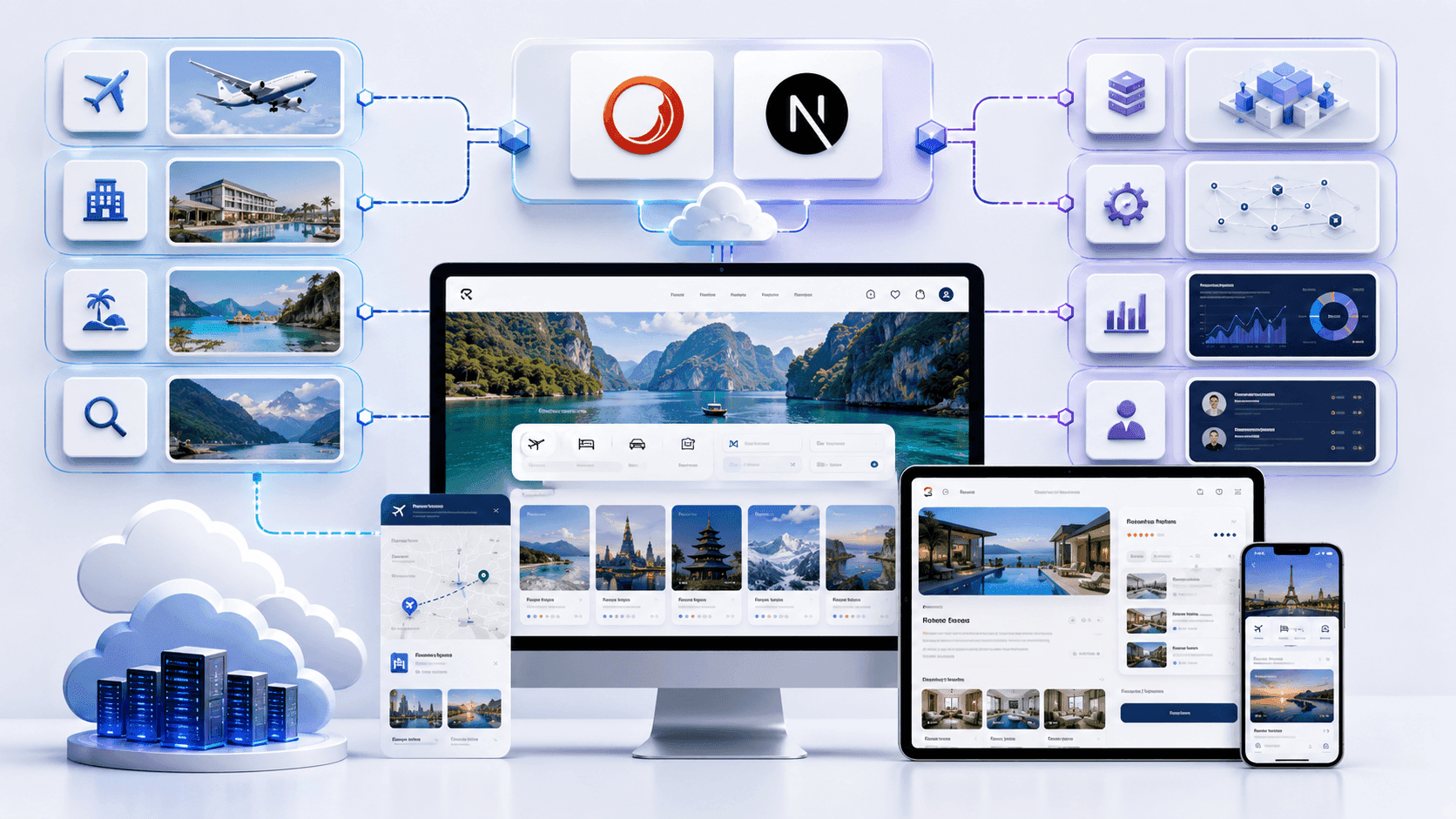
The platform was developed using Sitecore XM Cloud as the headless content management layer and Next.js as the frontend rendering application.
Sitecore JSS connected the content structure with the frontend component system, while GraphQL supported dynamic retrieval of structured content.
This separation created an important architectural advantage: marketing content could be managed within Sitecore while frontend teams retained greater control over presentation, performance, integrations, and application behavior.
Instead of coupling every experience directly to CMS implementation logic, the platform used reusable components and API-driven services that could be developed and deployed more independently.
Reusable, Marketing-Editable XM Cloud Components
A core requirement was giving content teams greater control over digital experiences.
Reusable Sitecore JSS components were developed for:
- Hero banners
- Destination content
- Promotional sections
- Travel campaign modules
- Booking-focused landing sections
- Dynamic marketing experiences
These components were structured so marketers could manage content through XM Cloud while maintaining a consistent presentation system across the website.
For travel businesses running frequent campaigns, destination promotions, seasonal offers, and changing travel content, this component approach provides a stronger foundation than relying on developers for routine page updates.
Connecting Flight, Hotel and Travel Booking APIs
The platform also needed to bridge CMS-driven experiences with external booking functionality.
Third-party APIs were integrated for flight bookings, hotel bookings, and destination or travel services.
Custom Node.js APIs and server-side integration workflows were used to connect external services with the digital experience layer.
This architecture allowed editorial content and transactional services to remain logically separated while appearing as part of a connected travel journey to the user.
A destination page, for example, can provide inspirational and promotional content through Sitecore while booking functionality retrieves relevant services from external systems.
That separation is especially important for enterprise travel platforms because booking providers, content requirements, and frontend experiences can change independently over time.
GraphQL-Driven Content Architecture
GraphQL played an important role in delivering content to the frontend.
The implementation included integrated GraphQL queries, component-level content queries, dynamic content retrieval, and search-oriented queries.
Rather than forcing every frontend component to depend on a rigid page structure, GraphQL enabled components to request the structured content required for their specific experience.
This supported a more flexible relationship between Sitecore content, reusable frontend components, and travel application functionality.
Next.js Frontend for Modern Travel Experiences
The rendering host was built using:
Next.js + Tailwind CSS + Sitecore JSS
The frontend approach focused on responsive interfaces, SEO-friendly page delivery, reusable UI patterns, and modern rendering architecture.
This was particularly important for a travel platform where customers may move between desktop and mobile devices while researching destinations, comparing options, and progressing toward booking.
Separating the Next.js frontend from the CMS also provided development teams with greater freedom to optimize the digital experience without tightly coupling frontend releases to the content-management platform.
Personalization for More Relevant Journeys
The solution also incorporated basic page-level personalization and dynamic content targeting.
Travel experiences are naturally contextual. Visitors may respond differently to destinations, promotions, and content depending on their interests or journey.
Introducing personalization at the content layer created a foundation for delivering more relevant digital experiences instead of presenting every visitor with an identical marketing journey.
Modernize Travel Booking Experiences with Sitecore and Next.js
Cloud Deployment with XM Cloud and Vercel
The deployment architecture combined Sitecore XM Cloud, Vercel-hosted Next.js rendering, and CI/CD workflows.
This separation allowed the CMS and frontend delivery layers to follow their own deployment and scaling patterns.
For development teams, it created a cleaner cloud delivery model. For marketing teams, it supported a content platform designed around reusable and independently managed digital experiences.
Business Impact
The implementation established a modern foundation for enterprise travel commerce and digital marketing.
Instead of operating content, frontend development, and booking integrations as tightly coupled concerns, the platform brought them together through a composable architecture.
The resulting solution provided:
- A modern headless CMS foundation
- Reusable marketing-managed components
- Flexible booking API integrations
- Structured GraphQL content delivery
- Modern Next.js frontend architecture
- Personalization capabilities
- Independent cloud deployment
- A scalable foundation for future travel experiences
Most importantly, the project demonstrates how Sitecore XM Cloud can operate as the experience and content layer within a wider travel technology ecosystem, while APIs and modern frontend technologies handle transactional and application-specific requirements.
Building or Modernizing a Sitecore Travel Platform?
Enterprise travel organizations increasingly need content platforms that can connect marketing experiences with booking engines, search, personalization, external APIs, and modern frontend applications.
Murmu Software Infotech provides Sitecore XM Cloud development, Next.js development, Sitecore JSS engineering, headless CMS architecture, API integrations, XM Cloud migration, composable DXP development, and Sitecore support services.
Whether you are replacing a legacy Sitecore implementation or building a new API-connected travel experience, we can help design a practical architecture around your content, booking systems, marketing workflows, and future digital roadmap.
Talk to our Sitecore team to explore how XM Cloud and Next.js can power your next enterprise digital platform.
Frequently Asked Questions
What is a Sitecore XM Cloud travel booking platform?
A Sitecore XM Cloud travel booking platform combines a headless content management system with modern frontend technology and booking APIs. XM Cloud manages destinations, campaigns and marketing content, while Next.js and external services can deliver flight, hotel and other travel booking experiences.
Why use Sitecore XM Cloud for an enterprise travel platform?
Sitecore XM Cloud enables enterprises to separate content management from frontend delivery, create reusable marketing components, support personalization and integrate content with external travel services through APIs and modern headless architecture.
How does Next.js work with Sitecore XM Cloud?
Next.js acts as the frontend rendering application while Sitecore XM Cloud manages structured content and page composition. Sitecore JSS and GraphQL can deliver content and layout information to the Next.js application through headless APIs.
Can Sitecore XM Cloud integrate with flight and hotel booking APIs?
Yes. A headless Sitecore architecture can connect marketing and destination content with external flight, hotel and travel services through custom APIs or integration layers, creating one connected customer journey.
What role does GraphQL play in Sitecore XM Cloud?
GraphQL allows frontend applications and components to retrieve structured Sitecore content and layout data. In a Next.js implementation, it can support component-level queries, dynamic content retrieval and headless content delivery.
Can marketers manage travel content without frontend deployments?
Yes. Reusable Sitecore components can allow marketers to manage destination pages, promotional sections, campaigns and other content through the CMS while frontend application development and deployment remain independently managed.
What is composable architecture for a travel booking platform?
Composable travel architecture separates capabilities such as CMS, frontend, booking services, search, personalization and analytics into connected systems. APIs allow these services to work together without requiring one tightly coupled application.
Can Sitecore XM Cloud support personalized travel experiences?
Yes. Sitecore supports personalization capabilities that can help organizations deliver different content or experiences based on audience and journey context when implemented according to the platform architecture and business requirements.
Why combine Sitecore XM Cloud with Vercel?
A Next.js frontend can be deployed independently from Sitecore using a modern cloud hosting platform such as Vercel. This separation supports independent frontend deployment, CI/CD workflows and a decoupled headless delivery model.
Can Murmu Software Infotech build Sitecore XM Cloud travel platforms?
Yes. Murmu Software Infotech provides Sitecore XM Cloud, Next.js, JSS, GraphQL, headless architecture, API integration, migration and enterprise digital experience development for travel and other complex digital platforms.