Sitecore XM Cloud Airport Website Case Study: Multilingual Next.js Digital Experience Platform
In This Article
- The Challenge: Managing a Complex Airport Digital Experience
- The Solution: Sitecore XM Cloud + Next.js
- Reusable, Marketing-Editable Components
- Multilingual Airport Content Delivery
- Connecting Content With Airport Systems
- GraphQL-Driven Headless Delivery
- Modern Next.js Frontend
- Cloud Deployment and Independent Scaling
- Business Impact
- Planning an Airport or Travel Digital Platform?
An airport website is far more than a marketing channel. Travelers depend on it for flight information, destinations, airlines, parking, passenger guidance, airport services, dining, shopping, accessibility information, news, and other time-sensitive content often across multiple languages and devices.
Murmu Software Infotech contributed to the development of a multilingual airport digital experience platform built with Sitecore XM Cloud, Next.js, Sitecore JSS, GraphQL, custom .NET APIs, and Vercel.
The objective was to create a modern headless platform where marketing and airport content teams could manage multilingual experiences efficiently while development teams retained flexibility over frontend delivery, integrations, and performance.
The Challenge: Managing a Complex Airport Digital Experience
Airport digital platforms serve several audiences simultaneously: departing passengers, arriving travelers, families, international visitors, business travelers, airport partners, and people researching destinations.
This creates a demanding content environment.
The platform needed to support multilingual publishing, reusable marketing components, destination and promotional content, external airport information, flight-related integrations, responsive experiences, and enterprise deployment requirements.
Traditional CMS workflows can make these experiences difficult to evolve. Content teams may depend on developers to update layouts, components become difficult to reuse, and tightly coupled frontend architecture can limit the speed at which digital experiences change.

Build Global Digital Experiences With XM Cloud
Create multilingual, high-performance digital platforms with XM Cloud, Next.js, reusable components, GraphQL, integrations, and scalable headless architecture for global audiences.
The challenge was therefore not simply to redesign an airport website.
It was to create a composable airport experience platform where editorial content, multilingual publishing, frontend applications, and operational data could work together without becoming tightly coupled.
The Solution: Sitecore XM Cloud + Next.js
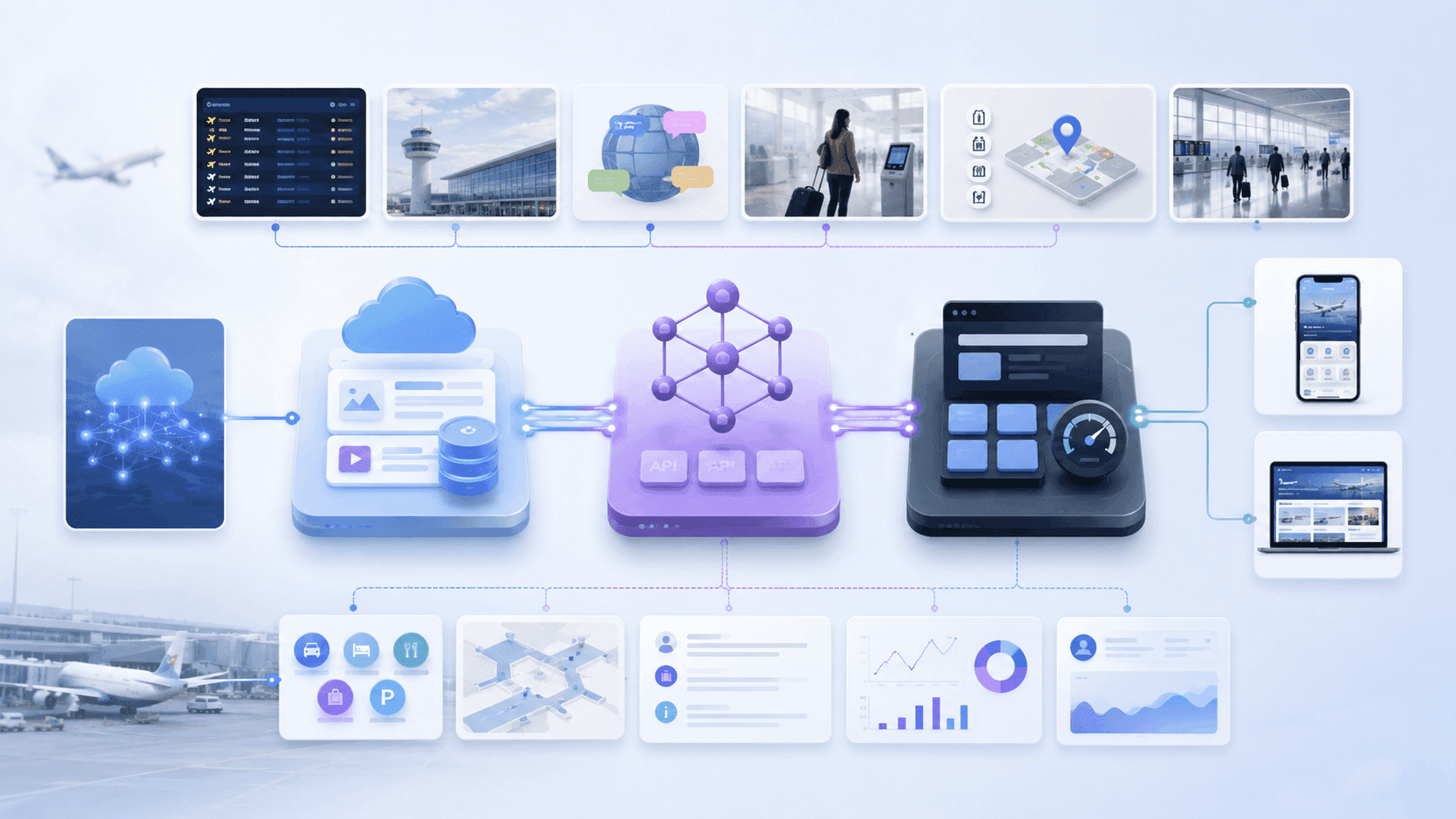
Sitecore XM Cloud was implemented as the headless content-management layer, while Next.js powered the rendering experience.
Sitecore JSS connected CMS-managed content with frontend components, and GraphQL supported structured content retrieval.
This architecture separated content operations from presentation logic.
Marketing teams could manage airport information, campaign content, destination pages, promotional sections, and other digital experiences through Sitecore, while frontend engineers could build and deploy the Next.js application independently.
That separation created a more flexible foundation for an airport platform expected to evolve continually.
Modernize Your Airport Experience with Sitecore XM Cloud
Reusable, Marketing-Editable Components
A major part of the implementation was the development of reusable XM Cloud components.
The component ecosystem included hero areas, promotional sections, airport information modules, campaign components, and destination or travel-content blocks.
Instead of requiring a new frontend implementation for every campaign or information page, editors could work with reusable building blocks.
This is particularly valuable for airports because digital content changes frequently around destinations, airline announcements, seasonal travel, passenger services, airport initiatives, news, and promotional activity.
Reusable components give marketing teams greater autonomy while helping maintain a consistent digital design system.
Multilingual Airport Content Delivery
Multilingual delivery was a core platform requirement.
The architecture supports localized content, dynamic rendering, and multi-region content management.
The current airport experience demonstrates why this matters: English and Arabic versions serve travelers with localized navigation, live flight information, airlines, services, passenger guidance, and media content.
For an international airport, multilingual architecture should not be treated as a translation layer added at the end of development. It needs to be part of the content model, component design, URL strategy, editorial workflow, and frontend rendering architecture from the beginning.
Connecting Content With Airport Systems
The project also included custom .NET Core APIs and integrations with external airport, flight-related, and marketing systems.
This is an important distinction.
A useful airport platform cannot rely exclusively on CMS content. Travelers increasingly expect digital experiences that combine editorial information with dynamic operational data.
The live airport experience currently includes flight search, arrivals and departures, airline information, destinations, interactive navigation, passenger guides, and service discovery.
The platform architecture therefore provides a bridge between content-managed experiences and data-driven airport services.
GraphQL-Driven Headless Delivery
GraphQL was used for component-based data retrieval and dynamic content fetching.
Rather than forcing the frontend into a rigid page structure, components can request the content required for their individual experience.
This supports a cleaner relationship between Sitecore content, reusable Next.js components, and external data sources.
Sitecore CLI serialization was also used to support version-controlled Sitecore development and repeatable deployment workflows.
Modern Next.js Frontend
The frontend rendering host was developed with Next.js, Sitecore JSS, and Tailwind CSS.
The implementation focused on responsive delivery, modern frontend architecture, SEO-friendly rendering, and reusable user-interface patterns.
For airport users, responsive delivery is particularly important because many journeys happen on mobile devices while travelers are moving through terminals, checking flights, finding services, or researching airport information.
Build a Multilingual Airport Platform That Scales Globally
Cloud Deployment and Independent Scaling
The platform uses Sitecore XM Cloud for CMS operations and Vercel for the Next.js rendering host.
This decoupled deployment model allows the content platform and frontend application to follow their own deployment and scaling patterns.
It also creates a cleaner separation between editorial operations and frontend engineering.
Business Impact
The project created a stronger digital foundation for multilingual airport marketing and traveler information.
Instead of treating content management, localization, frontend delivery, APIs, and airport systems as isolated concerns, the solution connects them through a composable architecture.
The result is a platform designed around reusable content, multilingual publishing, API-connected airport experiences, independent frontend delivery, and future digital expansion.
Most importantly, the case study demonstrates that Sitecore XM Cloud can operate as the experience layer of a broader airport ecosystem not simply as a website CMS.
Planning an Airport or Travel Digital Platform?
Murmu Software Infotech provides Sitecore XM Cloud development, Next.js engineering, multilingual website development, Sitecore JSS, GraphQL integrations, .NET APIs, composable DXP architecture, XM Cloud migration, and enterprise Sitecore support.
Whether you are modernizing an airport website, travel portal, destination platform, or other multilingual enterprise experience, we can help design a platform around your content operations, integrations, localization requirements, and future digital roadmap.
Talk to our Sitecore team to build a faster, more flexible, and globally accessible digital experience platform.
Frequently Asked Questions
What is a Sitecore XM Cloud airport website?
A Sitecore XM Cloud airport website uses headless CMS architecture to manage airport content while a frontend such as Next.js delivers traveler experiences including destinations, passenger information, marketing content and API-connected airport services.
Why use Sitecore XM Cloud for an airport website?
Sitecore XM Cloud supports structured content, reusable components, multilingual publishing, headless frontend development and composable integrations, making it suitable for complex enterprise airport digital experiences.
How was this multilingual airport platform built?
The platform uses Sitecore XM Cloud as the headless CMS, Next.js as the rendering application, Sitecore JSS, GraphQL, custom .NET Core APIs and Vercel deployment infrastructure.
Can Sitecore XM Cloud support multilingual airport websites?
Yes. The architecture can support localized content, multilingual page experiences, dynamic rendering and regional content management while allowing content teams to manage language-specific information through the CMS.
How does Next.js work with Sitecore XM Cloud?
Next.js provides the frontend rendering layer while Sitecore XM Cloud manages structured content and page composition. Sitecore JSS and GraphQL connect the frontend application with published Sitecore content.
Can a Sitecore airport website integrate with flight systems?
Yes. A composable Sitecore architecture can connect to external airport, flight and marketing systems through APIs. This project included custom .NET Core APIs and external airport and flight-related integrations.
What are editable components in Sitecore XM Cloud?
Editable components are reusable frontend sections whose content can be managed by marketing or content teams through Sitecore while developers maintain the presentation and component implementation in the headless frontend.
What role does GraphQL play in a Sitecore airport platform?
GraphQL enables Next.js components and services to retrieve structured content and rendering data from Sitecore, supporting dynamic component delivery and flexible headless frontend development.
Why use a headless CMS for an airport digital platform?
A headless CMS separates content management from frontend delivery, allowing airports to support multilingual content, reusable components, external data integrations and independent frontend development through a composable architecture.
Can Murmu Software Infotech build Sitecore airport platforms?
Yes. Murmu Software Infotech provides Sitecore XM Cloud, Next.js, JSS, GraphQL, multilingual website, .NET API, composable DXP, integration and enterprise Sitecore development services.