Case Study: Building a Complete Jewellery ERP, Inventory & POS Platform for Gehna Zevar
In This Article
- Transforming Jewellery Retail Operations With One Connected Web and Mobile Platform
- Project Overview
- The Client Challenge
- Our Solution
- Purchase to Inventory Automation
- Barcode & Jewellery Label Management
- Fast POS Billing Experience
- Staff, Roles & Operational Control
- Invoice & Transaction Management
- Technology Stack
- Business Outcome
- From Business Workflow to Custom Software
Transforming Jewellery Retail Operations With One Connected Web and Mobile Platform
Project Overview
Gehna Zevar needed more than traditional billing software. The business required a complete jewellery retail management platform capable of connecting purchasing, inventory, product preparation, barcode and label printing, branch operations, staff controls, POS billing, payments, invoices, customers and management reporting within one centralized system.
The objective was to replace fragmented operational processes with a custom digital platform built around the actual jewellery business lifecycle.
Murmu Software Infotech designed, developed, integrated and handed over a complete solution consisting of a Next.js/React management web platform, a React Native mobile POS application, centralized backend APIs and a PostgreSQL database.
The platform was built around one connected operational journey:
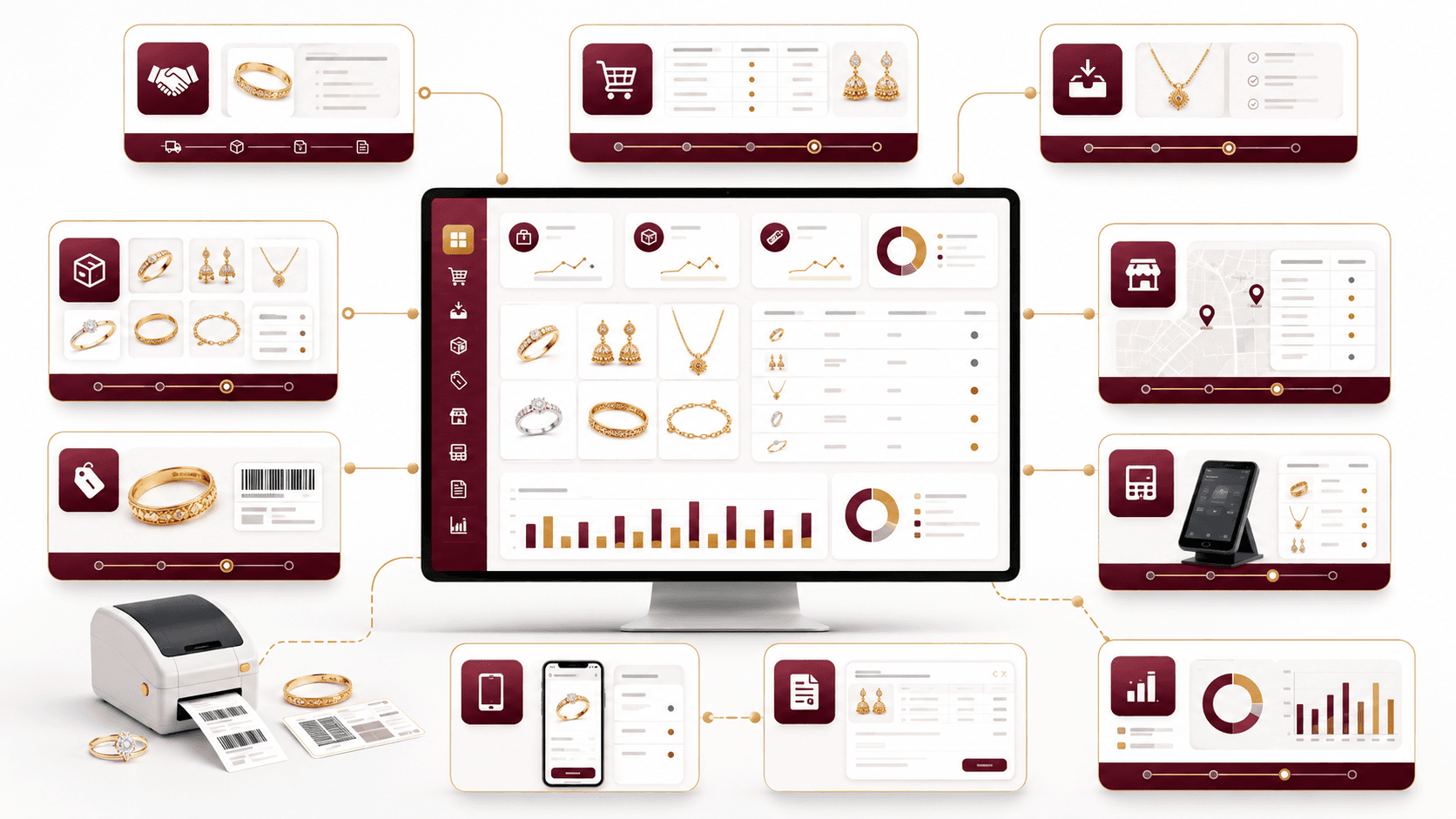
Vendor → Purchase → Goods Receiving → PLI → Barcode & Labeling → Dispatch → Branch Inventory → POS Sale → Payment → Invoice → Reporting
The underlying requirements also demanded centralized approval, inventory movement, audit, notification and security controls across modules.
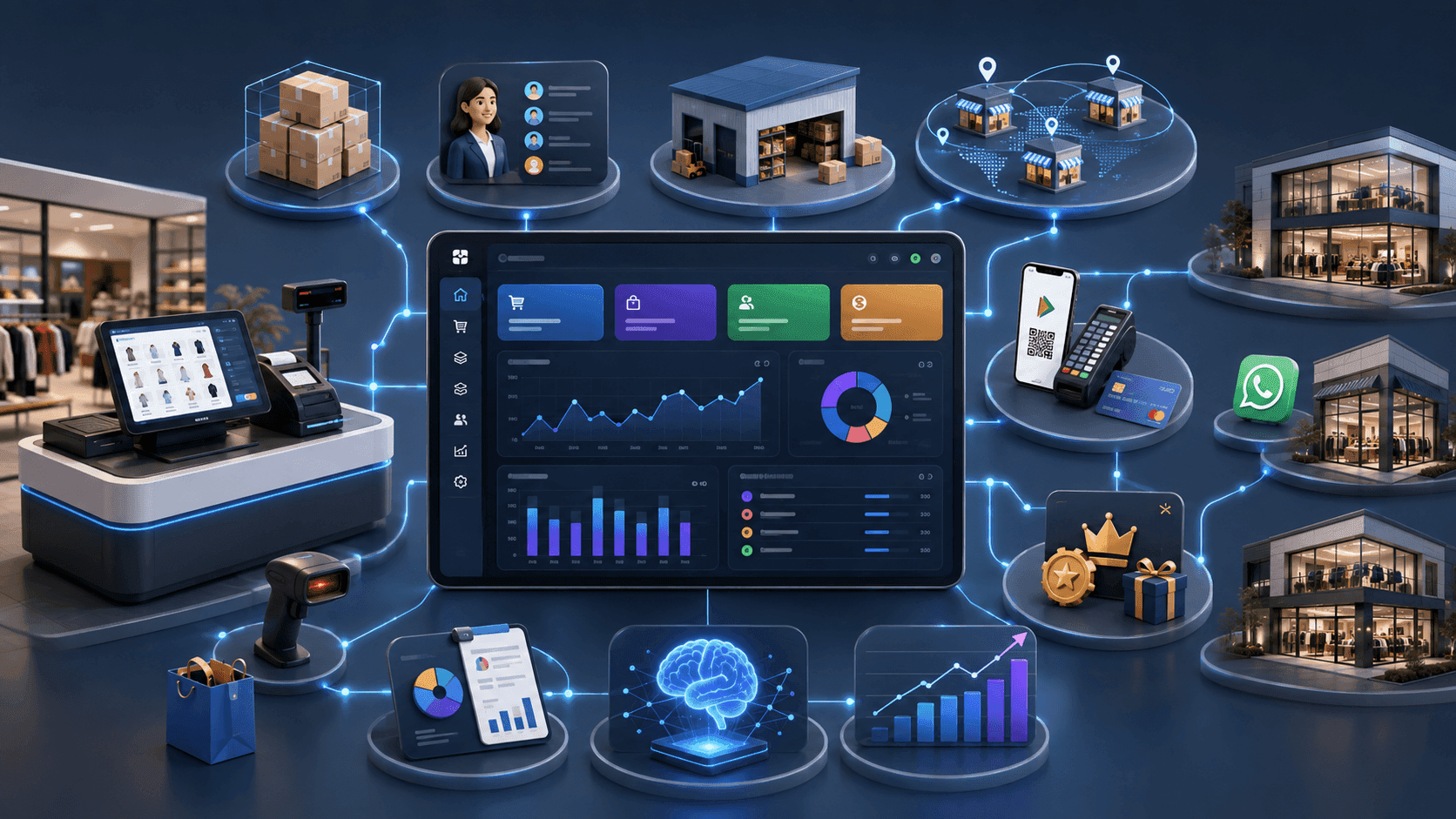
Build Your Connected Retail Platform
Transform purchasing, inventory, billing, branches, staff and reporting into one scalable web and mobile platform built around your workflow.
The Client Challenge
Jewellery retail operations involve considerably more complexity than simply generating an invoice.
Gehna Zevar needed visibility and control over products from the moment they were selected from vendors until they were eventually sold at a branch.
The major challenges included:
- Managing multiple vendors and purchase requirements
- Evaluating jewellery designs before procurement
- Tracking Purchase Requests and Purchase Orders separately
- Verifying incoming goods against supplier records
- Managing damaged, short or excess received stock
- Preparing products before sale
- Generating unique SKUs, barcodes and QR codes
- Printing jewellery-specific labels and tags
- Tracking stock across warehouse, PLI, dispatch and branches
- Providing quick POS billing at retail counters
- Managing discounts and split payments
- Maintaining customer-linked invoices
- Handling cashier register opening and closing
- Controlling staff access by role and branch
- Maintaining invoice history and cancellation controls
- Providing management reports across sales, inventory, purchases, branches and staff
Let’s Build Software Around Your Real Business Workflow
The requirements therefore called for an integrated ERP-style operating platform rather than another isolated POS application.
Our Solution
We designed the solution around a centralized business platform with two primary user experiences.
The web management application gives owners, administrators and operational teams control over procurement, stock, products, staff, branches, reporting and business configuration.
The React Native mobile application gives branch staff a faster interface specifically optimized for quick product selection, customer capture, cart management, payment and billing.
Both applications connect to the same backend and database, helping maintain a consistent source of business data.
Purchase to Inventory Automation
The procurement workflow begins with vendor management and can optionally include Design Polling, where branch teams provide ratings, demand levels, suggested selling prices and comments before management selects products for purchasing. The PRD specifically separates Purchase Requests from Purchase Orders and requires vendor confirmation before a PO is created.
Once products arrive, the Goods Receiving workflow records quantity verification, shortages, excess quantities and damaged products.
Approved products then move into Packing & Labeling Inventory (PLI).
Inside PLI, the system manages:
- SKU generation
- Barcode generation
- Product categorization
- Selling-price assignment
- Product photography
- Quality verification
- Barcode printing
- Jewellery label printing
- Tag assignment
Products cannot become dispatch-ready until required preparation, barcode generation and quality checks are completed.
Barcode & Jewellery Label Management
Because jewellery products require compact and accurately fitted tags, barcode and label management became an important part of the solution.
The platform supports unique barcode or QR identities, configurable category-based templates, different jewellery tag dimensions, label previews, batch printing and failed-label reprinting. Barcode information can be linked with SKU, item code, product name, category and selling price.
This provides traceability while enabling products to be scanned quickly during POS billing.
Fast POS Billing Experience
For branch staff, we designed the sales experience around speed.
On desktop and mobile POS, staff can:
- Search products by text, SKU or barcode
- Browse products visually using images
- Switch between product categories
- Select items from multiple categories
- Increase or decrease quantities in the cart
- Search or create a customer
- Apply authorized discounts
- View subtotal, tax and final payable amount
- Select payment type
- Generate the final invoice
Payment processing supports Cash, UPI, Credit Note and split-payment combinations. The system requires total payment allocation to match the invoice amount, while completed payment records remain protected from later modification.
The final billing workflow follows:
Register Open → Customer → Products → Cart → Discount → Payment → Invoice → Inventory Deduction → Completion.
Staff can also hold unfinished bills and resume them later without affecting inventory.
Staff, Roles & Operational Control
The platform includes role-based controls for owners, administrators, supervisors, branch staff, warehouse teams and PLI teams.
Permissions can govern actions including billing, discounts, bill cancellation, purchase creation, goods receiving, stock adjustments, branch access, printing and report exports.
Branch restrictions are enforced throughout the system so users only access operational data permitted for their assigned locations.
Turn Complex Operations Into One Connected Digital Platform
Invoice & Transaction Management
Invoices maintain complete transaction information including customer, branch, staff, products, quantities, prices, discounts and payments.
Completed invoices cannot simply be edited. Cancellation follows a controlled request and approval workflow, and cancelled transactions remain available historically while inventory is automatically reversed.
Thermal printing supports sales invoices as well as other transactional documents, with historical documents remaining available for reprinting.
Technology Stack
The final delivered platform uses:
Management Web Platform
- Next.js
- React
- TypeScript
- Responsive enterprise UI/UX
Mobile POS
- React Native
- Android-first quick billing experience
Backend
- ASP.NET Core Web API
- RESTful APIs
- JWT authentication
- Role and permission controls
Database
- PostgreSQL
Integrations & Hardware
- Barcode/QR scanners
- Thermal invoice printers
- Jewellery label printers
- File/image storage
- WhatsApp and notification-ready integrations
Business Outcome
The completed platform gives Gehna Zevar a single connected operating system for jewellery retail management rather than separate purchasing, stock and billing tools.
Management can control procurement, inventory, staff, branches and reporting from the web platform, while retail teams receive a focused mobile POS experience built for rapid billing.
Most importantly, every product can maintain a traceable journey from vendor and purchase through labeling, inventory movement, branch allocation and final customer sale.
The centralized reporting layer further provides visibility into inventory valuation, vendor performance, purchases, sales, customer activity, branch performance, staff productivity and profitability.
From Business Workflow to Custom Software
This project demonstrates our approach at Murmu Software Infotech: we do not start by forcing a business into generic software.
We first understand how the organization purchases, manages, moves, sells and reports its products. We then translate those real operational workflows into UI/UX, backend architecture, APIs, web software and mobile applications.
The result for Gehna Zevar is a scalable custom ERP, inventory, POS and billing ecosystem designed around the day-to-day realities of a jewellery retail business and ready to evolve with additional branches, integrations, automation and future AI capabilities.
Frequently Asked Questions
What is the Gehna Zevar jewellery ERP and POS platform?
Gehna Zevar is a custom jewellery retail management platform that connects purchasing, inventory, product labeling, branch stock, POS billing, customers, payments, invoices, staff permissions and business reporting through centralized web and mobile applications.
What business problems does the Gehna Zevar platform solve?
The platform replaces disconnected purchasing, inventory and billing processes with one centralized system that tracks products from vendor procurement and goods receiving through labeling, branch allocation, customer billing and reporting.
What modules are included in the jewellery ERP platform?
Core modules include vendor and purchase management, inventory management, packing and labeling inventory, barcode and QR management, dispatch, branch inventory, POS billing, customer management, invoice management, staff permissions, payments and centralized reporting.
How does inventory move through the Gehna Zevar system?
Inventory follows a controlled lifecycle from purchase and goods receiving to verification, PLI preparation, barcode and labeling, dispatch, branch inventory and final customer sale, maintaining traceability throughout the process.
Does the platform support jewellery barcode and label printing?
Yes. The platform supports unique SKU, barcode and QR generation, category-based jewellery label templates, label previews, bulk printing, printer configuration and label status tracking before dispatch.
How does quick POS billing work?
Staff can search or scan products, browse category-based product lists, add products from multiple categories, manage quantities, select or create customers, apply permitted discounts, choose payment methods and generate invoices through a focused billing interface.
Does the POS support split payments and customer credit?
Yes. The billing workflow supports cash, UPI and Credit Note payments along with split-payment combinations. Payment allocations are validated before the final invoice is completed.
What technology stack was used for the Gehna Zevar platform?
The delivered solution uses Next.js and React for the management web platform, React Native for the mobile POS application, ASP.NET Core Web API for backend services and PostgreSQL as the primary database.
Does the platform support role-based staff and branch access?
Yes. Owners, administrators, supervisors, branch staff, warehouse staff and labeling teams can receive different permissions for billing, purchases, inventory, discounts, cancellations, reports, approvals and branch-level data access.
Can Murmu Software Infotech build a similar custom ERP and POS platform?
Yes. Murmu Software Infotech develops custom ERP, POS, billing, inventory, CRM, web and mobile platforms based on each business's actual workflows, integrations, user roles and operational requirements.