Sanity Next.js Development Services
In This Article
- Build Fast, Scalable and AI-Ready Digital Platforms
- What Are Sanity Next.js Development Services?
- Why Combine Sanity CMS With Next.js?
- Structured content without design restrictions
- Flexible rendering and performance
- Better workflows for marketers
- What Our Sanity Next.js Development Services Include
- 1. Discovery and content architecture
- 2. Custom Sanity Studio development
- 3. Next.js frontend engineering
- 4. GROQ query development
- 5. Real-time visual editing
- 6. CMS migration
- 7. Integrations and headless commerce
- Building an AI-Ready Sanity and Next.js Platform
- Proven Through Our Own Sanity and Next.js Migration
- Choosing the Right Sanity Next.js Development Partner
- Build More Than a Website
Build Fast, Scalable and AI-Ready Digital Platforms
Modern businesses need more than an attractive website. They need a digital platform that enables marketing teams to publish quickly, developers to build without CMS limitations, and content to flow across websites, mobile applications, ecommerce storefronts, search engines and AI assistants.
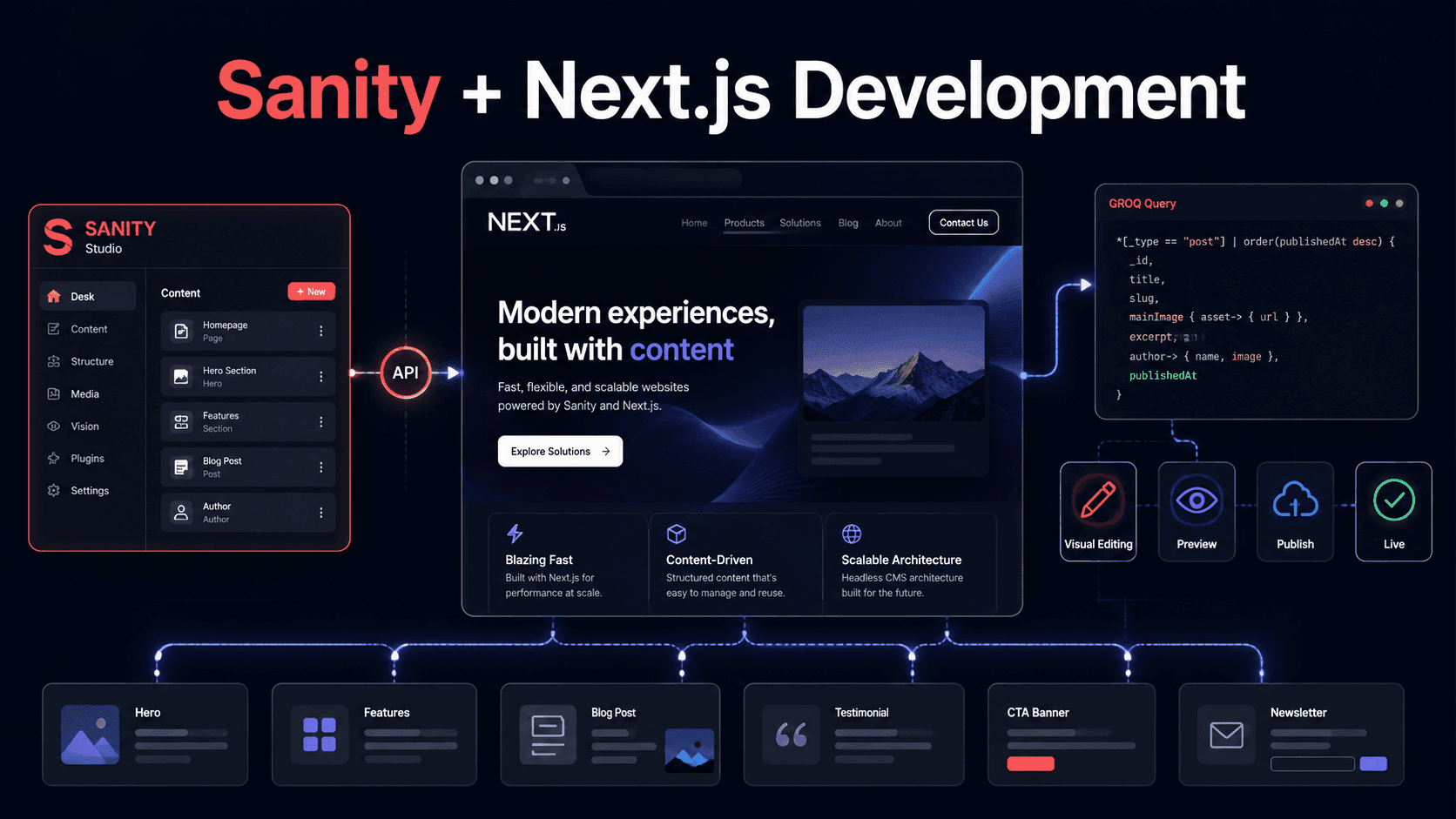
Professional Sanity Next.js development services combine Sanity’s structured-content platform with the flexible frontend capabilities of Next.js. The result is a decoupled architecture that can support high-performance customer experiences, reusable content, visual editing, multilingual publishing and AI-powered content operations.
Sanity provides an official Next.js toolkit supporting content integration, previews, Studio embedding and webhook verification. It also works with Next.js rendering and data-fetching approaches such as static generation, server-side rendering, incremental regeneration and React Server Components.
What Are Sanity Next.js Development Services?
Sanity Next.js development covers the strategy, design, engineering and maintenance required to create a content-driven platform using:
- Sanity CMS for structured content and editorial workflows
- Next.js for the customer-facing website or application
- GROQ for querying and shaping content
- Sanity Studio for content creation and management
- Visual Editing for in-context previews
- APIs and integrations for connected business systems
- AI workflows for content generation, translation and enrichment
A strong implementation should not simply connect a frontend to a CMS. It should create a content architecture aligned with the company’s services, products, audiences, locations, languages and publishing processes.
Why Combine Sanity CMS With Next.js?
Structured content without design restrictions
Sanity stores content independently from the presentation layer. Services, products, FAQs, case studies, locations, authors and calls to action can be modelled as reusable entities rather than duplicated across pages.
Next.js then gives the development team complete control over layouts, navigation, interactions and customer journeys. This separation allows the frontend to evolve without forcing the business to rebuild its content repository.
Flexible rendering and performance
Next.js supports server-side rendering, static generation and other modern rendering models. Sanity’s APIs can supply the exact content required by each component, while caching and incremental regeneration strategies help balance website speed with content freshness.
Better workflows for marketers
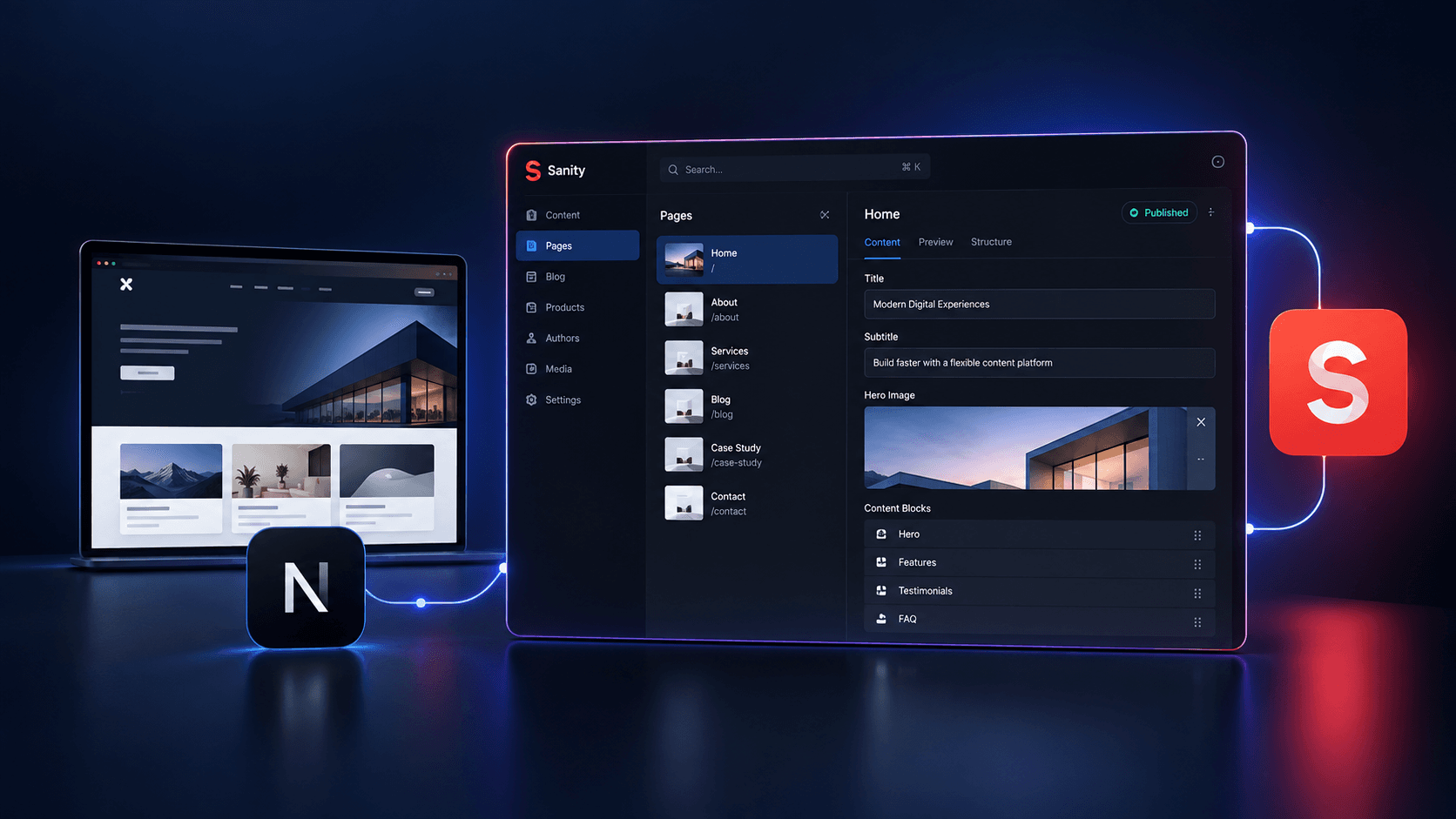
Sanity Studio can be customized around the actual needs of content and marketing teams. Editors can manage reusable page sections, preview changes, validate required fields and publish content without asking developers to change hardcoded frontend files.
Sanity’s official Next.js resources support live previews and real-time visual editing, helping editors understand how their changes will appear before publication.
What Our Sanity Next.js Development Services Include
1. Discovery and content architecture
We begin by reviewing your website, content inventory, customer journeys, publishing workflow and future requirements.
Our team identifies reusable content types, relationships, fields and validation rules before development begins. This helps avoid duplicated content and difficult schema changes later.
2. Custom Sanity Studio development
We configure Sanity Studio to match how your content team works, including:
- Structured schemas and document types
- Reusable landing-page components
- Custom input fields
- Editorial navigation
- Validation rules
- Role-based access
- Preview and publishing workflows
- SEO, AEO and GEO configuration
- Multilingual content controls
A well-designed Studio should simplify content operations rather than expose editors to unnecessary technical complexity.
Build Your AI-Ready Sanity Next.js Platform With Experts
3. Next.js frontend engineering
We build responsive and accessible Next.js websites with reusable components, dynamic routes and integration-ready architecture.
The implementation can include App Router, server components, metadata generation, image optimization, caching, draft previews, redirects, analytics and deployment to platforms such as Vercel or other cloud environments.
Development teams starting a new project can also follow our practical guide on how to configure Sanity CMS in a Next.js project.
4. GROQ query development
GROQ enables developers to filter, reference and shape Sanity content before returning it to the frontend. Instead of transferring entire documents, a query can return only the fields required by a particular page or component.
We create reusable, maintainable GROQ queries for pages, navigation, related content, localization, search, previews and API endpoints.
5. Real-time visual editing
Content editors should not have to switch repeatedly between a CMS form and the live website.
We implement Sanity Presentation and Next.js preview workflows so authorized editors can view draft content in context and select website elements for editing. Our guide to real-time visual editing with Sanity Presentation and Next.js App Router explains the technical architecture in greater detail.
6. CMS migration
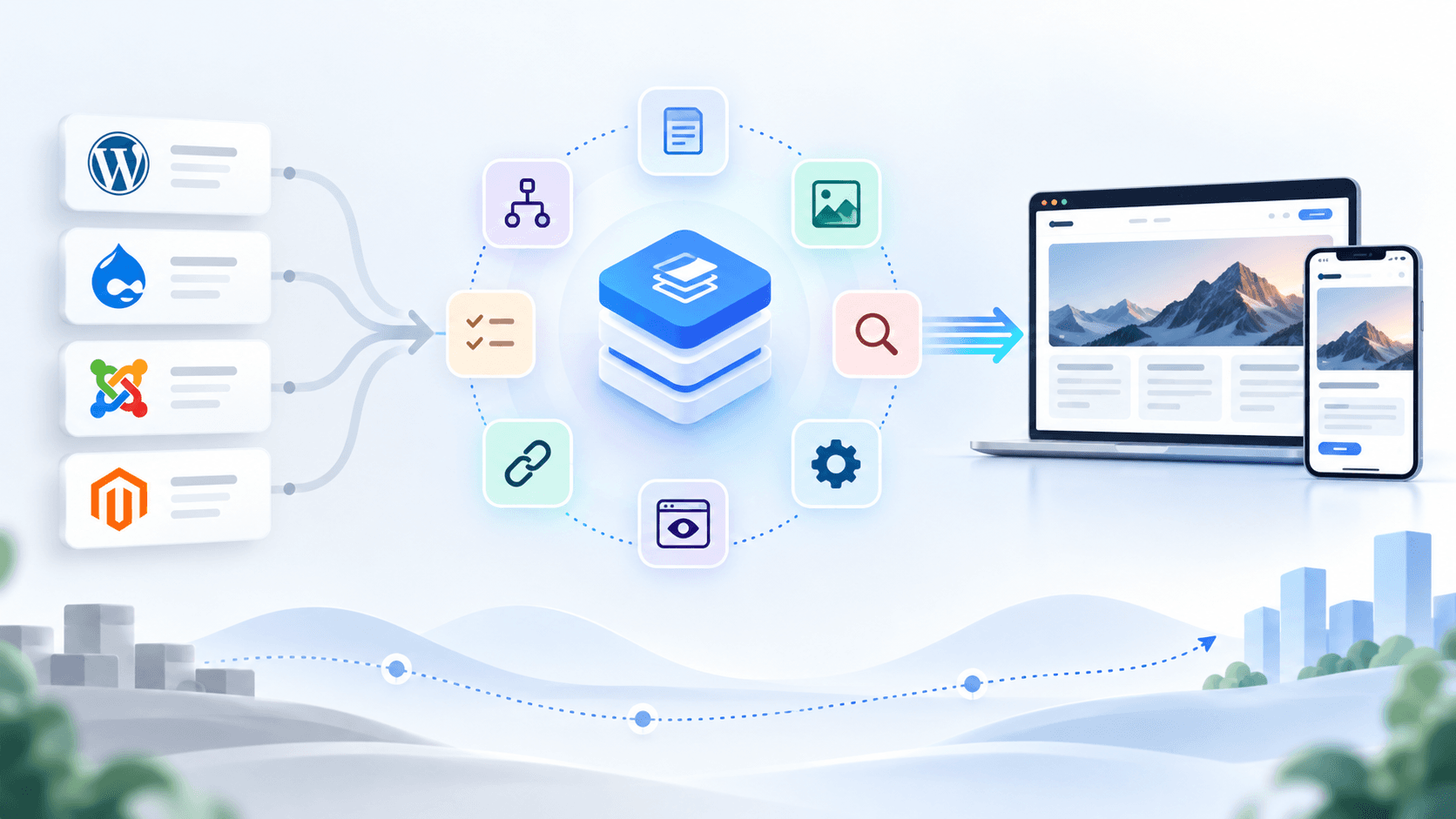
We migrate content from WordPress, legacy CMS platforms, custom admin panels and developer-managed systems into Sanity.
A complete migration may include:
- Content auditing and cleanup
- Schema mapping
- Transformation scripts
- Media migration
- Metadata preservation
- Internal-link updates
- Redirect planning
- Multilingual mapping
- Quality assurance
The objective is not to replicate the weaknesses of the old CMS. It is to restructure content for easier reuse, publishing and future growth.
7. Integrations and headless commerce
Sanity and Next.js can be connected with Shopify, Stripe, CRM platforms, ERP systems, search services, marketing automation, analytics and internal APIs.
This makes the stack suitable for SaaS websites, ecommerce storefronts, publishing platforms, healthcare websites, education portals and multi-brand digital ecosystems. Sanity-focused agencies commonly position this combination for marketing platforms, integrations, commerce and scalable multichannel content delivery.
Building an AI-Ready Sanity and Next.js Platform
The next stage of headless development is not simply separating the CMS from the frontend. It is making structured business content usable by AI systems.
An AI-ready Sanity implementation can support:
- AI-assisted page and blog creation
- Metadata and summary generation
- English, Hindi and multilingual translation
- Content audits and enrichment
- Structured FAQs and direct answers
- SEO, AEO and GEO fields
- AI chatbot knowledge retrieval
- Content delivery to agents and assistants
Sanity’s current Next.js positioning includes built-in AI automation and workflows for translation, content audits and structured-content operations.
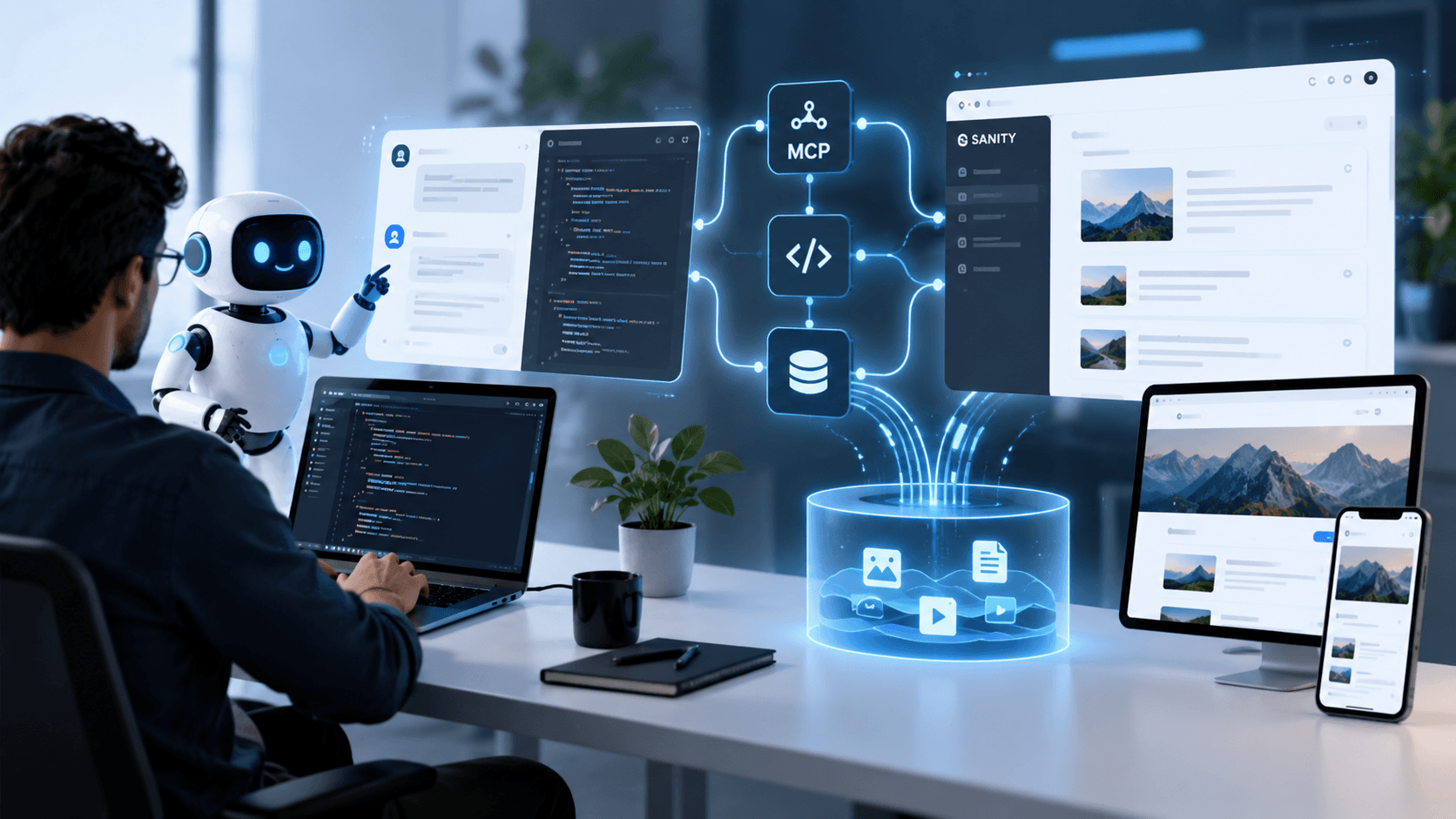
Murmu Software Infotech also provides AI-native Headless CMS and content automation with Sanity CMS, including Content Agent workflows and MCP-powered knowledge integration.
Modernize Content Delivery With Sanity, Next.js And AI
Proven Through Our Own Sanity and Next.js Migration
We applied this architecture to the official Murmu Software Infotech website.
Our previous Next.js and .NET content system required developer involvement for routine updates, with some changes taking two to four hours. We migrated the website to Sanity CMS and Next.js, introduced structured content models, GROQ-powered delivery, live editing and AI-assisted workflows.
The new implementation reduced routine updates to seconds or minutes and enabled non-technical teams to manage content more independently. We also connected our AI chatbot to CMS-driven knowledge using Sanity MCP Server.
Explore the full Sanity CMS and Next.js migration case study.
Choosing the Right Sanity Next.js Development Partner
Before selecting a partner, evaluate whether the team can:
- Design scalable Sanity schemas
- Write efficient GROQ queries
- Build production-ready Next.js applications
- Configure caching and content revalidation
- Implement visual editing and previews
- Protect SEO during migration
- Support multilingual publishing
- Connect external business systems
- Build AI-ready content workflows
- Provide documentation and ongoing support
The right partner should understand both sides of the platform: the editorial experience inside Sanity and the customer experience delivered through Next.js.
Build More Than a Website
Sanity and Next.js can provide the foundation for a fast, flexible and AI-ready digital platform—but only when content modelling, frontend engineering and editorial workflows are designed together.
Murmu Software Infotech delivers Sanity Next.js development services for startups, growing businesses, agencies and enterprises that need scalable websites, multilingual content, custom integrations and intelligent content operations.
Ready to modernize your content platform? Partner with Murmu Software Infotech to plan, build or migrate your Sanity and Next.js solution.
Frequently Asked Questions
What are Sanity Next.js development services?
Sanity Next.js development services cover content architecture, Sanity Studio customization, Next.js frontend development, GROQ queries, visual editing, CMS migration, integrations, multilingual publishing, AI workflows, deployment and ongoing support.
Why combine Sanity CMS with Next.js?
Sanity provides structured, reusable content and a customizable editorial workspace, while Next.js provides complete control over frontend design, routing, rendering and performance. Together, they support scalable websites, applications and omnichannel content delivery.
What platforms can be built with Sanity and Next.js?
The stack can support corporate websites, SaaS platforms, ecommerce storefronts, healthcare portals, education platforms, publishing websites, multilingual sites, customer portals and multi-brand digital ecosystems.
Can an existing website migrate to Sanity and Next.js?
Yes. Migration can include content auditing, schema mapping, media transfer, metadata preservation, internal-link updates, URL redirects, frontend redevelopment and editorial validation. WordPress, legacy CMS and custom content systems can be migrated in planned phases.
Does Sanity support the Next.js App Router?
Yes. Sanity provides current integration guidance for Next.js App Router, including the Sanity client, Draft Mode, Visual Editing and Live Content.
Can editors preview changes before publishing?
Yes. Sanity Visual Editing connects Studio with the Next.js frontend so editors can view drafts in context, select page elements and see content changes while editing.
Can AI content automation be added?
Yes. An AI-ready implementation can support page drafting, content enrichment, metadata generation, translation, content audits, structured FAQs and other governed content operations inside Sanity Studio.
Can Sanity and Next.js support multilingual websites?
Yes. The architecture can support field-level or document-level localization, translated URLs, language-specific metadata, publishing controls and AI-assisted translation. Editors can review content before each language version is published.
Can the platform support SEO, AEO and GEO?
Yes. Sanity schemas can store metadata, canonical URLs, entities, summaries, key facts, FAQs and direct answers. Next.js can render this structured information into crawlable pages and relevant structured data for search and AI discovery.
How much do Sanity Next.js development services cost?
Cost depends on design complexity, content models, reusable components, migration volume, integrations, languages, AI features and support requirements. A focused marketing website costs less than a multilingual, multi-brand or enterprise content platform.