Sanity CMS Development for AI-Ready Content Teams in the US, UK and Europe
In This Article
- Sanity CMS Development Starts With Structured Content
- Sanity CMS Development Services Should Improve Editorial Speed
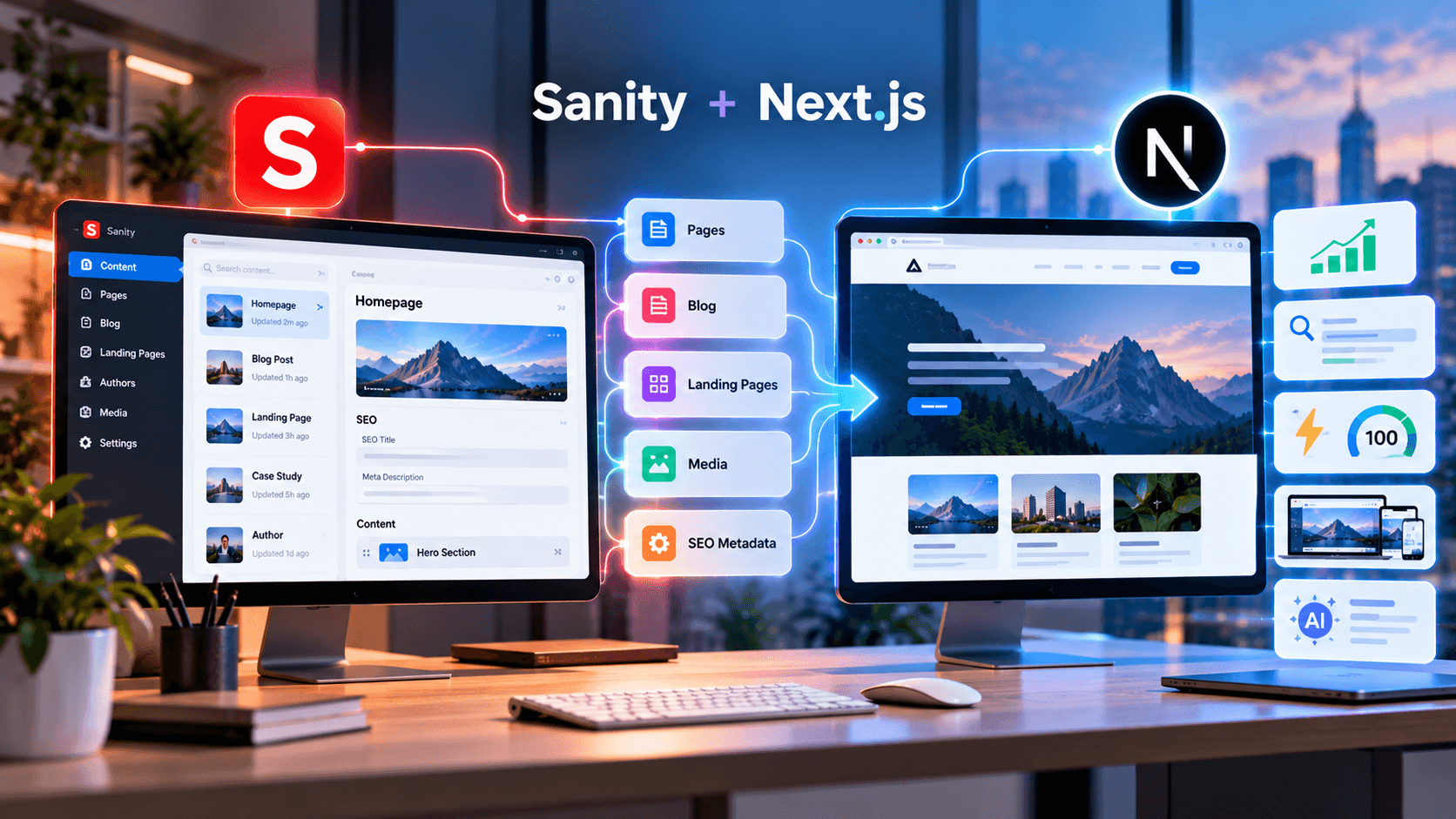
- Sanity Next.js Development Supports Faster Frontends
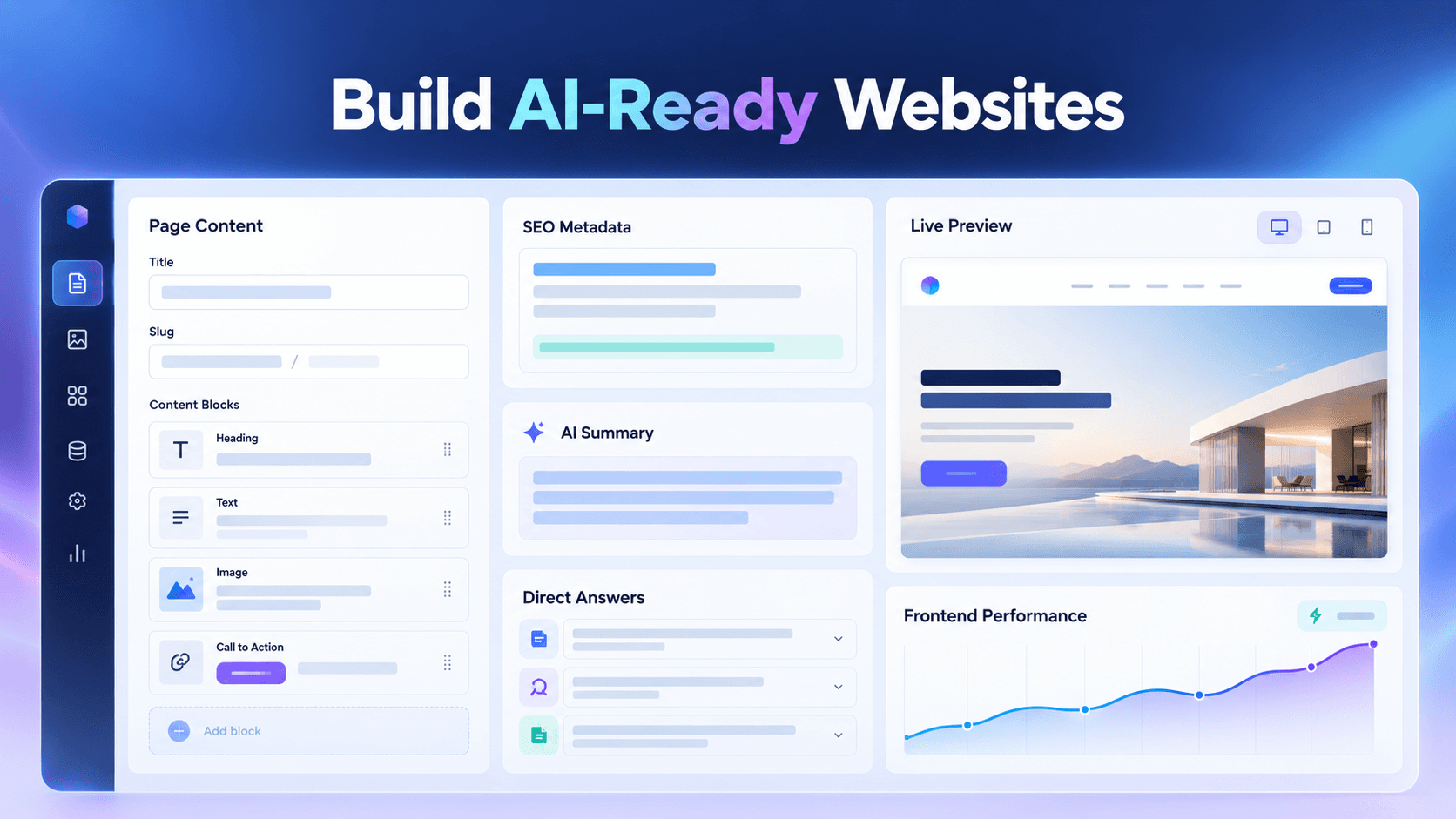
- AI-Ready CMS Architecture Requires Dedicated Fields
- Sanity CMS SEO Should Be Part of the Schema
- Build Content Operations Ready for Search and AI
- Visual Editing Helps Marketing Teams Publish Confidently
- Headless CMS Development Enables Content Reuse
- Real Proof: Moving From Developer-Dependent Publishing
- Sanity Can Also Support AI Agents and Automation
- Business Benefits of Sanity Website Development
- Who Should Hire a Sanity CMS Developer?
- Build an AI-Ready Sanity CMS
Modern marketing teams are publishing more content, across more channels than ever. Yet, most still rely on CMS platforms that were built around single web pages
This becomes a problem when SaaS companies, agencies and content-heavy businesses need to launch faster campaigns, reuse content, publish in multiple languages, fine-tune SEO, visually edit, and structure information that can also power AI search.
This is where Sanity CMS development becomes valuable.
A well-designed Sanity platform offers marketing teams increased publishing independence while providing developers with structured content APIs, reusable schemas and a flexible Next.js frontend architecture.
For companies looking to create an AI-ready content operation, the CMS has to provide more than publishing capabilities.
It needs to support search, answers, content reuse, automation and future AI experiences from the same content foundation.
Sanity CMS Development Starts With Structured Content
Traditional CMS platforms often organize information around pages.
But modern content teams frequently need the same information across:
- Website pages
- Landing pages
- Blogs
- Product pages
- Applications
- Email campaigns
- Search
- AI assistants
- Customer portals
Instead of duplicating that information, Sanity CMS development services can model it as reusable structured documents.
For example, a SaaS company might create separate schemas for:
- Products
- Features
- Integrations
- Pricing information
- FAQs
- Customer stories
- Authors
- Resources
- Comparison pages
The same content can then be referenced wherever needed.
This turns the CMS from a page repository into a structured content platform.
Businesses planning this architecture can explore Sanity CMS development services.
Build Content Ready for AI
Create structured Sanity content, faster Next.js experiences, visual editing, SEO-ready fields and scalable workflows for modern marketing teams.
Sanity CMS Development Services Should Improve Editorial Speed
A headless CMS should not put every marketing team request in the development queue.
Creating a Sanity Studio with the right permissions allows editors to add content while letting developers manage validation, structure and reusable components.
One possible implementation could be the following:
- Custom content types
- Required-field validation
- Reusable references
- Role-specific editing views
- Draft and preview workflows
- SEO fields
- Landing-page sections
- Scheduled releases
- Content review fields
This enables marketing teams to focus on day-to-day publishing, while developers can concentrate on platform improvements.
For companies with operations in the US, UK and Europe, this is particularly important where different teams need to publish campaigns, regional content and product updates without duplication of effort.
Build Faster Content Operations With Sanity and Next.js
Sanity Next.js Development Supports Faster Frontends
Sanity handles content.
Next.js handles the experience layer.
That separation allows development teams to control rendering, components, routing, caching and frontend performance independently from editorial content.
A well-built Sanity Next.js development project can include:
- Server rendering
- Static generation
- Revalidation
- Responsive components
- Image optimization
- Dynamic metadata
- Structured data
- Preview
- Visual editing
- Analytics integration
The objective is not simply to use modern technology.
The objective is to give marketers a flexible CMS while maintaining strong frontend performance and technical control.
AI-Ready CMS Architecture Requires Dedicated Fields
An AI-ready CMS should not rely only on long-form rich text.
Important information should be stored explicitly.
Useful Sanity fields can include:
- AI summary
- AI search snippet
- Key facts
- Direct answers
- FAQs
- Primary entity
- Target audience
- Service area
- Schema type
- Last reviewed date
This makes content easier to govern, reuse and expose through APIs.
Murmu Software Infotech implemented this model directly in Sanity, as documented in our guide to SEO, AEO and GEO implementation in Sanity CMS.
The goal is not to create special content only for AI.
It is to create clearer structured content that can serve people, search engines, applications and AI systems from the same source.
Sanity CMS SEO Should Be Part of the Schema
SEO should not be added after the frontend is complete.
Important page types can include structured fields for:
- SEO title
- Meta description
- Canonical URL
- Robots controls
- Open Graph information
- Social images
- Structured-data inputs
- Breadcrumb information
Next.js can then consume these fields and generate consistent metadata dynamically.
This creates better editorial control as the marketers can optimize important search fields directly in the CMS instead of having to change code.
For teams looking to extend traditional search to answer and generative search, structured content can also support AI search optimization.
Build Content Operations Ready for Search and AI
If your marketing team is still dependent on developers for routine publishing, content architecture may be the real bottleneck.
Build With Sanity CMS
Visual Editing Helps Marketing Teams Publish Confidently
Headless architecture is sometimes perceived as developer-friendly but editor-unfriendly.
It does not need to be.
Visual editing and preview workflows can let editors see draft content in the context of the actual frontend.
This is particularly useful for:
- Landing pages
- Product pages
- Campaigns
- Homepage sections
- Conversion pages
Teams can validate content before publishing while still using structured content models behind the scenes.
That balance matters because content teams want visual confidence while developers want predictable structured data.
Turn Your CMS Into an AI-Ready Content Platform
Headless CMS Development Enables Content Reuse
A modern headless CMS development architecture separates content from presentation.
That means one structured record can support multiple digital experiences.
For example, a product description could power:
Website → Mobile App → Search → AI Assistant → Campaign → Customer Portal
without recreating the content every time.
For growing companies, this reduces duplicated work and creates a stronger foundation for new channels.
Real Proof: Moving From Developer-Dependent Publishing
Murmu Software Infotech migrated its own production website to Sanity and Next.js after routine content changes frequently required developer involvement.
The migration rebuilt services, blogs, case studies, FAQs, CTAs and SEO information as structured Sanity content.
According to the published Sanity and Next.js migration case study, many routine updates that previously took hours could later be processed in seconds or minutes in the CMS.
The more significant consequence was architectural.
The content was decoupled from the application logic, thus giving marketing teams more control and letting developers focus on product and platform work.
Sanity Can Also Support AI Agents and Automation
Structured content has value beyond websites.
It can also become governed context for AI applications.
With schema-aware content access, structured CMS data can support:
- AI assistants
- Internal search
- Content automation
- Knowledge tools
- Retrieval workflows
- AI agents
Our article on Sanity AI agents and MCP explains how structured Sanity content can be queried by AI systems while maintaining controlled access.
This is one reason AI-ready Sanity CMS development increasingly matters to teams planning long-term content architecture.
Business Benefits of Sanity Website Development
A strong implementation can help businesses improve:
- Publishing speed
- Content reuse
- Editorial consistency
- SEO governance
- Developer efficiency
- Frontend performance
- Multilingual scalability
- AI readiness
- Landing-page flexibility
- Content automation
These benefits come from the architecture, not simply from installing a CMS.
Who Should Hire a Sanity CMS Developer?
A specialist Sanity CMS development company is particularly relevant for:
- SaaS companies scaling content
- Agencies building reusable client platforms
- Marketing teams dependent on developers
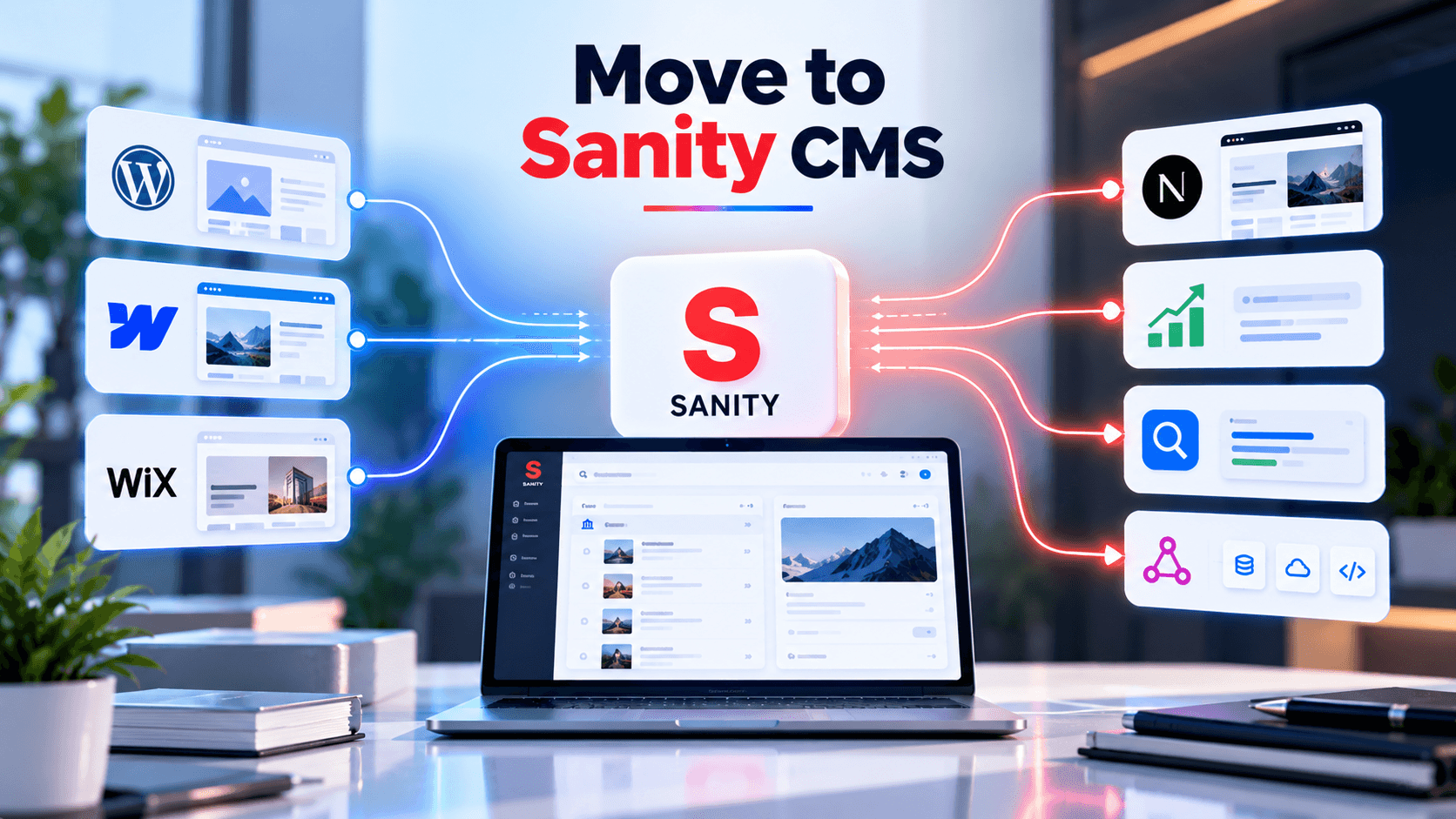
- Companies migrating from WordPress or custom CMS platforms
- Multilingual businesses
- Content-heavy publishers
- Teams building Next.js websites
- Brands preparing for AI search and content automation
Whether you need a Sanity CMS agency in the UK, a Sanity CMS development company in the USA, or a development partner supporting European operations, the important requirement is experience across both content architecture and frontend implementation.
Build an AI-Ready Sanity CMS
Modern content teams should not need to choose between flexibility and engineering excellence.
Sanity and Next.js can provide both through structured schemas, reusable components, visual editing, SEO-friendly fields and AI-focused content models.
The result is a CMS that is a content foundation for websites, search, campaigns, applications and AI-powered experiences beyond just a storage for pages.
Explore Sanity CMS development services to build a scalable content platform designed for modern marketing teams across the US, UK and Europe.
Frequently Asked Questions
What is Sanity CMS development?
Sanity CMS development includes structured content modeling, custom schemas, Studio configuration, APIs, visual editing, Next.js integration, SEO architecture, migrations and editorial workflow development.
Is Sanity CMS suitable for marketing teams?
Yes. A properly configured Sanity Studio can let marketing teams manage structured content, landing pages, metadata, reusable sections and routine publishing without requiring developers for every change.
Can Sanity CMS work with Next.js?
Yes. Sanity manages structured content while Next.js controls routing, rendering, frontend components, metadata, caching, performance and the public digital experience.
Can Sanity support SEO, AEO and GEO?
Yes. Sanity schemas can store traditional SEO metadata alongside direct answers, FAQs, key facts, entities, AI summaries, audience information and other structured search fields.
What makes Sanity an AI-ready CMS?
Sanity stores content as structured data that can be queried through APIs, making facts, entities, direct answers and reusable content easier to serve to websites, search systems and AI applications.
Does Sanity CMS support visual editing?
Yes. Sanity supports preview and visual-editing workflows that allow editors to inspect draft content in the context of a frontend and connect rendered content back to editable Studio fields.
Is Sanity suitable for multilingual websites?
Yes. Sanity can support field-level or document-level localization, regional content structures, role-based workflows and integrations with translation systems.
When should a company hire a Sanity CMS developer?
Specialist development is useful when the project requires custom schemas, Studio configuration, Next.js integration, visual editing, migration, multilingual workflows, structured SEO or AI-ready architecture.
Can an existing website migrate to Sanity CMS?
Yes. Existing content can be transformed into structured Sanity documents while URLs, metadata, assets, redirects, relationships and editorial workflows are mapped into the new architecture.
Does Sanity CMS guarantee better rankings or AI citations?
No. Sanity can provide stronger structured-content and technical foundations, but search rankings and AI citations depend on relevance, authority, technical quality and external search-platform behavior.