Sanity Next.js Development for Fast, AI-Ready Business Websites
In This Article
- Why Sanity Next.js Development Works for Modern Websites
- Sanity CMS Development Gives Marketing Teams More Control
- Next.js Website Development Keeps the Experience Layer Flexible
- Need a Faster, More Flexible Content Platform?
- An AI-Ready CMS Starts With Structured Content
- Build an SEO-Ready CMS for SEO, AEO and GEO
- What a Sanity Website Development Platform Should Include
- Sanity Next.js Development Cost and Timeline Factors
- Build More Than Another Business Website
- Frequently Asked Questions
- What is Sanity Next.js development?
- Why use Sanity CMS with Next.js?
- Can Sanity and Next.js support SEO?
- What makes Sanity an AI-ready CMS?
- Can an existing website be migrated to Sanity and Next.js?
- Who should hire a Sanity Next.js development agency?
Build a fast, scalable and AI-ready website with Sanity CMS and Next.js using structured content, SEO fields, visual editing and modern frontend delivery.
Modern business websites have an increasing content problem.
Marketing teams need to ship landing pages, update services, write articles, edit SEO metadata and embrace new search opportunities. At the same time developers require a frontend that stays fast, maintainable and flexible as the website grows.
When every content change requires development or when content is locked into rigid page templates the website becomes harder to scale.
This is why Sanity Next.js development is becoming a viable architectural option for businesses, SaaS companies, agencies and marketing teams who want to have structured content management while keeping frontend performance up to date.
Why Sanity Next.js Development Works for Modern Websites
The combination separates two important responsibilities.
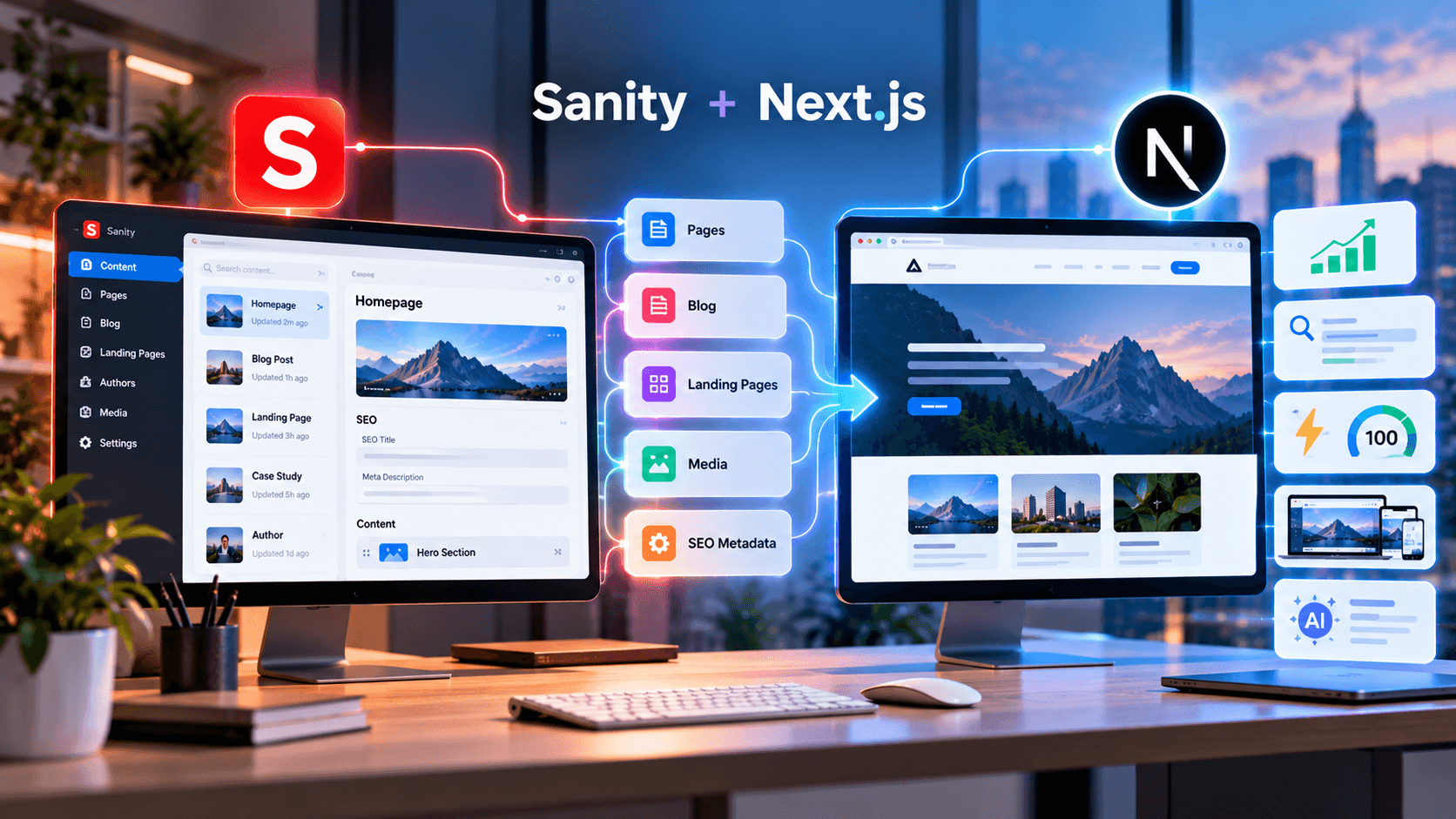
Sanity CMS becomes the structured content and editorial layer.
Next.js becomes the frontend experience layer responsible for components, routing, rendering, performance and integrations.
Instead of storing everything as large page-shaped content blocks, businesses can create reusable structures for:
- Services
- Products
- Landing pages
- Blog articles
- Case studies
- FAQs
- Calls to action
- SEO metadata
- AI summaries
- Direct answers
- Business entities
These content models can then power multiple pages or digital experiences.
Businesses planning this architecture can explore MSI's Sanity Next.js development services.
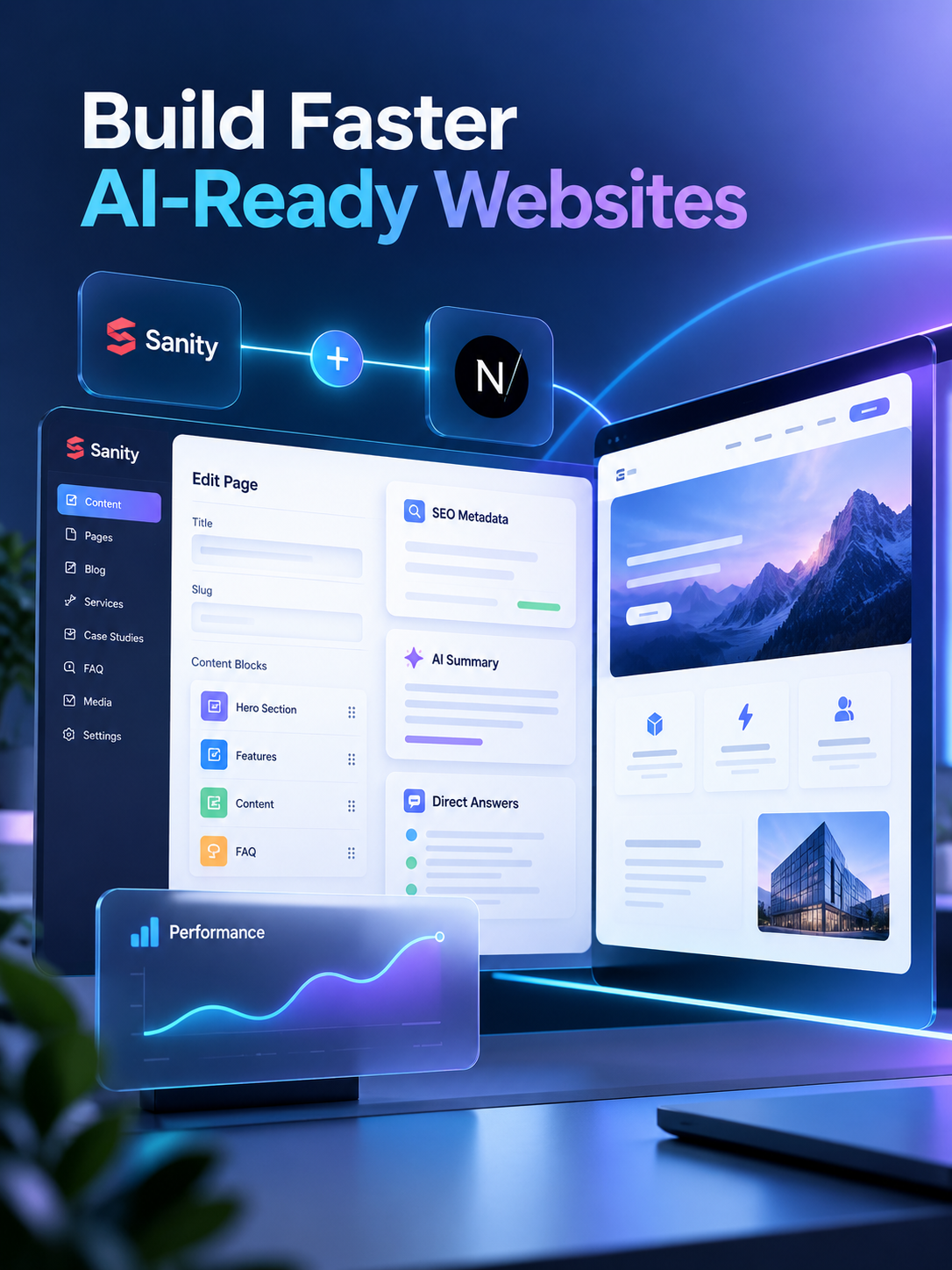
Build Faster AI-Ready Websites
Create structured, SEO-ready and scalable websites with Sanity CMS and Next.js for faster publishing, better performance and AI search visibility.
Sanity CMS Development Gives Marketing Teams More Control
A major purpose of Sanity CMS development is reducing unnecessary developer dependency.
Marketing teams should not need a frontend deployment simply to change a page title, improve a description, publish a new FAQ or update campaign content.
Sanity Studio can provide editors with structured fields, validation, previews and customized editorial workflows while developers retain control over how that information appears on the website.
MSI experienced this problem directly before migrating its own website. Routine content changes that previously could take approximately two to four hours could often be completed in seconds or minutes after moving to a structured Sanity architecture.
The complete implementation is documented in the Sanity + Next.js headless CMS migration case study.
For businesses needing deeper CMS customization, integrations or content modelling, Sanity CMS development services provide a broader implementation path.
Next.js Website Development Keeps the Experience Layer Flexible
A headless architecture should not sacrifice editorial control for the sake of frontend quality.
Through Next.js website development, developers manage page rendering, routing, responsive design, app functionality, data fetching, caching and content revalidation separately from the CMS.
As such, the website interface can be evolved independently of the content repository, requiring less frequent rebuilding of the latter.
Particularly valuable for SaaS sites, B2B websites, corporate portals, campaign-driven marketing websites and content-heavy business platforms, this approach enables continuous introduction of new page types and experiences.
A more far-reaching headless CMS development could also help businesses transition away from tightly coupled legacy platforms.
Build a Faster AI-Ready Website With Sanity and Next.js
Need a Faster, More Flexible Content Platform?
Build structured content, visual editing, modern Next.js delivery and AI-ready website architecture around your business requirements.
An AI-Ready CMS Starts With Structured Content
An AI-ready CMS is not simply a website with an AI chatbot attached.
AI systems work more effectively when business information is organized into clear, reusable and queryable structures.
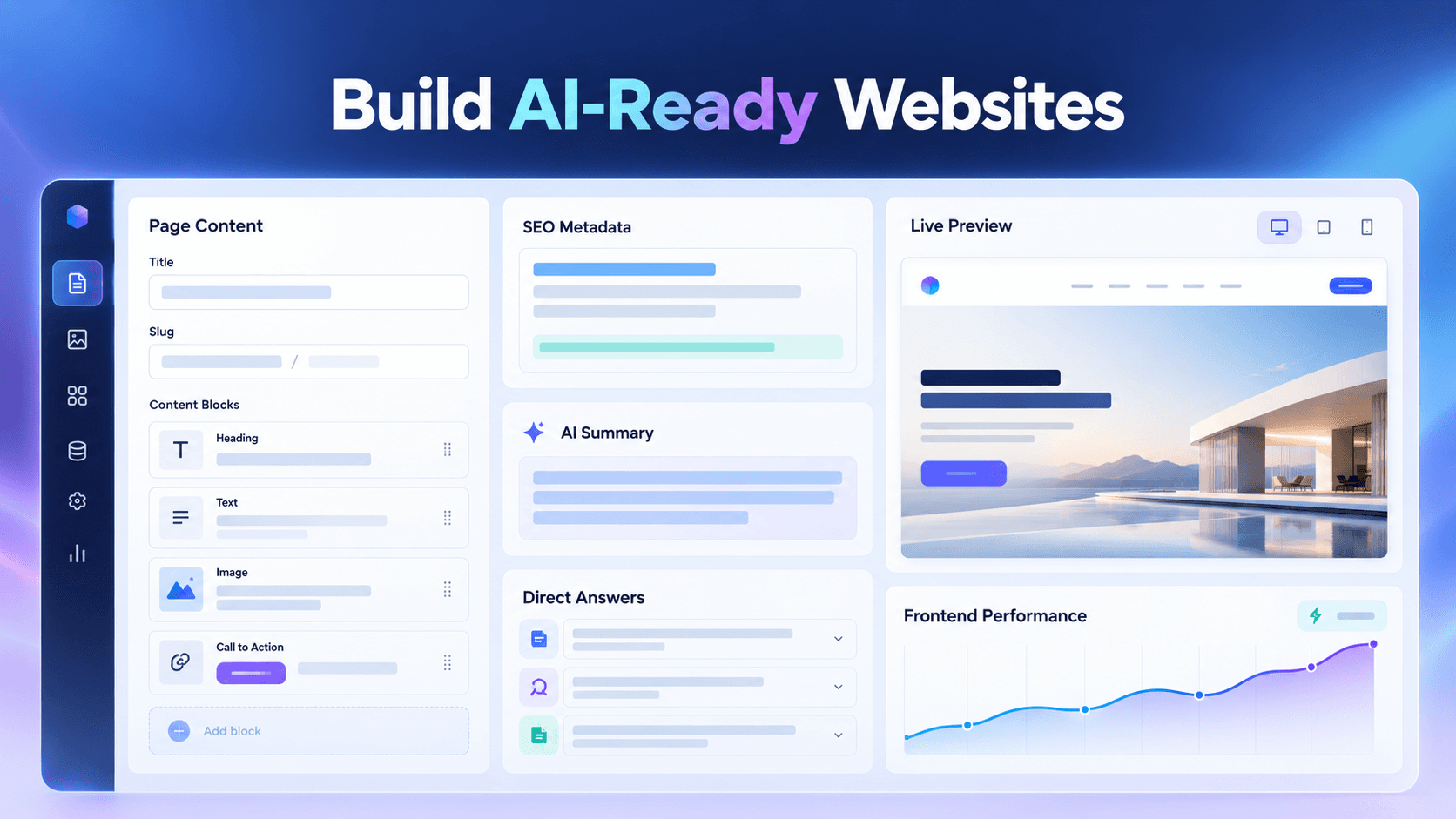
Instead of hiding important information inside long page bodies, Sanity schemas can explicitly model information such as:
AI Summary → Key Facts → Questions → Direct Answers → Entities → Audience → Service Area → Review Date
That structured information can support websites, internal tools, APIs, assistants and future agent workflows.
MSI has also explored this architecture through Sanity AI Agent and MCP integration, where structured CMS content can become part of contextual AI workflows.
The objective is to create one governed content foundation that can serve both human visitors and machine-driven experiences.
Build an SEO-Ready CMS for SEO, AEO and GEO
Traditional SEO fields should not be scattered through frontend code.
An SEO-ready CMS can give editors dedicated fields for meta titles, descriptions, canonical URLs, Open Graph information, social metadata, robots settings and structured-data inputs.
But modern search discovery increasingly extends beyond traditional blue-link results.
Structured content can also support:
- SEO — search engine crawling, indexing and presentation
- AEO — clear answers to specific questions
- GEO — factual, structured information that generative systems can understand and retrieve
MSI implemented these concepts directly in Sanity using dedicated AI summaries, AI search snippets, key facts, questions, direct answers, entities, audiences, service areas and editorial review dates.
Read the implementation approach in How We Implemented SEO, AEO and GEO in Sanity CMS.
Businesses developing this capability can also combine CMS architecture with AI search optimization.
What a Sanity Website Development Platform Should Include
When building a production-ready Sanity website development project, it's important to look beyond connecting an API to a frontend
A proper implementation includes structured schemas, custom Sanity Studio, reusable page sections, GROQ queries, previews, visual editing, SEO controls, responsive Next.js components, caching/revalidation, analytics, multilingual content and AI fields
The underlying structure should support the particular business need, not dictate a one-size-fits-all page builder
A SaaS company would want to highlight product, documentation, and comparisons, while an agency would need reusable landing-page components. A marketing team would prioritize campaign publishing and SEO controls, while an enterprise would need to support multiple sites, regions, languages and governance.
Sanity Next.js Development Cost and Timeline Factors
There is no established fixed cost for each Sanity + Next.js implementation.
It all depends on the current size of your website plus the types of content, schemas specific to your business, the number of page templates, migration specifics (visual editing or not), integrations required, languages supported, SEO requirements (retaining URLs), and AI-powered features.
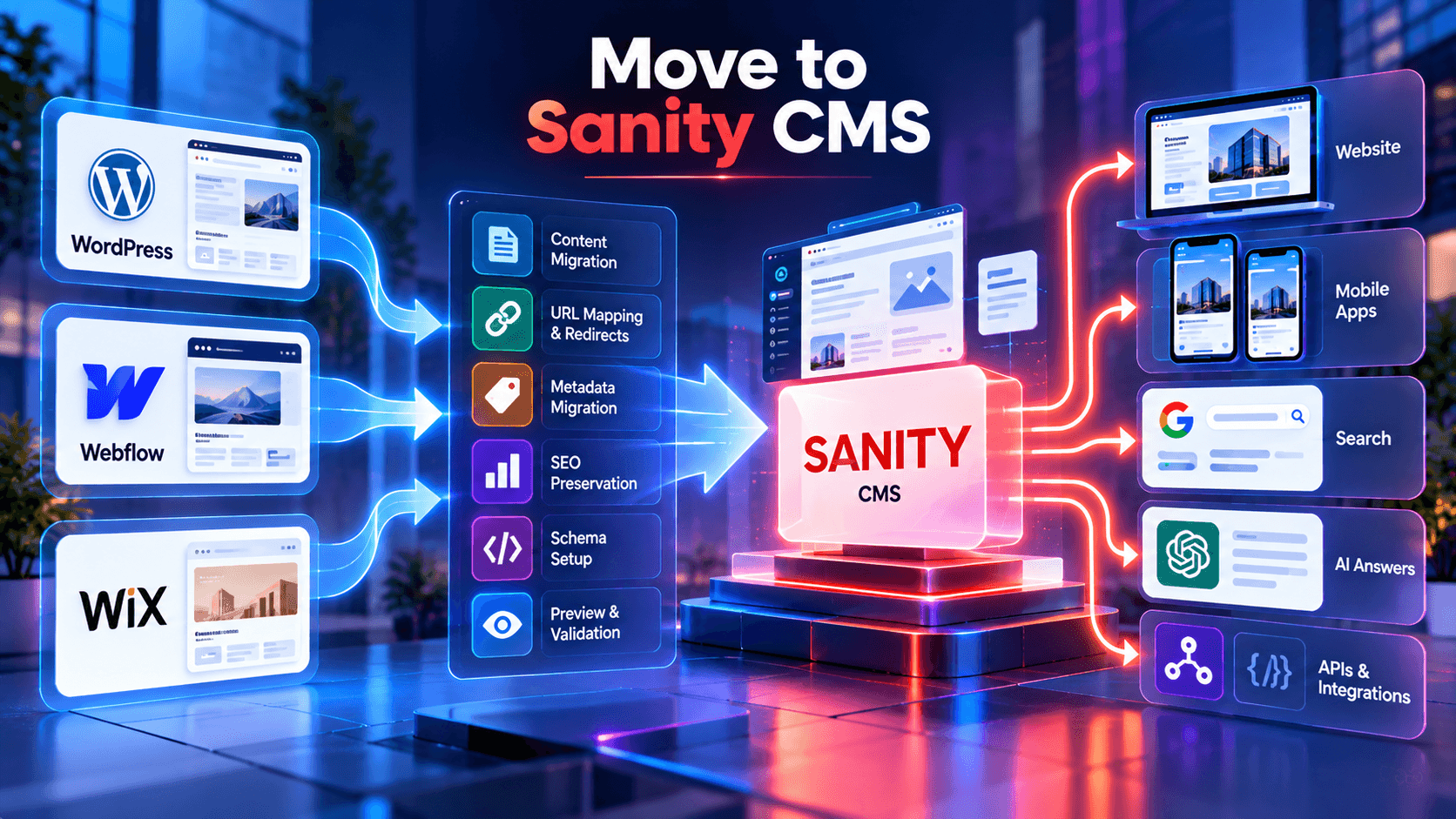
If you already have a website that you plan to migrate over to Sanity, expect additional costs related to URL mapping, metadata migration, redirects setup, content cleanups, and validation.
A phased rollout often makes sense in order to prioritize high-value page types first, followed by a gradual expansion of your structured-content powered website.
Build More Than Another Business Website
The long-term value of Sanity Next.js development is not simply changing technologies.
It is creating an architecture where marketers can publish faster, developers can control frontend experiences, SEO data can be managed systematically and structured content can support emerging AI-driven discovery and automation.
Murmu Software Infotech builds Sanity and Next.js platforms for businesses, SaaS companies, agencies and marketing teams that need flexible content operations and modern frontend delivery.
Ready to turn your website into a structured, scalable and AI-ready content platform?
Frequently Asked Questions
What is Sanity Next.js development?
Sanity Next.js development combines Sanity as a structured headless CMS with Next.js as the frontend framework, separating content management from website presentation and application functionality.
Why use Sanity CMS with Next.js?
Sanity provides structured and reusable content management, while Next.js gives developers control over frontend rendering, components, routing, performance and integrations.
Discuss Your Sanity and Next.js Website With Our Team
Can Sanity and Next.js support SEO?
Yes. Sanity can store structured SEO metadata, FAQs and other optimization fields, while Next.js can render metadata, canonical information, structured data and crawlable website experiences.
What makes Sanity an AI-ready CMS?
Sanity can model content as structured data, including summaries, facts, questions, answers and entities that can be reused by websites, APIs, assistants and AI-oriented workflows.
Can an existing website be migrated to Sanity and Next.js?
Yes. Migration can include content modelling, content transfer, frontend redevelopment, metadata preservation, URL mapping, redirects, integrations and editorial workflow configuration.
Who should hire a Sanity Next.js development agency?
Businesses, SaaS companies, agencies and marketing teams should consider specialist development when they need custom schemas, migrations, complex integrations, visual editing, scalable frontend architecture or AI-ready content workflows.
Frequently Asked Questions
What is Sanity Next.js development?
Sanity Next.js development combines Sanity as a structured headless CMS with Next.js as the frontend framework. Sanity manages reusable content while Next.js handles routing, rendering, components, performance and the website experience.
Why use Sanity CMS with Next.js?
Sanity provides structured content, customizable editorial workflows and flexible APIs, while Next.js gives developers control over performance, rendering, routing and frontend experiences. Together they support scalable, content-driven websites.
Is Sanity CMS good for SEO?
Yes. Sanity can store structured SEO fields such as meta titles, descriptions, canonical URLs, Open Graph data, schema inputs, FAQs and AI-focused content fields that can be rendered through a Next.js frontend.
What makes Sanity an AI-ready CMS?
Sanity can organize content into structured fields such as summaries, key facts, questions, direct answers, entities and service information. This structured data can be reused by websites, APIs, search systems and AI applications.
Can Sanity and Next.js improve website performance?
Yes. Next.js supports modern rendering, caching and revalidation strategies, while Sanity delivers content through APIs. The final performance depends on implementation quality, frontend architecture, media optimization and hosting configuration.
Can an existing website be migrated to Sanity and Next.js?
Yes. Existing websites can be migrated by modelling content in Sanity, transferring pages and assets, rebuilding the frontend in Next.js and preserving important SEO elements such as URLs, metadata, redirects and structured data.
Can marketing teams manage content without developers in Sanity?
Yes. Sanity Studio can provide structured editing interfaces, custom fields, validation and preview workflows so marketing teams can update approved content without changing frontend code for routine edits.
Can Sanity support SEO, AEO and GEO optimization?
Yes. Sanity can store traditional SEO metadata together with answer-focused fields, AI summaries, key facts, direct answers, entities and audience information that can support SEO, answer engines and generative search workflows.
How much does Sanity Next.js website development cost?
Cost depends on website size, content models, custom components, integrations, migration complexity, visual editing, multilingual requirements, SEO preservation and AI-related functionality. Custom projects should be estimated after reviewing the required architecture.
Who should hire a Sanity Next.js development agency?
Businesses, SaaS companies, agencies, marketing teams and enterprises can benefit when they need custom schemas, migrations, integrations, reusable content, high-performance frontend development or AI-ready content architecture.