How Much Does Sitecore Cost in 2026? A Clear Look at Sitecore Development Cost
In This Article
Ask five Sitecore agencies what a project costs and you'll usually hear "it depends." That's true, but not helpful when you need a budget approved. So let's break down what actually drives Sitecore development cost, with real numbers you can work from.
First, Separate the License From the Development
Most budget confusion comes from mixing two very different costs.
The license is what you pay Sitecore. For mid-market to enterprise companies with personalization, several modules, 15–50 users, and higher traffic, budgets typically run $250,000–$750,000+ a year. On-premises deployments also carry annual maintenance of around 20–22% of the license value.
Development is what you pay people to build, customize, and maintain your site. And it's often bigger than expected: implementation costs can equal or exceed annual license fees depending on complexity.
This blog focuses on the second number, because that's the one you can actually control.
Control Your Sitecore Costs
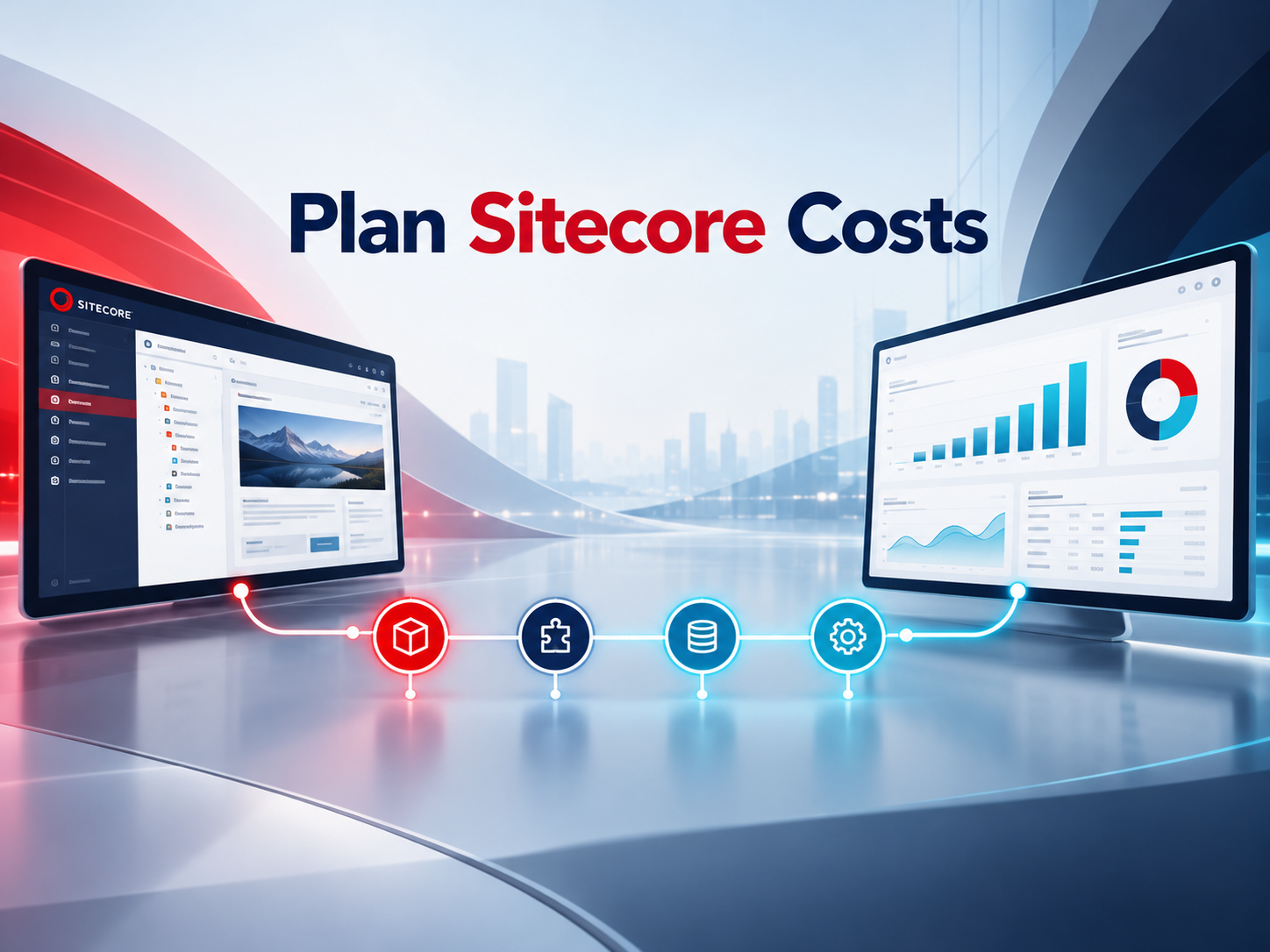
Plan builds, upgrades, XM Cloud migration and support with clearer scope, reusable components and a delivery model designed to control spend.
A Real Project Example
Oshyn shared a useful benchmark: a hotel website with a standard brochure section and a booking experience, where stakeholders already had a clear idea of the final product. Estimated cost: $350,000–$800,000.
Notice that even a well-defined project has a wide range. That gap comes down to integrations, number of components, team location, and how quickly decisions get made internally.
Plan Your Sitecore Budget Before Development Costs Start Growing
What Different Sitecore Projects Usually Involve
Instead of one number, think about the type of work:
- New Sitecore build: biggest cost; components, templates, integrations, content setup
- Version upgrade: moderate; depends on how far behind you are and how much custom code exists
- XM Cloud migration: often close to a rebuild, because the front end moves to headless Next.js
- Ongoing support: monthly retainer or dedicated developer; predictable and easier to budget
- Small enhancements: new components, forms, or integrations; usually priced by hours
Hidden Costs Most Budgets Miss
- Infrastructure: if your partner has to build hosting infrastructure instead of using managed cloud, costs rise significantly.
- Slow internal decisions: how quickly your company makes decisions directly affects implementation cost. Every week of waiting on approvals is billed.
- Redesign vs replatform: a re-platform is usually faster and cheaper than a full redesign.
- Post-launch support: budget for it from day one, not after the first outage.
Control Sitecore Costs With Clear Scope and Delivery
How to Reduce Sitecore Development Cost Without Cutting Quality
- 1Lock scope before development starts. Changes mid-build are the most expensive kind.
- Reuse components. A library of 25 well-built components beats 80 one-offs.
- Don't migrate dead content. Fewer pages means less work.
- 4Use a blended team. Keep strategy local, and move development hours to an experienced offshore team.
- Avoid unnecessary upgrades. If you're heading to XM Cloud anyway, skip the in-between upgrade.
How Murmu Software Infotech Helps You Control Sitecore Costs
Murmu Software Infotech is an India-based software company with hands-on Sitecore experience across SXA, JSS, Helix/Habitat, and Sitecore MVC, along with .NET, React, and Next.js. That means one team can handle traditional XP builds and modern headless work, without paying US or UK agency rates.
With Murmu Software Infotech, you can:
- Hire Sitecore developers on a dedicated or project basis
- Plan Sitecore XM Cloud migrations with a clear scope upfront
- Get predictable Sitecore support on a monthly model
- Use white-label delivery if you're an agency in the US, UK, or UAE
Share your requirements with Murmu Software Infotech and get a scoped estimate, broken down by work type, so you know exactly where your budget goes.
Frequently Asked Questions
How much does Sitecore development cost in 2026?
Sitecore development cost varies significantly by project scope, number of components, integrations, content volume, frontend architecture, migration requirements and development team location.
Is Sitecore licensing included in development cost?
No. Sitecore licensing and development are separate budget items. Licensing is paid for platform access, while development covers implementation, customization, integrations, migrations and ongoing technical work.
Why is Sitecore development expensive?
Sitecore projects often involve enterprise architecture, custom components, integrations, multilingual content, personalization, testing, deployment and specialized development skills, which increase implementation effort.
How much does a new Sitecore website cost?
A new Sitecore implementation is usually one of the largest cost categories because it can require architecture, templates, components, integrations, content setup, testing and deployment from the ground up.
How much does an XM Cloud migration cost?
XM Cloud migration cost depends on the legacy Sitecore implementation, number of components, integrations, content volume and frontend rebuilding required. Many projects resemble a partial or full headless rebuild.
Is a Sitecore upgrade cheaper than a rebuild?
Often yes, but the answer depends on how old the implementation is, how much custom code exists and whether the business plans to move to XM Cloud soon.
What hidden costs should be included in a Sitecore budget?
Common hidden costs include infrastructure, delayed internal approvals, redesign work, migration cleanup, additional integrations, testing, training and post-launch support.
How can businesses reduce Sitecore development cost?
Businesses can control costs by locking scope early, reusing components, removing outdated content, reducing unnecessary customizations and using an experienced blended or offshore development team.
Should post-launch Sitecore support be budgeted separately?
Yes. Ongoing support, bug fixes, security updates, performance work and enhancements should be planned from the beginning rather than added only after launch.
When should a business request a Sitecore project estimate?
Request an estimate after defining the target architecture, required integrations, component scope, content migration needs, timeline and support expectations so the estimate can be broken down by work type.