How a Website with CRM Prevents Indian Businesses from Losing Leads
In This Article
- Why Businesses Lose Leads After the First Enquiry
- What Is a Website with CRM?
- How the Website-to-CRM Process Works
- 1. A Visitor Submits an Enquiry
- 2. The Enquiry Enters the CRM Automatically
- 3. The Lead Is Assigned to a Staff Member
- 4. The Team Follows Up
- 5. The Lead Moves Through Defined Stages
- How CRM Integration Prevents Lead Loss
- Every Enquiry Has an Owner
- Follow-Ups Become Scheduled Tasks
- Communication History Remains Available
- Management Gains Pipeline Visibility
- Dormant Leads Can Be Re-Engaged
- Which Indian Businesses Benefit Most?
- Healthcare Organisations
- Education and Training Companies
- Real-Estate Companies
- Manufacturers and Distributors
- Professional and B2B Services
- What Is Included in the ₹75,000 Growth Website and CRM Plan?
- Do You Need More Leads—or Better Lead Management?
How many enquiries are currently lost inside WhatsApp conversations, spreadsheets and email inboxes?
A potential customer discovers your business, visits your website and submits an enquiry. But after that, the information may be copied manually into a spreadsheet, forwarded to a salesperson or left unnoticed in an inbox.
The website generated the lead—but the business failed to manage it.
For Indian SMEs and growing companies, a website connected with a customer relationship management system creates a more reliable journey:
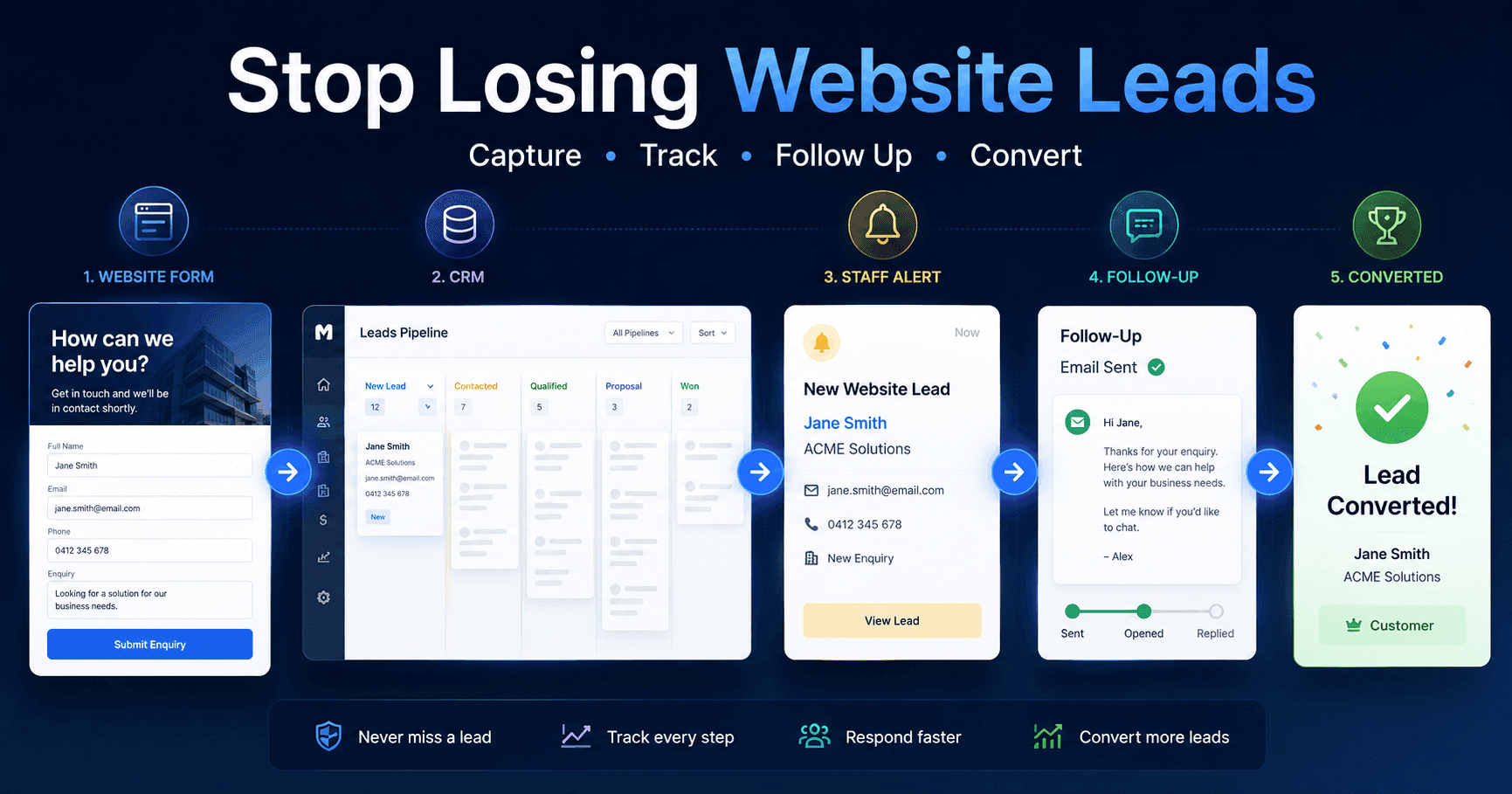
Website visitor → Enquiry form → CRM → Staff assignment → Follow-up → Conversion
A CRM-enabled website does not guarantee every enquiry will become a customer. It gives your team the structure, visibility and reminders needed to prevent qualified opportunities from being forgotten.
Why Businesses Lose Leads After the First Enquiry
Most lead leakage happens after a customer expresses interest.
Typical problems include:
- Website forms sending enquiries to an unmonitored inbox
- WhatsApp conversations remaining on individual employees’ phones
- Sales teams manually copying information into spreadsheets
- No clear person responsible for each enquiry
- Delayed responses
- Follow-ups depending on memory
- No record of previous calls or messages
- Management unable to see which leads are active, converted or lost
Indian buyers may compare several providers and take time before making a decision. A single response is therefore rarely enough. Businesses need a process that records every enquiry and keeps follow-up consistent.
CRM guidance from Vtiger highlights that a structured system can bring web forms, emails and phone enquiries into one database, assign them to the appropriate representative and trigger follow-up reminders.
What Is a Website with CRM?
A website with CRM integration automatically sends customer information from website forms, landing pages, consultation requests or registrations into a central lead-management system.
Instead of receiving only an email notification, the business receives a structured lead record containing details such as:
- Customer name
- Phone number and email
- Company or organisation
- Service of interest
- Enquiry message
- Lead source
- Campaign or landing page
- Assigned staff member
- Current lead status
- Next follow-up date
- Communication history
This creates one organised record that can remain available even when employees change, messages are deleted or the customer contacts the business through another channel.
Website and CRM integration also reduces repeated manual data entry, improves response coordination and creates the foundation for sales automation.
How the Website-to-CRM Process Works
1. A Visitor Submits an Enquiry
The customer arrives through Google Search, a social-media campaign, a referral or a paid advertisement.
They complete a form, request a consultation, download a resource, book an appointment or ask for a quotation.
The form should capture only the information needed to understand and qualify the enquiry. Complex forms may discourage customers from completing them.
2. The Enquiry Enters the CRM Automatically
The submitted information is saved directly in the CRM rather than remaining only in an email inbox.
The system may also record the source, campaign, service page and submission time. This helps the business understand which marketing activities generate meaningful opportunities.
3. The Lead Is Assigned to a Staff Member
The CRM can assign the enquiry according to location, service, department, availability or another business rule.
The assigned employee receives a notification and can see the customer’s complete information without searching through multiple channels.
Stop Losing Leads with a Website Built for Follow-Up
4. The Team Follows Up
The salesperson or service representative contacts the customer through phone, email or WhatsApp.
Follow-up reminders can be scheduled so the next action does not depend entirely on memory. Automated acknowledgement messages may also reassure customers that their request has been received while a staff member prepares a personal response.
Immediate acknowledgement and structured assignment help prevent website leads from cooling while waiting for a response.
5. The Lead Moves Through Defined Stages
The business can use practical stages such as:
New → Contacted → Qualified → Proposal Sent → Follow-Up → Converted or Lost
These stages allow staff and management to understand what has happened with each opportunity and what should happen next.
How CRM Integration Prevents Lead Loss
Every Enquiry Has an Owner
A lead without an assigned owner can easily be ignored. CRM assignment makes responsibility visible.
Follow-Ups Become Scheduled Tasks
Salespeople are often busy handling calls, meetings and existing customers. CRM reminders and task automation reduce the risk of promising a follow-up and forgetting it.
CRM automation should begin with practical activities such as lead capture, assignment and follow-up reminders rather than attempting to automate the entire sales process immediately.
Communication History Remains Available
When customer messages, notes and calls are recorded against one lead, another employee can continue the conversation without asking the customer to repeat everything.
Management Gains Pipeline Visibility
A dashboard can show:
- New enquiries received
- Leads awaiting follow-up
- Proposals sent
- Conversion by source
- Average response time
- Lost-lead reasons
- Performance by staff member
- Opportunities requiring management attention
This helps decision-makers identify process problems rather than relying on assumptions.
Dormant Leads Can Be Re-Engaged
A prospect who did not buy immediately may still have a valid requirement later.
CRM records can help the team segment inactive leads, understand why they did not proceed and reconnect with relevant case studies, service updates or revised offers. A structured re-engagement process should consider the original source, previous interaction, loss reason and preferred communication channel.
Which Indian Businesses Benefit Most?
A website with CRM is particularly valuable for businesses that receive regular enquiries or have several employees involved in customer follow-up.
Healthcare Organisations
Hospitals, clinics and diagnostic centres can capture appointment requests, treatment enquiries and doctor-selection questions through structured forms.
The healthcare website development case study demonstrates how appointment forms, patient enquiries, WhatsApp integration and campaign landing pages can support a complete patient-acquisition journey.
More advanced healthcare businesses may eventually connect enquiry management with appointment booking, notifications and patient workflows. The DOC247 telemedicine platform case study shows how digital journeys can extend into booking, provider allocation, reminders and real-time service delivery.
Turn Every Website Enquiry into a Trackable Sales Opportunity
Education and Training Companies
Education businesses can track course enquiries, counselling requests, admissions status and follow-up calls.
Real-Estate Companies
Property enquiries can be assigned by location, project, budget or salesperson while follow-ups and site visits remain visible.
Manufacturers and Distributors
B2B enquiries can be categorised by product, region, requirement, quotation status and expected order value.
Professional and B2B Services
Consulting firms, technology companies and agencies can organise consultation requests, proposals and longer sales cycles from one system.
What Is Included in the ₹75,000 Growth Website and CRM Plan?
Murmu Software Infotech’s current Growth Website + CRM Plan is listed at ₹75,000 for the predefined package scope. It is designed for Indian businesses that want their website to support lead generation and structured follow-up—not only company presentation.
The package can include:
- Conversion-focused business website
- Additional service and business pages
- Campaign landing pages
- Dynamic and video-enabled sections
- Standard CRM system
- Admin dashboard
- Admin and staff login
- Website lead capture
- Enquiry management
- Lead-status tracking
- Email follow-up facility
- WhatsApp follow-up facility
- AI chatbot integration
- Blog and article management
- Website-health reporting
- One year of basic monitoring and support
The published price applies to the approved predefined scope. Advanced workflows, third-party CRM products, extensive automation, custom reporting, ERP connectivity or additional user roles may require a separate quotation.
The full package scope, conditions and other development options are available in the Monsoon Digital Product Launch Offer 2026. A broader comparison of websites, e-commerce, mobile apps and MVP packages is available in the Digital Product Launch Offer pricing guide.
Do You Need More Leads—or Better Lead Management?
Many businesses spend money on SEO, advertisements and social media while continuing to manage incoming enquiries manually.
Before increasing the marketing budget, review what happens after a customer contacts you:
- Is every enquiry recorded?
- Is ownership assigned?
- Does the customer receive a timely response?
- Is the next follow-up scheduled?
- Can management view the pipeline?
- Are lost leads reviewed and re-engaged?
A website can attract interest. A CRM-enabled website helps turn that interest into an organised sales process.
Stop collecting enquiries across disconnected tools. Build a connected platform that helps your team capture, track, follow up and convert.
Frequently Asked Questions
What is a website with CRM integration?
A website with CRM integration automatically transfers enquiries, registrations, consultation requests and other customer information into a central lead-management system. Staff can then assign ownership, update lead status, schedule follow-ups and maintain communication history without relying on disconnected spreadsheets or inboxes.
How does a CRM-enabled website prevent businesses from losing leads?
It records every website enquiry in one system, assigns the lead to a responsible employee and creates a trackable follow-up process. This reduces the risk of enquiries being forgotten inside WhatsApp conversations, individual email accounts or manually maintained spreadsheets.
How much does a website with CRM cost in India?
Murmu Software Infotech’s limited-period Growth Website + CRM Plan is currently listed at ₹75,000 for the predefined package scope. Additional user roles, advanced automation, third-party CRM subscriptions, ERP connections, APIs and custom reporting may require a separate quotation.
What is included in the ₹75,000 Growth Website and CRM Plan?
The plan can include a conversion-focused website, campaign landing pages, CRM and admin dashboard, admin and staff login, lead capture, enquiry management, lead-status tracking, email and WhatsApp follow-up, AI chatbot integration, dynamic content sections, blog management and website-health reporting.
Can website enquiries automatically enter a CRM?
Yes. Enquiry forms, consultation requests, campaign landing pages and registrations can be connected directly to a CRM. Customer details, lead source, requested service and submission time can be stored automatically, reducing manual data entry and improving response coordination.
Can a website CRM connect with WhatsApp and email?
Yes. A CRM-enabled website can support email acknowledgements, staff notifications and structured WhatsApp follow-up. The exact functionality depends on the approved workflow, messaging provider, API availability and applicable third-party usage charges.
Which businesses benefit most from a website with CRM?
CRM-enabled websites are useful for healthcare organisations, education companies, real-estate agencies, manufacturers, distributors, consulting firms, B2B service providers and multi-location companies that receive regular enquiries and need several employees to manage follow-ups.
What lead stages should an SME use in its CRM?
A practical starting pipeline is: New, Contacted, Qualified, Proposal Sent, Follow-Up, Converted and Lost. Businesses can adapt these stages according to their sales cycle, services, team responsibilities and reporting requirements.
Does a CRM automatically convert every website enquiry?
No. A CRM does not guarantee conversion. It provides the structure needed to record leads, assign responsibility, schedule follow-ups and measure progress. Conversion still depends on response time, customer need, pricing, communication quality and the sales process.
What is included in one year of monitoring and support?
Basic monitoring and support can cover availability checks, basic error monitoring, troubleshooting delivered functionality, deployment assistance, initial bug investigation and technical guidance. It excludes new pages, new features, redesigns, additional integrations, API modifications and dedicated development hours.