CMS + CRM
How CEOs Should Choose Between a Website, CRM, App
PPrem M.7 Min Read

When a company decides to invest in digital transformation, the first question is often:
What should we build?
A new website? A CRM? A mobile app? An e-commerce platform? Or an MVP for an entirely new business idea?
For CEOs, founders and business leaders, choosing the wrong starting point can create unnecessary cost without solving the real business problem.
The better approach is to start with the business outcome and work backward to the technology.
A website helps you attract and convert prospects. A CRM helps you manage opportunities. An e-commerce platform helps customers buy. A mobile app improves repeat interactions. An MVP helps validate an entirely new product or business model.
The right investment depends on where the biggest bottleneck currently exists.
Technology selection should follow requirements, not lead them.
Before approving a project, leadership should answer:
This requirements-first approach is consistent with platform-selection guidance: businesses should define requirements and eliminate solutions that do not address them rather than choosing technology first.
Once the problem is clear, choosing the appropriate digital product becomes considerably easier.

Identify whether your next investment should be a website, CRM, mobile app, e-commerce platform or MVP based on business outcomes.
A professional website should normally be the first investment when your company lacks a credible, discoverable and conversion-focused digital presence.
Choose a website when you need to:
For professional services, healthcare providers, manufacturers, education businesses and B2B companies, the website often operates as the top of the digital sales funnel.
But do not judge ROI simply by website traffic.
The stronger metrics are:
Qualified enquiries → meetings → proposals → customers → revenue
If a ₹1 lakh website contributes even a handful of valuable B2B customers over several years, its business return may substantially exceed its development cost.
A business does not necessarily need more traffic if existing enquiries are already being lost inside WhatsApp, spreadsheets and employee inboxes.
That is a CRM problem.
Choose CRM when your organisation needs:
A website and CRM are particularly powerful when connected:
Visitor → Website Form → CRM → Salesperson → Follow-Up → Conversion
For companies with an existing sales process, the ROI case should focus on revenue leakage.
If the company generates 200 enquiries monthly but fails to follow up consistently, improving the conversion of existing demand may create more value than increasing advertising expenditure.
An MVP-style CRM implementation can also reduce risk by introducing essential workflows first and expanding them after teams begin using the system. This phased approach is specifically recommended for controlling CRM and ERP implementation risk and resource consumption.
If customers are already discovering your products but must call, message or visit a physical location to purchase, e-commerce may offer the clearest revenue opportunity.
Choose an e-commerce platform when you need:
The platform decision should account for features, costs, customer experience, SEO and operational requirements not simply appearance. Coursera recommends comparing platform capabilities through cost-benefit analysis, user experience and SEO considerations.
For straightforward commerce, hosted SaaS platforms such as Shopify can reduce infrastructure and maintenance responsibilities. Custom development becomes more relevant when the company has unusual workflows, complex integrations, high scalability requirements or differentiated customer experiences.
For CEOs, the core ROI formula is straightforward:
Traffic × Conversion Rate × Average Order Value × Repeat Purchase Frequency
The platform should improve one or more of those variables while supporting fulfilment efficiently.
A mobile app is rarely the best first digital investment for a company whose customers interact only occasionally.
It becomes strategically valuable when users repeatedly perform the same activity.
Choose a mobile app when customers need:
Apps can also be powerful internally for field sales, technicians, delivery teams and employees who need access to operational workflows away from a desktop.
The decision should therefore be driven by frequency of use.
Web applications generally offer faster, lower-cost validation and easier search-driven discovery, while mobile applications can provide stronger engagement through app-specific capabilities and notifications.
A useful CEO question is:
“Will customers have a compelling reason to open this application every week?”
If the answer is no, improving the mobile website may offer stronger ROI.
An MVP serves a fundamentally different purpose.
You are not primarily improving an existing process. You are testing whether a new digital product deserves further investment.
Choose an MVP when you are validating:
The first release should test the most important assumption with the fewest necessary capabilities.
Salesforce describes this approach in commerce: an MVP may contain only the customer experience necessary to begin generating value, with further capabilities introduced after learning from real usage.
A founder should therefore avoid asking:
“How many features can we build?”
Instead ask:
“What must this product prove before we invest another ₹5 lakh, ₹20 lakh or more?”
That question keeps capital focused on validation rather than speculation.
A CEO can simplify the decision using this framework:
Need more enquiries? → Website
Build search visibility, credibility, landing pages and lead generation.
Have enquiries but lose them? → Website + CRM
Create structured lead capture, assignment and follow-up.
Need customers to transact online? → E-commerce
Connect products, payments, orders, inventory and fulfilment.
Need customers or employees to interact repeatedly on mobile? → App
Create faster repeat experiences, notifications and device-enabled workflows.
Testing a new digital business model? → MVP
Build the smallest working version capable of validating demand.
This prevents organisations from buying technology simply because it appears modern.
The initial development quotation is only one part of the investment.
Decision-makers should consider:
Total cost of ownership can materially affect ROI, especially for larger commerce platforms where ongoing technology, integrations, operations and maintenance continue beyond launch.
The cheapest initial implementation may become expensive if every future change requires redevelopment.
Likewise, an expensive enterprise platform can be wasteful when a smaller system would solve the problem adequately.
One of the strongest strategies for controlling digital-product investment is phased delivery.
For example:
Phase 1: Website and lead capture
Phase 2: CRM and automation
Phase 3: Customer portal
Phase 4: Mobile app
Phase 5: AI and advanced automation
An e-commerce business could similarly begin with storefront, payments and order management, then add inventory integration, loyalty, marketplace channels and mobile commerce.
Scalability and integration capability should therefore be assessed before committing to a platform. Enterprise commerce guidance identifies future readiness, integration and user experience as major CEO-level selection criteria.
Before approving any digital investment, leadership should be able to clearly state:
Problem: What business problem are we solving?
User: Who will use the platform?
Outcome: What measurable result are we expecting?
Scope: What is included in the first release?
Investment: What is the initial and ongoing cost?
Integration: What existing systems must connect?
Scalability: What will we likely add over the next 12–24 months?
Measurement: How will we know whether the project worked?
If these answers are unclear, the organisation is not yet ready to approve development.
CEOs should not choose between a website, CRM, mobile app, e-commerce platform and MVP based on which sounds most advanced.
Choose according to the bottleneck:
Visibility problem → Website
Lead-management problem → CRM
Online-sales problem → E-commerce
Repeat-engagement problem → Mobile App
Unproven product idea → MVP
And when several problems exist, create a phased roadmap rather than launching every platform simultaneously.
The strongest digital investment is the one that solves a clearly defined business problem, produces a measurable outcome and creates a foundation for the company's next growth stage.
Murmu Software Infotech's Digital Product Launch Offer 2026 brings these options together for Indian founders, SMEs and growing businesses—from professional websites and CRM platforms to e-commerce, mobile applications, MVPs and AI-powered products.
Explore packages, scope, project showcases and current development options:
https://murmusoftwareinfotech.com/monsoon-digital-product-launch-offer-2026
Do not ask what software your company should buy next. Ask which business constraint technology should remove next.
Start with the biggest business bottleneck. Choose a website for visibility and lead generation, CRM for lead management, e-commerce for online transactions, a mobile app for repeat engagement, and an MVP for validating a new digital product.
Choose a website when search visibility, credibility, content marketing and customer acquisition are priorities. A mobile app becomes more valuable when customers or employees need frequent, repeat interactions.
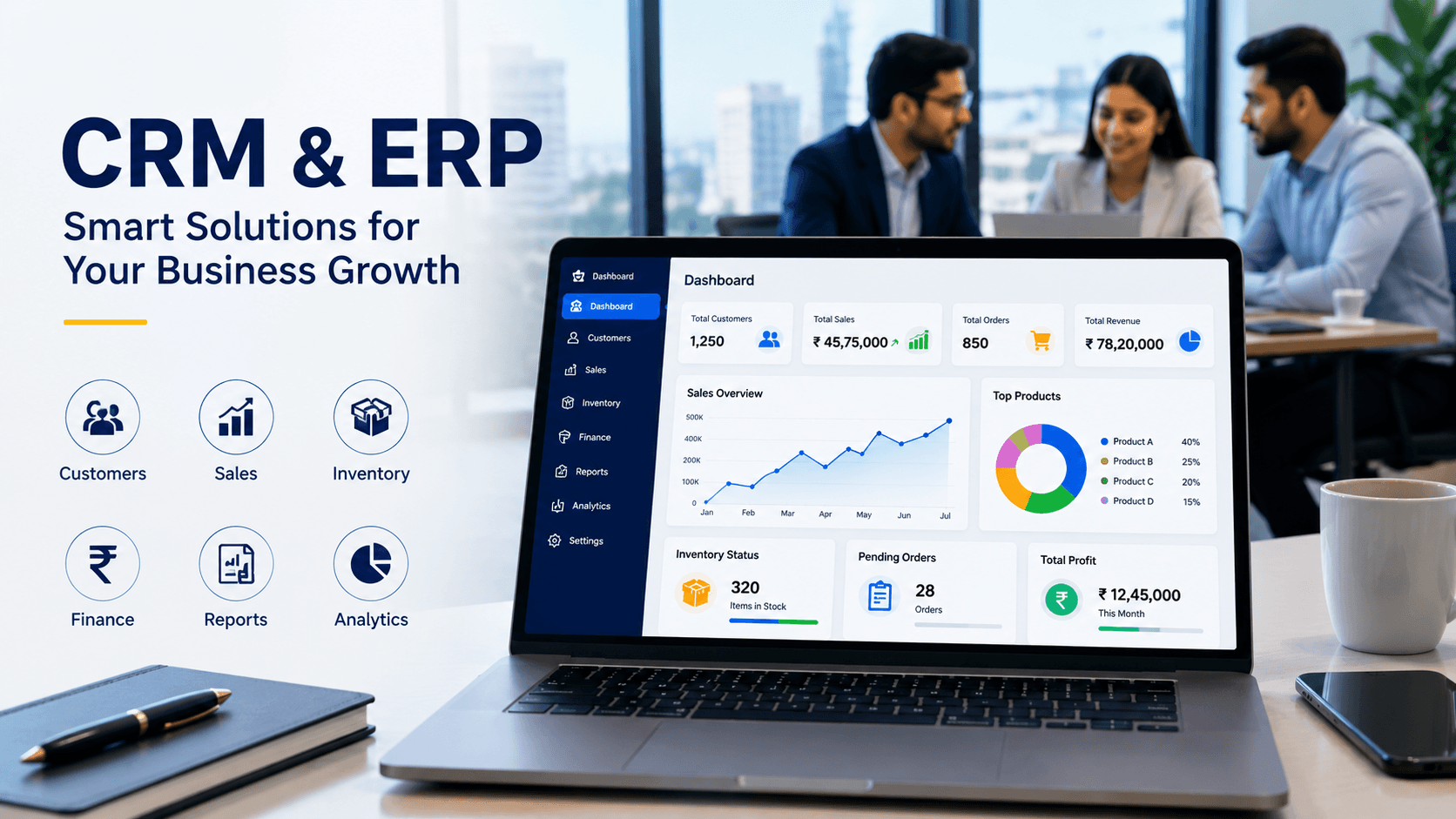
A CRM becomes valuable when website enquiries need structured assignment, tracking, reminders and follow-up. Integrating the website with CRM can turn disconnected enquiries into a measurable sales pipeline.
Choose e-commerce when customers should be able to discover products, pay online and manage orders digitally. Inventory, shipping, payments and customer accounts can then become part of one connected commerce workflow.
A mobile app makes sense when customers repeatedly book, order, track, communicate or manage services, or when field employees need mobile access to operational workflows.
Build an MVP when a new product, SaaS concept, marketplace or digital business model still needs validation. The first release should test the most important assumption before significant capital is committed.
Measure outcomes such as qualified leads, conversion rate, revenue, order value, repeat purchases, process efficiency, customer retention and operating-cost reductions against development and ongoing ownership costs.
Yes. A website can acquire customers, CRM can manage their sales journey, and a mobile app can support ongoing engagement. APIs and shared backend services can connect these experiences into one digital ecosystem.
Usually not. A phased roadmap reduces risk. Businesses can solve the highest-priority problem first, measure results and add CRM, commerce, mobile, automation or AI capabilities as requirements become clearer.
Evaluate the business problem, target users, expected outcome, first-release scope, development and ownership costs, required integrations, scalability requirements, security and the metrics that will define success.