Healthcare Website Development Case Study: SEO, Patient Leads & Appointment Conversion
In This Article
- For many patients, the first visit to a hospital no longer begins at the reception desk.
- The Challenge: Patients Could Find Information, But Not Easily Take Action
- The Solution: Build Around the Patient Search Journey
- Doctor Profiles That Build Digital Credibility
- Service and Treatment Pages Designed for Search Intent
- Appointment Conversion Without Friction
- SEO Architecture Built for Long-Term Growth
- Healthcare Content as an Authority Engine
- Campaign-Ready Healthcare Marketing
- Mobile and Accessibility by Design
- Business Value
- From Hospital Website to Digital Patient Platform
For many patients, the first visit to a hospital no longer begins at the reception desk.
It begins on Google.
Patients search for doctors, specialties, treatments, diagnostic services, locations, reviews, appointment availability, and consultation options before deciding which healthcare provider to contact.
That makes a hospital website much more than an online brochure.
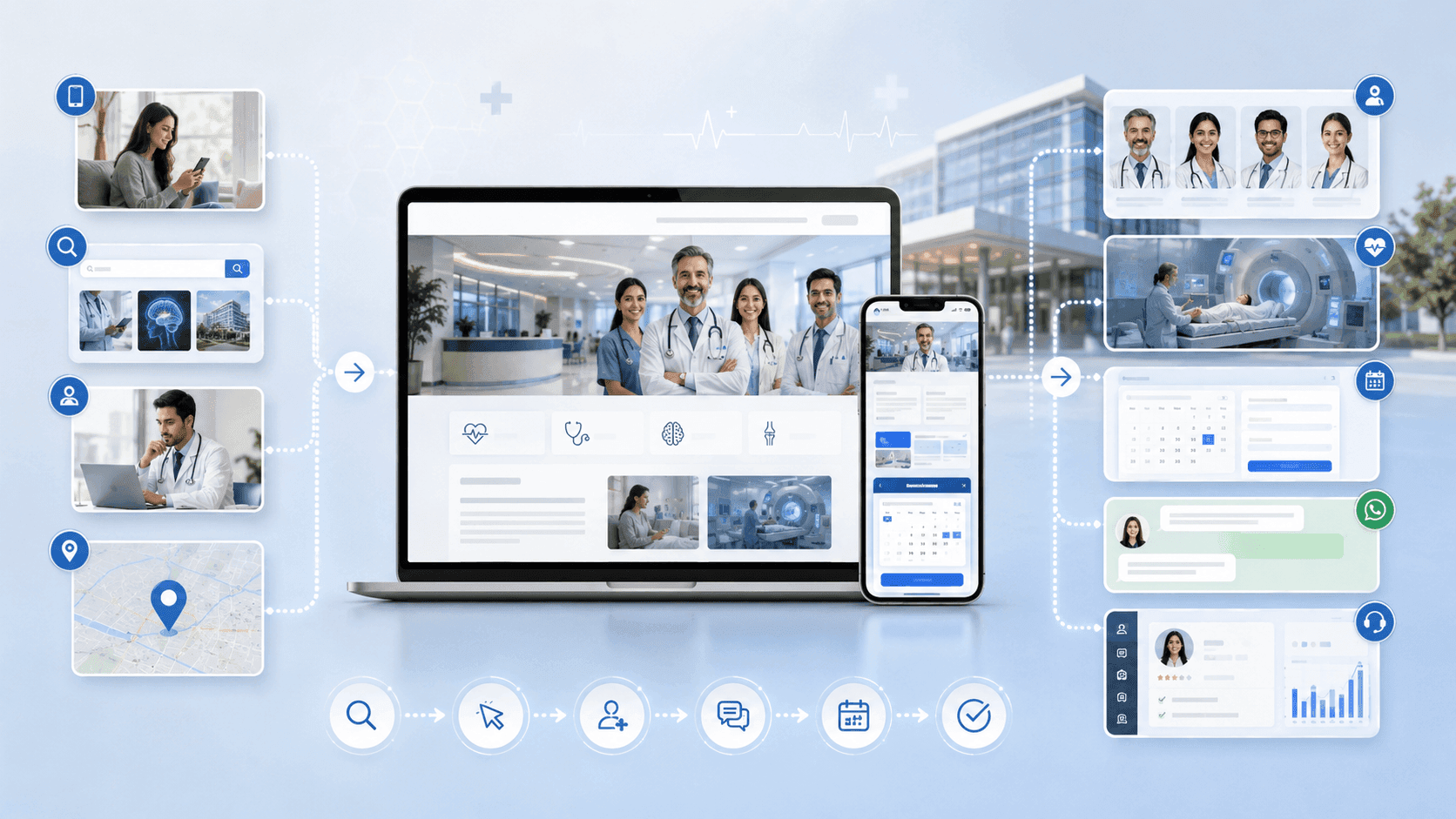
Murmu Software Infotech developed a conversion-focused healthcare website platform for hospitals, clinics, doctors, diagnostic centers, and healthcare providers, designed to combine professional digital branding, doctor discovery, healthcare SEO, appointment generation, patient inquiries, mobile accessibility, content marketing, and campaign-ready landing pages within one digital patient-acquisition ecosystem.

Turn Healthcare Traffic Into Appointments
Connect doctor discovery, treatment pages, SEO, appointment journeys, WhatsApp, CRM, and mobile experiences to convert more patient interest into qualified enquiries.
The Challenge: Patients Could Find Information, But Not Easily Take Action
The healthcare organization faced a familiar digital-growth problem.
Its online presence was not structured around the way modern patients search and make healthcare decisions.
Common challenges included outdated design, weak mobile experience, slow pages, limited visibility for treatment and location searches, fragmented service information, poor appointment journeys, and little infrastructure for digital marketing or patient lead generation.
The real challenge was therefore not simply:
“How do we redesign the hospital website?”
It was:
“How do we turn digital discovery into patient trust, enquiries, and appointments?”
Turn More Healthcare Searches Into Qualified Patient Appointments
The Solution: Build Around the Patient Search Journey
The redesigned platform was structured around a clear acquisition journey:
Patient Search → Healthcare Page → Doctor or Service Discovery → Trust → Appointment CTA → Inquiry → Follow-Up
This changed the role of the website.
Instead of visitors reaching a generic homepage and searching through menus, dedicated service, treatment, and doctor pages could match specific patient intent.
For example, a person searching for a cardiologist should be able to discover the relevant specialty, understand available services, evaluate doctors, and request an appointment without unnecessary navigation.
That is where SEO architecture and conversion design begin working together.
Doctor Profiles That Build Digital Credibility
Doctor discovery is one of the strongest conversion opportunities on a healthcare website.
The platform includes structured doctor profiles showing specialization, professional experience, qualifications, and appointment calls to action.
Instead of listing doctors as names in a directory, each profile becomes a discoverable digital asset.
A stronger patient journey becomes:
Search Doctor or Specialty → Review Credentials → Understand Expertise → Request Consultation
For larger hospitals, these pages can also become valuable organic-search landing pages for specialty-specific queries.
Service and Treatment Pages Designed for Search Intent
The solution also uses dedicated department, service, and treatment landing pages.
These pages allow healthcare organizations to explain individual services clearly while creating focused search-engine entry points.
A hospital should not expect one generic “Services” page to rank effectively for dozens of different patient needs.
A stronger architecture separates topics such as:
Cardiology → Orthopedics → Diagnostics → Women’s Health → Pediatrics → Procedures → Locations
Each page should answer what patients actually want to know: who provides the service, what conditions are treated, where it is available, what the next step is, and how to book.
Appointment Conversion Without Friction
Traffic alone does not create healthcare growth.
Patients need an obvious next action.
The platform includes mobile-friendly appointment forms, consultation requests, callback workflows, contact forms, and lead capture. WhatsApp integration provides an additional communication path for patients who prefer conversational enquiries.
The key conversion principle is simple:
Every high-intent page should make the next step obvious.
Forms should also remain short and accessible. W3C guidance recommends clearly labeled controls, appropriate instructions, and asking only for information required to complete the process because unnecessary fields can increase abandonment.
SEO Architecture Built for Long-Term Growth
The website was structured with search-friendly page architecture, metadata, healthcare keyword targeting, blogs, and treatment-focused educational content.
But sustainable healthcare SEO should go beyond adding keywords.
The stronger model is:
Technical SEO + Helpful Medical Content + Doctor/Service Entities + Location Relevance + Internal Linking + Strong Page Experience
Google currently recommends good Core Web Vitals and an overall mobile-friendly, secure, usable page experience. Current Core Web Vitals guidance targets an LCP within 2.5 seconds, INP below 200 milliseconds, and CLS below 0.1 for a good experience.
That makes performance part of both patient experience and search strategy.
Healthcare Content as an Authority Engine
The platform includes a blog and educational content system for treatment awareness and healthcare articles.
This creates an opportunity to build topic clusters such as:
Condition → Symptoms → Treatment Options → Department → Doctor → Appointment
Rather than publishing disconnected blog posts, content should guide patients from information-seeking queries toward appropriate healthcare services while clearly distinguishing educational content from individual medical advice.
Build a Healthcare Website That Converts Trust Into Action
Campaign-Ready Healthcare Marketing
Dedicated Google Ads landing pages were also built into the platform, giving marketing teams focused destinations for individual campaigns.
This is strategically important.
A paid campaign for a specific treatment should not send visitors to a general hospital homepage.
A stronger journey is:
Campaign → Relevant Landing Page → Clear Value Proposition → Doctor/Service Proof → Appointment CTA → Lead Capture
That makes marketing performance easier to measure and optimize.
Mobile and Accessibility by Design
Because patients frequently interact with healthcare websites from phones, responsive design and fast mobile browsing were core parts of the implementation.
I would strengthen the revised platform further by making WCAG 2.2 accessibility an explicit design objective covering keyboard accessibility, readable contrast, semantic structure, accessible forms, focus visibility, usable touch targets, and assistive-technology compatibility. W3C recommends WCAG 2.2 for maximizing accessibility across devices and users.
Business Value
The strongest defensible outcome is not that a website automatically increases patient volume.
It is that the new platform creates a significantly stronger digital-growth foundation:
better service discoverability → clearer doctor credibility → lower appointment friction → stronger mobile access → more measurable digital enquiries → scalable SEO and paid marketing
The existing case study reports improved visibility, appointment inquiries, mobile experience, branding, and digital marketing readiness.
For even stronger credibility, future versions should publish measurable metrics such as organic clicks, appointment-form conversion rate, qualified enquiries, Core Web Vitals, cost per lead, and traffic-to-appointment conversion.
From Hospital Website to Digital Patient Platform
The next stage can connect the website with Healthcare CRM, HMS, telemedicine, patient mobile apps, AI chatbots, OPD queue systems, appointment automation, and analytics dashboards capabilities identified as future expansion opportunities in the existing case study.
Murmu Software Infotech develops healthcare websites and connected digital-health solutions for hospitals, clinics, doctors, diagnostic centers, and healthcare organizations.
The goal is no longer simply to build a hospital website. It is to create a digital front door that helps patients discover, trust, contact, and connect with the right healthcare service faster.
Frequently Asked Questions
What should a healthcare website include?
A strong healthcare website should include doctor profiles, department and treatment pages, appointment and inquiry forms, mobile-responsive design, healthcare content, clear contact options, SEO-ready architecture and conversion-focused calls to action.
How can a hospital website generate more patient enquiries?
A hospital website can improve enquiry opportunities by matching patient search intent with relevant doctor and service pages, clear appointment CTAs, short inquiry forms, mobile usability and direct communication options such as WhatsApp.
Why are doctor profile pages important for hospital websites?
Doctor profile pages help patients evaluate specialization, qualifications, experience and consultation options while also creating dedicated pages that can improve doctor and specialty discoverability in search.
How does healthcare SEO help hospitals?
Healthcare SEO improves the ability of doctor, department, treatment, location and educational pages to appear for relevant patient searches by combining strong content structure, metadata, technical SEO and useful healthcare information.
Should each hospital treatment have a separate landing page?
Important departments, treatments and services should generally have focused pages so patients can quickly understand the service, relevant doctors, location and next action without searching through one large generic services page.
Can a hospital website include online appointment booking?
Yes. Healthcare websites can include appointment inquiry forms, consultation requests, callbacks and other booking workflows, and these can later integrate with CRM, HMS or appointment-management platforms.
Why is mobile-first design important for healthcare websites?
Patients frequently research doctors and healthcare services from smartphones. Responsive layouts, fast performance, readable content, accessible controls and simple appointment journeys help reduce friction on mobile devices.
Can a healthcare website integrate WhatsApp and CRM?
Yes. The documented platform supports WhatsApp enquiry workflows and a patient acquisition journey where leads can be captured for CRM-based follow-up and consultation coordination.
Can healthcare websites support Google Ads campaigns?
Yes. Campaign-specific landing pages can be created for treatments, departments or healthcare offers so paid traffic reaches a focused page with relevant proof, information and appointment calls to action.
Who develops healthcare websites for hospitals, clinics and doctors?
Murmu Software Infotech develops healthcare websites with doctor profiles, service pages, appointment workflows, healthcare SEO, mobile-first design, lead generation, WhatsApp integration and digital marketing infrastructure.