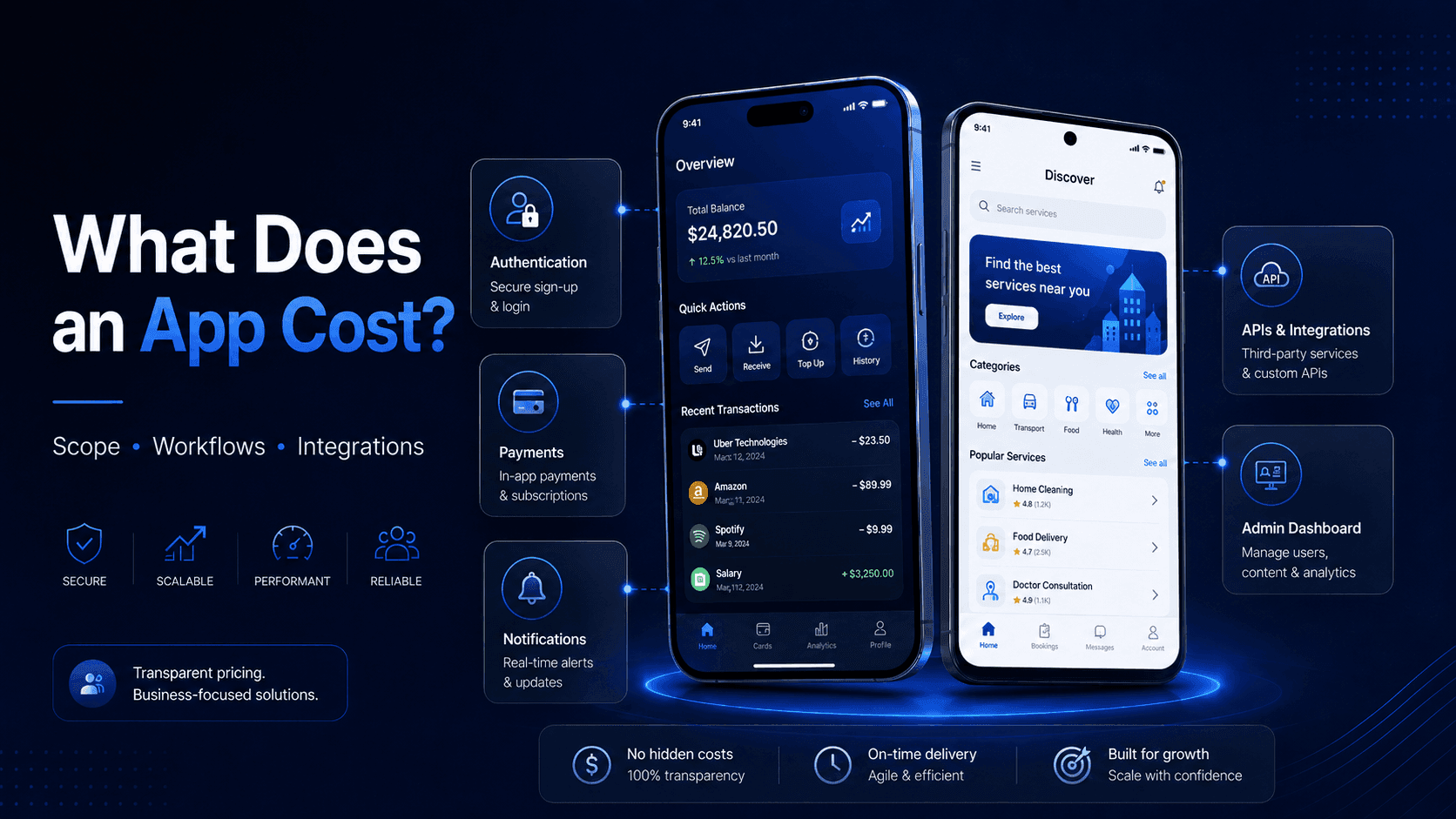
How Much Does It Cost to Build an Android and iOS Business Application?
In This Article
- Quick Answer: Android and iOS App Development Cost
- What Is Included in a Mobile App MVP?
- What Factors Increase Mobile App Development Cost?
- 1. Number and Complexity of Workflows
- 2. Android and iOS Development Approach
- 3. Backend and Admin Dashboard
- 4. Integrations
- 5. Security and Compliance
- Real Mobile App Cost Drivers Through Project Examples
- Mobile Billing and Business Operations
- Telemedicine and Appointment Booking
- AI-Powered Customer Engagement
- Learning and Mobile Commerce
- Costs Commonly Excluded From the Development Quote
- How to Reduce App Development Cost Without Reducing Quality
- Start With One Valuable Workflow
- Separate MVP Features From Future Features
- Complete Discovery Before Development
- Use Milestone-Based Delivery
- Build a Scalable Foundation
- Build an App That Improves a Real Business Outcome
A mobile app should not be a smaller version of your website.
It should make an important customer or business workflow faster—whether that means booking an appointment, generating a bill, purchasing a product, completing a course, receiving a notification or managing field operations.
So, how much does it cost to build an Android and iOS business application in 2026?
Under Murmu Software Infotech’s current launch offer, a cross-platform mobile app MVP starts from $8,500. A defined package may include authentication, user profiles, core workflows, API integration, notifications, payment integration, an admin dashboard, analytics and app-store submission assistance.
The final investment depends on what the application must help users accomplish.
Quick Answer: Android and iOS App Development Cost
The cost of developing an Android and iOS business app is determined by:
- Number of user roles and screens
- Complexity of the main workflow
- Backend and API requirements
- Payment, maps and third-party integrations
- Real-time communication or notifications
- Admin-dashboard requirements
- Security and compliance
- Native or cross-platform development
- AI, automation or recommendation features
- Testing, deployment and post-launch support
A focused mobile MVP costs less than a large marketplace, telemedicine ecosystem, learning platform or AI-powered customer application because it includes fewer workflows, integrations and administrative controls.
What Is Included in a Mobile App MVP?
A mobile MVP is the smallest reliable version of an application that delivers its primary business value.
Depending on the approved scope, it may include:
- Product discovery and workflow planning
- Mobile UI/UX design
- Android and iOS development
- User registration and authentication
- Profiles and role-based permissions
- One core customer or business workflow
- Backend APIs and database
- Push notifications
- Payment-gateway integration
- Basic admin dashboard
- Analytics and error monitoring
- App Store and Google Play submission assistance
- Selected launch-stage support
The objective is not to build every future feature. It is to launch a credible application, observe how real users interact with it and invest further based on evidence.
What Factors Increase Mobile App Development Cost?
1. Number and Complexity of Workflows
An application with registration, profile management and one booking flow will require less development than a platform combining bookings, video consultations, subscriptions, payments, chat, notifications and multiple dashboards.
Every additional workflow requires design, backend logic, validation, testing and administrative control.
Before requesting an estimate, define the single most important action the application must help users complete.
2. Android and iOS Development Approach
Businesses generally choose between:
- Separate native Android and iOS applications
- One cross-platform application for both platforms
Native development may be appropriate when an application depends heavily on platform-specific hardware, advanced graphics or highly specialized performance.
For many business applications, React Native provides a practical cross-platform approach because much of the application logic and interface can be shared across Android and iOS. This can reduce duplicated development and simplify future updates.
The correct decision should be based on the product requirements—not only the lowest initial estimate.
Turn Your Mobile App Idea Into Business Growth
3. Backend and Admin Dashboard
The visible mobile application is only one part of the product.
Most business applications also require:
- Database architecture
- Secure APIs
- User and role management
- Content or product management
- Order or booking management
- Reports and analytics
- Notification controls
- Payment records
- Customer-support tools
- Administrative permissions
A strong backend and admin dashboard often determine whether the application can operate efficiently after launch.
4. Integrations
Third-party integrations can significantly change the scope.
Common integrations include:
- Payment gateways
- Google Maps
- Video and voice calling
- SMS and email providers
- Firebase notifications
- CRM and ERP systems
- E-commerce platforms
- Accounting software
- Identity verification
- AI services
- Analytics platforms
Each integration requires configuration, testing, error handling and sometimes ongoing usage fees.
5. Security and Compliance
Applications handling healthcare, financial, identity or sensitive customer information require stronger safeguards.
The scope may include encryption, secure authentication, audit logs, consent management, access controls, backup strategies and compliance-specific workflows.
Security should be planned during architecture—not added after development.
Real Mobile App Cost Drivers Through Project Examples
Mobile Billing and Business Operations
The Smart Billing Lite mobile billing application combines billing, QR and UPI payments, customer management, WhatsApp invoice sharing, reports and AI-powered business insights.
Its value comes from accelerating a repeated workflow:
Customer purchase → Billing → Payment → Invoice → Customer record → Business insight
An application like this costs more than a basic billing calculator because it also requires customer data, payment workflows, reporting, messaging and backend services.
Telemedicine and Appointment Booking
The DOC247 telemedicine platform includes appointment booking, doctor availability, virtual waiting rooms, video consultation, maps, real-time queues and notifications.
Healthcare applications require multiple user journeys, external integrations and secure communication. That makes their scope substantially different from a basic appointment application.
AI-Powered Customer Engagement
The TribalShaadi AI matrimony platform combines profiles, AI matchmaking, identity verification, subscriptions, real-time communication, engagement notifications and an administrative dashboard.
AI recommendations, verification services, chat, subscriptions and moderation each introduce separate technical and operational requirements.
Learning and Mobile Commerce
The Seekoji Electric EdTech and e-commerce platform enables users to purchase courses, access protected learning content, buy electrical products and use technical reference tools.
Combining learning, payments, commerce, content protection and administration creates a broader product than a standalone learning app.
Costs Commonly Excluded From the Development Quote
Decision-makers should budget beyond initial application development.
Possible additional costs include:
- Apple and Google developer accounts
- Cloud infrastructure and data storage
- Paid APIs and third-party services
- Payment-gateway transaction charges
- SMS, email or WhatsApp usage
- Maps, video calling or identity verification
- Security or compliance services
- App marketing and user acquisition
- Ongoing maintenance and OS compatibility updates
These charges depend on actual usage and provider pricing. Under the current MSI offer, third-party licences, paid APIs, cloud usage, payment charges and app-store fees are excluded unless specifically included in the approved proposal.
Build a Faster Customer Workflow With One Mobile App
How to Reduce App Development Cost Without Reducing Quality
Start With One Valuable Workflow
Do not begin with a long feature wishlist.
Identify the action that creates the greatest value, such as booking, billing, purchasing, learning or completing a field task.
Separate MVP Features From Future Features
Classify requirements as:
- Required for launch
- Important after validation
- Useful in a future phase
- Not currently necessary
Complete Discovery Before Development
Early discovery should define users, workflows, integrations, security requirements and measurable outcomes.
This reduces unclear assumptions and expensive changes during development.
Use Milestone-Based Delivery
Divide the project into discovery, UI/UX, architecture, development, integrations, testing and launch.
Clear milestones improve budget visibility and give decision-makers structured approval points.
Build a Scalable Foundation
A focused MVP should not be disposable.
Modular architecture, secure APIs, analytics and a well-designed database allow the product to expand without rebuilding the entire system.
Build an App That Improves a Real Business Outcome
The right mobile application can improve customer access, accelerate transactions, reduce manual work and create a new digital revenue channel.
But the investment should be based on the workflow being improved—not merely the number of screens.
Murmu Software Infotech develops Android and iOS business applications for healthcare, retail, education, marketplaces, commerce, customer engagement and operational workflows.
Explore the Limited Digital Product Launch Offer 2026 to discuss your mobile-app requirements, architecture, integrations and milestone-based development plan.
The strongest app is not the one with the most features.
It is the one that helps users complete an important task faster.
Frequently Asked Questions
How much does it cost to build an Android and iOS business app?
Cross-platform Android and iOS mobile app MVP development currently starts from $8,500 under Murmu Software Infotech’s Limited Digital Product Launch Offer 2026. Final pricing depends on the application’s workflows, screens, user roles, backend services, integrations, security and launch requirements.
What factors affect mobile app development cost?
The main cost factors include the number of screens, user roles, workflow complexity, UI/UX requirements, backend APIs, payments, notifications, maps, chat, video, analytics and administrative controls. Security, compliance, testing and third-party integrations can also increase the required development effort.
Is it cheaper to build one cross-platform app for Android and iOS?
Cross-platform development can reduce duplicated work when Android and iOS share the same workflows, interface and backend services. However, the best approach depends on device capabilities, performance requirements, offline functionality and the amount of platform-specific development needed.
What is included in a mobile app MVP?
A mobile app MVP may include product discovery, UI/UX design, Android and iOS development, registration, authentication, profiles, one primary workflow, backend APIs, notifications, analytics and a basic administrative dashboard. Payments, maps and third-party integrations may be added when they are essential to the first release.
How long does it take to build an Android and iOS application?
The timeline depends on the approved scope, design complexity, number of workflows, integrations, testing requirements and speed of stakeholder approvals. A focused MVP can launch faster than a platform combining several user types, payments, chat, video, commerce and complex administration.
Does a business mobile app need a backend and admin dashboard?
Most business applications require a backend to manage users, data, authentication, transactions, notifications and integrations. An admin dashboard enables staff to manage customers, content, bookings, payments, reports and operational workflows without changing the mobile application.
Are app-store, cloud and third-party service charges included?
Apple and Google developer accounts, cloud hosting, paid APIs, maps, video services, SMS, WhatsApp, payment-gateway fees and other third-party charges are normally separate unless specifically included in the approved proposal. These costs depend on providers and actual usage.
How much does mobile app maintenance cost after launch?
Maintenance depends on hosting, usage, bug fixes, operating-system updates, security patches, monitoring, new devices and ongoing feature development. Businesses should plan separate budgets for technical maintenance and product improvements after the initial launch.
Can a mobile app MVP scale into a complete product?
Yes. A focused MVP can scale when it uses modular architecture, secure APIs, a structured database and clear separation between the application, backend and integrations. Scalability should be planned from the beginning without building every future feature in the first release.
How can a business reduce mobile app development cost?
Start with one valuable customer or operational workflow, separate launch features from future features and complete product discovery before development begins. Cross-platform development, reusable components, milestone-based delivery and early integration planning can reduce unnecessary rework without lowering product quality.