When Sitecore XM Cloud is the right modernization path and when it is not.
In This Article
- When XM Cloud Is the Right Modernization Path
- 1. You Want a SaaS Operating Model
- 2. You Are Already Planning a Website Rebuild
- 3. Headless and Composable Delivery Match Your Roadmap
- 4. You Are Paying for XP Capabilities You Do Not Use
- 5. Marketing and Development Agility Are Strategic Priorities
- When XM Cloud May Not Be the Right Move
- 1. Your Existing XP Platform Is Stable and Delivering Value
- 2. You Recently Completed a Redesign or Major Upgrade
- 3. Data Residency or Infrastructure Control Is Non-Negotiable
- 4. The Timeline Does Not Allow Complex Capabilities to Be Rebuilt
- 5. You Only Want to Move Existing XP Infrastructure to the Cloud
- 6. Another Platform Better Matches the Future Requirement
- Choose the Right Migration Model
- Make the Decision Through Discovery
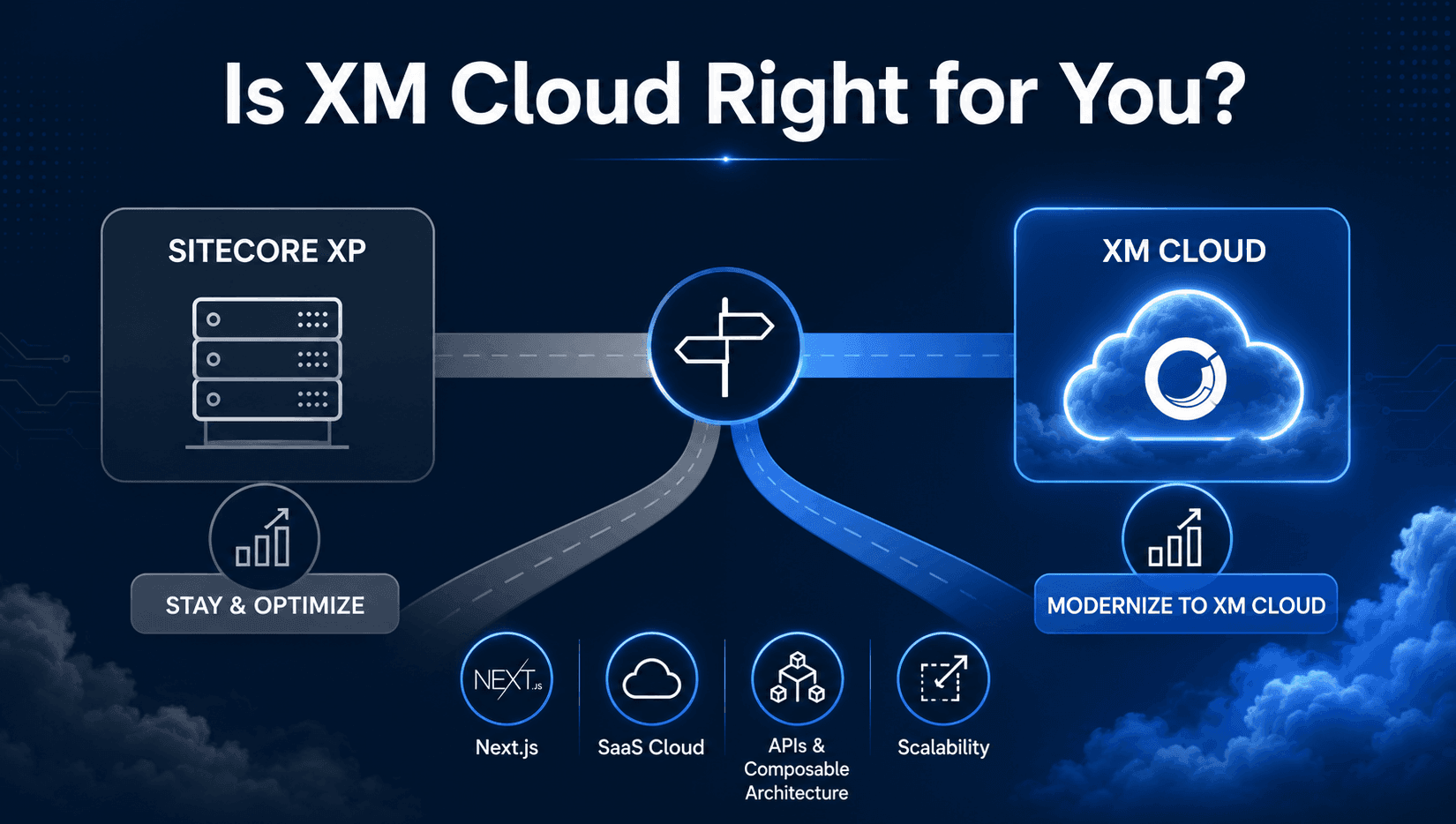
For enterprises running Sitecore XP or XM, the modernization question must be “Which platform and operating model will support our business for the next five years?”
Sitecore XM Cloud can provide a strong SaaS, headless and composable foundation. But it is not simply Sitecore XP hosted in the cloud, and it is not automatically the best next step for every organization. Sitecore describes XP/XM and XM Cloud as fundamentally different products, with changes required across search, architecture, frontend delivery, integrations and platform operations.
Before committing, compare the platforms through our Sitecore XM Cloud vs Sitecore XP guide.
When XM Cloud Is the Right Modernization Path
1. You Want a SaaS Operating Model
XM Cloud is a strong fit when your organization wants Sitecore to manage the core CMS platform while your engineering team focuses on digital products, frontend experiences and integrations.
This reduces responsibility for traditional CMS infrastructure and major platform upgrades. However, frontend hosting, monitoring, APIs, integrations and delivery pipelines remain part of the overall architecture and cost model.
XM Cloud should therefore be viewed as an operating-model change-not just a hosting change.
2. You Are Already Planning a Website Rebuild
Migration becomes easier to justify when an enterprise is already preparing for a redesign, frontend replacement or wider digital transformation.
Legacy MVC renderings cannot simply run unchanged in XM Cloud. Sitecore’s migration guidance explains that existing HTML and CSS may be reusable, but the presentation layer generally needs to move to Next.js and the content must be reshaped for a headless architecture.
A planned rebuild creates an opportunity to:
- Remove unused templates and components
- Simplify content models
- Replace tightly coupled integrations
- Improve accessibility and performance
- Introduce reusable headless components
- Preserve SEO through controlled redirects and metadata migration
Our Sitecore XM Cloud migration services cover discovery, component mapping, content migration, Next.js development, integration modernization and SEO preservation.
Plan The Right Sitecore Modernization Strategy For Your Enterprise
3. Headless and Composable Delivery Match Your Roadmap
XM Cloud is appropriate when your organization wants to deliver structured content through APIs to websites, applications and emerging digital channels.
It supports an architecture in which the CMS, frontend, search, customer data, personalization, DAM and commerce capabilities can be selected and integrated independently. Sitecore’s guidance notes that XM Cloud alone may not replace every capability previously delivered by the monolithic XP platform.
This model works particularly well for:
- Global multisite platforms
- Multilingual websites
- Next.js and React development
- API-first enterprise integrations
- Independent frontend deployment
- Composable search and personalization
- SitecoreAI-aligned content operations
See our Sitecore XM Cloud development services for the technical architecture and delivery model.
4. You Are Paying for XP Capabilities You Do Not Use
Sitecore XP remains powerful when organizations actively use xDB, xConnect, analytics, personalization and marketing automation. But some businesses operate XP mainly as an expensive content-management system.
We argue that organizations underusing XP’s wider feature set may receive greater practical value from a simpler composable model. Conversely, businesses deeply dependent on XP’s integrated marketing capabilities may face a much larger replacement scope.
5. Marketing and Development Agility Are Strategic Priorities
XM Cloud can be valuable when content teams need more flexible authoring and developers want modern frontend workflows.
The business case becomes stronger when the existing platform causes:
- Slow campaign launches
- Long deployment cycles
- Heavy developer dependency
- Difficult component reuse
- Performance or scalability problems
- Limited support for new channels
Our enterprise healthcare XM Cloud and AI Search case study demonstrates how Next.js, GraphQL, Sitecore Search and Content Hub can support a modern healthcare experience.
When XM Cloud May Not Be the Right Move
1. Your Existing XP Platform Is Stable and Delivering Value
Migration should not be driven by fashion.
Remaining on Sitecore XP may be sensible when the platform is supported, secure, performant and closely aligned with business requirements. This is particularly true when the organization fully uses XP personalization, analytics, marketing automation and custom business integrations.
We similarly highlights staying on Sitecore 10.x as a valid option when the platform continues to meet organizational needs and is properly maintained.
In this situation, targeted upgrades and Sitecore support and maintenance services may deliver better near-term value than a complete re-platforming.
2. You Recently Completed a Redesign or Major Upgrade
A recent MVC rebuild represents substantial investment. Moving immediately to XM Cloud could require rebuilding many of those components again for headless delivery.
Velir identifies recent redesigns and upgrades as common reasons to delay migration, especially when the current experience is still meeting performance, content and marketing goals.
The better approach may be to maximize the current platform while preparing content, integrations and governance for a future transition.
3. Data Residency or Infrastructure Control Is Non-Negotiable
Highly regulated organizations may have strict requirements governing data location, infrastructure access, deployment control and system boundaries.
Healthcare, government, banking and other regulated enterprises should validate data residency, security, contractual and compliance requirements before selecting a SaaS architecture. We identify these concerns as potential barriers to immediate XM Cloud adoption.
4. The Timeline Does Not Allow Complex Capabilities to Be Rebuilt
A direct migration can be risky when an organization has complex Solr search, custom Sitecore Forms, authenticated journeys, extensive xDB logic or deeply embedded server-side integrations.
Sitecore’s guidance suggests that tight timelines and complex search requirements may justify a phased approach-such as introducing headless delivery first and modernizing search in a later stage.
modernize Sitecore with Confidence, Clarity and Business Alignment
5. You Only Want to Move Existing XP Infrastructure to the Cloud
XM Cloud is not a lift-and-shift destination for an existing XP solution.
Sitecore’s Accelerate guidance distinguishes moving XP infrastructure to a managed environment from adopting XM Cloud as a true SaaS, headless and composable CMS. If the objective is simply to retain the existing application while outsourcing infrastructure, a broader re-platforming may not be justified.
6. Another Platform Better Matches the Future Requirement
When modernization already involves rebuilding components, search, integrations, workflows and authenticated portals, the organization should evaluate whether Sitecore remains the best long-term fit.
We recommend comparing XM Cloud against rebuilding within Sitecore or moving to another DXP when future requirements center on complex portals, role-based experiences, enterprise workflows or a different cost model.
Choose the Right Migration Model
Sitecore outlines two primary transition approaches:
Direct migration: Suitable when the scope is manageable, the organization has committed to XM Cloud and a coordinated re-platforming can be completed without unacceptable disruption.
Hybrid migration: Suitable for large or multisite platforms where sections can move gradually. Routing technology directs users between old and new environments, although search, authentication and content governance become more complex while two platforms operate simultaneously.
Make the Decision Through Discovery
Before approving an XM Cloud program, assess:
- Current XP capabilities and actual usage
- MVC, SXA and headless components
- Search, forms and personalization
- xDB and xConnect dependencies
- Content and media volume
- CRM, ERP, DAM and external integrations
- Data residency and compliance
- Frontend hosting and DevOps
- Migration cost and operational savings
- Three-to-five-year digital roadmap
Murmu Software Infotech provides Sitecore CMS development and modernization services from Ranchi, Jharkhand, India, for enterprises and digital agencies worldwide.
XM Cloud is the right path when it supports a deliberate move to SaaS, headless delivery and composable architecture. It is not the right path when the business case depends only on following the newest platform direction.
Frequently Asked Questions
When is XM Cloud the right Modernization path?
XM Cloud is appropriate when an organisation wants a managed SaaS CMS, headless delivery, modern frontend development, composable integrations and reduced responsibility for core CMS infrastructure and upgrades.
When is XM Cloud not the right choice?
XM Cloud may not be the right immediate choice when Sitecore XP is stable, heavily customised, delivering substantial value or dependent on integrated xDB, xConnect, MVC and marketing capabilities that would be expensive to redesign.
Can an enterprise stay on Sitecore XP?
Yes. Remaining on Sitecore XP can be valid when the platform is supported, secure, performant and aligned with business requirements. Modernization should be based on measurable value rather than platform pressure.
Is XP to XM Cloud a normal Sitecore upgrade?
No. It is generally a replatforming initiative involving content migration, component redevelopment, frontend Modernization, integration redesign, testing, SEO preservation and operational change.
Can legacy Sitecore MVC code run on XM Cloud?
Traditional MVC renderings and server-side customisations do not run unchanged on XM Cloud. They generally need to be mapped and rebuilt as headless frontend components.
Can existing website designs be reused?
Existing HTML, CSS, design systems and visual assets may be reusable, but presentation logic normally needs to be rebuilt for Next.js, Headless SXA and the target Sitecore SDK.
What happens to existing Sitecore content?
Content should be audited and classified as content to migrate unchanged, transform, consolidate, rebuild manually or retire. Moving all legacy content without review can transfer unnecessary complexity into the new platform.
What is a direct XM Cloud migration?
A direct migration moves the target platform, frontend and approved content to XM Cloud within one coordinated programme. It can be efficient when scope and dependencies are manageable.
What is a hybrid XM Cloud migration?
A hybrid migration moves individual sites or website sections gradually while routing traffic between Sitecore XP and XM Cloud. It is useful for large programmes but introduces additional search, authentication and governance complexity.
What happens to Sitecore XP personalisation?
XP personalisation, analytics, xDB and xConnect dependencies must be inventoried. Required capabilities may be redesigned using SitecoreAI, CDP, Personalize or other suitable services and integrations.
Does XM Cloud eliminate hosting costs?
XM Cloud reduces the need to manage core CMS infrastructure, but enterprises still require frontend hosting, integrations, monitoring, security, deployment pipelines and ongoing support.
Which SDK should new XM Cloud projects use?
Sitecore currently recommends Content SDK 1.x for active XM Cloud development. Existing JSS applications should be evaluated against Sitecore's current SDK support lifecycle.
How is XM Cloud migration readiness assessed?
A readiness assessment reviews the Sitecore version, content, templates, components, custom code, xDB usage, search, forms, integrations, infrastructure, security, SEO and internal delivery capabilities.
How long does XM Cloud migration take?
Timing depends on content volume, components, languages, integrations, search, forms, testing and approvals. An MSI planning range for a focused migration is approximately two to five months, while complex programmes may take longer.
Who provides Sitecore XM Cloud migration services in India?
Murmu Software Infotech provides XM Cloud readiness assessment, Sitecore XP Modernization, content migration, Next.js development, integrations, search Modernization, SEO preservation and managed support from India.