Sanity CMS
Sanity vs Strapi CMS
PPrem M.7 Min Read

Choosing between Sanity vs Strapi CMS can delay a website project longer than it should.
Both are modern headless content platforms. Both can power Next.js, React, mobile applications and API-driven experiences. Both support structured content and custom development.
But they solve the CMS problem differently.
The decision becomes easier when you stop asking:
Which CMS is better?
and instead ask:
Which CMS fits how our business wants to manage content, infrastructure, developers and future digital channels?
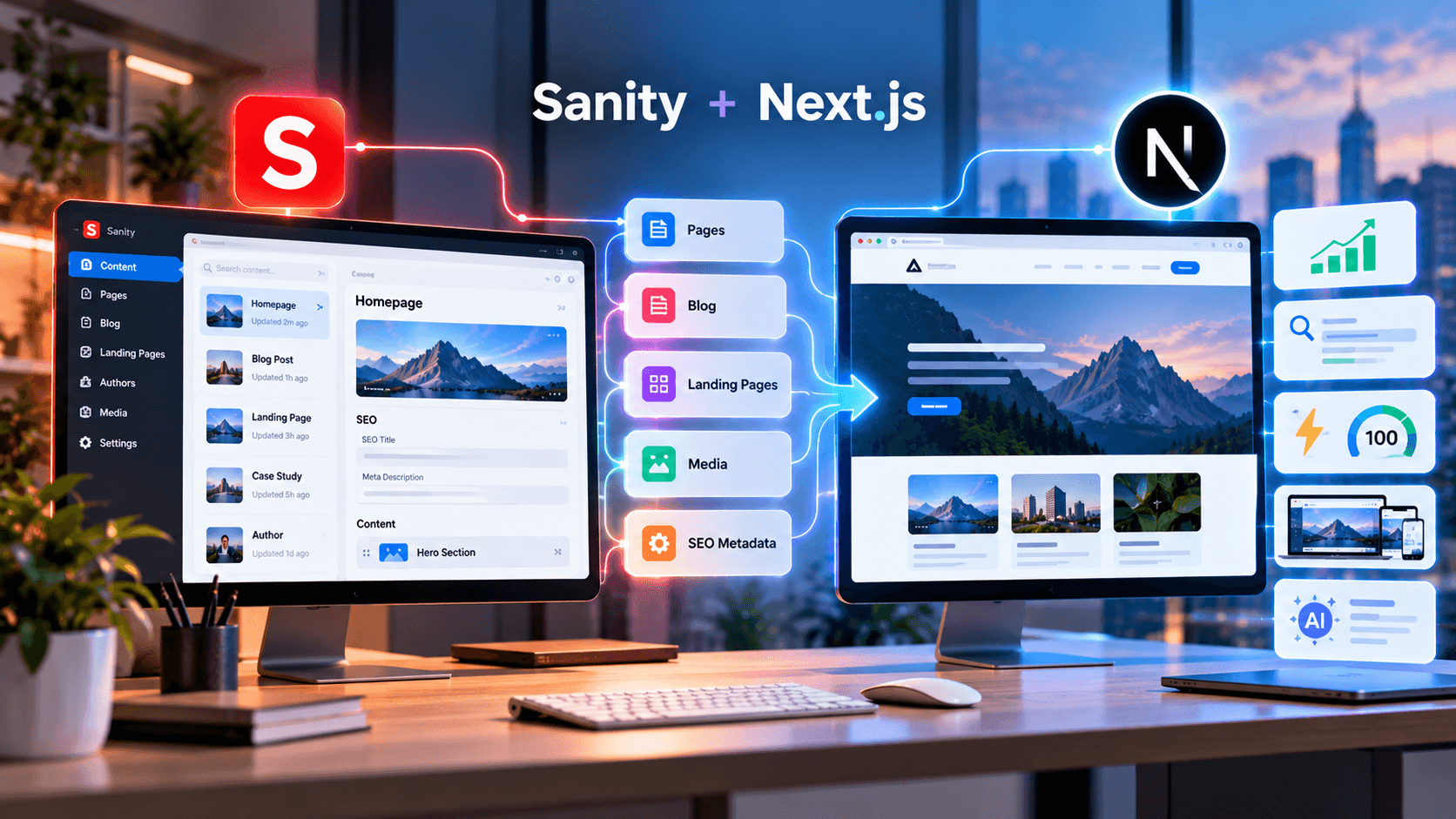
For most content-heavy business websites, SaaS marketing sites, multi-market websites and organizations with active marketing teams, Sanity is often the stronger fit because infrastructure is managed and the editing environment supports real-time collaboration and deep customization. Sanity stores content in its managed Content Lake and allows teams to customize Sanity Studio with React.

Compare Sanity and Strapi for content operations, hosting control, Next.js development, scalability, and long-term business requirements before you commit.
For businesses that require self-hosting, direct database ownership, custom backend logic or tighter infrastructure control, Strapi may be the better choice. Strapi provides access to its Node.js application, custom middleware/controllers and supported relational databases while allowing either self-hosting or Strapi Cloud deployment.
Business Requirement
Sanity
Strapi
Marketing/content-heavy website
Excellent fit
Good fit
Real-time editorial collaboration
Strong advantage
More traditional workflow
Managed infrastructure
Built in
Available via Strapi Cloud
Self-hosting
No
Yes
Direct database control
No
Yes
Custom backend/server logic
Limited to platform architecture
Strong advantage
Structured content
Excellent
Excellent
Next.js development
Excellent
Excellent
Custom editor experience
Highly customizable Studio
Customizable admin
Infrastructure responsibility
Low
Higher when self-hosted
Data/infrastructure sovereignty
More constrained
Greater control
Sanity treats content as structured data rather than simply storing pages as HTML.
Developers define schemas in JavaScript or TypeScript, editors work inside Sanity Studio, and frontend applications query the content through APIs including GROQ. Portable Text also keeps rich content structured rather than tying it permanently to one website presentation.
That architecture is particularly useful when the same content may eventually power:
Website → mobile app → customer portal → ecommerce experience → internal search → AI assistant
Sanity's biggest business advantage, however, is often editorial operations.
Multiple editors can collaborate in real time, while the Studio itself can be customized around the organization's content workflow. Sanity also now positions capabilities such as Content Agent, Agent API and MCP Server within its broader content platform, making structured-content architecture increasingly relevant to AI-enabled content operations.
For organizations evaluating this direction, our Sanity CMS Development Services cover schema modelling, Sanity Studio, Next.js, GROQ, migrations and AI-enabled content workflows.
Strapi gives engineering teams much more control over the backend itself.
It is an open-source Node.js application under the MIT licence. Businesses can host it within their preferred infrastructure, choose supported databases and write custom middleware, controllers and services when standard CMS behaviour is not enough.
This can matter when your “business website” is becoming more like a software application.
For example:
Strapi's Content-Type Builder also gives teams a visual approach to defining content structures, while REST APIs are generated automatically and GraphQL is supported.
The trade-off is operational responsibility.
When Strapi is self-hosted, your team owns more of the deployment, patching, backups, database management, monitoring and scaling. Strapi Cloud reduces that burden, but the fundamental platform still offers greater infrastructure control than Sanity's managed backend.
Sanity has the advantage for highly collaborative content organizations.
Sanity provides simultaneous editing, presence and customizable editorial experiences. Both Sanity's own comparison and Strapi's comparison page acknowledge real-time collaboration as an important Sanity differentiator.
That can be valuable when content moves through:
SEO → copywriting → product → legal → localization → publishing
Strapi provides a more conventional form-based administrative experience, which may actually feel simpler to teams moving from traditional CMS platforms.
So the question is not simply which editor “looks better.”
Ask:
Does your team need a familiar CMS interface, or a highly configurable content workspace designed around your publishing operation?
Both are strong options.
With Strapi, Next.js typically consumes REST or GraphQL APIs from your Strapi instance.
With Sanity, Next.js can query structured content using GROQ and Sanity's client APIs, while the managed content backend removes the need to operate a separate CMS application/database stack.
For a marketing-led Next.js website, I would usually lean toward Sanity.
For a Next.js product where the CMS must behave as a deeply customized application backend, I would evaluate Strapi more seriously.
Our own website migration provides a practical example of the first model. See the Sanity + Next.js Headless CMS Migration Case Study.
Do not compare only the CMS subscription.
Strapi's Community Edition can be used without a CMS licence charge, but self-hosting still creates costs around infrastructure, databases, backups, monitoring, upgrades and engineering time. Sanity includes the hosted content backend but follows SaaS/usage-based pricing. Cosmic's August 2026 comparison highlights precisely this problem: the prices are not directly comparable because Sanity includes hosting while self-hosted Strapi transfers operational costs to your organization.
Calculate:
CMS fees + hosting + DevOps + developer maintenance + editor productivity + upgrades + support = real TCO
A platform with a lower monthly licence can still become more expensive if it requires significantly more operational engineering.
Both can support multilingual architectures.
Strapi provides built-in internationalization capabilities, while Sanity allows developers to model localization according to the required content structure for example, field-level translations or related language documents.
Strapi may feel faster when you want a more standardized localization configuration.
Sanity can offer greater modelling flexibility when multilingual content workflows differ significantly between markets.
For an AI-ready business website, content structure matters more than adding an AI plugin.
You may eventually want content to support:
AI search → RAG → content agents → translation → automated audits → chatbots → GEO/AEO → personalized experiences
Sanity is particularly interesting here because its platform now includes Content Agent, Agent API and MCP Server capabilities alongside the structured Content Lake.
Strapi is also moving deeper into AI and now promotes Strapi AI and MCP capabilities, while retaining the major advantage of backend ownership and extensibility.
For a broader architecture decision, see our Headless CMS Development Services Guide.
Your website is heavily driven by marketing and content operations; multiple editors collaborate frequently; you want structured reusable content; Next.js is central to your frontend strategy; you prefer managed infrastructure; or content may increasingly support AI-driven experiences.
You require self-hosting; direct database and infrastructure control matter; your developers need extensive backend customization; data residency is important; or your CMS is becoming part of a larger custom application backend.
And if neither requirement is clear yet, do not choose the CMS first.
Document:
Who edits → what content exists → how often it changes → which channels consume it → what integrations are required → who will operate the infrastructure → what AI use cases may come next.
Then make the platform decision.
For a modern business website where content, marketing agility, Next.js, collaboration and future AI-readiness are the primary priorities, Sanity would generally be my first recommendation.
For a business application requiring maximum backend, hosting and database control, Strapi is often the stronger architectural choice.
There is no universal winner.
Sanity optimizes for managed content operations. Strapi optimizes for engineering ownership.
Choose according to the operating model your business wants to maintain for the next several years not according to which CMS has the longer feature list.
We can assess your content model, editorial workflow, integrations, hosting requirements, Next.js architecture and future AI roadmap before you commit to either platform.
Choose once. Architect it correctly. Avoid another CMS migration later.
Neither platform is universally better. Sanity is often a strong fit when structured content, marketing workflows, collaboration and lower infrastructure management are priorities. Strapi can be a stronger fit when the business requires self-hosting, backend customization, infrastructure control or direct ownership of the application runtime.
The main difference is the operating model. Sanity emphasizes managed content infrastructure and customizable editorial workflows, while Strapi gives development teams greater control over hosting, backend logic and infrastructure.
Both can work well with Next.js. Sanity can be especially attractive for content-led Next.js websites where structured content, preview and editorial workflows matter, while Strapi can suit Next.js applications requiring a more customizable backend and self-hosting control.
The answer depends on total cost of ownership. A self-hosted CMS can reduce platform subscription costs but introduces hosting, database, backups, monitoring, upgrades and DevOps responsibilities. Businesses should compare complete operating costs rather than software pricing alone.
Yes. Strapi is commonly considered when organizations want the option to manage their own hosting and application infrastructure. Managed hosting can also be considered when teams want to reduce operational responsibility.
Sanity can be a strong option for organizations with active content teams because its architecture supports structured content and highly configurable editorial workflows. The right choice still depends on the complexity of the publishing process and the technical resources available.
Strapi is generally more suitable when developers need extensive control over server-side logic, middleware, APIs, hosting and database infrastructure. Sanity is better approached as a managed content platform rather than a customizable application backend.
Both can supply structured content to AI applications. Sanity can be particularly attractive for content-centric AI workflows and agentic content operations, while Strapi can suit applications where AI features need deeper custom backend integration and infrastructure control.
Yes. Migration normally requires mapping content models, exporting content, transforming data, migrating assets, rebuilding integrations, validating frontend queries and testing editorial workflows before the new platform replaces the existing CMS.
Compare editorial workflows, hosting requirements, backend customization, developer skills, integrations, localization, infrastructure responsibility, expected scale, AI roadmap and total cost of ownership before selecting either platform.