Multi-Location Hospital Management Case Study: Centralized HMS for Hospital & Clinic Networks
In This Article
- The Challenge: Every Branch Operated Like a Separate Organization
- The Solution: One Platform Across Every Healthcare Location
- Centralized Branch Management
- Unified Patient Records Across Locations
- Multi-Location Appointment and Doctor Management
- Branch-Level Revenue and Performance Visibility
- Role-Based Access Across the Network
- Executive Analytics for Healthcare Leadership
- Cloud Architecture for Expansion
- Business Impact
- Building a Multi-Location Healthcare Platform?
Growing from one hospital or clinic into a multi-location healthcare network introduces a new level of operational complexity.
Each branch may have its own doctors, staff, appointments, billing activity, patient records, operating processes, and reporting requirements. When branches use disconnected systems, leadership can struggle to understand what is happening across the healthcare network.
That was the challenge addressed through this Multi-Location Hospital Management Software initiative.
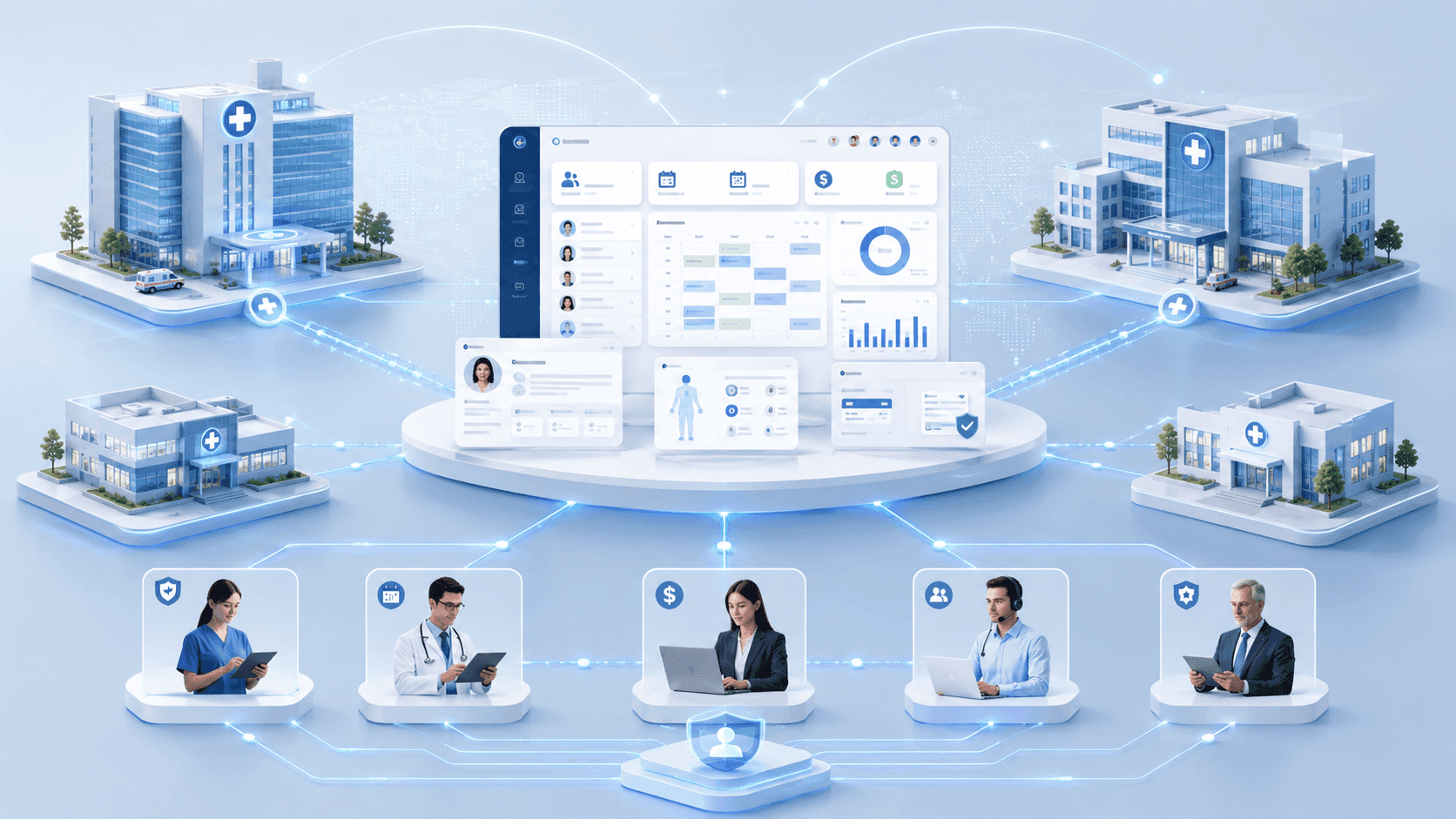
Murmu Software Infotech developed a centralized healthcare management platform designed for hospital chains, clinic networks, diagnostic-center groups, healthcare franchises, and multi-city healthcare organizations. The platform connects branch management, patient information, appointments, workforce operations, financial visibility, reporting, access control, and executive analytics within one scalable environment.
Unify Every Hospital Location
Connect branches, patient records, doctors, appointments, permissions, and analytics through one scalable platform built for growing healthcare networks.
The Challenge: Every Branch Operated Like a Separate Organization
Healthcare expansion often happens faster than software architecture evolves.
One location may maintain patient information independently. Another may use different reporting workflows. Leadership may receive branch performance data through spreadsheets or manual summaries. Staff permissions become difficult to coordinate, and patient history may remain trapped at the location where treatment first occurred.
The live project identified several recurring problems:
- Disconnected branch operations
- Fragmented patient records
- Manual coordination
- Inconsistent revenue visibility
- Weak centralized reporting
- Complex role and access management
- Limited scalability of legacy systems
The strategic issue was therefore bigger than software duplication.
The healthcare group lacked a single operational view of the entire network.
Unify Every Hospital Location with One Scalable HMS Platform
The Solution: One Platform Across Every Healthcare Location
The system was designed around centralized administration while preserving branch-level operational control.
A simplified model became:
Healthcare Network → Branches → Doctors & Staff → Patients → Appointments → Billing → Analytics → Leadership Dashboard
Head-office teams can manage the healthcare network centrally, while branch users access the workflows and information relevant to their responsibilities.
This creates an important balance:
central governance + local execution.
That is the core value proposition of a true multi-location HMS.
Centralized Branch Management
The platform allows new healthcare locations to be onboarded into the same operational environment.
Instead of deploying isolated systems at every branch, administrators can manage locations, monitor branch activity, and maintain standardized operational processes from a common platform.
For a growing hospital group, this creates a more repeatable expansion model.
Opening another branch no longer requires creating an entirely separate digital operating environment.
Unified Patient Records Across Locations
One of the most valuable capabilities is centralized patient information.
The platform enables shared patient profiles and cross-location access to healthcare records according to authorized permissions.
That means a returning patient does not necessarily become an entirely new digital record simply because they visit another branch.
The workflow becomes:
Patient Visits Branch A → Record Updated → Patient Visits Branch B → Authorized Team Accesses Shared History
This supports better continuity across the healthcare network while reducing duplicate operational work.
Multi-Location Appointment and Doctor Management
Appointments are another area where branch fragmentation quickly becomes visible.
The system centralizes appointment workflows, doctor scheduling, multi-location booking, and queue-management processes. Doctors and staff can also be coordinated across locations from the same environment.
For healthcare groups operating several clinics, this can create a more consistent scheduling experience while giving administrators better visibility into doctor availability and branch demand.
Branch-Level Revenue and Performance Visibility
Hospital leadership needs more than total revenue.
They need to understand how each branch performs.
The platform includes branch-wise revenue reporting, billing visibility, appointment analytics, operational-performance tracking, branch comparisons, and centralized KPI views.
This allows leadership to move from:
How is the healthcare group performing?
to more useful questions such as:
Which branch is growing fastest?
Where is appointment demand increasing?
Which location requires operational attention?
How do branch revenue patterns compare?
That creates a stronger foundation for expansion and resource planning.
Role-Based Access Across the Network
Centralized systems also create a critical governance requirement: not every user should see everything.
The platform supports branch-level permissions, department-level access, and role-based operational controls.
A branch receptionist, doctor, administrator, finance user, and group-level executive can therefore have different levels of access.
This is essential in healthcare, where centralization must not mean uncontrolled information access.
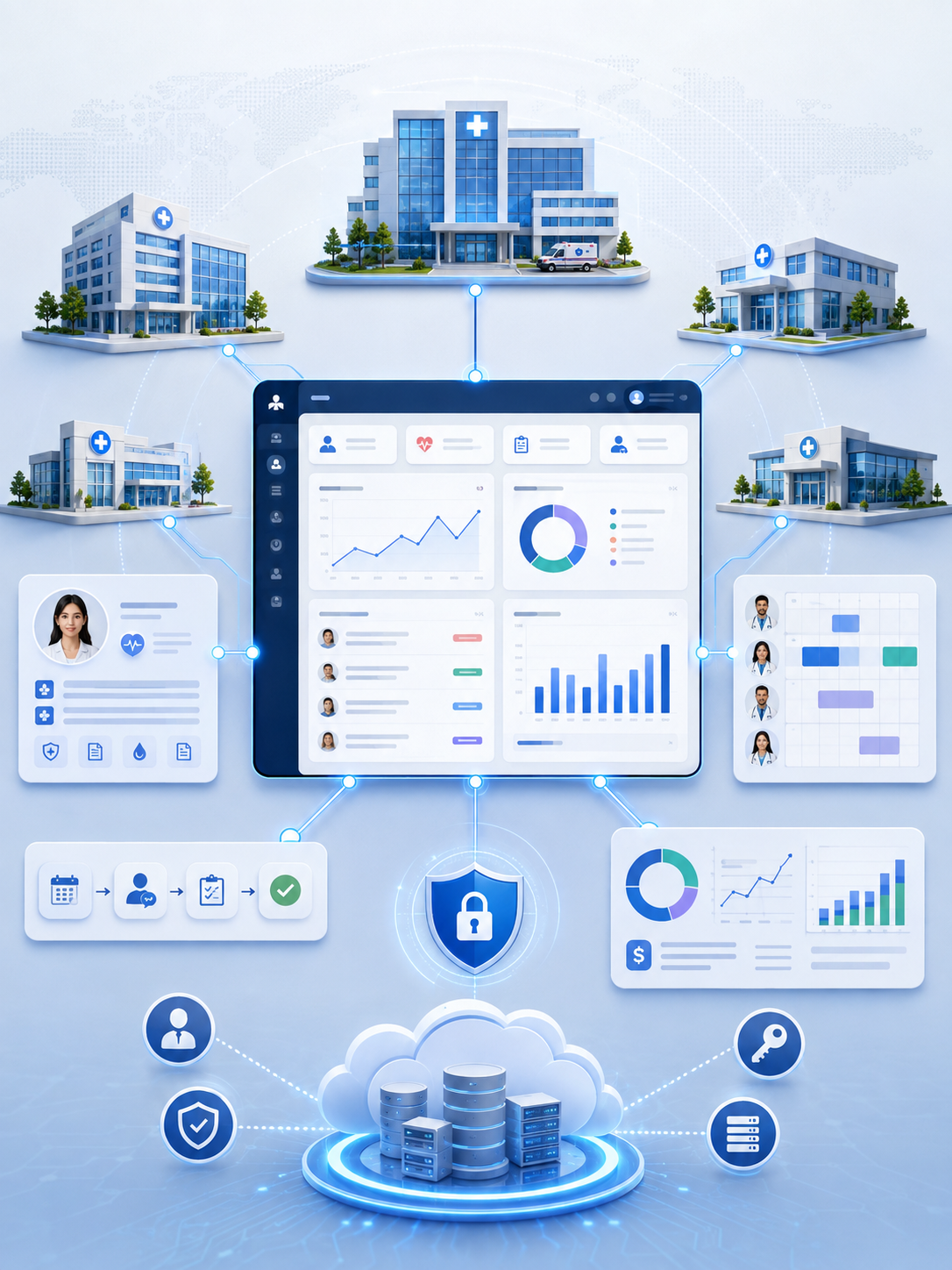
Connect Branches, Patients, Teams and Analytics in One System
Executive Analytics for Healthcare Leadership
The centralized dashboard gives leadership a broader operational view across branches.
Branch comparisons, appointments, revenue indicators, operational trends, and network-level KPIs can be consolidated into executive reporting.
The biggest value is not merely prettier dashboards.
It is reducing the delay between what happens at a branch and what leadership knows about it.
That makes the platform useful not just as an HMS, but as a healthcare network intelligence layer.
Cloud Architecture for Expansion
The project also emphasizes cloud-ready infrastructure and multi-city scalability.
This gives the healthcare organization a foundation for adding branches without rebuilding the entire platform architecture each time.
Future capabilities can also extend into pharmacy and laboratory integrations, healthcare CRM, telemedicine, patient mobile apps, analytics, AI assistants, automation, and ABDM-aligned integrations where required. These are identified as future expansion opportunities rather than current implemented capabilities.
Business Impact
The strongest documented outcomes are improved branch visibility, centralized operational control, better patient-record continuity, stronger appointment coordination, improved revenue visibility, reduced manual coordination, and greater readiness for multi-location growth.
This is a more credible conclusion than claiming that software automatically increases revenue or patient satisfaction.
The real transformation is:
Disconnected Branches → Connected Healthcare Network
Building a Multi-Location Healthcare Platform?
Murmu Software Infotech develops Multi-Location HMS platforms, hospital-chain management systems, clinic-network software, healthcare CRM, telemedicine platforms, healthcare analytics, cloud healthcare infrastructure, and custom healthcare automation solutions.
Frequently Asked Questions
What is multi-location hospital management software?
Multi-location hospital management software is a centralized HMS platform that allows hospital groups, clinic networks and healthcare organizations to manage branches, patient records, doctors, staff, appointments, revenue and analytics from one system.
How does multi-branch HMS work?
A multi-branch HMS connects each healthcare location to a central platform while preserving branch-level workflows, permissions and reporting. Leadership receives consolidated visibility while local teams continue managing day-to-day operations.
Can patient records be shared across hospital locations?
Yes. The documented platform supports centralized patient profiles, unified healthcare records and authorized cross-location access so patient history can follow the patient across branches.
Can hospital chains manage appointments across multiple locations?
Yes. Multi-location appointment workflows can include branch selection, doctor scheduling, multi-location booking and queue-management processes within one centralized system.
Can a multi-location HMS manage doctors and staff centrally?
Yes. The platform can support centralized doctor scheduling, staff workflows and multi-location workforce coordination while maintaining branch-specific operational visibility.
Can hospital leadership compare branch performance?
Yes. Branch-wise reporting can provide revenue analytics, appointment data, operational performance tracking, branch comparison analytics and centralized KPI visibility.
Does multi-location hospital software support role-based access?
Yes. The documented platform includes branch-level permissions, department-based access control and secure role-based operational workflows.
Can multi-location HMS support hospital expansion into new cities?
Yes. A cloud-ready architecture can support additional locations, centralized data access and multi-city operational scalability without requiring completely separate systems for each branch.
What is the difference between normal HMS and multi-location HMS?
A standard HMS may focus on one hospital, while multi-location HMS adds centralized branch management, cross-location patient records, group-level analytics, branch permissions, multi-location scheduling and healthcare-network reporting.
Who develops custom multi-location hospital management software?
Murmu Software Infotech develops multi-location HMS platforms, hospital chain management systems, clinic-network software, healthcare CRM, telemedicine platforms, healthcare analytics and cloud healthcare solutions.