AI Search Optimization for Enterprise Brands: SEO, AEO and GEO in One Strategy
In This Article
- Enterprise brands are entering a different search environment.
- AI Search Optimization Still Starts With SEO
- AEO Services Make Enterprise Content Answer-Ready
- GEO Services Build Citation and Recommendation Readiness
- AI Visibility Optimization Needs Strong Entity Signals
- Make Enterprise Content Easier to Find and Cite
- An AI-Ready CMS Makes Optimization Scalable
- Structured Data Supports Understanding
- Sitecore, Sanity and Headless CMS Websites Need Different Implementation Paths
- Measure AI Search Differently From Traditional SEO
- Proof: Audit First, Then Implement
- Who Should Invest in Enterprise AI SEO Services?
- Build One Strategy for Search and AI
Enterprise brands are entering a different search environment.
For years visibility meant ranking on Google and winning the click. But today, buyers may receive a summarized answer, a recommendation, a comparison or cited source before they ever reach a traditional results page.
That changes the optimization question.
It is no longer only:
“Can this page rank?”
It is also:
“Can search and AI systems understand, extract, trust and potentially cite this content?”
That is where AI search optimization becomes important.
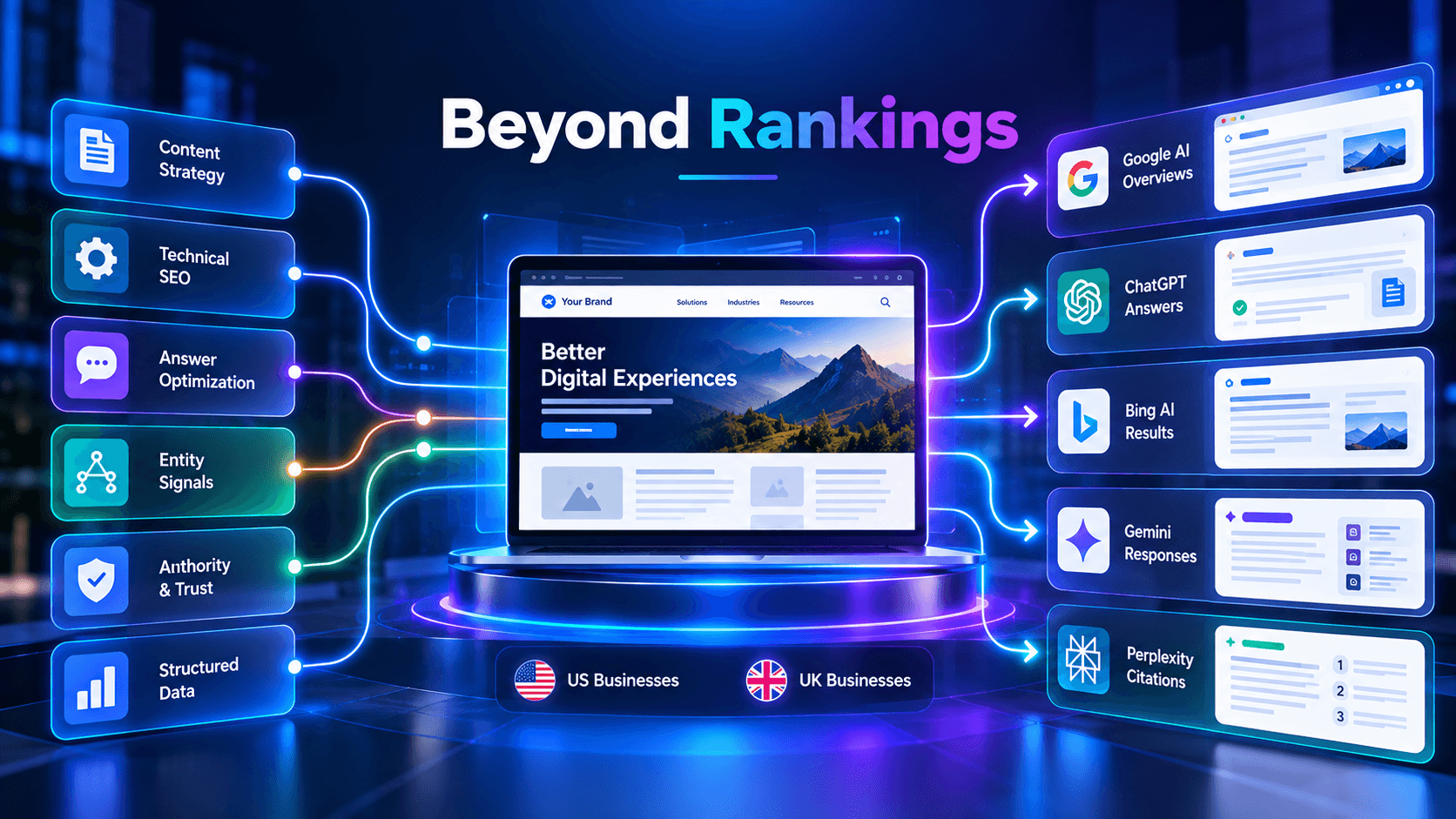
For enterprise brands, SaaS companies, agencies and CMS-heavy websites, the strongest strategy is not choosing between SEO, AEO and GEO. It is combining them into one system.
AI Search Optimization Still Starts With SEO
Traditional SEO remains the foundation.
Search and AI systems still depend on technically accessible content, clear site architecture and reliable indexing.
Enterprise websites should first validate:
- Crawlability
- Indexation
- Canonicals
- Internal linking
- Rendering
- Page performance
- Mobile usability
- Metadata
- Sitemaps
- Structured data
Google’s current guidance for generative AI search specifically states that normal SEO best practices remain relevant because its AI features are grounded in core Search systems.
So AI SEO services should not begin with AI-specific tricks.
They should begin by fixing the technical foundation.
Businesses that need a structured starting point can use AI search optimization services to evaluate technical SEO, answer readiness, entity clarity and AI visibility together.
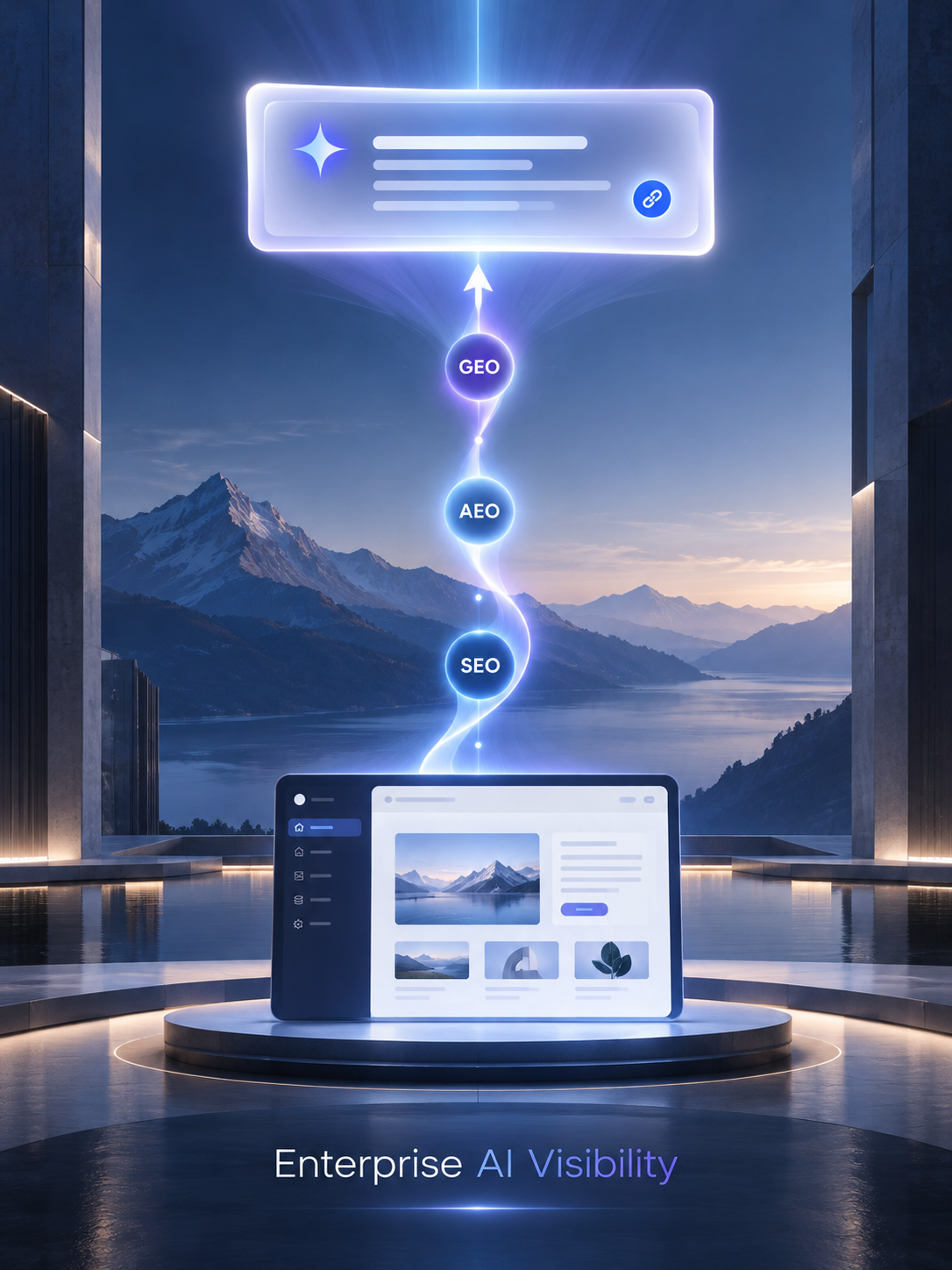
Build Visibility Beyond Rankings
Combine SEO, AEO, GEO, structured content and AI-ready CMS architecture to strengthen enterprise discovery across modern search experiences.
AEO Services Make Enterprise Content Answer-Ready
Answer Engine Optimization focuses on structuring content so useful answers can be identified quickly.
Many enterprise pages are technically comprehensive but difficult to extract from.
Important answers are often buried inside:
- Long introductions
- Large rich-text blocks
- Complex accordions
- Unclear headings
- Repeated marketing language
A better AEO structure starts with the user’s question.
For example:
What does the service do?
Give a direct answer first.
Who is it for?
Define the audience clearly.
How long does implementation take?
Provide a concise range with context.
What makes the approach different?
Answer directly, then support with evidence.
AEO does not mean writing only short content.
It means making important answers easy to locate inside deeper content.
Find Why AI Search Is Missing Your Enterprise Brand
GEO Services Build Citation and Recommendation Readiness
Generative Engine Optimization extends optimization beyond ranking.
The goal is to strengthen the signals that help generative systems understand what a brand is, what it knows and whether its content is useful enough to reference.
Current GEO frameworks commonly focus on four areas:
Technical accessibility - can systems access the content?
Content quality - is the information useful and extractable?
Entity clarity - does the system understand the brand and its relationships?
Brand authority - are there enough trust and credibility signals?
These layers work together rather than independently.
For enterprise teams, useful GEO signals can include:
- Clear organization information
- Expert authorship
- Original case studies
- Product facts
- Consistent naming
- Useful statistics
- Strong topical depth
- Supporting evidence
- Updated review dates
No agency can guarantee an AI citation. GEO improves clarity, authority and citation readiness, not guaranteed placement.
AI Visibility Optimization Needs Strong Entity Signals
A brand cannot be recommended confidently if systems struggle to understand what the brand actually is.
Entity optimization should make relationships explicit.
That can include:
- Organization name
- Products
- Services
- Industries served
- Locations
- Authors
- Expertise
- Customers
- Partnerships
- Case studies
- Related topics
This is particularly vital for enterprise brands that encompass more than one business unit, product name, market segment, and website presence.
Having consistent entity information across these facets can minimize ambiguity in knowledge graphs.
Entity clarity is increasingly being viewed as a critical layer of visibility by current AI-search research since systems are required to be able to differentiate one company, product or concept from another before they can successfully retrieve or cite it.
Make Enterprise Content Easier to Find and Cite
Find technical gaps, weak entities, missing answers and content architecture problems before they reduce AI visibility.
Request AI Search Audit
An AI-Ready CMS Makes Optimization Scalable
Enterprise optimization fails when important fields live only inside long page copy.
An AI-ready CMS can provide structured fields such as:
- AI summary
- AI search snippet
- Key facts
- Questions
- Direct answers
- Primary entity
- Target audience
- Service area
- Schema type
- Author
- Last reviewed date
This helps content teams publish information consistently.
Structured CMS architecture also makes it easier to reuse facts across landing pages, search, APIs and future AI workflows.
Murmu Software Infotech implemented this approach in Sanity CMS, including structured SEO, AEO and GEO fields. The Sanity SEO, AEO and GEO implementation case study shows how these fields can be built into the CMS rather than hardcoded into individual pages.
Structured Data Supports Understanding
Schema should support the visible content on the page.
Google is continuing its practice of using structured data to better understand page content & entities, but structured data should be accurate and relevant, as opposed to mechanically added.
Enterprise websites can use structured cms fields to generate markup such as:
- Article
- Organization
- Product
- Person
- BreadcrumbList
- Other supported types where appropriate
The strongest approach is:
CMS data → visible content → structured data
All three should stay aligned.
Sitecore, Sanity and Headless CMS Websites Need Different Implementation Paths
The strategy is similar, but implementation varies by platform.
For Sitecore estates, technical SEO and GEO may require changes to templates, renderings, metadata logic and content fields. MSI’s Sitecore GEO and AEO optimization guide covers this CMS-specific approach.
Enterprises with Sitecore performance or search issues can also use Sitecore SEO services.
Sanity-based teams can build AI-ready fields directly into schemas using Sanity CMS development services.
For broader composable architectures, headless CMS development services can connect structured content with modern frontend delivery.
Turn Enterprise SEO Into Stronger AI Search Visibility
Measure AI Search Differently From Traditional SEO
Traditional metrics still matter:
- Rankings
- Organic sessions
- Impressions
- Clicks
- Conversions
But enterprise AI visibility optimization should also consider:
- Brand mentions
- Citation frequency
- Prompt visibility
- Citation sources
- Answer inclusion
- Competitive visibility
- AI referral traffic
Do not replace revenue metrics with vanity visibility metrics.
The better approach is to understand whether visibility contributes to qualified traffic, conversions, pipeline or brand discovery.
Proof: Audit First, Then Implement
AI-search work should begin with measurement.
The AI search optimization audit and 30-day roadmap provides a practical sequence:
Audit → prioritize → fix technical issues → structure answers → strengthen entities → implement in CMS → remeasure
That sequence prevents teams from publishing more content before fixing the underlying architecture.
Who Should Invest in Enterprise AI SEO Services?
This approach is most relevant for:
- Enterprise brands
- SaaS companies
- B2B organizations
- Agencies
- Content-heavy platforms
- Large Sitecore websites
- Sanity implementations
- Headless CMS ecosystems
- Companies already investing heavily in SEO
If your buyers use search and AI tools to compare products, vendors or expertise, AI visibility should now be part of the broader organic strategy.
Build One Strategy for Search and AI
SEO, AEO and GEO should not become three disconnected programs.
The stronger model is:
SEO → discovery
AEO → answers
GEO → understanding, authority and citation readiness
Then connect all three through structured content, schema, entity signals and CMS implementation.
Explore AI search optimization services to identify where your website is strong, where AI systems may be missing context and what should be implemented next.
Frequently Asked Questions
What is AI search optimization for enterprise brands?
AI search optimization combines SEO, AEO, GEO, structured content, entity optimization and technical implementation to improve how enterprise brands are discovered, understood and potentially cited across traditional and AI-powered search.
What is the difference between SEO, AEO and GEO?
SEO improves crawling, indexing and organic search performance. AEO structures content for direct answers. GEO strengthens entity clarity, authority and citation readiness for generative search systems.
Does traditional SEO still matter for AI search?
Yes. Technical accessibility, useful content, internal linking, indexing, page experience and clear site architecture remain important foundations for AI-powered search visibility.
What are AEO services?
AEO services improve answer readiness by organizing content around user questions, concise direct answers, FAQs, semantic headings and supporting context.
What are GEO services?
GEO services improve how generative systems understand and evaluate a brand through entity clarity, topical depth, evidence, authority signals and citation-ready content.
What makes a CMS AI-ready?
An AI-ready CMS stores important information such as summaries, key facts, questions, direct answers, entities, audiences, service areas and freshness dates as structured fields rather than burying everything in rich text.
Does schema markup improve AI visibility?
Relevant structured data can improve machine understanding when it accurately represents visible content, but schema alone does not guarantee rankings or AI citations.
How can enterprises measure AI search visibility?
Track brand mentions, citations, prompt visibility, citation sources, answer inclusion, AI referral traffic and competitive visibility alongside traditional SEO and conversion metrics.
Can AI search optimization guarantee AI citations?
No. Search and AI platforms independently determine which sources they retrieve, surface or cite. Optimization improves technical quality, clarity, authority and citation opportunities.
When should an enterprise request an AI search audit?
An audit is useful when organic SEO is mature but AI visibility is unclear, content is poorly structured, CMS fields are limited, entities are inconsistent or the business wants to measure prompt-level visibility.