React Native App Development for Startups: Launch Your Mobile MVP Faster
In This Article
- 1. Why React Native App Development Makes Sense for Startups
- 2. Why Manual Workflows Limit Mobile Business Growth
- 3. Cross-Platform App Development: What Should a Mobile MVP Include?
- 4. MSI's Mobile MVP Development Approach
- Ready to Build Your Mobile MVP?
- 5. Mobile App Development Use Cases Across Industries
- 6. React Native Development Services: Practical Project Examples
- 7. React Native MVP Development Cost and Timeline
- 8. Business Benefits of Launching a Mobile MVP First
- Conclusion: Launch Faster, Learn Earlier, Scale Smarter
- Build Your React Native Mobile MVP
Your startup has a brilliant concept for a mobile application. But developing the Android and iOS apps, leading multi-skilled teams of developers, and building features before knowing if your customers will actually buy from you, can take a huge toll on your budget.
For founding teams, small businesses, and product managers, the challenge is not launching the product. It is shipping the right product, validating demand, and iterating the business model before investing more resources.
This is where React Native app development and mobile MVP development consultants such as ourselves can help.
Instead of developing two native mobile applications, startups can utilize cross-platform mobile app development approaches and launch their MVP on both the Android and iOS platforms. This enables them to reach out to wider audiences and utilize similar lines of code for both operating systems.
As a leading React Native application development company, Murmu Software Infotech can help you build focused MVPs, which have intuitive UI/UX, robust backend API, admin dashboards, analytical tools, and well-architected software code, to drive your business forward.
1. Why React Native App Development Makes Sense for Startups
React Native is a mobile application development framework that enables developers to create Android and iOS applications using JavaScript or TypeScript and React.
For startups, its most important advantage is the ability to reuse application logic and interface components across platforms.
This can provide several benefits:
- Reduced duplication between Android and iOS development.
- Faster implementation of shared product features.
- Easier coordination within one mobile development team.
- Consistent core user experiences across devices.
- Simpler iteration when early users request improvements.
However, some platform-specific functionality still requires native development and testing.
React Native is not automatically the best choice for every application, but it is a strong option for many workflow-driven mobile MVPs.
Explore MSI's mobile app development services for Android, iOS, and cross-platform application requirements.
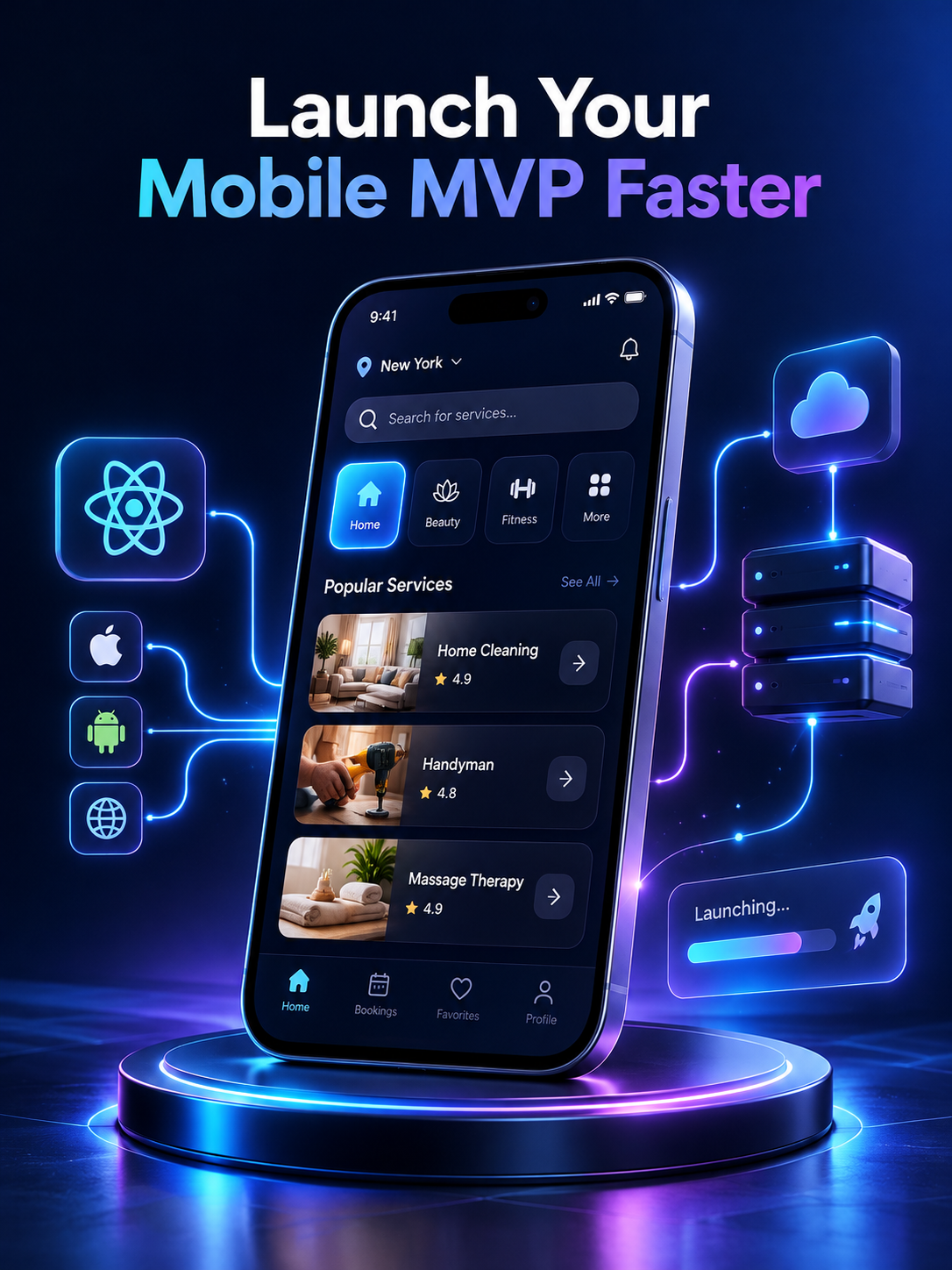
Launch Your Mobile MVP Faster
Transform your app idea into a market-ready Android and iOS MVP with React Native, seamless integrations, and scalable backend architecture.
2. Why Manual Workflows Limit Mobile Business Growth
Many companies manage their order, appointment, customer support, and field service processes with spreadsheets, phone calls, text messages, and reports.
As the volumes grow, having disconnected order management systems creates operational challenges.
Teams face issues such as data redundancy, poor update synchronization, missed or unfulfilled customer requests, and lack of business intelligence.
A mobile-based solution can unify the customer, employee, and admin experience in one integrated process.
For instance, a service company may decide to launch its MVP with a customer sign-up sheet, booking system, reminder notifications, and an administrative dashboard.
The company does not have to build an end-to-end solution in its first version.
The main point of an MVP app development is to digitize the most critical process.
3. Cross-Platform App Development: What Should a Mobile MVP Include?
A successful cross-platform app development strategy begins with defining the core customer journey.
Depending on business requirements, a mobile MVP may include:
- User authentication: Secure registration, login, and role-based access.
- Core mobile workflow: Booking, purchasing, requesting services, or managing tasks.
- Backend APIs: Reliable communication between the app, database, and business systems.
- Admin dashboard: Management of users, requests, listings, or transactions.
- Push notifications: Relevant updates and customer communication.
- Payment integration: Transactions or subscription workflows where necessary.
- Analytics: Tracking user activation, engagement, and conversion.
- Security: Appropriate data protection, validation, and access controls.
The goal is not to build the longest feature list.
It is to deliver one complete experience that users can test and businesses can measure.
Turn Your Mobile App Idea Into a Market-Ready MVP Faster
4. MSI's Mobile MVP Development Approach
MSI approaches startup MVP development through practical planning and phased delivery.
Step 1 — Product discovery
Understand the target audience, business problem, revenue model, and success criteria.
Step 2 — MVP feature prioritization
Identify essential features for launch and postpone functionality that does not support early validation.
Step 3 — Mobile UI/UX design
Create intuitive user journeys, wireframes, and application screens.
Step 4 — React Native development
Build shared mobile functionality alongside required Android- and iOS-specific components.
Step 5 — Backend and admin integration
Connect APIs, databases, administrative workflows, authentication, and necessary third-party services.
Step 6 — Testing and launch
Validate functionality across supported devices, resolve critical issues, and prepare application-store submissions.
Step 7 — User feedback and iteration
Measure actual usage and improve features based on customer behavior.
Our MVP application development services support founders who want to validate software products before scaling.
Ready to Build Your Mobile MVP?
Turn your app idea into a focused Android and iOS product with essential features, connected workflows, and a practical launch plan.
5. Mobile App Development Use Cases Across Industries
React Native can support different mobile-first business models.
Marketplace startups: Buyer and seller registration, listings, inquiries, transactions, and management dashboards.
Retail and eCommerce: Mobile catalogs, shopping carts, order tracking, customer accounts, and payment workflows.
Healthcare and clinics: Appointment booking, patient communication, notifications, and operational workflows.
Service businesses: Customer booking, technician assignments, service status updates, and feedback.
Logistics and delivery: Delivery requests, order tracking, driver workflows, and operational visibility.
Enterprises and SMEs: Internal approvals, field reporting, employee applications, and business process automation.
The right feature set depends on what the business must validate first.
6. React Native Development Services: Practical Project Examples
Before choosing a development partner, founders should examine relevant technical experience and application workflows.
MSI's React Native Development Services Guide explains cross-platform development considerations and practical application capabilities.
Its React Native Development Use Case Study provides additional context for mobile application use cases.
For marketplace founders, the Gaxa Local Marketplace Platform case study offers an example of buyer-and-seller platform workflows.
These resources help illustrate relevant development approaches without assuming that every project has identical requirements or outcomes.
7. React Native MVP Development Cost and Timeline
How much does mobile MVP development cost?
The answer depends on application complexity, feature scope, and technical requirements.
Important factors include:
- Number of user roles and screens.
- Backend and database complexity.
- Custom UI/UX requirements.
- Payment, mapping, and messaging integrations.
- Real-time updates and offline functionality.
- Device-specific features.
- Security, testing, and deployment.
- Maintenance and post-launch improvements.
A simple mobile prototype may take several weeks, while a production-ready marketplace or service platform with multiple user roles can require several months.
React Native may reduce duplicated cross-platform effort, but it does not eliminate backend, testing, infrastructure, or integration costs.
Founders should request an estimate based on a clearly documented MVP scope rather than relying on a generic fixed price.
Ready to Launch Your Mobile App Without Wasting Development Budget?
8. Business Benefits of Launching a Mobile MVP First
A validation-first approach gives founders the opportunity to:
- Test customer demand before expanding the product.
- Collect feedback from Android and iOS users.
- Evaluate onboarding and user engagement.
- Validate transactions, subscriptions, or service workflows.
- Identify usability problems earlier.
- Prioritize features using real evidence.
- Control unnecessary initial development investment.
Key performance indicators may include activation rate, completed bookings, repeat usage, customer retention, and paid conversion.
A successful MVP does not simply demonstrate that the software works.
It demonstrates whether the product creates value for its intended users.
Conclusion: Launch Faster, Learn Earlier, Scale Smarter
Founders rarely need two separate mobile development teams and full-featured applications at launch. Sometimes they need something they can rely on for months and years to come. A product that would address real-world problems, tying together core business processes and acting as a source of actionable feedback from users.
By building the application with React Native, the right backend architecture, administrative panel, and an eye toward future development, your business can have a sustainable product that evolves with users’ needs.
MSI can help you design and develop a product around your specific requirements if you need to build a marketplace app, a service platform, an eCommerce storefront, or a tool for your business or team.
Build Your React Native Mobile MVP
Start with the right features, validate your business idea, and prepare your mobile application for future growth.
Frequently Asked Questions
What is React Native app development and why is it good for startups?
React Native app development uses a cross-platform framework to build Android and iOS applications with a largely shared JavaScript or TypeScript codebase. It can help startups reduce duplicated development effort, launch mobile MVPs faster and test customer demand before investing in a larger product. Platform-specific development and testing may still be required.
How much does React Native app development cost in 2026?
React Native app development costs depend on the number of screens, user roles, UI/UX design, backend APIs, payment integrations, security and testing. A basic MVP generally requires less investment than a complex marketplace or multi-role business application. Startups should request a cost estimate based on documented features, technical requirements and the intended launch scope.
How long does it take to build a React Native mobile MVP?
A simple React Native prototype may take several weeks, while a production-ready mobile MVP with authentication, backend integration, payments, admin dashboards and testing may require several months. The development timeline depends on feature complexity, design requirements, integrations and app-store readiness.
Is React Native better than native Android and iOS development for an MVP?
React Native can be a strong choice when startups need to launch on Android and iOS with shared features, limited budgets and fast iteration. Fully native development may be more appropriate for applications requiring highly specialized device capabilities, intensive graphics or platform-specific optimization. The best option depends on product requirements.
What features should a React Native mobile MVP include?
A React Native mobile MVP should include the minimum features required to validate its main business workflow. Common features include secure login, user profiles, essential application screens, backend API integration, basic admin management, analytics and notifications. Payments, maps and additional integrations should be included when they are necessary to test the business model.
Can React Native be used to build marketplace and eCommerce mobile apps?
Yes. React Native can be used to develop marketplace and eCommerce applications with product listings, buyer and seller accounts, carts, checkout, order tracking, service booking, notifications and customer dashboards. These features typically rely on supporting backend services, databases and payment integrations.
Can React Native apps work on both Android and iOS?
Yes. React Native supports Android and iOS development using a largely shared codebase. Developers can reuse business logic and many interface components, although some native modules, device integrations, platform-specific adjustments and operating-system testing remain necessary.
How do I choose the right React Native app development company?
Choose a React Native app development company with relevant cross-platform experience, demonstrable application workflows, backend API expertise, UI/UX capabilities, mobile security practices and post-launch support. Review its development process, project scope, communication standards, testing approach and ability to prioritize MVP features.
Can a React Native MVP scale into a full mobile application?
Yes. A React Native MVP can evolve into a larger mobile application when its codebase, backend architecture, APIs, security and infrastructure are designed for maintainability. Scaling may require performance optimization, additional services, improved monitoring and architectural changes as usage increases.
Does Murmu Software Infotech provide React Native and mobile MVP development services?
Murmu Software Infotech provides React Native mobile app development, cross-platform application development and startup MVP development services. Its development approach includes product discovery, UI/UX design, Android and iOS application development, backend API integration, admin dashboards, testing and iterative product improvement. Businesses can discuss their requirements and request a mobile MVP development estimate.