Case Study: AI Product & Service Cost Calculator for Manufacturing
In This Article
Transforming Cost Estimation, Quotation Speed, and Profitability with AI
Manufacturing companies work in such a way where the quotation process needs to be quick and accurate. There are various factors that a manufacturing company considers when quotation for any product is to be made including cost of materials, number of hours, wages, the process of production, wastage, tools and spares, quality inspection, packing and delivery. There are multiple costs involved and it is only natural that mistakes are made when all these costs are calculated in excel sheet, manually or based on individual knowledge which can lead to delays in quotation process, incorrect pricing, loss of margins and missed sales opportunities.
The AI Product & Service Cost Calculator is designed to solve this challenge by offering them a centralized intelligent platform for product costing, service costing, scenario analysis, margin management and quotation preparation.
This case study demonstrates how a medium or large manufacturing company may use this platform to accelerate, improve accuracy, increase profits and convert revenues.
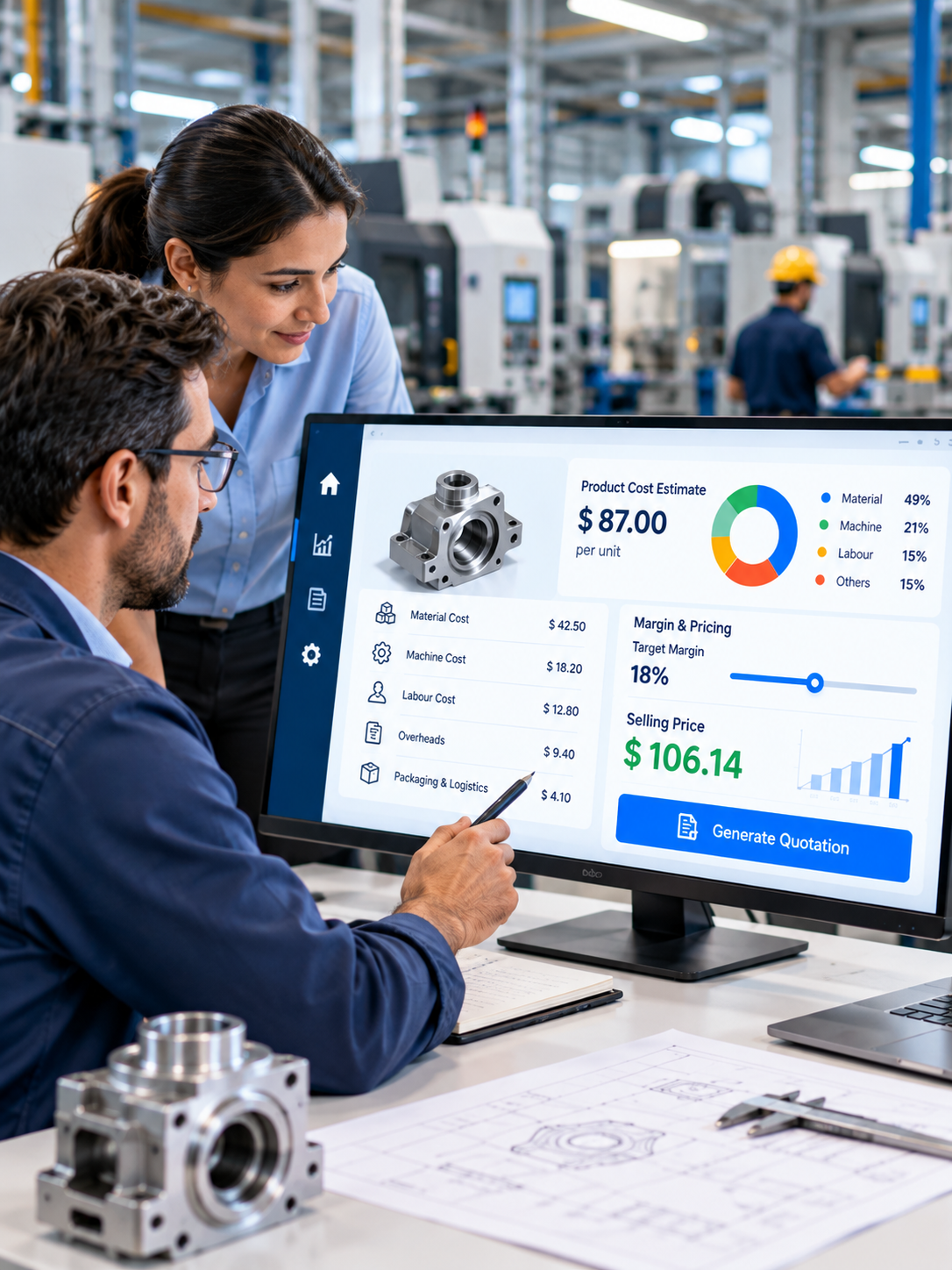
Turn Costing Into Competitive Advantage
Accelerate manufacturing estimates, evaluate cost scenarios, protect margins, and move from customer requirements to profitable quotations with AI-assisted costing.
The Business Challenge
A manufacturing company gets hundreds of RFQs (request for quotation) and pricing requests each week. For each request, the customer usually specifies various terms and conditions, such as product type, quantity, materials, manufacturing processes, delivery dates, services, and commercial terms.
Before responding to an RFQ with a quotation, the estimation team might need to ask the procurement, production, engineering, quality, finance, and sales departments for information.
A typical costing exercise may involve:
- Checking raw-material prices
- Preparing or reviewing a BOM
- Calculating material wastage
- Estimating machine hours
- Calculating labour requirements
- Adding outsourced processes
- Applying factory overheads
- Including packaging and logistics
- Calculating service or installation charges
- Deciding a target margin
- Preparing the final customer quotation
In many companies, this information is scattered all over the place – in spreadsheets, ERP reports, emails, PDFs, old quotations, and the heads of individual employees.
Thus, a simple quotation that should take only a few minutes can swallow up hours or even days.
This causes three significant business challenges.
The first problem is that the company reacts too slowly to requests, handing them over to faster competitors.
Second, costing errors lead to lower margins and loss of profit.
Third, the management has no clear understanding of which elements affect the composition of the product and how to cut costs in the future.
See How AI Can Transform Your Manufacturing Costing
The Solution
The AI Product & Service Cost Calculator provides one platform where the entire costing process can be structured, calculated, analyzed, and converted into a quotation.
The solution combines:
BOM + Material Cost + Machine Cost + Labour + Manufacturing Processes + Overheads + Quality + Packaging + Logistics + Service Cost + Margin + Quotation
The application uses a deterministic calculation engine for all financial calculations, and AI helps the user understand the requirements, find missing cost components, analyze cost drivers, compare scenarios, and generate management insights.
For example, a cost engineer can enter:
“We need to manufacture 5,000 industrial pump housings using SS316 with CNC machining, drilling, finishing, inspection, and packaging.”
The AI can identify the relevant costing components and suggest the manufacturing structure. The user reviews and approves those suggestions, and the cost engine then calculates the actual estimate using configured rates and formulas.
This creates a controlled combination of AI intelligence and reliable financial calculation.
Faster Cost Estimation
One of the major advantages of estimating software is the reduced turnaround time
Instead of manually building each estimate on a blank spreadsheet, your estimators will be able to leverage job-costing masters for materials, machines, labour categories, manufacturing processes, overheads, and products previously estimated.
Previously estimated products can also serve as cost references.
For similar and recurring products, estimators can copy previous estimates, adjust quantities or material rates, and re-generate cost figures in one click.
Estimating software can also help you identify missing components (e.g., tooling, testing, wastage, inspection, subcontracting, shipping) for more accurate customer quotes.
With a centralized estimate database and automated processing, you can move from a fragmented spreadsheet-based costing process to a standardized digital estimating workflow.
This drastically reduces the time spent preparing quotes and enables you to handle more RFQs with the same team, without the need to hire additional people.
Better Margin Protection
Fast quotations alone are not enough. They must also be profitable.
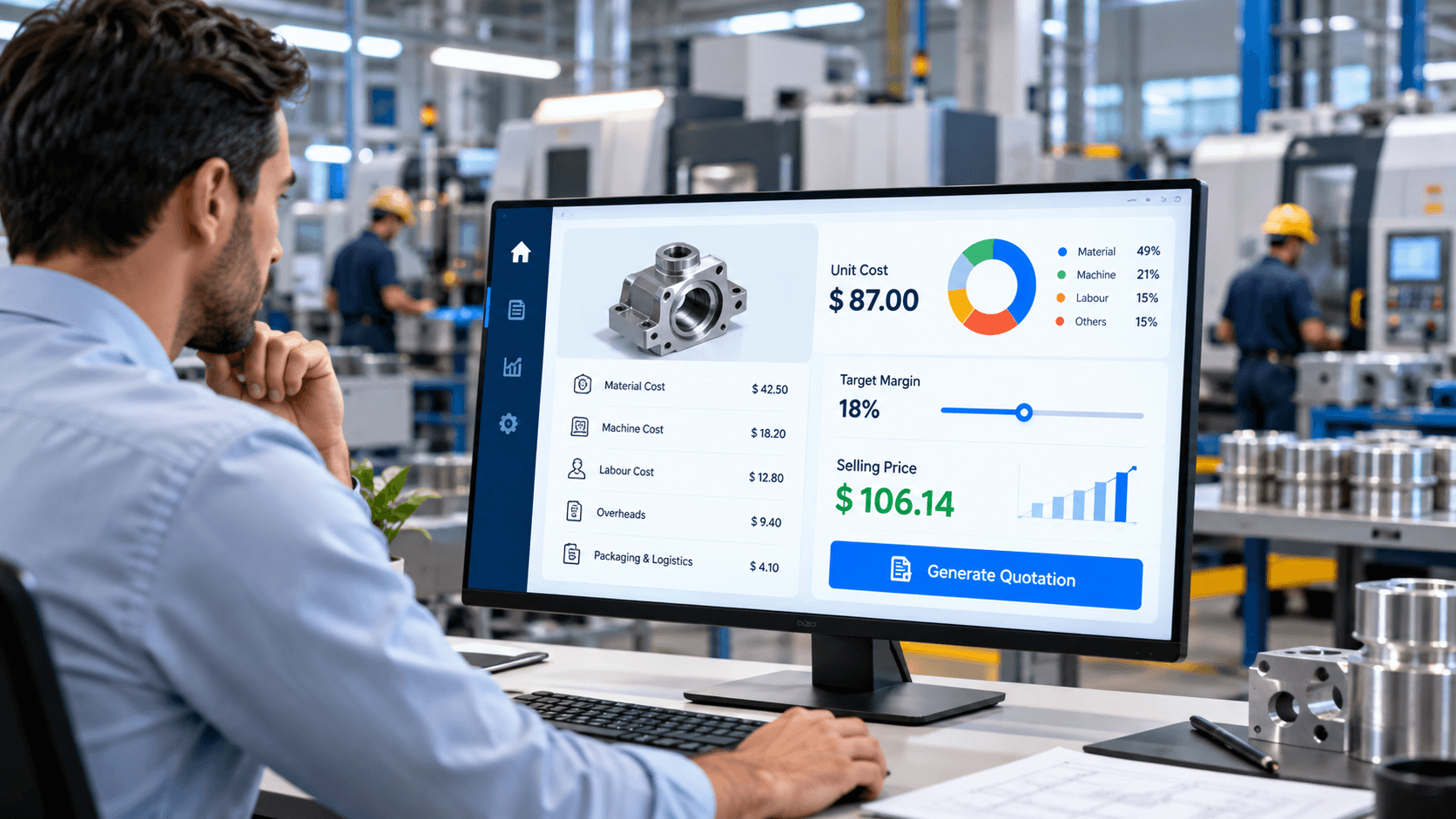
The platform gives clear visibility into every major cost component and calculates both total cost and unit cost.
Management can immediately see:
- Material contribution
- Machine contribution
- Labour contribution
- Process costs
- Overheads
- Packaging
- Logistics
- Additional costs
The system also distinguishes between markup and target gross margin, which is important because the two calculations are often confused in manual costing.
For example, if a product costs ₹100 and the company wants a 20% gross margin, the correct selling price is ₹125 not ₹120.
By making these calculations standardized and transparent, the company reduces the risk of margin leakage caused by incorrect formulas or inconsistent spreadsheet practices.
Scenario Analysis for Better Decisions
There are always changes in manufacturing costs.
Raw material prices, order quantities, labour rates, supplier quotations and customer discounts are just some of the variables that can change.
The platform allows you to carry out these variations in a trial run, before making a commercial decision.
For example:
What happens if SS316 increases by 8%?
What happens if the order increases from 5,000 to 10,000 units?
What if we use an alternative supplier?
What selling price is required to maintain an 18% margin?
The Scenario Engine recalculates these alternatives without changing the original estimate.
This allows sales, procurement, finance, and management to make decisions using numbers rather than assumptions.
Quote Faster, Protect Margins, and Win More Orders
Supporting Revenue Growth
The platform helps revenue growth in several ways.
The most immediate impact is quotation speed.
When a company responds faster to customer RFQs, it increases its chances of entering negotiations before competitors.
The second impact is quotation capacity. If the costing team can process more opportunities in the same amount of time, the sales organization can pursue more business without creating an operational bottleneck.
The third impact is better commercial decisions. Sales teams can quickly understand how much discount can be offered without damaging the required margin.
Instead of asking finance or costing teams to repeatedly recalculate a proposal, they can review approved pricing scenarios instantly.
The fourth impact is reuse of historical intelligence.
If the company has previously quoted a similar product, the platform can surface the historical cost, quantity, material price, and selling price. This reduces duplicate effort and improves consistency.
Over time, this creates a valuable manufacturing cost knowledge base.
Business Outcome
The AI Product & Service Cost Calculator transforms costing from a spreadsheet-driven back-office activity into a strategic commercial capability.
A manufacturing company can move toward:
Faster RFQ response → More quotations → Better pricing decisions → Protected margins → Higher conversion potential → Revenue growth
At the same time, management gains greater insight into where the money is spent, which products are expensive to make, where the costs are rising, and where there are opportunities to optimize.
The solution can later be integrated with ERP, MES, PLM, procurement, CRM, and supplier systems, creating an extensive ecosystem of manufacturing intelligence.
The value is not in calculating a number.
It is in helping the manufacturer quote faster, price smarter, control costs, protect margins, and convert more opportunities into profitable business.
Frequently Asked Questions
What is an AI manufacturing cost calculator?
An AI manufacturing cost calculator helps manufacturers structure product and service estimates using materials, BOMs, machine time, labour, processes, overheads, packaging, logistics and other cost inputs. AI can assist with requirement interpretation and cost analysis, while deterministic calculation rules produce the financial totals.
How does AI help manufacturers calculate product costs faster?
AI can interpret manufacturing requirements, identify relevant materials and processes, highlight missing cost components and summarize cost drivers. This reduces manual preparation while a rules-based cost engine performs the actual cost calculations.
Can AI manufacturing costing reduce quotation turnaround time?
Yes. By centralizing costing data, reusing historical estimates, automating calculations and assisting with RFQ interpretation, manufacturers can reduce the manual effort required to move from customer requirements to a commercial quotation.
What costs should manufacturing cost estimation software include?
A comprehensive manufacturing estimate can include raw materials, BOM quantities, wastage, machine hours, labour, manufacturing processes, tooling, subcontracting, quality inspection, packaging, logistics, overheads and other organization-specific costs.
How can manufacturing costing software help protect profit margins?
Manufacturing costing software provides visibility into unit cost, total cost and major cost drivers before a quotation is submitted. It can calculate selling prices using target margin or markup rules and help teams understand the commercial effect of discounts or cost changes.
Can manufacturers perform what-if cost analysis using AI?
Yes. Users can model scenarios such as material price increases, production-volume changes, different supplier rates, labour-rate changes or alternative target margins. The scenario is interpreted and then recalculated using the deterministic cost engine.
Can an AI cost calculator integrate with SAP or other ERP systems?
Yes. An enterprise implementation can integrate with systems such as SAP, Microsoft Dynamics, Oracle or custom ERP platforms to retrieve materials, BOMs, supplier prices, customers, orders and other approved master or transactional data.
What is the difference between markup and gross margin in manufacturing pricing?
Markup is calculated as a percentage added to cost, while gross margin represents profit as a percentage of selling price. For example, a product costing 100 with a 20 percent markup sells for 120, while a 20 percent gross-margin target requires a selling price of 125.
Can AI manufacturing costing use historical quotations?
Yes. Historical estimates and quotations can help users find similar products, compare previous material and production costs, understand cost changes and prepare new estimates using relevant prior manufacturing knowledge.
How can faster manufacturing costing support revenue growth?
Faster costing can help sales teams respond to more RFQs, shorten quotation turnaround, evaluate commercial scenarios sooner and make better-informed pricing decisions. This can increase quotation capacity while helping the organization protect required margins.