Healthcare ERP Case Study: Unifying Hospital Finance, Inventory, HR & Operations
In This Article
- The Challenge: Too Many Departments, Too Little Shared Visibility
- The Solution: One Healthcare ERP Across Operations
- Finance and Billing: Improving Financial Visibility
- Inventory, Pharmacy and Procurement Working Together
- HR and Workforce Operations
- Laboratory and Department Coordination
- Executive Reporting and Role-Based Access
- Business Impact
- Built for Expansion
- Building a Healthcare ERP Platform?
As healthcare organizations grow, operational complexity increases quickly.
A hospital may have excellent clinical teams yet still struggle with fragmented finance systems, manual procurement, disconnected inventory records, separate pharmacy workflows, spreadsheet-based HR processes, delayed management reports, and limited visibility across departments.
That was the core challenge behind this healthcare ERP initiative.
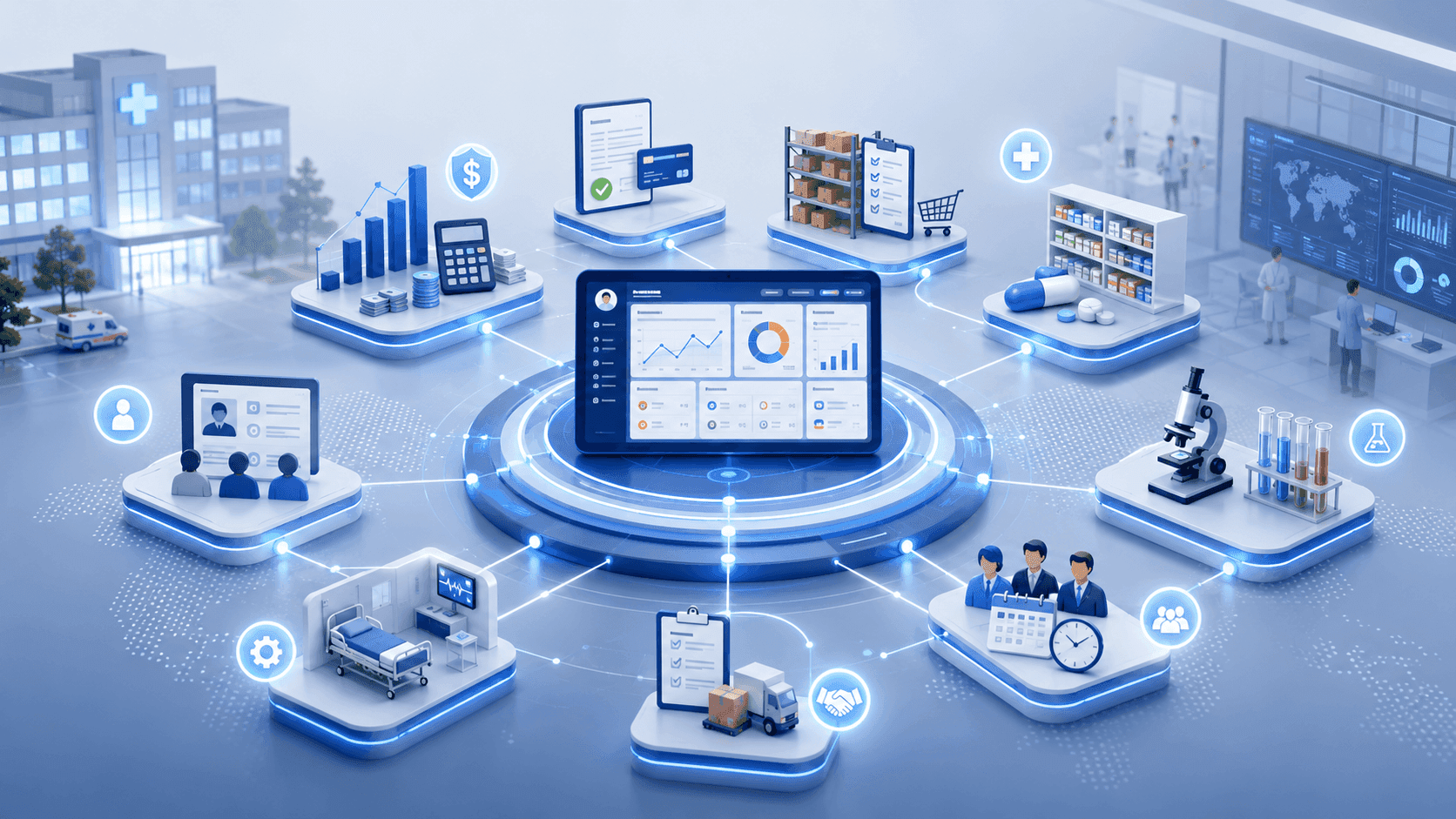
Murmu Software Infotech developed an integrated Healthcare ERP platform designed to connect hospital administration, finance, billing, inventory, pharmacy, laboratory operations, HR, procurement, vendors, departmental workflows, and management reporting within one enterprise system.
The objective was not simply to digitize individual departments.
It was to create one operational backbone for the healthcare organization.
The Challenge: Too Many Departments, Too Little Shared Visibility
The organization was operating through multiple disconnected workflows.
Departments worked independently, many activities still depended on spreadsheets and paperwork, medicine and equipment tracking lacked transparency, financial reporting was delayed, HR processes were fragmented, and procurement teams had limited visibility into supplier performance and stock requirements.
These issues created a familiar enterprise problem:
each department had data, but leadership lacked one reliable operational picture.

Unify Hospital Operations with ERP
Connect finance, inventory, procurement, HR, pharmacy, laboratories, and analytics through one scalable platform built for modern healthcare organizations.
That made it harder to answer basic management questions such as:
- What is current revenue versus expense?
- Which departments are driving costs?
- Which medicines or consumables are running low?
- What stock should be purchased next?
- Which vendors are performing reliably?
- What payroll or staffing issues need attention?
- How is each department performing today?
The hospital needed a platform that connected these questions instead of answering them through separate reports.
Unify Hospital Operations with a Scalable Healthcare ERP Platform
The Solution: One Healthcare ERP Across Operations
The solution unified the major administrative and operational functions of the healthcare organization.
A simplified enterprise workflow became:
Patient Activity → Billing & Finance → Lab/Pharmacy → Inventory → Procurement → HR & Operations → Reporting → Executive Dashboard
This creates a continuous flow of operational data rather than isolated departmental records.
Importantly, this is where an ERP differs from a basic HMS.
An HMS is primarily focused on patient and hospital-service workflows. A healthcare ERP extends much further into enterprise finance, workforce, supply chain, procurement, vendor management, inventory control, and management intelligence.
Finance and Billing: Improving Financial Visibility
The finance layer brought billing automation, revenue monitoring, payment tracking, and financial reporting into a centralized workflow.
Instead of waiting for manually consolidated reports, management could work from more current operational information.
The business value is not just faster billing.
It is the connection between services delivered, payments collected, department activity, inventory consumption, procurement, and financial reporting.
That gives finance teams a stronger basis for understanding where money is coming from and where operational costs are being created.
Inventory, Pharmacy and Procurement Working Together
Hospital inventory is more complex than general office stock.
Medicines, consumables, medical equipment, and department-specific supplies need continuous visibility.
The ERP included stock tracking, medicine inventory, equipment management, low-stock alerts, pharmacy workflows, purchase processes, supplier management, and stock-related reporting.
The most important architectural improvement is the connection:
Consumption → Stock Level → Low-Stock Signal → Procurement → Supplier → Replenishment
Instead of inventory and procurement operating independently, purchasing decisions can be informed by actual operational demand.
This can help reduce avoidable overstocking, shortages, and emergency purchasing.
HR and Workforce Operations
Hospitals also manage complex workforce requirements across clinical, administrative, technical, and support teams.
The ERP included employee records, attendance, shift management, and payroll workflows.
Centralizing these processes gives administrators better visibility into staffing and reduces reliance on separate attendance, payroll, and workforce spreadsheets.
For growing hospital groups, this becomes increasingly important because workforce administration must scale alongside clinical operations.
Connect Finance, Inventory, HR and Operations in One System
Laboratory and Department Coordination
The platform also connected laboratory workflows including test processing, sample tracking, report generation, and lab analytics.
Department-level workflow management added process tracking, approvals, and cross-department coordination.
This matters because healthcare operations rarely stop at department boundaries.
A single patient journey may involve registration, consultation, diagnostics, pharmacy, billing, and follow-up.
The ERP helps create a shared operational environment around those connected activities.
Executive Reporting and Role-Based Access
One of the most important benefits of enterprise software is not automation alone it is visibility.
The platform included revenue dashboards, department reports, operational KPIs, performance analytics, and executive reporting.
Role-based access controls were also implemented with department-level permissions, user controls, and audit tracking.
This allows the same ERP to serve different responsibilities:
Executives see organizational performance.
Finance sees financial controls.
Operations sees workflows.
HR sees workforce information.
Department teams see only what they need.
Business Impact
The case study reports faster workflows, reduced manual effort, stronger financial visibility, improved stock planning, quicker reporting, better departmental coordination, and multi-location readiness.
The strongest conclusion is therefore not that ERP automatically “reduces costs.”
It is that an integrated ERP creates better operational control and better information for making cost, staffing, procurement, and growth decisions.
That is a more credible and strategically valuable result.
Built for Expansion
The platform was also positioned for future integrations including healthcare analytics, CRM, telemedicine, mobile applications, AI chatbots, ABDM-aligned systems, executive dashboards, and multi-location healthcare management.
This creates an important architectural principle:
ERP should become the operational backbone not another isolated application.
Building a Healthcare ERP Platform?
Murmu Software Infotech develops Healthcare ERP, Hospital Management Systems, healthcare CRM, pharmacy and laboratory software, inventory and procurement platforms, HR/payroll systems, analytics dashboards, telemedicine applications, and multi-location healthcare solutions.
For hospitals and healthcare groups planning to scale, the goal should not be simply adding more software.
The goal is connecting finance, people, inventory, procurement, departments, and leadership around one reliable operational system.
Frequently Asked Questions
What is healthcare ERP software?
Healthcare ERP software is an integrated enterprise platform that connects hospital administration, finance, billing, inventory, procurement, HR, pharmacy, laboratories, vendors and management reporting within one operational system.
What is the difference between Hospital Management Software and Healthcare ERP?
Hospital Management Software primarily manages patient and clinical workflows such as registration, appointments, OPD, IPD and billing. Healthcare ERP extends further into finance, HR, payroll, procurement, inventory, vendors, supply chain and enterprise reporting.
What modules are included in a healthcare ERP?
Typical modules include patient management, finance and billing, inventory, procurement, HR and payroll, pharmacy, laboratory management, vendor management, departmental workflows, reporting, analytics and role-based access control.
How does healthcare ERP improve hospital finance management?
Healthcare ERP centralizes billing, revenue monitoring, payment tracking, cost visibility and financial reporting so finance and leadership teams can work from more consistent operational information.
Can healthcare ERP manage hospital inventory and procurement?
Yes. Healthcare ERP can track medicines, consumables and equipment, generate low-stock visibility, manage suppliers and purchase workflows, and connect stock consumption with procurement planning.
Does healthcare ERP include HR and payroll management?
Yes. Healthcare ERP can centralize employee records, attendance, shift management, workforce administration and payroll workflows for clinical, administrative and support teams.
Can healthcare ERP integrate pharmacy and laboratory operations?
Yes. Pharmacy workflows can connect medicine inventory, prescriptions, sales and procurement, while laboratory modules can support test workflows, sample tracking, reporting and analytics.
Can healthcare ERP support multiple hospitals or locations?
Yes. A scalable healthcare ERP architecture can support additional departments, branches and healthcare locations while providing centralized reporting and operational visibility.
Does healthcare ERP provide analytics and executive dashboards?
Yes. Healthcare ERP can provide revenue dashboards, operational KPIs, department reports, performance analytics and executive-level visibility for faster management decisions.
Who develops custom Healthcare ERP software?
Murmu Software Infotech develops custom Healthcare ERP, Hospital Management Systems, healthcare CRM, inventory and procurement platforms, HR and payroll systems, pharmacy and laboratory software, analytics dashboards and multi-location healthcare solutions.