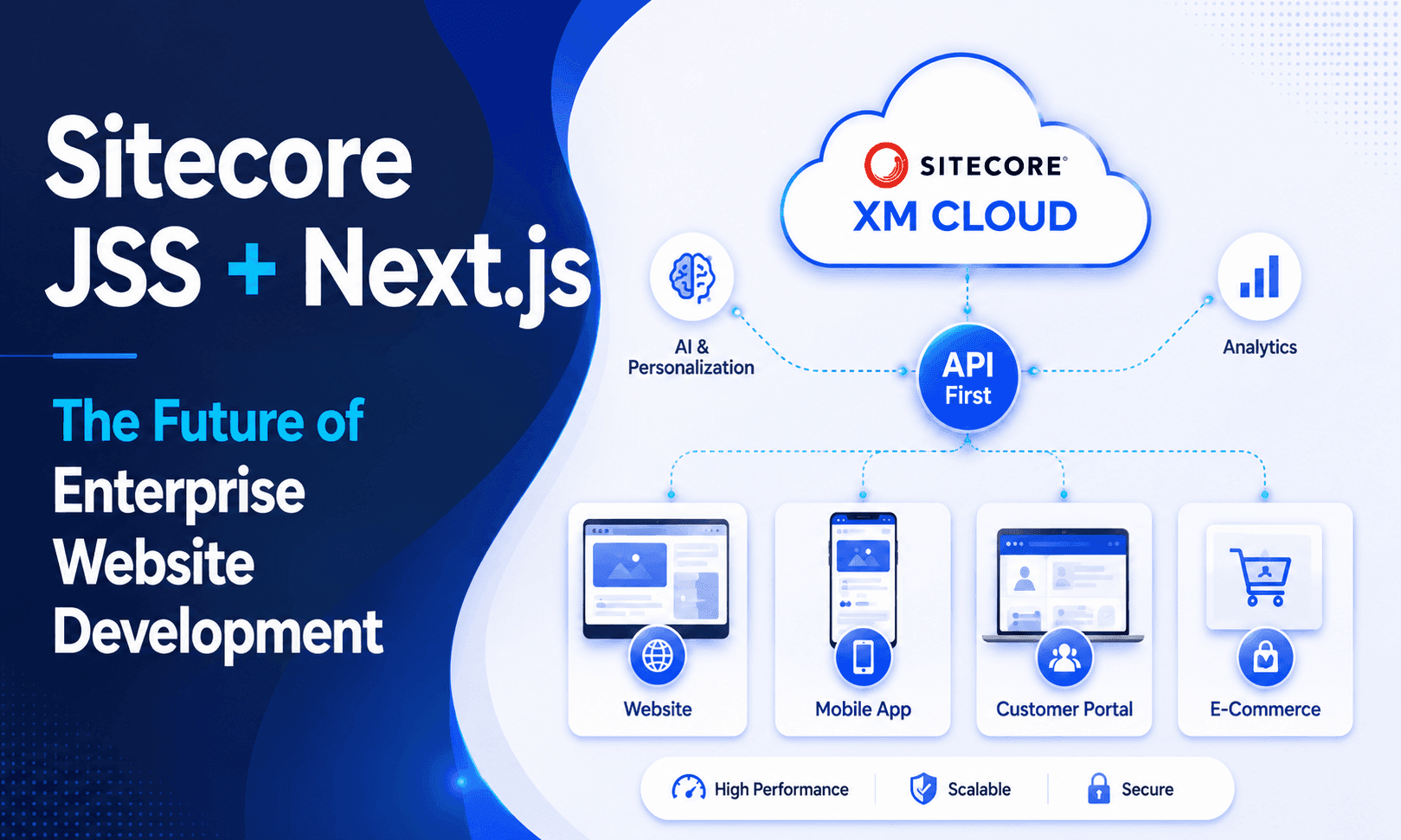
Enterprise digital experience expectations are evolving rapidly.
Modern businesses are expected to deliver:
High-performance websites
Personalized customer experiences
Omnichannel content delivery
AI-powered engagement
Cloud-native scalability
Traditional CMS architectures are increasingly unable to support these requirements efficiently.
This is why enterprises are rapidly adopting modern headless architecture powered by Sitecore JSS & Next.js.
Today, organizations are moving toward composable digital experience platforms where frontend experiences are decoupled from backend content management systems.
Technologies like:
@sitecore-jss/sitecore-jss-nextjs
Next.js
React
GraphQL
Sitecore XM Cloud
are becoming the foundation of enterprise website development in 2026 and beyond.
This guide explains why modern enterprises are choosing Sitecore JSS with Next.js, how it improves scalability and performance, and why it represents the future of enterprise website development.
1. Business Problem: Why Traditional Website Development Is Failing Enterprises
AI-driven experiences are becoming essential for enterprise growth.
Modern Sitecore ecosystems support:
Personalized journeys
AI-powered recommendations
Intelligent content delivery
3. What is Sitecore JSS & Next.js?
Sitecore JSS (JavaScript Rendering SDK) enables developers to build modern frontend applications using frameworks like React and Next.js while integrating seamlessly with Sitecore CMS and XM Cloud.
The package:
@sitecore-jss/sitecore-jss-nextjs
provides the framework for building enterprise-grade headless applications powered by Sitecore.
What is Next.js?
Next.js is a React-based framework designed for:
High-performance frontend applications
SEO optimization
Server-side rendering
Static site generation
Enterprise scalability
It has become one of the preferred frontend frameworks for modern enterprise digital experience platforms.
How Sitecore JSS & Next.js Work Together
The architecture separates:
Backend content management (Sitecore)
Frontend rendering (Next.js)
Content is delivered via APIs and rendered through modern frontend components.
This creates significantly greater flexibility and scalability.
4. Why Enterprises Are Choosing Sitecore JSS & Next.js
Modern enterprises increasingly prioritize:
Speed
Scalability
Flexibility
AI-readiness
Omnichannel delivery
Sitecore JSS with Next.js supports all these priorities.
High-Performance Websites
Next.js improves:
Core Web Vitals
SEO performance
User experience
Website speed
This directly impacts enterprise growth.
Cloud-Native Scalability
Modern Sitecore ecosystems align naturally with:
Sitecore XM Cloud
SaaS-native architecture
API-first deployment models
Omnichannel Delivery
Content can be delivered seamlessly across multiple channels.
AI & Personalization Capability
Modern Sitecore platforms support:
AI-driven customer experiences
Personalized journeys
Smart recommendations
Frontend Flexibility
Organizations gain freedom to build advanced frontend experiences using:
Next.js
React
GraphQL
5. Understanding componentfactory.ts in Enterprise Architecture
One of the key concepts in Sitecore JSS projects is:
componentfactory.ts
This file helps manage frontend component rendering by mapping Sitecore-rendered components to frontend React/Next.js components.
Why It Matters for Enterprises
A scalable component architecture improves:
Reusability
Maintainability
Scalability
Faster development cycles
Enterprise organizations increasingly rely on modular component systems to support rapid growth and agile content operations.
6. Traditional CMS vs Modern Sitecore JSS & Next.js Stack
Capability
Traditional CMS
Sitecore JSS & Next.js
Website Performance
Moderate
High-speed
Frontend Flexibility
Limited
Extensive
SEO Optimization
Moderate
Strong
Omnichannel Delivery
Weak
Strong
AI Integration
Minimal
Advanced
Scalability
Moderate
Enterprise-grade
Cloud-Native Support
Limited
Strong
Future Readiness
Lower
High
Why Enterprises Are Moving Toward Modern Website Builder Architecture
Modern enterprises increasingly require:
Faster websites
Better scalability
Omnichannel capability
AI-powered personalization
Agile frontend architecture
Traditional CMS systems increasingly struggle to support these goals.
Modern website builder ecosystems powered by Next.js and Sitecore provide a future-ready foundation.