Sitecore Translation Workflow for UK Enterprises With Multilingual Content
In This Article
- Why Sitecore Translation Requires More Than a Plugin
- What Should a Sitecore Translation Workflow Look Like?
- AI Can Accelerate Translation But Governance Still Matters
- Plan Language Architecture Before Translation Starts
- Multilingual SEO Must Be Part of the Workflow
- Is Sitecore a Headless CMS?
- When Should You Consider Migration From Sitecore to Headless CMS?
- Could Sanity Simplify Multilingual Structured Content?
- Simplify Multilingual CMS Operations
- Simplify Multilingual CMS
For UK enterprises operating across Europe, North America, the Middle East or Asia, multilingual content management becomes much more complicated than translating an English webpage into another language.
Marketing teams must coordinate source content, regional variations, approvals, terminology, metadata, URLs, publishing schedules and continuous updates. When this process depends heavily on spreadsheets, manual exports or disconnected translation tools, publishing slows down and inconsistencies increase.
A well-designed Sitecore translation workflow turns localization into a governed content operation rather than a repetitive translation task.
Why Sitecore Translation Requires More Than a Plugin
A Sitecore translation plugin can help move content between the CMS and a translation service, but technology alone does not determine whether the workflow scales.
Enterprises need to define which content is translated, which fields remain shared, how new language versions are created, who reviews them, what happens when the English source changes and how approved translations reach production.
Sitecore supports multilingual content and language versions, while modern SitecoreAI capabilities can translate individual content items, pages and entire sites. Brand kits can also guide terminology, tone and localization rules during AI-assisted translation.
For enterprises with complex requirements, Sitecore CMS development services can help configure multilingual architecture, integrations, workflows and publishing rules around actual business processes.
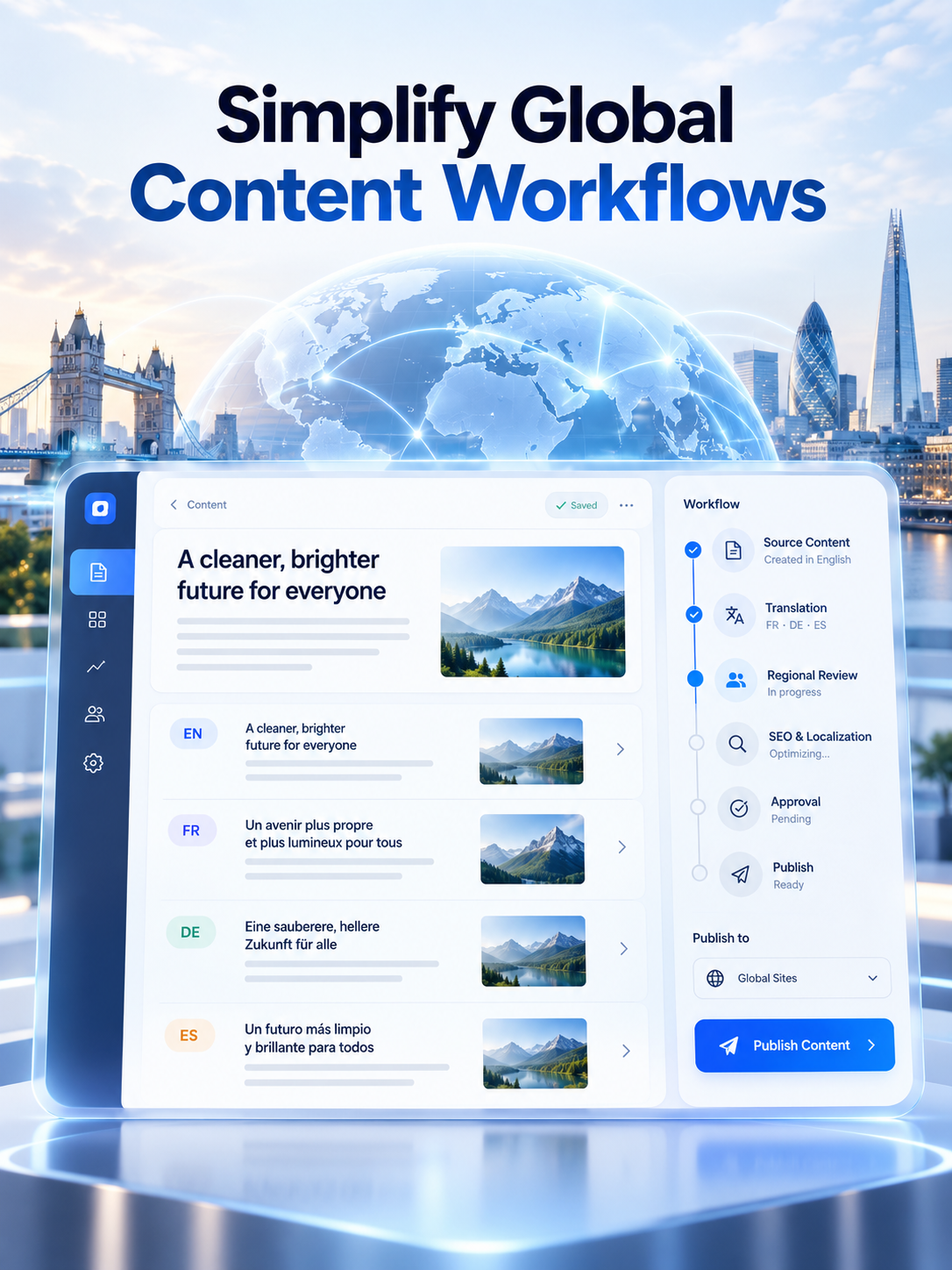
Simplify Global Content Workflows
Improve multilingual Sitecore publishing with structured translation, review, SEO and localization workflows built for global enterprise content teams.
What Should a Sitecore Translation Workflow Look Like?
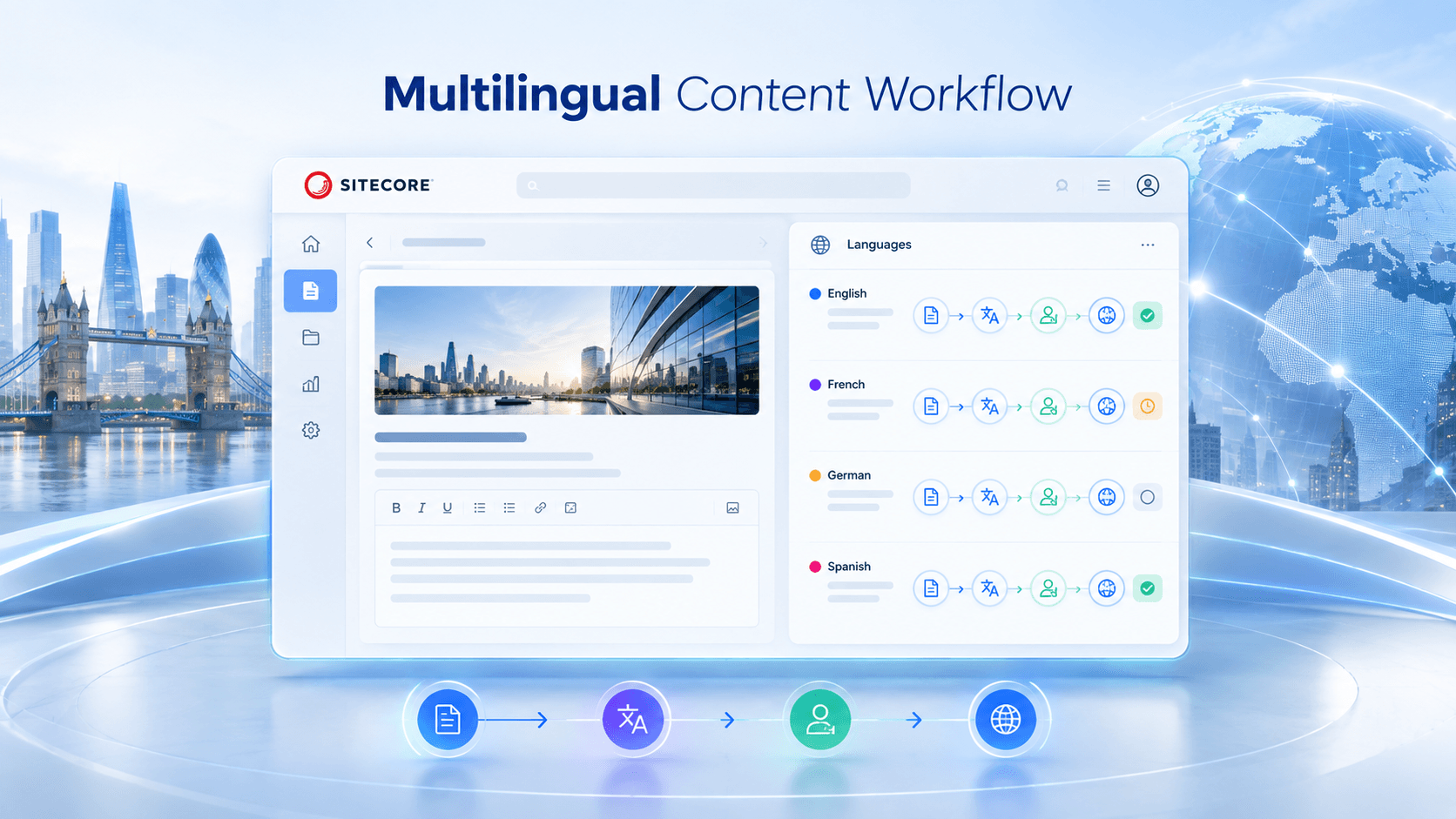
A practical multilingual workflow can follow this sequence:
Approved source content → Translation request → AI or translation provider → Regional review → SEO validation → Approval → Preview → Publishing → Ongoing synchronization
The important part is not simply generating translated text.
Each stage should preserve the relationship between the source version and each localized version.
If the UK marketing team changes a product benefit, compliance statement or campaign CTA, regional teams need to know what changed and whether their existing translation requires review.
Enterprise translation connectors can automate content movement between Sitecore and translation-management platforms, including sending content for translation, returning completed versions and tracking project status. Sitecore's connector ecosystem is designed specifically to reduce one-off integration work and support maintainable integrations.
AI Can Accelerate Translation But Governance Still Matters
AI is changing multilingual content workflows significantly.
SitecoreAI currently supports page translation, full site translation, individual content item translation and a Translator agent for interactive translation workflows. It can apply glossary and localization rules from an assigned brand kit, helping teams protect product terminology and brand language.
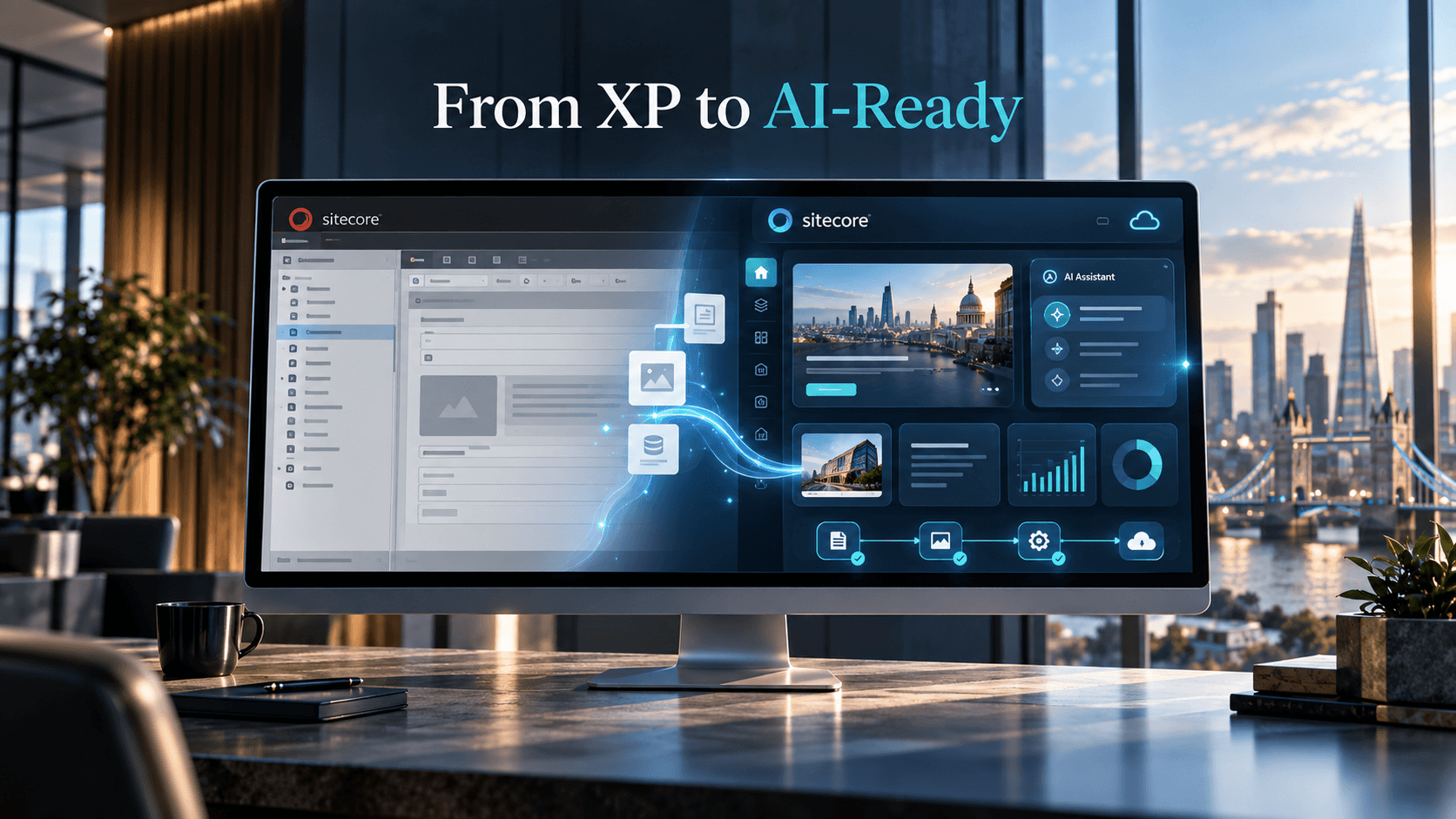
Sitecore XP also provides AI-assisted translation options that can create language versions of Sitecore items, while newer XP 10.4 functionality can translate pages and related referenced content.
That does not mean every translation should publish automatically.
Legal copy, financial information, medical terminology, regulated content and high value campaign messaging may still require human review.
The most scalable model is often:
AI for speed + terminology controls for consistency + human review for risk and quality.
Simplify Sitecore Translation Workflows for Global Content Teams
Plan Language Architecture Before Translation Starts
One of the biggest multilingual CMS mistakes is adding languages without defining how they behave.
Sitecore's current localization guidance recommends keeping CMS language configuration and the head application aligned. It also supports language fallback, allowing a default language to be returned when a requested localized version is unavailable when configured appropriately.
Enterprises should decide early whether content requires straightforward translation or genuine regional variation.
For example, a French version may need different legal terms, offers, imagery or product information rather than merely translated English copy.
That distinction matters because translation and localization are not the same thing.
Translation changes language.
Localization adapts the experience to the target market.
Multilingual SEO Must Be Part of the Workflow
Publishing translated pages without international SEO controls can create another problem: search engines may not understand which page should rank for which country or language.
Every multilingual Sitecore implementation should consider language-specific URLs, hreflang relationships, canonical URLs, localized metadata, image alt text, structured data and XML sitemaps.
These should be generated or governed systematically rather than requiring editors to maintain technical relationships manually.
The translation workflow should therefore include SEO validation before publishing, not as a later optimization exercise.
This becomes especially important for UK organisations targeting variants such as English for the UK, US or other English-speaking markets where much of the content may appear similar.
Is Sitecore a Headless CMS?
This question appears frequently during multilingual platform reviews.
Sitecore supports headless architecture, where the content management layer is separated from frontend presentation and content is delivered through APIs. Sitecore describes its current SitecoreAI platform as a hybrid headless DXP, combining headless flexibility with marketer-oriented visual authoring and governance.
That architecture can benefit multilingual organisations because the same structured content can support websites, applications and other digital channels.
However, moving to headless architecture does not automatically fix poor translation workflows.
Content modelling, locale strategy, approvals and governance still need to be designed correctly.
Plan Your Multilingual CMS Strategy With Our Experts
When Should You Consider Migration From Sitecore to Headless CMS?
Some organisations eventually find that their multilingual requirements have changed.
They may want simpler structured content, lighter editorial workflows, API-first delivery or greater flexibility across websites and applications.
Before migrating, evaluate whether the real problem is Sitecore itself or an unnecessarily complicated implementation.
A headless CMS migration may make sense when teams want to restructure content into reusable models and simplify how localized content is delivered across channels.
The migration assessment should examine content models, language versions, assets, URLs, SEO data, translation integrations, redirects and regional publishing processes before choosing a replacement architecture.
Could Sanity Simplify Multilingual Structured Content?
For organisations comparing alternative headless platforms, structured-content systems can provide a different model for localization.
Rather than managing multilingual content primarily as website pages, information can be structured into reusable documents and fields that applications query through APIs.
This can make localization attractive for organisations delivering the same product, service or editorial content across several channels.
Businesses evaluating this approach can explore Sanity CMS development services as one potential structured-content architecture.
The important question is not simply which CMS has translation features.
It is which content model makes global publishing easiest to govern over the next several years.
Simplify Multilingual CMS Operations
For UK enterprises, successful multilingual content management requires more than installing a Sitecore translation plugin.
It requires a connected operating model combining content architecture, language versions, translation automation, AI, human review, international SEO, approvals and publishing governance.
Review the workflow from source content to regional publication. Identify unnecessary manual handoffs. Automate repetitive translation tasks while preserving review where risk matters.
When translation becomes part of the content architecture instead of an external process, global teams can publish faster without losing consistency or control.
Simplify Multilingual CMS
Improve translation workflows with Sitecore, headless CMS, Sanity and structured content architecture.
Frequently Asked Questions
How does Sitecore translation work?
Sitecore supports multilingual content through language versions and translation workflows. Enterprises can combine language configuration, AI-assisted translation, translation connectors, review, approval and publishing processes to manage localized content across multiple markets.
What is a Sitecore translation workflow?
A Sitecore translation workflow is the process used to move source content through translation, regional review, SEO validation, approval and publishing. A structured workflow helps global teams maintain consistency while reducing manual localization work.
Does Sitecore support AI translation?
Yes. SitecoreAI supports AI-assisted translation for pages, sites and individual content items. Organizations can also use translation guidance such as terminology and localization rules to improve brand consistency across languages.
What are Sitecore translation plugins and connectors?
Sitecore translation plugins or connectors integrate Sitecore with translation management or localization systems. They can help automate content transfer, translation requests, translated content return and workflow tracking.
Can Sitecore manage multilingual websites?
Yes. Sitecore supports multiple languages and language versions, allowing organizations to manage localized website content for different countries, regions and audiences from a shared content platform.
Does Sitecore support language fallback?
Yes. Language fallback can be configured so content from another language is displayed when a localized version is unavailable. It should be planned carefully so untranslated content does not create confusing regional experiences.
How can UK enterprises improve Sitecore translation workflows?
UK enterprises can improve translation workflows by standardizing source content, automating translation handoffs, using terminology controls, adding regional review, validating multilingual SEO and monitoring changes between source and localized versions.
Is Sitecore a headless CMS?
Sitecore supports headless and hybrid headless architectures where content management is separated from frontend presentation. This allows structured content to be delivered to websites, applications and other digital channels through APIs.
When should a business migrate from Sitecore to a headless CMS?
A migration may be worth evaluating when organizations need simpler structured content, API-first delivery, reduced platform complexity or different editorial workflows. The decision should consider existing Sitecore investment, integrations, localization requirements and migration cost.
What should be included in multilingual CMS SEO?
Multilingual CMS SEO should include localized URLs, hreflang implementation, canonical URLs, translated titles and descriptions, localized structured data, internal linking, image metadata and language-specific XML sitemap strategies.