AI Hospital Chatbot Case Study: Patient Support, Appointment Automation & Healthcare CRM
In This Article
- The Challenge: Patient Communication Was Highly Manual
- The Solution: One AI Layer Across Patient Engagement
- Appointment Booking Without Front-Desk Friction
- WhatsApp and Website Communication
- FAQ and Administrative Query Automation
- Follow-Ups, Reminders and Report Notifications
- Healthcare CRM Integration
- AI With Safe Healthcare Boundaries
- Business Value
- From Chatbot to Healthcare Automation Platform
Hospitals, clinics and diagnostic centers handle a constant flow of repetitive patient communication: appointment requests, department questions, doctor availability, billing queries, report-status checks and follow-up reminders.
When every interaction depends on the front desk, communication becomes slower during peak hours, staff spend time answering the same questions repeatedly, and high-intent appointment enquiries can be lost.
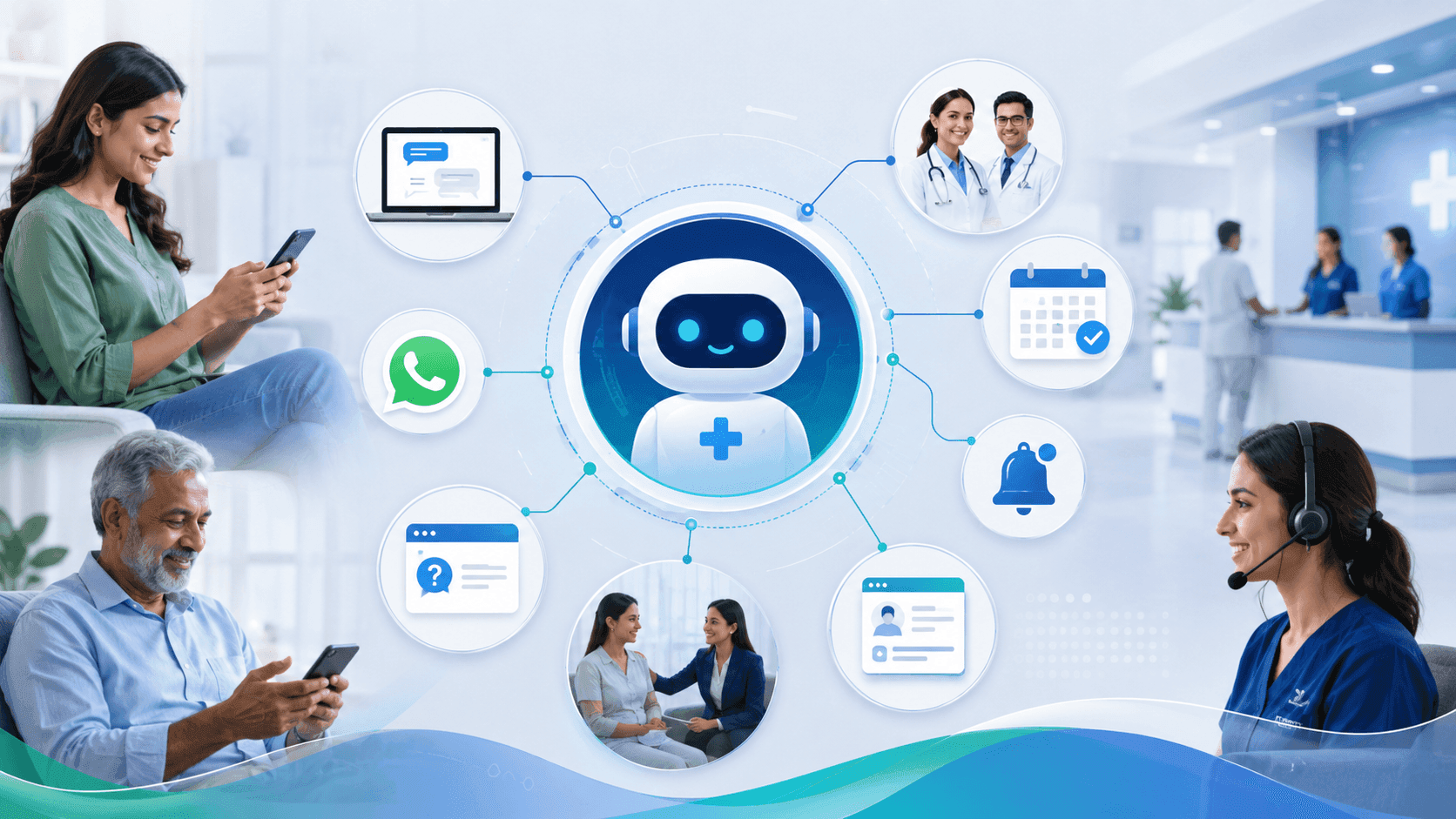
Murmu Software Infotech developed an AI Hospital Chatbot & Healthcare Automation Platform designed to automate common administrative patient interactions across hospital websites and WhatsApp while connecting appointments, reminders, report notifications and CRM workflows.
The objective was not to replace doctors, nurses or front-desk teams. It was to create a digital communication layer that handles predictable administrative requests quickly and allows staff to focus on conversations requiring human judgement.
Automate Patient Engagement with AI
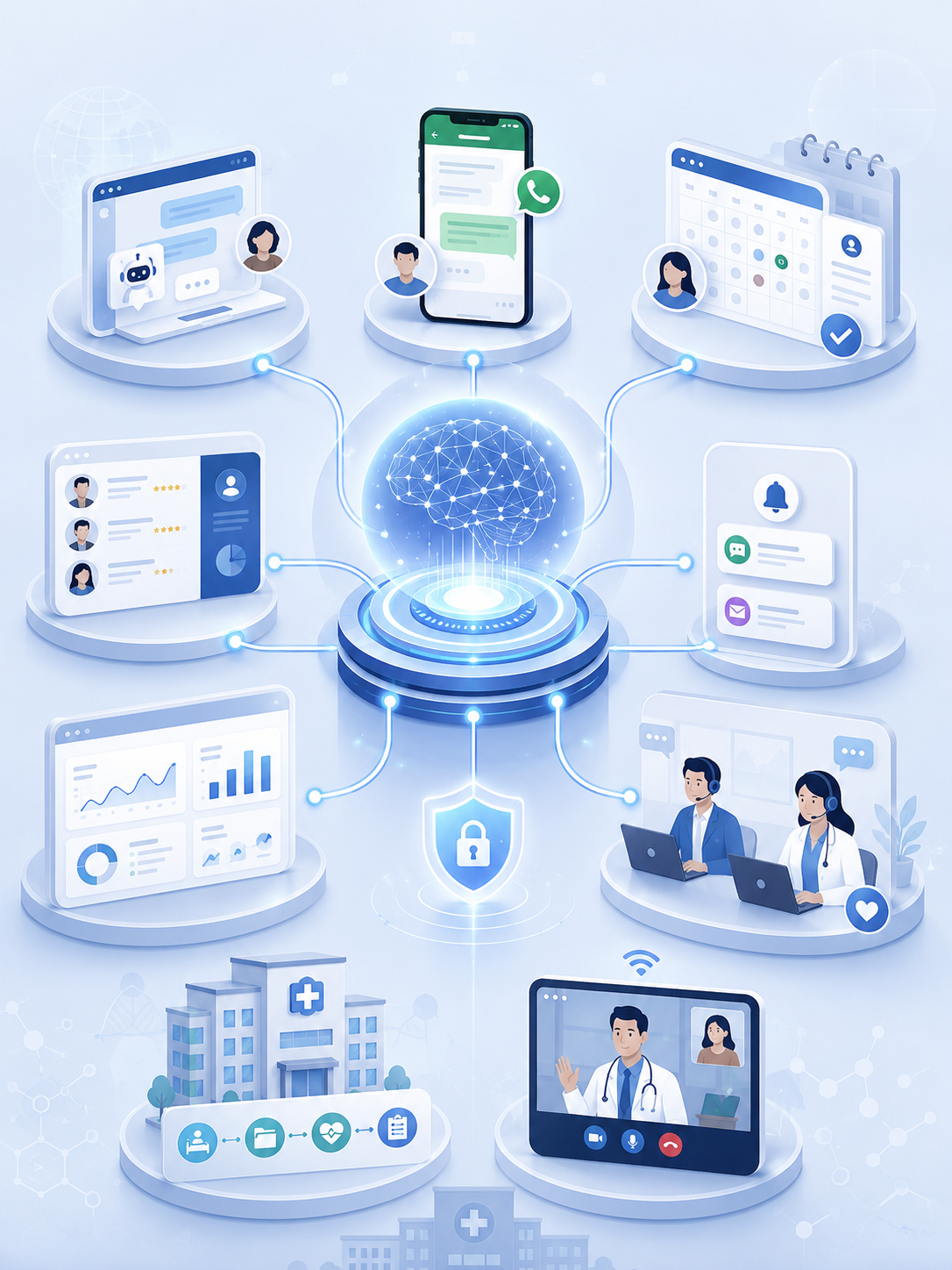
Connect website chat, WhatsApp, appointments, reminders, CRM, analytics, and human support through one intelligent healthcare automation platform.
The Challenge: Patient Communication Was Highly Manual
The healthcare organization was receiving patient interactions through websites, phone calls, WhatsApp, appointment requests, follow-up questions, billing enquiries and diagnostic-report requests.
That created several operational problems:
- Front-desk teams repeatedly answered routine questions.
- Patients waited longer during busy periods.
- Appointment enquiries were vulnerable to drop-off.
- Follow-up communication was inconsistent.
- Information was fragmented across channels.
- Round-the-clock support was difficult to provide manually.
The opportunity was therefore bigger than adding a chat widget. The organization needed a connected patient-communication workflow.
The Solution: One AI Layer Across Patient Engagement
The platform was designed around a simple journey:
Patient Enquiry → Intent Identified → FAQ / Appointment / Support Workflow → Confirmation or Notification → CRM Update → Continued Engagement
The chatbot can provide hospital and department information, guide patients toward relevant services, support appointment workflows and automate repetitive questions.
This makes the chatbot an operational assistant rather than a standalone conversational feature.
Automate Patient Support Without Losing the Human Touch
Appointment Booking Without Front-Desk Friction
Appointment coordination was one of the highest-value automation opportunities.
The chatbot supports doctor availability, department-based scheduling, appointment booking and automated confirmations.
Instead of forcing every patient to wait for a call-back, the digital workflow can move a high-intent enquiry toward a scheduled consultation more quickly.
Patient Question → Doctor or Department Identified → Availability → Appointment Request → Confirmation
This helps reduce manual coordination and creates a more consistent digital booking experience.
WhatsApp and Website Communication
The platform supports both website chatbot experiences and WhatsApp-based patient communication.
A patient may discover the hospital through search, open the website, ask a question, later continue through WhatsApp, and eventually request an appointment.
Connecting these journeys creates a stronger model:
Website / WhatsApp → AI Assistance → Appointment or Support Workflow → CRM
Rather than treating each channel as a separate inbox, hospitals can build a more centralized communication process.
FAQ and Administrative Query Automation
Many hospital enquiries are predictable: department availability, doctor schedules, appointment steps, hospital location, services, billing information and report status.
The chatbot automates these repetitive information workflows, helping reduce unnecessary front-desk pressure.
This is where AI automation is especially valuable: high-volume, repeatable, administrative communication with clear boundaries.
Follow-Ups, Reminders and Report Notifications
The platform also supports appointment reminders, follow-up alerts, consultation notifications and diagnostic-report availability messages.
Instead of requiring staff to manually track every routine communication event, automation can trigger the appropriate message when the associated workflow reaches the right stage.
For privacy-sensitive healthcare communication, notification content should disclose only what is necessary and use appropriate safeguards. U.S. HHS guidance, for example, permits appointment communications but recommends limiting information where privacy could be exposed.
Healthcare CRM Integration
The chatbot connects with healthcare CRM workflows for lead management, engagement synchronization and automated workflow triggers.
A patient enquiry should not disappear when the chat ends.
A stronger lifecycle becomes:
Enquiry → Qualification → Appointment → Reminder → Follow-Up → CRM History → Continued Communication
For hospital growth and operations teams, this creates better continuity between digital enquiries and internal follow-up.
Turn Patient Enquiries Into Faster Appointments and Follow-Ups
AI With Safe Healthcare Boundaries
Healthcare chatbot design requires clearer guardrails than a normal customer-service bot.
The strongest use cases in this project are administrative: appointments, FAQs, department information, billing guidance, reminders and report-status notifications.
The chatbot should not be positioned as replacing clinical judgement or providing unverified diagnosis or treatment advice.
WHO guidance on AI in health emphasizes governance, validation, transparency, privacy and human oversight. For production deployments, healthcare organizations should define escalation rules so urgent, ambiguous or clinically sensitive conversations can be redirected to qualified staff.
Privacy should also follow data-minimization principles. Where HIPAA applies, HHS requires regulated organizations to limit many uses and disclosures of protected health information to the minimum necessary for the intended purpose.
Business Value
The strongest business value is not simply “having an AI chatbot.”
It is creating a scalable communication layer that can:
- handle repetitive enquiries faster,
- reduce routine front-desk workload,
- support appointment conversion workflows,
- improve communication continuity,
- automate reminders and notifications,
- connect patient engagement with CRM,
- extend support beyond normal front-desk hours.
The live case study reports better response speed, reduced support workload, improved appointment coordination and stronger digital engagement after automating these workflows.
For stronger proof, future versions should publish measurable metrics such as chatbot containment rate, appointment conversion rate, average response time, front-desk hours saved and human-escalation rate.
From Chatbot to Healthcare Automation Platform
The broader opportunity is to evolve the chatbot into a connected healthcare automation layer integrated with HMS, CRM, telemedicine, patient mobile apps, OPD queue systems, analytics dashboards and voice AI—all of which are identified as expansion opportunities on the current case study.
Murmu Software Infotech develops AI healthcare chatbots, appointment automation, healthcare CRM, HMS platforms, telemedicine solutions, patient applications and AI workflow automation.
The goal is not to automate every patient conversation. It is to automate the right administrative interactions, protect sensitive information, escalate appropriately, and give patients a faster path to the healthcare service or human support they actually need.
Frequently Asked Questions
What is an AI hospital chatbot?
An AI hospital chatbot is a conversational automation platform that can assist patients with common administrative queries, appointment workflows, department information, reminders, report notifications and other routine hospital communications.
How can AI chatbots help hospitals?
AI chatbots can reduce repetitive front-desk communication by handling common patient questions, supporting appointment coordination, automating reminders and connecting conversations with hospital CRM workflows.
Can a hospital chatbot book appointments?
Yes. A hospital chatbot can guide patients toward departments or doctors, assist with available appointment workflows, capture booking requests and provide automated confirmation or follow-up communication.
Can hospitals use AI chatbots on WhatsApp?
Yes. The documented platform includes WhatsApp chatbot integration so patients can access automated support, appointment assistance and communication through a familiar messaging channel.
Can an AI healthcare chatbot answer patient FAQs?
Yes. Administrative FAQs such as hospital services, departments, appointment processes, doctor availability, billing guidance and other approved information can be automated.
Can AI automate patient follow-up reminders?
Yes. Healthcare automation workflows can support appointment reminders, follow-up notifications and other scheduled patient communications.
Can an AI chatbot notify patients when reports are available?
Yes. The documented solution includes report-availability alerts that can notify patients when an associated workflow reaches the appropriate stage.
Can an AI hospital chatbot integrate with healthcare CRM?
Yes. CRM integration can connect chatbot enquiries with patient engagement, lead management, follow-up workflows and communication history.
Should an AI hospital chatbot provide diagnosis or treatment advice?
Administrative healthcare chatbots should not be positioned as replacements for qualified clinical judgement. Clinically sensitive, urgent or ambiguous conversations should use appropriate safeguards and escalation to trained healthcare professionals.
Who develops custom AI hospital chatbot solutions?
Murmu Software Infotech develops AI hospital chatbots, WhatsApp healthcare automation, appointment workflows, healthcare CRM integrations, patient engagement solutions and AI-powered hospital automation platforms.