ABDM Healthcare Software Case Study: ABHA, Consent & Digital Health Integration
In This Article
- The Challenge: Hospital Data Remained Fragmented
- The Solution: Build ABDM Readiness Into the Healthcare Platform
- ABHA and Digital Patient Identity
- Digital Health Records and Record Linking
- Consent-Based Health Information Sharing
- Faster Digital Registration with Scan & Share
- HFR and HPR Integration Readiness
- Security and Data Governance
- API-First Modernization Instead of Complete Replacement
- Business Value
- Preparing Your Hospital for ABDM?
India’s healthcare ecosystem is moving from isolated digital systems toward a more connected, interoperable health infrastructure through the Ayushman Bharat Digital Mission (ABDM).
For hospitals, clinics, diagnostic centers, laboratories, and digital-health companies, this creates a new technology requirement.
Digitizing patient registration or maintaining an electronic medical record is no longer enough. Healthcare platforms increasingly need to support standardized digital identities, interoperable health-record workflows, patient-controlled data sharing, facility and professional registries, secure APIs, and integration with India’s broader digital-health ecosystem.
Murmu Software Infotech designed an ABDM-ready healthcare software architecture to help Indian healthcare organizations modernize existing systems and prepare for integration with ABDM services. The solution focuses on ABHA-related workflows, digital patient identity, structured health records, consent-based information sharing, API integration readiness, secure healthcare-data governance, and long-term hospital digital transformation.
Build ABDM-Ready Healthcare Platforms
Connect ABHA, consent, digital health records, secure APIs, and interoperable workflows to prepare hospitals for India’s evolving digital-health ecosystem.
The Challenge: Hospital Data Remained Fragmented
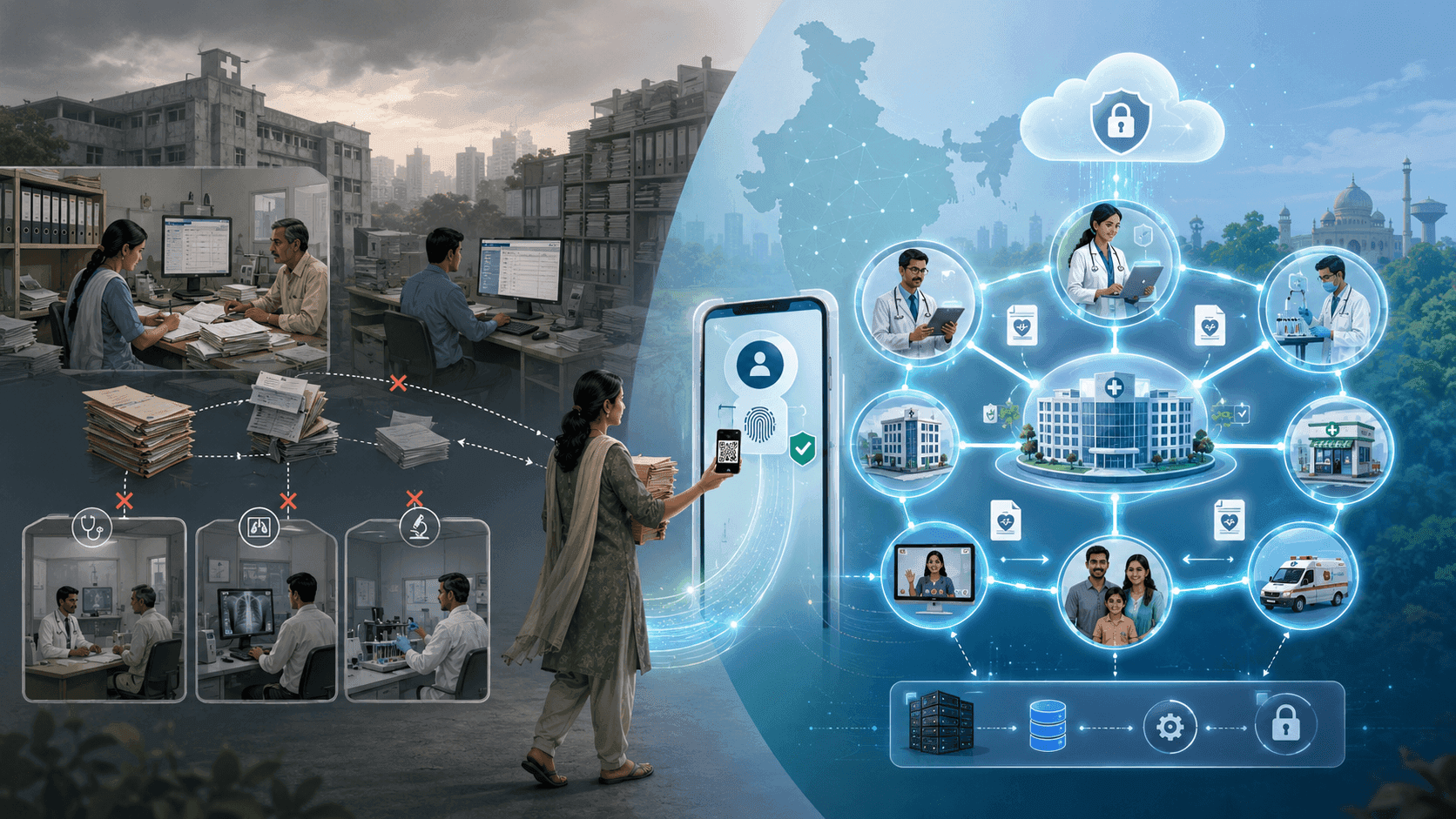
Many healthcare organizations still operate through disconnected applications, paper records, spreadsheets, legacy HMS platforms, and department-specific software.
Patient information may exist independently across registration, OPD, laboratory, pharmacy, billing, and specialist systems.
This creates recurring challenges:
- Duplicate or fragmented patient identities
- Paper-dependent healthcare records
- Difficult cross-system integration
- Limited interoperability
- Manual information-sharing processes
- Weak patient control over record sharing
- Complex modernization of legacy HMS environments
The requirement was therefore larger than adding another API.
The organization needed an architecture capable of participating in a connected national digital-health ecosystem.
Prepare Your Healthcare Platform for Secure ABDM Integration
The Solution: Build ABDM Readiness Into the Healthcare Platform
The platform was structured around an integration journey:
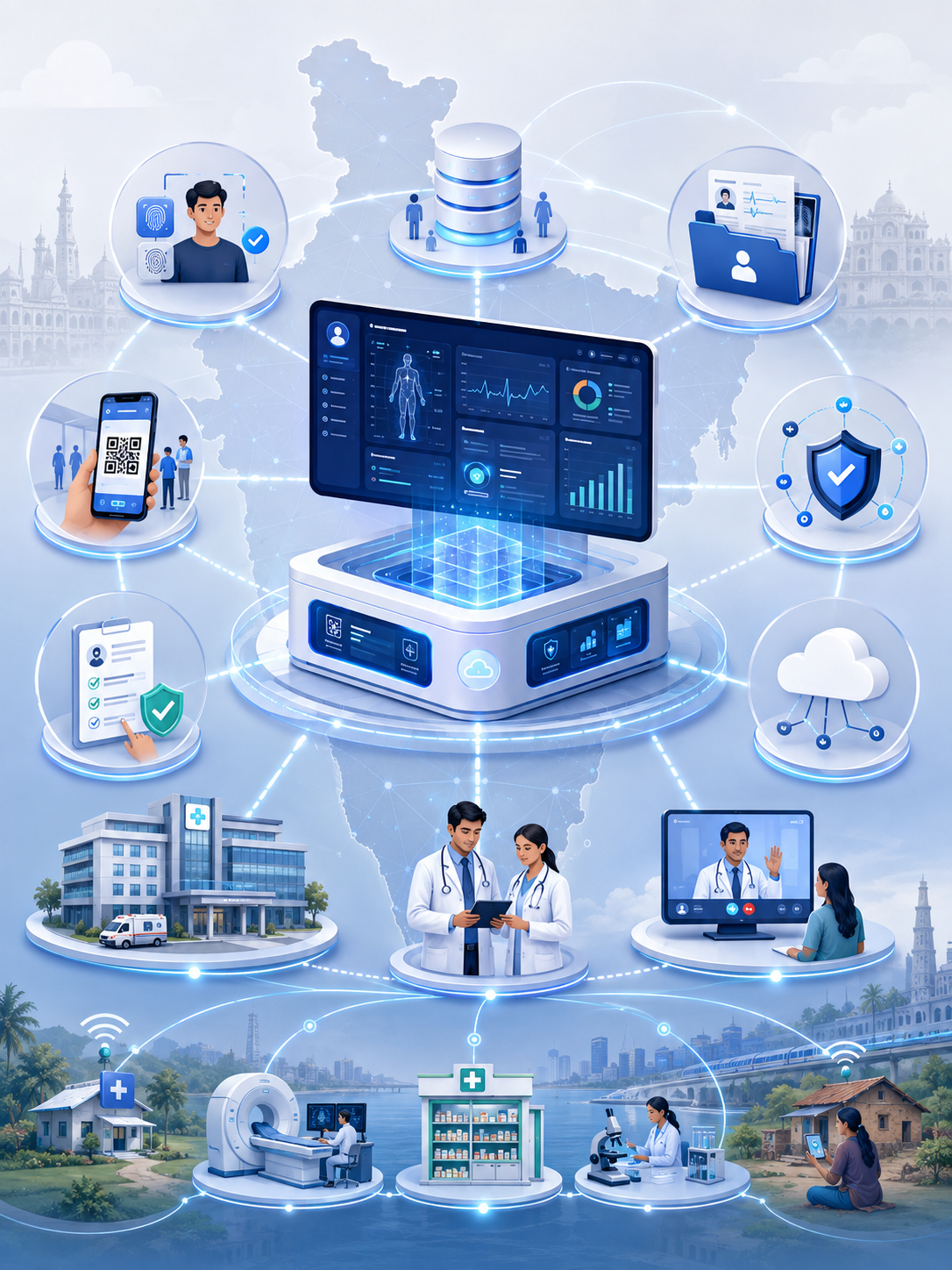
Patient Identity → ABHA Workflow → Health Record Creation → Record Linking → Consent → Secure Exchange → Connected Healthcare Services
This closely reflects ABDM’s citizen-centric model, where individuals can use ABHA-related services to discover, link, view, and share health records through supported applications.
ABDM’s official guidance also makes an important architectural distinction: medical records remain with the healthcare providers that create them. ABDM facilitates secure exchange between intended participants after appropriate patient consent rather than becoming one central repository for every clinical record.
That federated approach should shape hospital-software architecture from the beginning.
ABHA and Digital Patient Identity
The first layer is digital patient identity.
The solution supports planning for ABHA-related workflows and mapping existing patient-registration processes to a standardized digital identity model.
Instead of treating an individual differently every time information passes between systems, the architecture creates a stronger foundation for connecting the patient journey across healthcare services.
ABDM also distinguishes the ABHA Number from an ABHA Address, which can be used within Personal Health Record workflows for linking and sharing records.
For hospital technology teams, this means ABHA integration should not be reduced to simply storing another identifier in the patient table.
It should be treated as part of the overall identity, record-linking, consent, and interoperability architecture.
Digital Health Records and Record Linking
The platform supports structured digital patient-record workflows that can progressively replace paper-based processes.
Relevant healthcare documents can include items such as:
- OP consultation records
- Prescriptions
- Diagnostic reports
- Discharge summaries
- Immunization records
- Other supported health documents
ABDM-enabled PHR applications allow individuals to discover records created by participating health facilities, link them with their ABHA Address, view them, and share them with healthcare providers subject to consent.
The technology objective is therefore not merely:
“Convert paper to PDF.”
It is:
“Create structured healthcare information capable of participating in interoperable digital workflows.”
Consent-Based Health Information Sharing
Patient-controlled consent is central to the ABDM model.
The platform therefore incorporates consent-aware healthcare-data workflows rather than designing unrestricted access between connected systems.
A simplified journey becomes:
Healthcare Provider Requests Information → Patient Authorizes Sharing → Approved Information Is Exchanged → Access Is Governed and Auditable
This is a major architectural shift.
Integration should no longer mean giving every connected healthcare application permanent access to all patient information.
The system should be built around purpose, authorization, appropriate access, and patient control.
Faster Digital Registration with Scan & Share
An ABDM-ready hospital roadmap should also consider Scan & Share where relevant.
ABDM provides QR-based workflows that allow patients using supported applications to share demographic information with participating facilities for faster OPD registration.
The National Health Authority has promoted Scan & Share specifically as a way of reducing manual registration effort and hospital queues.
For hospitals, this connects national digital-health infrastructure directly with a practical operational objective:
faster registration with less repetitive patient data entry.
Connect ABHA, Consent and Health Records with Confidence
HFR and HPR Integration Readiness
ABDM is not only about patient identity.
Its wider digital-health ecosystem also includes the Health Facility Registry (HFR) and Healthcare Professionals Registry (HPR).
These registries help establish trusted digital identities for healthcare facilities and professionals.
A mature hospital modernization roadmap should therefore consider not just ABHA, but how the organization’s facilities, practitioners, services, and patient workflows fit into the larger ABDM ecosystem.
This is particularly important for multi-location hospital groups, diagnostic networks, and digital-health platforms.
Security and Data Governance
ABDM readiness must be designed alongside security and privacy.
Healthcare systems should incorporate:
role-based access → secure authentication → controlled APIs → data encryption → auditability → consent management → monitoring → backup and recovery
Official ABDM guidance currently notes that health-record storage and processing are also subject to applicable Indian laws, including the Digital Personal Data Protection Act, 2023, Information Technology Act, Aadhaar Act where applicable, and other relevant laws.
ABDM integration should therefore never be marketed as a substitute for broader healthcare-data governance.
API-First Modernization Instead of Complete Replacement
A major concern for hospital leaders is whether ABDM adoption requires replacing their existing HMS.
Not necessarily.
A better strategy can be:
Existing HMS/LIMS/CRM → Integration Layer → ABDM Workflows
This allows organizations to modernize incrementally by introducing APIs, standardized identities, consent workflows, digital-record capabilities, and interoperable services around existing systems where technically practical.
The result is less disruption and a clearer modernization roadmap.
Business Value
The strongest benefits of an ABDM-ready platform are:
- Better digital-health readiness
- More standardized patient identity workflows
- Reduced paper dependency
- Stronger consent and governance processes
- Improved interoperability readiness
- Easier future integration
- Better foundation for digital OPD experiences
- Scalable architecture for connected healthcare
The transformation can be summarized as:
Disconnected Hospital Systems → ABDM-Ready Digital Healthcare Ecosystem
Preparing Your Hospital for ABDM?
Murmu Software Infotech develops Hospital Management Systems, ABDM integration architecture, ABHA-ready workflows, OPD platforms, LIMS, healthcare CRM, telemedicine systems, patient applications, healthcare APIs, analytics, and healthcare modernization solutions for hospitals and digital-health organizations across India.
The objective should not simply be to add an “ABDM” checkbox to hospital software.
The real opportunity is to build a secure, interoperable and patient-controlled digital healthcare platform that can participate effectively in India’s evolving national health ecosystem.
Frequently Asked Questions
What is ABDM-ready hospital software?
ABDM-ready hospital software is designed to prepare hospital workflows and technical architecture for integration with the Ayushman Bharat Digital Mission ecosystem, including ABHA-related identity workflows, consent-based health information sharing, interoperable records and secure APIs.
What is ABHA integration in hospital software?
ABHA integration connects supported hospital identity and health-record workflows with the Ayushman Bharat Health Account ecosystem so patient identification, record linking and related digital-health processes can be handled through ABDM-enabled workflows.
Does ABDM store all patient medical records centrally?
No. ABDM follows a federated architecture. Healthcare providers continue storing the health records they create, while ABDM enables secure exchange between authorized participants based on patient consent.
What is consent-based health information sharing in ABDM?
Consent-based sharing gives individuals control over access to supported health information. Healthcare information can be exchanged between authorized participants according to the patient's approved consent and applicable ABDM workflows.
What is Scan and Share in ABDM?
Scan and Share is an ABDM-enabled registration workflow that allows patients using supported applications to scan a facility QR code and share relevant demographic information for faster OPD registration.
What are HFR and HPR in ABDM?
The Health Facility Registry provides verified information about participating health facilities, while the Healthcare Professionals Registry provides a digital registry for healthcare professionals participating in India's digital-health ecosystem.
Can an existing HMS be integrated with ABDM?
Potentially yes. An existing HMS can often be modernized through an integration layer, APIs, patient identity workflows, consent handling and interoperable record capabilities instead of requiring a complete replacement, subject to its technical architecture.
Does ABDM use healthcare interoperability standards?
Yes. ABDM promotes interoperability between different healthcare systems and aligns digital health information exchange with common healthcare data standards, including FHIR-based interoperability approaches.
Is ABDM-ready software automatically ABDM-compliant?
No. ABDM-ready means the architecture and workflows are being prepared for integration. Production participation may require applicable ABDM APIs, sandbox validation, conformance requirements, security assessment and onboarding processes.
Who develops ABDM-ready healthcare software in India?
Murmu Software Infotech develops ABDM-ready hospital software architecture, ABHA-related workflows, HMS, OPD systems, LIMS, healthcare CRM, telemedicine, patient applications, APIs and digital healthcare modernization solutions.