Case Study & Journal
Doctor & Staff Mobile App Case Study: Mobile Hospital Workforce & Workflow Management
PPrem Murmu5 Min Read
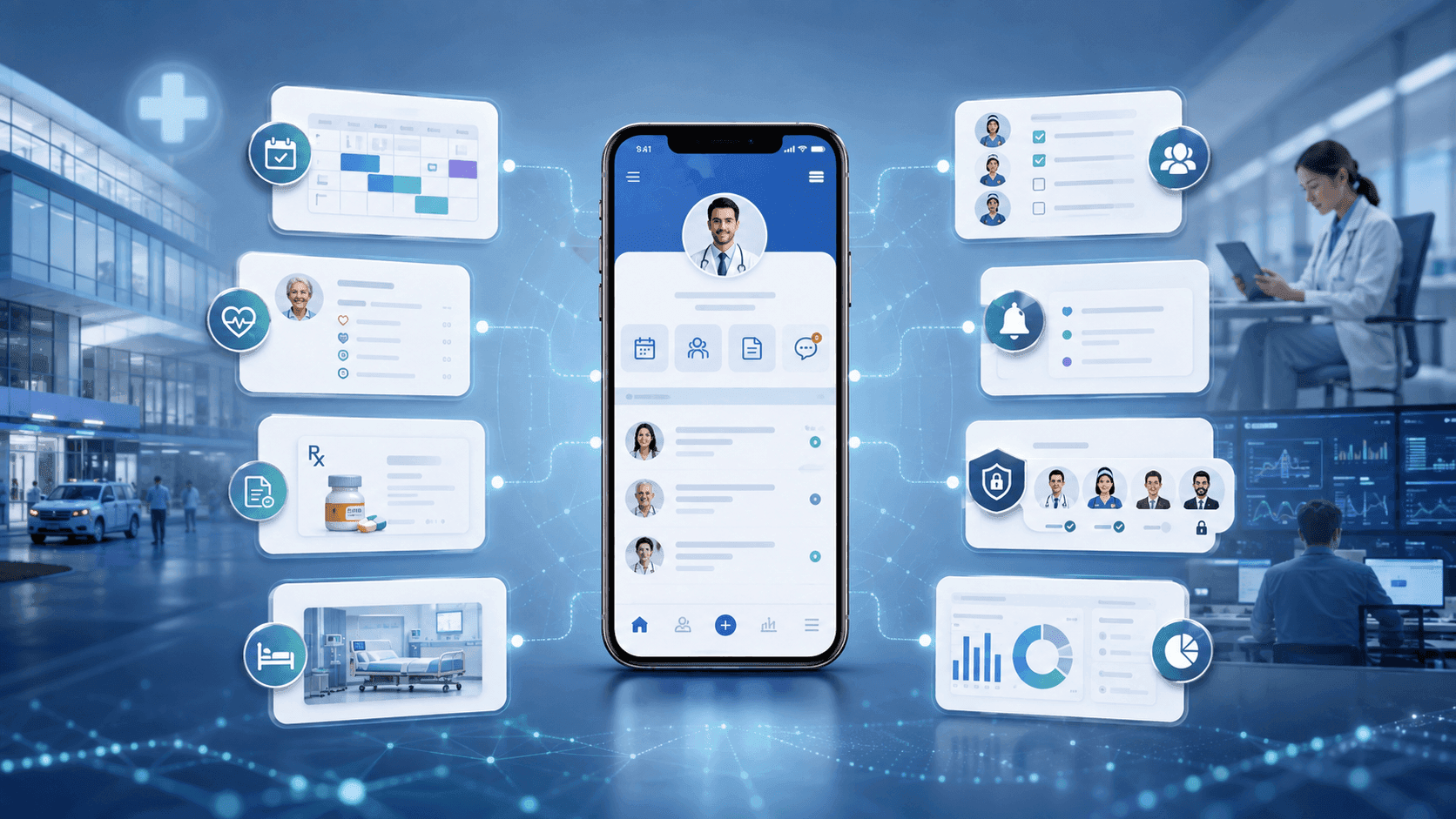
Doctors move between consultation rooms, OPD departments, wards and diagnostic areas. Nurses manage patient updates and daily responsibilities across multiple touchpoints. Operations teams coordinate tasks, patient movement, communication and department workflows throughout the day.
Yet many healthcare systems still depend heavily on desktop applications, paper records and manual communication.
Murmu Software Infotech developed a Doctor & Staff Mobile App designed to create a mobile operating layer for hospital teams. The platform brings together appointments, consultation history, prescription access, staff tasks, OPD/IPD updates, patient status, internal notifications, role-based permissions and operational dashboards within one mobile-first experience.
The objective was not simply to put hospital software onto a smartphone.
It was to help healthcare teams access the right operational information while they are actually moving through the hospital.
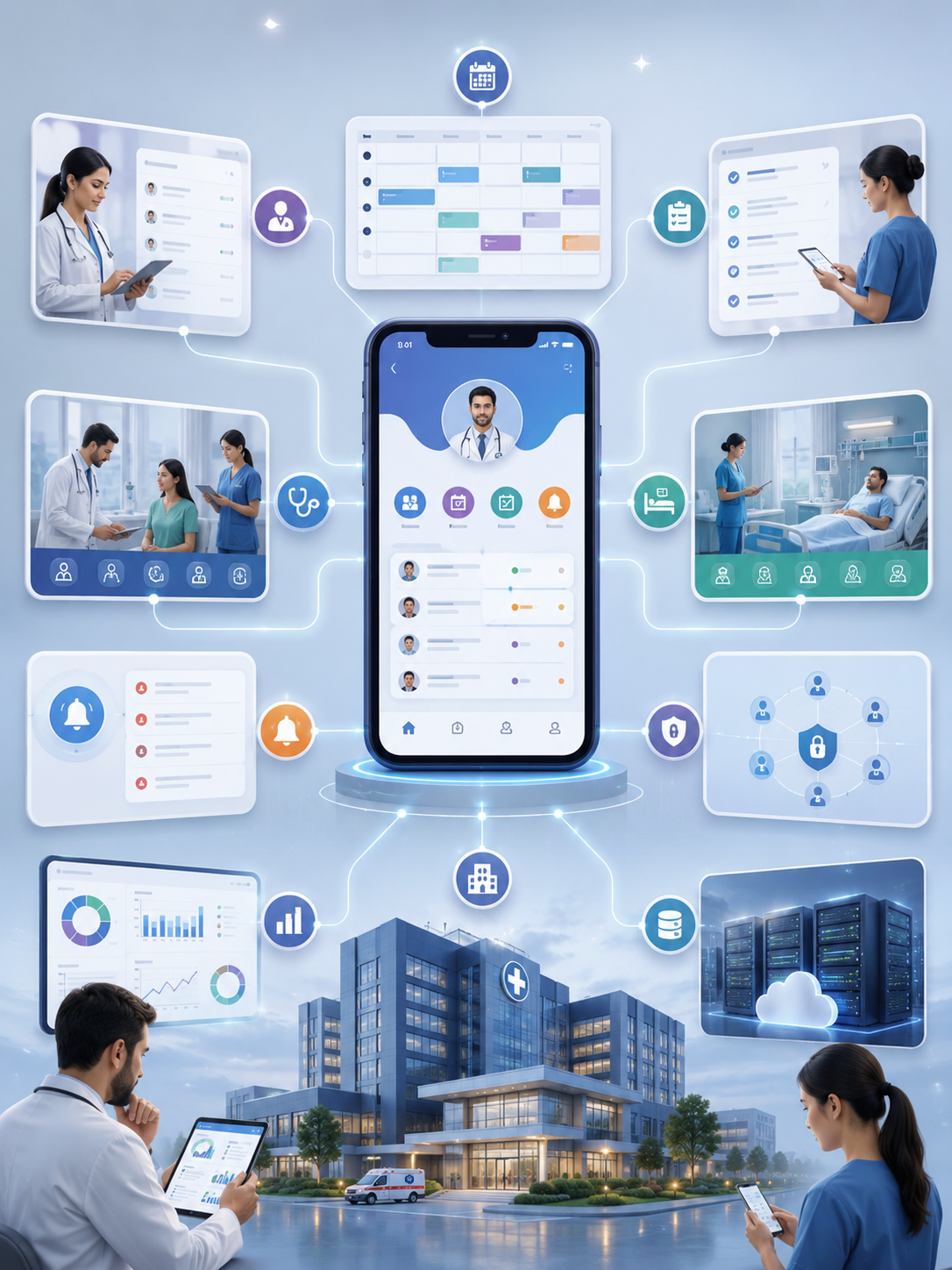
Connect doctors, nurses, tasks, patient workflows, OPD/IPD updates, notifications, and secure mobile access through one scalable hospital workforce platform.
The hospital environment depended on manual communication, paper-based processes, desktop-only access and disconnected patient updates.
This created recurring operational problems:
The live case study identifies these as major barriers to healthcare mobility and workforce coordination.
The real problem therefore was not simply lack of a mobile app.
It was the absence of a connected mobile healthcare workforce layer.
The application was designed around a connected staff journey:
Secure Login → Appointment Schedule → Patient History → Prescription Workflow → OPD/IPD Updates → Staff Tasks → Notifications → Patient Status → Mobile Dashboard
This gives doctors, nurses, administrators and operational teams a clearer view of their responsibilities without depending entirely on desktop systems.
Instead of creating separate apps for every operational activity, the solution centralizes the highest-value daily workflows.
Doctors can access daily appointment schedules directly from mobile devices, including patient-wise consultation visibility and OPD appointment information.
A typical journey becomes:
Doctor Opens App → Reviews Schedule → Selects Patient → Reviews Relevant History → Prepares for Consultation
The advantage is not simply convenience.
It reduces the friction between moving through the hospital and accessing information required for the next consultation.
The platform also gives authorized healthcare teams access to previous consultation information, medical notes and treatment history.
This supports a more continuous workflow when a patient returns or moves between departments.
Rather than describing this as automatically improving clinical outcomes, the more defensible benefit is:
authorized teams receive faster access to relevant historical information for operational and consultation continuity.
Doctors and permitted staff can access digital prescription workflows and prescription history linked to consultations.
This reduces dependence on disconnected paper trails and creates better visibility into medication-related workflow information.
Future e-prescription integration is listed separately in the existing case study and should remain positioned as an expansion capability until implemented.
Hospital operations involve hundreds of small responsibilities that must happen at the right time.
The mobile platform supports task assignment, pending-task visibility, workflow tracking and team coordination.
For operations teams, this creates a clearer accountability loop:
Task Assigned → Staff Member Notified → Progress Tracked → Pending Work Visible → Completion Monitored
This is a stronger productivity story than simply adding another internal messaging tool.
The application provides mobile visibility into OPD activity, IPD status, bed movement, department updates and patient progress.
This helps teams understand where patients are within operational workflows and where coordination may be required.
Where the current article uses “real-time,” I recommend using “centralized mobile updates” or “near-real-time visibility” unless actual synchronization latency is documented.
The app includes workflow notifications, internal messaging and department updates.
The goal is to reduce communication fragmentation.
A doctor should not need one channel for appointments, another for operational updates and another for task coordination when the relevant notifications can be connected to the workflow itself.
Healthcare mobility increases convenience, but it also increases the importance of security.
The application includes doctor permissions, staff role management, department-based visibility, authorization controls and secure authentication.
For stronger future implementations, mobile security should be tested against recognized controls such as the OWASP Mobile Application Security Verification Standard (MASVS), which covers secure storage, cryptography, authentication, network communication, privacy, platform security and code resilience.
The principle should remain:
minimum necessary mobile access for each role.
The application consolidates appointments, tasks, notifications and daily workflows into one mobile dashboard.
For doctors, this improves accessibility.
For operations teams, it improves workflow visibility.
For hospital leadership, the broader value is creating a more connected workforce infrastructure instead of relying on desktop-based processes alone.
The strongest defensible outcomes are better mobile workflow visibility, faster internal coordination, clearer task accountability, improved consultation readiness and reduced dependency on fixed workstations. The live case study reports improvements across these areas following implementation.
To make the published case study even stronger, add measurable KPIs such as:
task completion time, notification response time, consultation preparation time, missed-task rate, daily active staff users and mobile workflow adoption rate.
The future opportunity is to connect this mobile layer with HMS, telemedicine, healthcare CRM, OPD queues, AI-assisted workflows, wearable devices, multi-location hospital operations and e-prescription systems all identified as future expansion paths in the current case study.
Murmu Software Infotech develops Doctor & Staff Mobile Apps, HMS platforms, telemedicine systems, healthcare CRM, patient apps and connected hospital workflow solutions.
A doctor and hospital staff mobile app gives authorized healthcare teams mobile access to daily workflows such as appointments, patient consultation history, prescriptions, staff tasks, OPD/IPD updates, notifications and patient-status information.
A mobile workforce app gives doctors, nurses and operations teams access to relevant schedules, tasks, notifications and patient workflow information without depending entirely on fixed desktop workstations.
Yes. The documented platform allows doctors to access daily consultation schedules, patient-wise appointments and OPD consultation information from mobile devices.
Yes. Authorized healthcare users can access previous consultation information, medical notes and treatment history to support consultation preparation and workflow continuity.
Yes. The platform supports task assignment, pending-task visibility, workflow tracking and team coordination for hospital staff.
Yes. The documented solution includes OPD/IPD updates, patient movement information, status tracking and department-level operational visibility.
Yes. Internal notifications, workflow alerts and department updates are included so important operational information can reach healthcare teams more consistently.
Hospital mobile applications should use role-based authorization, secure authentication, protected network communication, secure storage and appropriate access controls so users only access information required for their responsibilities.
Yes. Mobile healthcare applications can integrate with an HMS through secure APIs so appointments, patient records, tasks and operational updates remain connected to the hospital's central systems.
Murmu Software Infotech develops doctor and staff mobile apps, Hospital Management Systems, telemedicine platforms, healthcare CRM, patient applications and connected hospital workflow solutions.