SEO vs AEO vs GEO: What Enterprise Marketing Teams Need to Know
In This Article
- Enterprise search visibility is no longer just about ranking on page one.
- SEO Still Builds the Foundation
- What Is Answer Engine Optimization?
- What Is Generative Engine Optimization?
- SEO vs AEO vs GEO: Quick Comparison
- AI Visibility Requires Structured Content
- FAQs Are More Important Than Ever
- Key Facts Make Content Easier to Cite
- Schema Helps Machines Understand Context
- Your CMS Is Part of the AI Search Strategy
- Measure More Than Rankings
- Build SEO, AEO and GEO Into One Workflow
- SEO Is the Foundation. AEO and GEO Extend Visibility.
Enterprise search visibility is no longer just about ranking on page one.
Customers now discover brands through traditional search, featured answers, Google AI results, Bing, ChatGPT, Gemini, Perplexity, Copilot and other generative experiences.
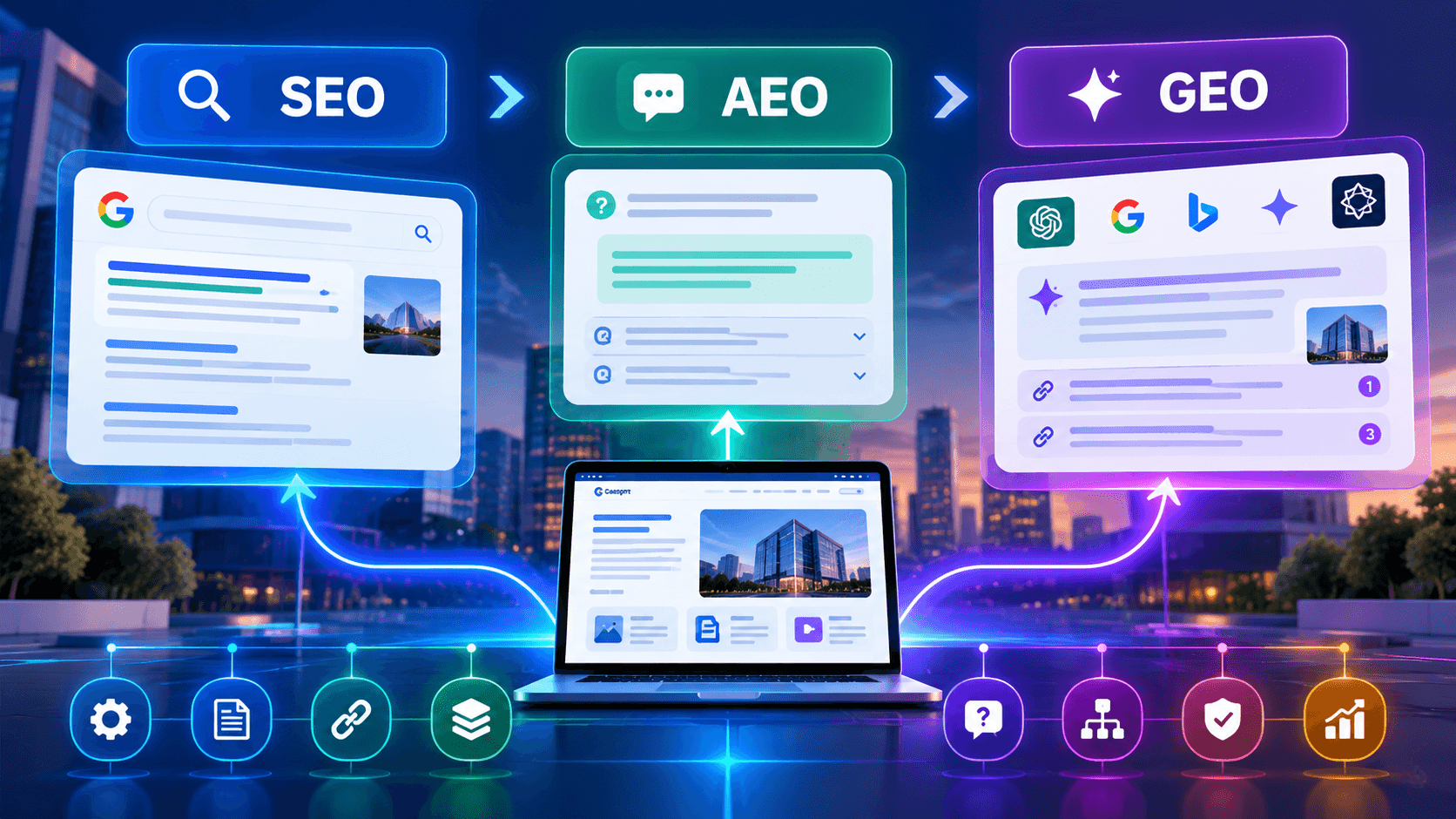
This shift has introduced three connected disciplines:
SEO - Search Engine Optimization
AEO -Answer Engine Optimization
GEO - Generative Engine Optimization
The important question for enterprise marketing teams is not which one to choose.
It is how SEO vs AEO vs GEO work together to increase visibility across every stage of modern search.
SEO Still Builds the Foundation
SEO remains the technical and strategic base.
It helps search engines discover, crawl, index, understand, and rank your website.
Core enterprise SEO still includes:
- Technical crawlability
- Indexability
- Internal linking
- Page speed
- Core Web Vitals
- Canonical URLs
- XML sitemaps
- Structured data
- Content quality
- Topical authority
- Backlinks
- Search intent
Without these fundamentals, AI visibility becomes harder.
A website that search engines struggle to crawl or understand will also create challenges for answer engines and generative systems.
Enterprise teams using Sitecore can address these foundations through Sitecore SEO services, including technical SEO, performance, structured content, and enterprise CMS optimization.
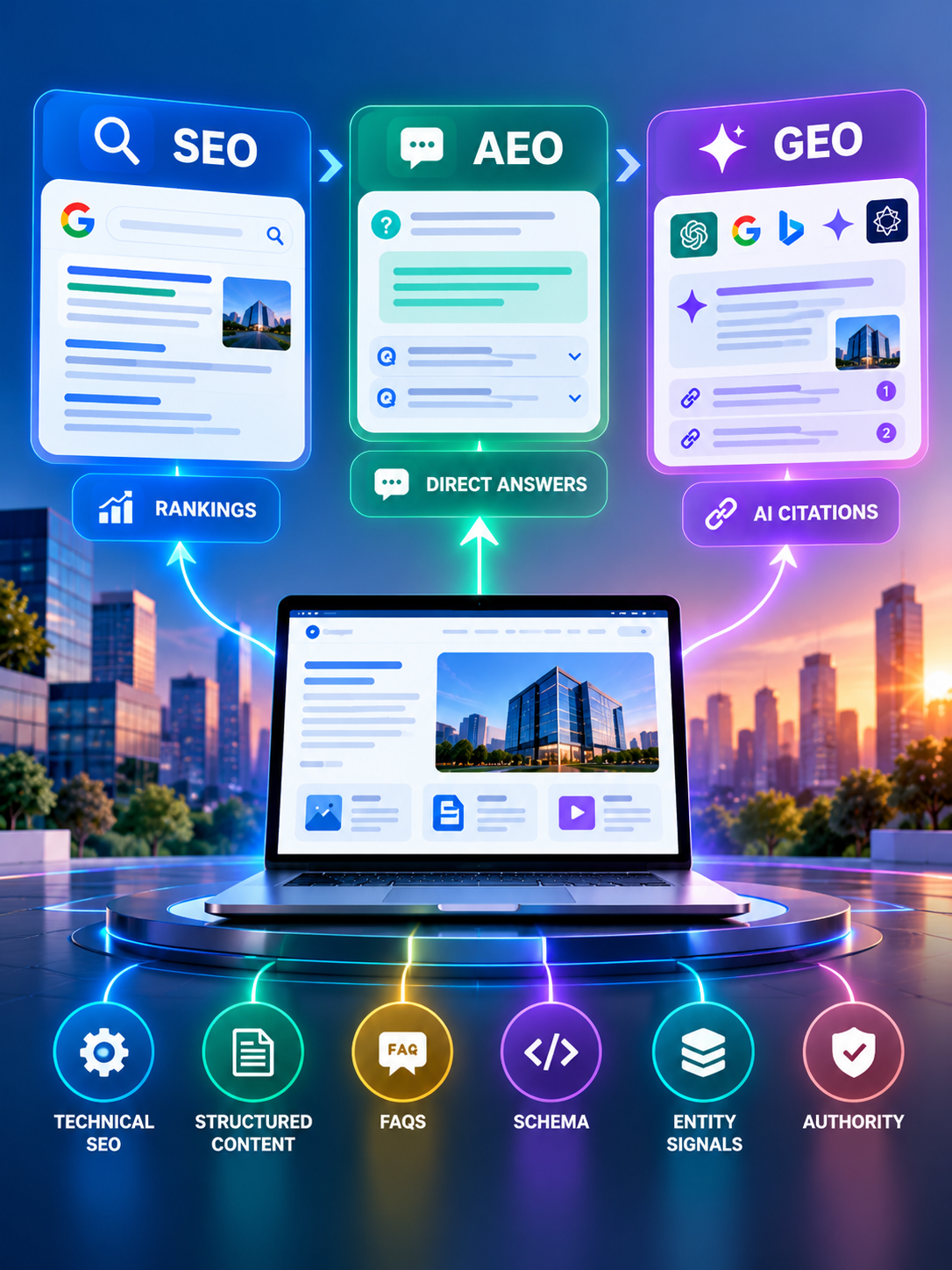
Build Visibility Beyond Rankings
Combine SEO, AEO, GEO, structured content, and citation-ready signals to improve enterprise visibility across search and AI-generated answers.
What Is Answer Engine Optimization?
Answer Engine Optimization focuses on making your content easy to extract and present as a direct answer.
Instead of optimizing only for a keyword such as:
enterprise cms migration
AEO asks:
“What exact question is the buyer asking?”
For example:
- How much does a CMS migration cost?
- How do we protect SEO during migration?
- Which CMS is best for an enterprise?
- How long does migration take?
Strong AEO content answers these questions clearly and early.
A useful structure is:
Question → direct answer → explanation → evidence
That makes content easier for search engines, featured-answer systems, and AI tools to retrieve.
What Is Generative Engine Optimization?
Generative Engine Optimization focuses on helping generative AI systems understand, trust, and potentially cite your brand.
Unlike traditional search results, generative engines often synthesize one answer from multiple sources.
That means enterprise content needs to be:
- Clear
- Factual
- Current
- Structured
- Entity-rich
- Evidence-supported
- Easy to quote
- Easy to verify
GEO is not simply adding AI-related keywords.
It is about producing content that can function as reliable source material.
Our AI search optimization services focus on this wider layer of search visibility, including SEO, AEO, GEO, entity clarity, citation readiness, and AI discovery.
SEO vs AEO vs GEO: Quick Comparison
| Area | SEO | AEO | GEO |
|---|---|---|---|
| Primary goal | Rank in search | Become the direct answer | Be used or cited in generated answers |
| Main focus | Crawlability, relevance, authority | Clear question-answer structure | Trust, context, citations, entities |
| Content style | Comprehensive and optimized | Concise and direct | Evidence-rich and citation-ready |
| mportant formats | Guides, landing pages, category pages | FAQs, definitions, concise answers | Research, comparisons, facts, expert content |
| Key metric | Rankings, clicks, traffic | Answer inclusion | AI citations, mentions, referral visibility |
The strongest enterprise strategy combines all three.
AI Visibility Requires Structured Content
Enterprise websites often bury important information inside large page-builder blocks.
That creates problems for reuse, consistency, and machine understanding.
A modern CMS should make important information explicit.
Useful fields can include:
- AI summary
- Direct answer
- Key facts
- FAQ questions
- FAQ answers
- Primary entity
- Service area
- Target audience
- Review date
- Schema type
That information can support website pages, structured data, internal search, APIs, AI assistants, and answer engines.
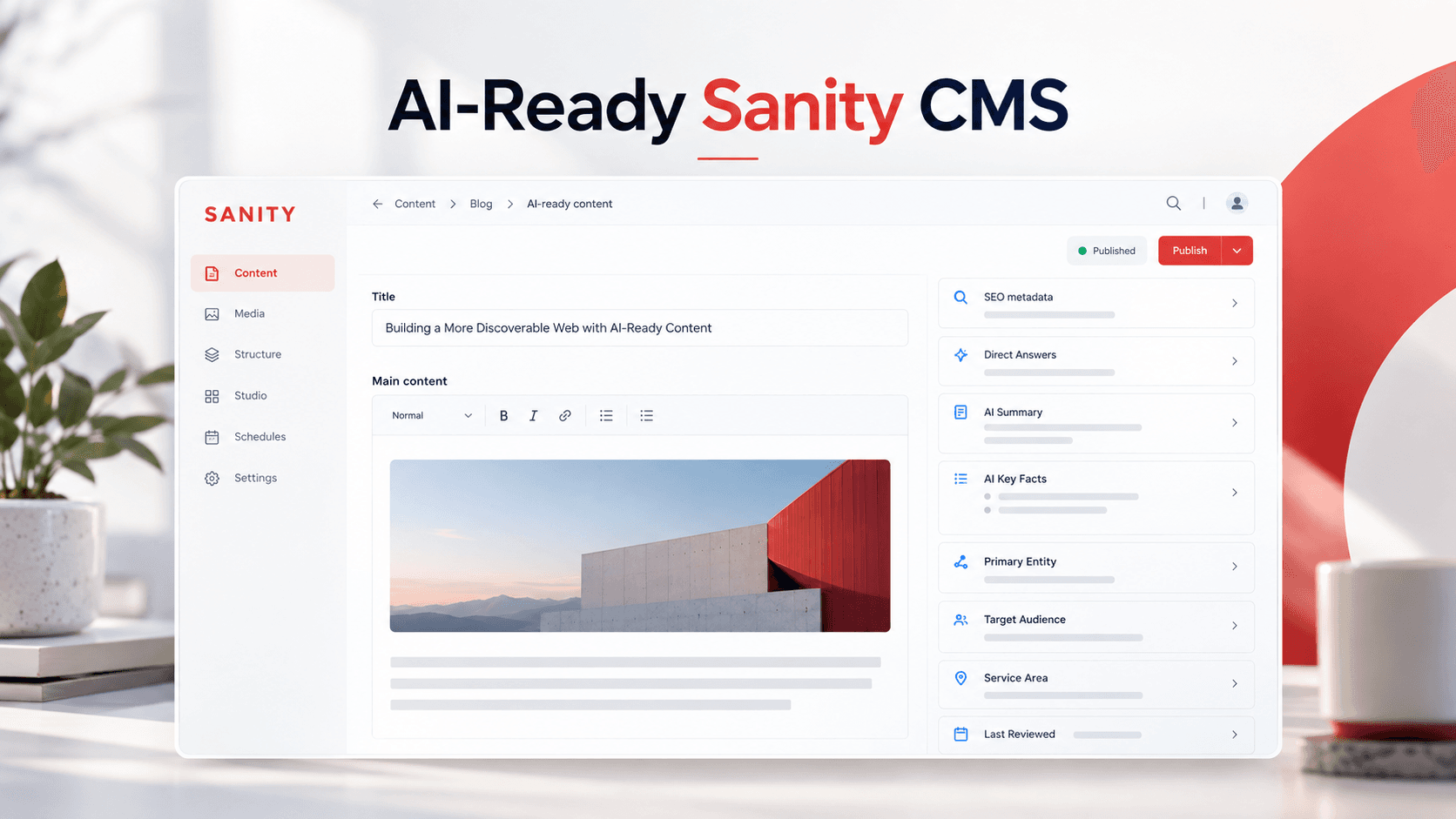
We have implemented this approach directly in structured CMS environments, including SEO, AEO and GEO fields in Sanity CMS.
FAQs Are More Important Than Ever
FAQ content is not useful because search engines simply prefer the format.
It is useful because well-designed FAQs reflect how people actually ask questions.
Enterprise pages should identify commercial questions such as:
- What does this service cost?
- Who is this solution for?
- How does implementation work?
- How does this compare with another option?
- What are the risks?
- What happens after launch?
Answer each question directly.
Then support the answer with useful context.
This improves usability for people while creating clearer information blocks for answer engines.
Key Facts Make Content Easier to Cite
Generative systems often need precise statements they can retrieve independently.
Long, vague paragraphs make that difficult.
Add concise factual statements such as:
- Supported platforms
- Service regions
- Implementation requirements
- Technical capabilities
- Measurable results
- Pricing models where appropriate
- Deployment options
These facts should be accurate and verifiable.
Unsupported marketing claims are much less useful than concrete information.
Schema Helps Machines Understand Context
Structured data does not guarantee an AI citation.
But it can help search systems understand what a page represents.
Depending on the page, useful schema types may include:
- Article
- Service
- Product
- Organization
- Person
- FAQPage
- BreadcrumbList
- LocalBusiness
Schema should reflect visible page content rather than introducing information users cannot see.
For enterprise CMS teams, schema generation works best when it is driven from structured CMS fields instead of manually hardcoded page by page.
Turn Enterprise SEO Into Visibility Across AI Search
Your CMS Is Part of the AI Search Strategy
Many marketing teams treat SEO, AEO, and GEO as copywriting tasks.
That is too narrow.
The CMS architecture determines whether teams can consistently manage:
- Metadata
- Canonicals
- FAQs
- Direct answers
- Structured data
- Entities
- Author information
- Content relationships
- Review dates
- Regional information
Organizations using a structured headless stack can benefit from Sanity CMS development services, while migration teams should preserve these signals when planning headless CMS migration services.
Measure More Than Rankings
Enterprise search reporting now needs additional metrics.
Traditional SEO measures still matter:
- Rankings
- Organic traffic
- Conversions
- Search impressions
- Click-through rate
But AI visibility adds:
- Brand mentions
- AI citations
- Answer inclusion
- Citation source
- Prompt coverage
- AI referral traffic
- Brand representation accuracy
This means search teams need to understand not only where the website ranks, but also whether the brand appears inside the answer.
Build SEO, AEO and GEO Into One Workflow
The most scalable approach is not to create separate teams optimizing the same content independently.
Build one workflow:
Technical SEO → structured content → direct answers → schema → factual evidence → entity signals → AI visibility monitoring
This approach reduces duplication and creates a stronger content system.
For Sitecore environments, our guide to SEO, AEO, GEO and AI digital marketing explains how these disciplines can work together at enterprise scale.
You can also explore our Sitecore GEO, AEO and AI integration guide for a CMS-specific implementation perspective.
SEO Is the Foundation. AEO and GEO Extend Visibility.
Enterprise teams should not abandon traditional SEO,
they should expand their SEO.
SEO gets your content discovered.
AEO gets it answered.
GEO gets it referenced.
When you combine technical SEO plus structured CMS fields, direct answers, FAQs, schema, entities, and evidencing this prepares your website to be found by both search engines and AI discovery. If your brand is already spending time and money on SEO but isn't showing up in AI answer boxes, begin by auditing your ability to extract, understand, verify, and reference information.
Explore our AI search optimization services to improve search, answer-engine, and generative visibility together.
Frequently Asked Questions
What is the difference between SEO, AEO and GEO?
SEO focuses on traditional search visibility and rankings, AEO structures content so answer engines can extract direct responses, and GEO improves the likelihood that generative AI systems understand, use and potentially cite your content.
Does AEO replace SEO?
No. AEO builds on SEO fundamentals. Content still needs to be crawlable, indexable, relevant and authoritative before answer engines can reliably discover and use it.
Does GEO replace traditional SEO?
No. Generative engine optimization extends traditional SEO by focusing on citation readiness, entity clarity, evidence, structured content and visibility inside generated answers.
What is Answer Engine Optimization?
Answer Engine Optimization is the practice of structuring content so search engines and AI systems can quickly identify concise, accurate answers to specific questions.
What is Generative Engine Optimization?
Generative Engine Optimization is the practice of improving content, entities, authority and factual clarity so generative systems can understand the source and potentially use or cite it in generated answers.
How can enterprises optimize content for AEO?
Use question-based headings, provide direct answers early, add FAQs, structure content clearly, maintain strong technical SEO and use appropriate structured data.
How can businesses optimize for GEO?
Publish clear facts, original evidence, expert insights, comparisons, definitions and current information while strengthening entity signals and source credibility.
Does schema markup help with AEO and GEO?
Schema markup can help machines interpret entities and page context, but it does not guarantee inclusion in direct answers or AI-generated citations.
Why should AI fields be added to the CMS?
Structured CMS fields for summaries, key facts, direct answers, entities and review dates make important information easier to manage consistently and reuse across websites, search systems and AI applications.
How should enterprise teams measure SEO, AEO and GEO success?
Track traditional SEO metrics such as rankings, traffic and conversions alongside AI-focused metrics including answer inclusion, brand mentions, citations, citation sources, prompt coverage and AI referral traffic.