Sanity CMS AEO and GEO Implementation Services for AI-Ready Content
In This Article
- Why Sanity Structured Content Fits AI Search
- What We Can Implement Inside Sanity CMS
- Direct Answers for Sanity AEO
- Build GEO Fields for AI-Ready Context
- Connect Sanity With Next.js SEO
- Generate Schema From Structured Content
- Add Freshness and Editorial Governance
- AEO and GEO Implementation Is More Than Adding Fields
- Turn Sanity Into an AI-Ready CMS
Sanity gives content teams tremendous flexibility. But flexibility alone does not make a website ready for Google, Bing, ChatGPT, AI Overviews, answer engines or generative search.
Many Sanity implementations still treat optimization as a frontend task: hardcoded metadata, manually assembled JSON-LD, unstructured FAQs and content models designed primarily for human-readable pages.
A better approach is to make SEO, AEO and GEO part of the Sanity content architecture itself.
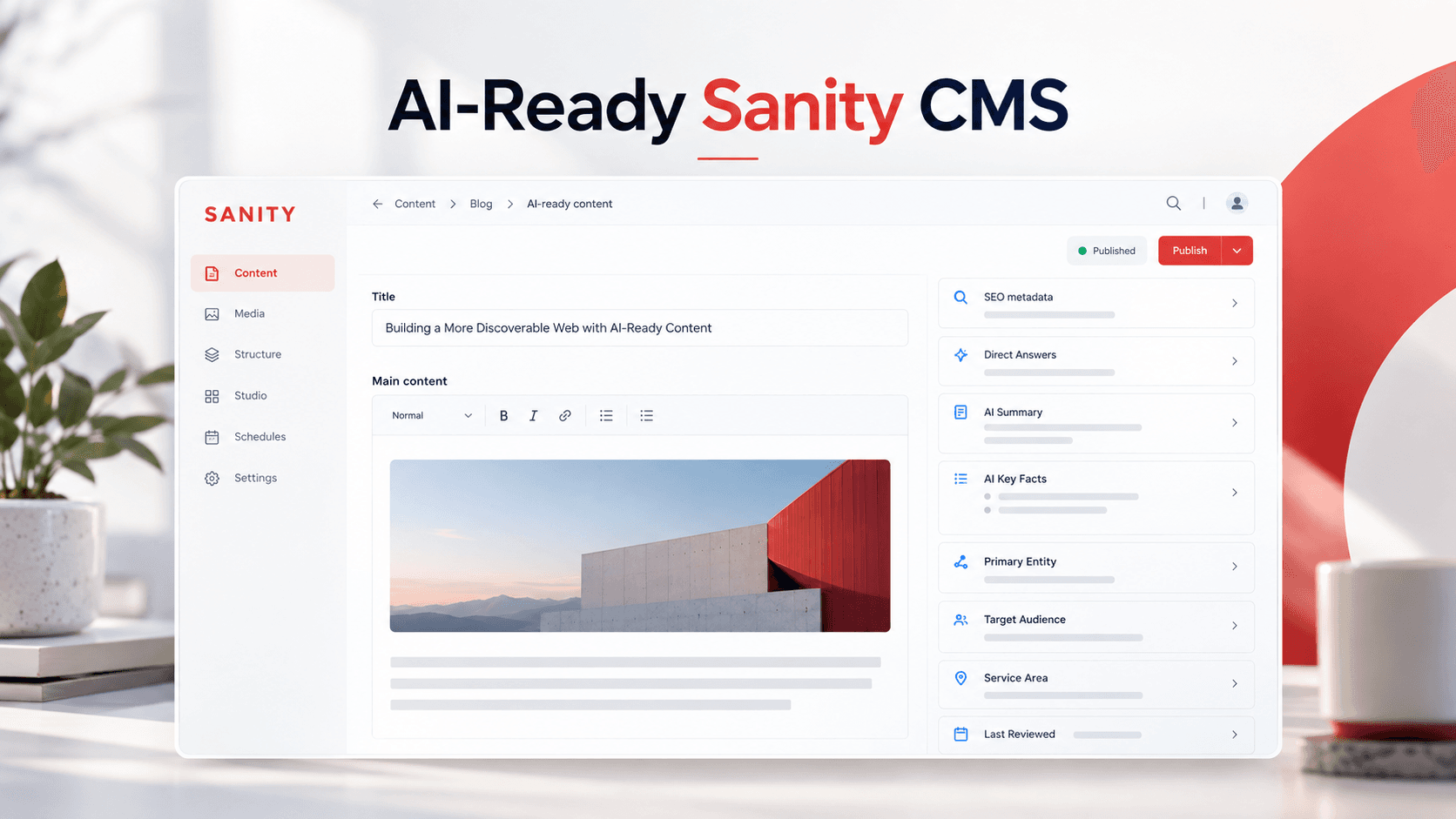
With the right Sanity CMS AEO and GEO implementation, editors can manage metadata, direct answers, AI summaries, key facts, questions, entities, audience information and freshness signals from the same CMS that powers the website.
That is what turns Sanity into an AI-ready CMS.
Why Sanity Structured Content Fits AI Search
AI-powered search does not simply match keywords to entire pages. Modern retrieval systems can identify relevant passages, synthesize information and cite supporting sources.
That makes clear, self-contained and well-structured content increasingly valuable.
Current AEO/GEO developer guidance emphasizes that AI retrieval works at the passage level and recommends answer-first content, strong evidence, semantic structure and server-rendered critical information.
Sanity is well suited to this model because important information can be stored as structured fields rather than buried inside one large rich-text document.
Instead of asking an editor to manually create AI-friendly formatting on every page, the CMS can provide reusable content fields designed for traditional search, answer engines and generative discovery.
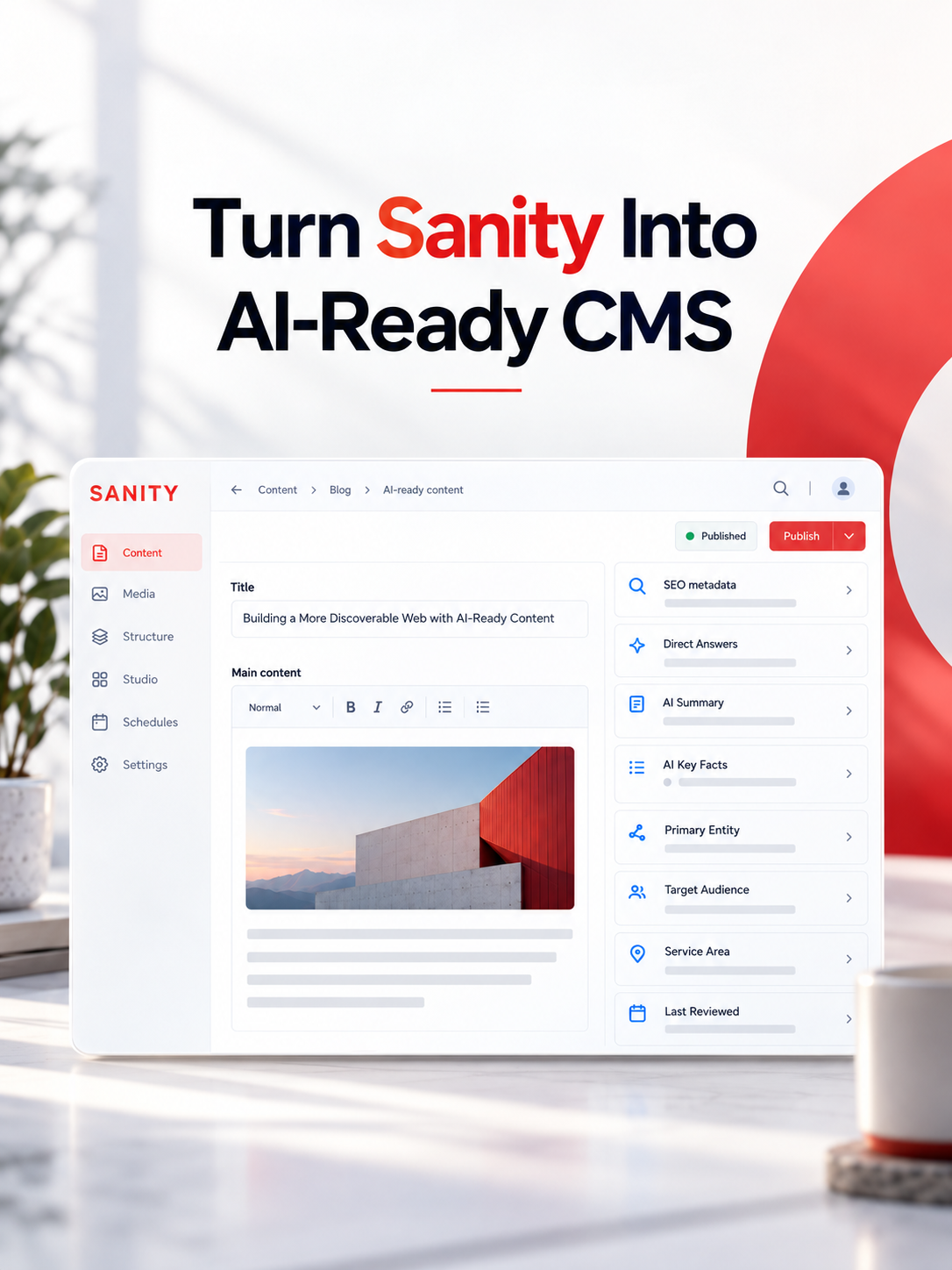
Turn Sanity Into AI-Ready CMS
Implement SEO, AEO, GEO, direct answers, AI summaries, structured data and Next.js metadata for stronger search and AI visibility.
What We Can Implement Inside Sanity CMS
A commercial Sanity CMS SEO implementation can extend your schemas with dedicated SEO, social, AEO and GEO fields.
Traditional SEO fields can include meta title, meta description, canonical controls, robots directives, Open Graph data and social sharing metadata.
The AEO layer can introduce structured question-and-answer content, direct answers and FAQs that editors can reuse across page components and structured outputs.
The GEO layer can include an AI Summary, AI Search Snippet, AI Key Facts, AI Questions, Primary Entity, Target Audience, Service Area, preferred schema type and Last Reviewed date.
This architecture has already been implemented as a practical Sanity model where optimization information is managed separately from the main article body and then consumed by the frontend.
For teams that want this built into their own platform, explore Sanity CMS Development Services.
Direct Answers for Sanity AEO
One of the most useful additions is a structured directAnswers field.
Instead of hoping an AI system can extract the correct answer from several paragraphs, editors can maintain a concise question and standalone answer directly inside Sanity.
For example:
Question: What is headless CMS migration?
Direct answer: Headless CMS migration moves content from a page-coupled CMS into a structured content platform where the frontend consumes content through APIs.
The visible page can still contain a detailed explanation. The direct answer simply creates a reusable, answer-ready source that can power FAQs, page sections, APIs and other experiences.
Official developer guidance similarly recommends question-based headings followed quickly by clear standalone answers.
Turn Your Sanity CMS Into an AI-Ready Platform
Build GEO Fields for AI-Ready Context
GEO requires more than FAQs.
Generative systems benefit when content clearly communicates what the page is about, who it serves, what facts matter and when the information was reviewed.
That is why an AI-ready Sanity model can store Primary Entity, AI Key Facts, Target Audience, Service Area and Last Reviewed At as explicit fields.
For example, a service page could identify its primary entity as “Sanity CMS Development Services,” its target audience as enterprise content teams and its service area as the United States.
Instead of forcing every downstream system to infer these facts from prose, the CMS exposes them as structured content.
This aligns with the broader shift toward content systems that can provide reusable facts and context to websites, applications and AI consumers.
Connect Sanity With Next.js SEO
Strong Sanity Next.js SEO requires both content modeling and frontend implementation.
Sanity fields should flow into the rendered application.
Next.js can query the document through GROQ and map those fields into page titles, descriptions, canonical URLs, robots directives, social previews, semantic page sections and JSON-LD.
Critical content should also be available in server-rendered HTML rather than depending entirely on client-side JavaScript. Current developer guidance specifically recommends server-rendering important text, headings and answers so crawlers and retrieval systems can access them reliably.
A mature implementation therefore connects Sanity schema → GROQ → Next.js → rendered HTML → structured data.
That connection is where many generic SEO implementations stop short.
Generate Schema From Structured Content
Editors should not need to write JSON-LD manually.
If Sanity already stores the author, organization, FAQs, service information, dates and entities, Next.js can transform those values into appropriate structured data automatically.
Structured data should represent the visible page accurately. It should not contain invented information or become a separate editorial database.
Schema also should not be marketed as a guaranteed AI-citation technique. Current AI-search guidance explicitly notes that structured data remains useful but is not a requirement or magic switch for generative citations.
The goal is consistency: one structured source in Sanity supporting multiple outputs.
Plan Your Sanity AEO and GEO Implementation Strategy
Add Freshness and Editorial Governance
AI-ready content cannot be a one-time implementation.
Content becomes outdated. Services change. Statistics expire. Pages lose relevance.
Sanity provides timestamps such as _updatedAt, while custom review fields can give editorial teams stronger control over meaningful content reviews.
A lastReviewedAt field can help teams identify pages requiring another editorial review and distinguish genuine content maintenance from minor technical edits.
Practical Sanity AEO/SEO implementations increasingly connect freshness, structured data, sitemaps and recurring technical validation rather than treating SEO as a launch-only task.
AEO and GEO Implementation Is More Than Adding Fields
Simply adding fields does not guarantee rankings, AI citations or visibility.
The real value comes from connecting the entire system: structured content modeling, editorial controls, technical SEO, semantic rendering, Next.js metadata, JSON-LD, internal linking, crawler accessibility, answer-ready content and ongoing optimization.
For broader AI visibility strategy, auditing and citation-readiness work, explore AI Search Optimization Services.
Organizations running multiple digital channels can also extend the same structured-content approach through Headless CMS Development Services.
Turn Sanity Into an AI-Ready CMS
Your CMS should do more than store pages.
It should give editors a structured system for managing how content is described, answered, contextualized, reviewed and delivered across search engines, websites, applications and AI discovery experiences.
We can implement the Sanity schemas, SEO fields, direct answers, AI summaries, key facts, entity context, structured data and Next.js integration required to create that foundation.
Build AI-Ready Sanity CMS
Frequently Asked Questions
What is Sanity CMS AEO?
Sanity CMS AEO is the implementation of structured, answer-ready content inside Sanity so search and answer systems can understand important questions and concise responses. It can include direct answers, FAQs, semantic headings, entity fields, structured metadata and frontend rendering.
What is Sanity CMS GEO?
Sanity CMS GEO structures content so generative search systems can more clearly understand entities, facts, audiences, expertise and context. Typical GEO fields can include AI summaries, AI search snippets, key facts, primary entities, target audiences, service areas and editorial review dates.
How can Sanity CMS be made AI-ready?
Sanity can be made AI-ready by modeling content as reusable structured data, adding SEO, AEO and GEO fields, defining clear entity relationships, exposing answer-ready content in server-rendered pages and delivering the same structured information through websites, APIs or other channels.
What SEO fields should be implemented in Sanity CMS?
Common Sanity SEO fields include SEO title, meta description, canonical URL, robots controls, Open Graph metadata, social metadata, schema settings, primary entity and content review information. The exact field model should match the website architecture and editorial workflow.
What AEO and GEO fields can be added to Sanity?
Useful fields include Direct Answers, AI Summary, AI Search Snippet, AI Key Facts, AI Questions, Primary Entity, Target Audience, Service Area, FAQs, preferred schema type and Last Reviewed date. These fields should support visible, useful page content rather than hidden keyword stuffing.
How does Sanity work with Next.js SEO?
Sanity can provide structured SEO and AI-search fields through GROQ queries, while Next.js maps that content into titles, descriptions, canonical tags, social metadata, semantic page sections, JSON-LD and server-rendered answer content.
Does Sanity need special AI schema for Google AI search?
No special AI-specific schema is required for Google AI Overviews or AI Mode. Structured data should accurately represent visible page content, while crawlability, indexability, internal links, content quality and page experience remain important.
Why are direct answers useful in Sanity CMS?
Direct answers give editors a dedicated structured field for concise responses to important questions. The same answer can then support visible AEO sections, FAQs, structured outputs, APIs and other content experiences without repeatedly rewriting the information.
Should I hire a Sanity developer for SEO, AEO and GEO implementation?
A Sanity developer is useful when optimization requires schema design, GROQ queries, Studio configuration, Next.js integration, structured data, server rendering, validation and reusable editorial workflows rather than only content recommendations.
Can Sanity AEO and GEO guarantee AI citations?
No. CMS implementation cannot guarantee citations or rankings from Google, Bing, ChatGPT or other AI systems. A strong Sanity implementation improves content structure, accessibility, clarity, freshness and citation readiness, but external platforms decide what they surface or cite.