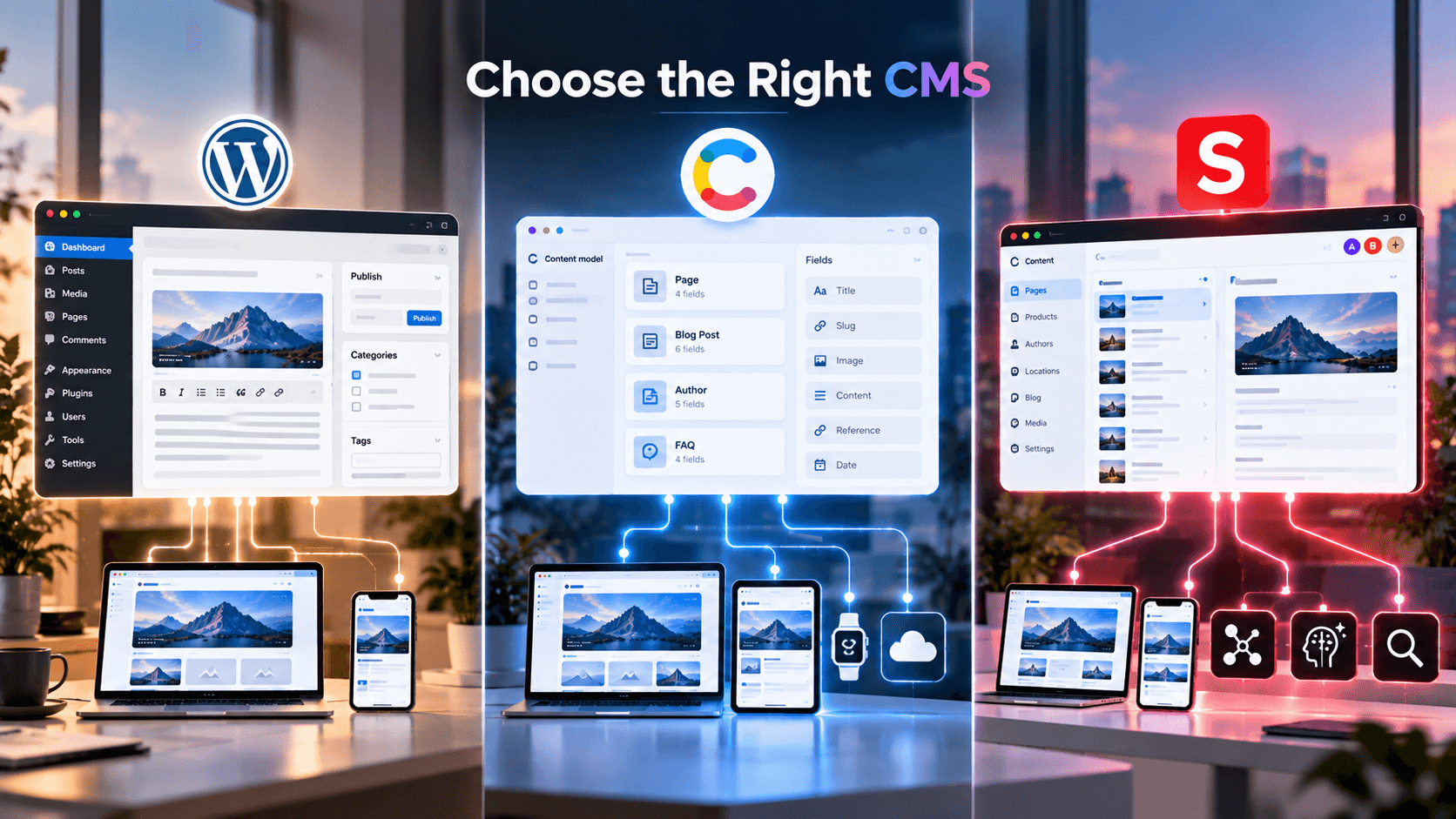
Sanity CMS and Next.js Development for Fast, SEO-Ready Websites
In This Article
- A modern business website has to do more than look good.
- Why Sanity and Next.js Work Well Together
- Build Fast Websites Without Hardcoding Content
- Make SEO Fields Part of the Content Model
- Give Editors Visual Preview and Editing
- Build Reusable Landing Pages Without Losing Structure
- Create a Better Blog System
- Prepare Content for AI Search
- Use Sanity Beyond a Single Website
- What Should a Sanity Next.js Development Agency Deliver?
- Build for Performance, Editors and Search
A modern business website has to do more than look good.
It has to be performant, rank well, support landing pages and blogs, give editors control of content, provide previews, and adapt to new search and AI experiences.
That is why more businesses are evaluating Sanity Next.js development as an alternative to tightly coupled CMS platforms.
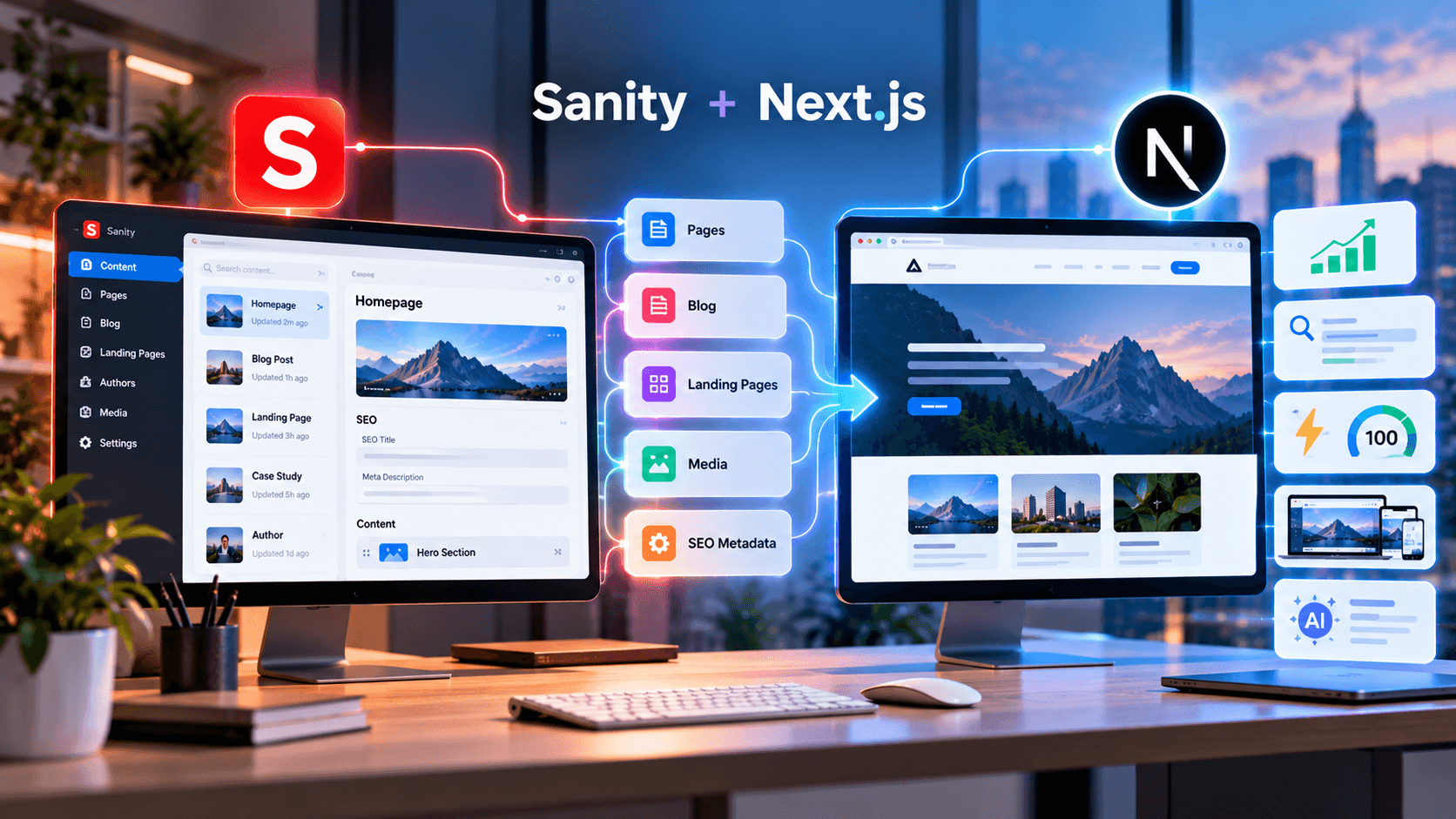
Sanity provides the structured content layer. Next.js provides the frontend application. Together they form a flexible architecture for marketing websites, SaaS platforms, service businesses, ecommerce experiences, and content-heavy websites.
Why Sanity and Next.js Work Well Together
Traditional CMS platforms often contain content management, templates, rendering, and plugins within the same system.
Sanity and Next.js separate these responsibilities.
Sanity can manage:
- Page content
- Blog posts
- Service pages
- Landing pages
- Case studies
- Authors
- FAQs
- Testimonials
- SEO metadata
- Calls to action
- Reusable content sections
Next.js then controls how that content is rendered and delivered.
This gives developers more control of performance while letting marketing teams manage content without touching on application code.
Businesses evaluating this architecture can explore our Sanity CMS development services for content modelling, implementation, migration, integrations, and ongoing support.
Build Fast Websites Without Hardcoding Content
Performance is one of the main reasons businesses choose modern Next.js CMS development.
Next.js supports several rendering and caching strategies, letting developers decide how different pages should be delivered in accordance with their needs.
A marketing homepage may benefit from cached or pre-rendered content, while dynamic experiences may demand server-rendered or frequently refreshed data.
The important point is that performance can be designed intentionally.
A well built Sanity and Next.js website can also optimize:
- images
- JavaScript delivery
- Fonts
- Route loading
- API requests
- Caching
- Revalidation
- Server rendering
- Static pages
Businesses that need dedicated frontend expertise can also review our Sanity and Next.js development services.

Build Faster With Sanity
Launch a high-performance Next.js website with structured content, visual editing, SEO metadata, landing pages, and AI-ready architecture.
Make SEO Fields Part of the Content Model
A strong Sanity CMS SEO starts with content architecture.
SEO should not be added after the website is finished.
Important content types can include dedicated fields for:
- SEO title
- Meta description
- Canonical URL
- Open Graph title
- Open Graph description
- Social image
- Robots directives
- Structured data inputs
- URL slug
- Breadcrumb information
Next.js can then use those structured fields to generate page metadata dynamically.
This makes SEO easier to manage on a large scale, as editors do not have to rely on developers to update metadata for every page.
Our implementation approach to structured SEO, AEO, and GEO fields is explained further in how we implemented SEO, AEO and GEO in Sanity CMS.
Give Editors Visual Preview and Editing
A common concern with headless CMS architecture is the editing experience.
Marketing teams do not want to publish content blindly and expect the frontend to look right.
Sanity's visual editing workflow can be connected to the rendered Next.js website directly.
Editors can preview drafts, inspect rendered pages, click content on the frontend, and navigate back to the corresponding structured field.
That creates a much more intuitive content workflow.
For teams using the modern Next.js App Router, Visual Editing can be connected through Draft Mode, live content, content source mapping, and Sanity's Presentation tooling. Sanity's current documentation supports click-to-edit workflows and real-time content updates in this setup.
For a practical implementation walkthrough, see our guide to Sanity Presentation, Visual Editing and Next.js App Router.
Build Reusable Landing Pages Without Losing Structure
Marketing teams want the freedom of a page builder.
Development teams want structure and consistency.
Sanity can support both.
Instead of giving editors completely unrestricted page-building capabilities, developers can create structured reusable sections such as:
- Hero banners
- Feature blocks
- Logo grids
- Testimonials
- Pricing sections
- FAQs
- Comparison tables
- Forms
- Calls to action
- Case-study highlights
- Related content
Editors can then assemble landing pages from approved sections, while the development team maintains design consistency and frontend quality.
This approach is particularly useful for SEO landing pages and campaign pages, as the structure can remain predictable while content changes quickly.
Create a Better Blog System
A modern blog should be more than a rich-text field.
Sanity can model blog content around reusable structured entities such as authors, categories, related services, featured images, FAQs, schema information, and internal-link relationships.
That makes it easier to build:
- Author archives
- Category pages
- Related articles
- Topic hubs
- Internal linking systems
- Dynamic schema markup
- SEO templates
- AI-ready summaries
If you are starting from scratch, this guide explains how to configure Sanity CMS in a Next.js project.
Build a Faster Sanity Website That Converts More Visitors
Prepare Content for AI Search
Traditional website content is often stored primarily for human readable pages.
Modern content architecture increasingly requires support for machines.
Structured Sanity schemas can include explicit fields for:
- Summaries
- Key facts
- Questions
- Direct answers
- Entities
- Service areas
- Target audiences
- Schema types
- Review dates
These fields can support website rendering while making important facts easier to expose to AI-powered search, answer engines, internal search, knowledge applications, and APIs.
For companies planning this kind of architecture, our AI search optimization services focus on making content clearer for both traditional search and AI discovery.
Use Sanity Beyond a Single Website
One of the biggest advantages of structured content is reusability.
A service description does not need to exist only inside a webpage.
It can be reused across:
- Main website
- Regional websites
- Landing pages
- Mobile applications
- Product interfaces
- Internal tools
- Search experiences
- AI assistants
That is why businesses with larger content ecosystems increasingly evaluate headless CMS development services instead of building every experience on the one page-based CMS.
What Should a Sanity Next.js Development Agency Deliver?
A capable Sanity Next.js development agency should offer more than CMS configuration.
Look for experience across:
- Sanity schema design
- Sanity Studio customization
- GROQ
- Next.js App Router
- Rendering strategy
- Visual Editing
- Preview workflows
- Metadata implementation
- Technical SEO
- Structured data
- Landing-page systems
- Blog architecture
- API integrations
- Analytics
- Performance optimization
- Deployment
- AI-ready content modelling
If you plan on hiring a Sanity developer, make sure the person or team understands both frontend engineering and content architecture.
The best implementation comes from designing the CMS and frontend together.
Build for Performance, Editors and Search
Sanity and Next.js work particularly well when a business needs three things at the same time:
a fast frontend, a flexible editorial experience, and structured content that can support SEO and future AI use cases.
The technology alone is not enough for delivering results.
Performance, SEO, editor usability, and maintainability depend on how the system is designed.
But with the right architecture, Sanity website development can give marketing teams more control, while providing a cleaner and more scalable frontend stack to developers.
For businesses planning to launch a new website, migrate, or build a structured content platform, explore our Sanity CMS development services to build a faster, SEO-ready, and AI-ready digital experience.
Frequently Asked Questions
Why use Sanity CMS with Next.js?
Sanity provides structured content management while Next.js handles frontend rendering, routing and performance. Together they allow businesses to build fast custom websites while giving editors a flexible CMS for managing pages, blogs, metadata and reusable content.
Is Sanity CMS good for SEO?
Yes, when implemented correctly. Sanity can store SEO titles, descriptions, canonical URLs, Open Graph data, structured data inputs and other metadata, while Next.js can render those signals into crawlable pages.
Is Next.js good for SEO websites?
Next.js supports server rendering, static generation, metadata management, image optimization, routing and caching strategies that can create a strong technical foundation for SEO. Results still depend on content quality and implementation.
Can Sanity CMS manage landing pages?
Yes. Sanity can model reusable landing-page sections such as heroes, testimonials, pricing blocks, FAQs, forms, features and calls to action. Editors can assemble pages while developers maintain design and structural consistency.
Can Sanity CMS manage a blog?
Yes. Sanity can manage posts, authors, categories, images, SEO metadata, related content, FAQs and structured data. Its schema system allows developers to design a blog around the organization's specific requirements.
Does Sanity support visual editing with Next.js?
Yes. Sanity Visual Editing can integrate with Next.js so editors can preview drafts, see content updates in context and navigate from rendered content to its source fields in Sanity Studio.
How does Sanity CMS support AI search optimization?
Sanity can store structured summaries, key facts, questions, answers, entities and other machine-readable fields. These can support AI applications and answer-oriented experiences when combined with strong content, technical SEO and accessible frontend delivery.
Can Sanity and Next.js improve website speed?
They can provide a strong foundation for performance because developers can control rendering, caching, image delivery, data fetching and frontend code. Actual speed depends on architecture, implementation and third-party scripts.
What should a Sanity Next.js development agency provide?
A capable agency should provide schema design, Sanity Studio customization, Next.js development, GROQ queries, visual editing, SEO metadata, structured data, performance optimization, integrations, migration, deployment and ongoing support.
When should I hire a Sanity developer?
Hire a Sanity developer when you need custom content models, Studio workflows, Next.js integration, GROQ queries, CMS migration, preview functionality, SEO implementation, API integrations or performance-focused website development.