MVP Application Development Services in India
In This Article
- Complete Guide
- What Are MVP Application Development Services?
- Why MVP Development Matters for Startups in India
- MVP vs Full Product Development
- Common Types of MVP Applications
- MVP Development Process
- MVP Development Cost in India
- When You Need MVP Rescue
- Why Choose Murmu Software Infotech?
- Build Your MVP the Smart Way
Complete Guide
Launching a new app idea is exciting, but building a full product without validation can become expensive, slow, and risky. Many startups and businesses spend months developing features, only to discover that users do not need them, the market is not ready, or the product requires major changes after launch.
This is where MVP application development services become important.
An MVP, or Minimum Viable Product, is the first working version of your application with only the most essential features required to test your idea in the real market. It is not a half-built product. It is a focused, usable, and business-ready application designed to validate demand, collect feedback, and reduce development risk before scaling.
For startups, founders, business owners, and enterprises in India, MVP development is one of the smartest ways to move from idea to market faster without wasting budget.

Turn Your Idea Into Reality
Launch a focused, scalable MVP faster, validate your business idea with real users, reduce development risk, and build for future growth.
What Are MVP Application Development Services?
MVP application development services help businesses plan, design, build, launch, and test the first version of a software product. The goal is to create a working application that solves one core problem for one clear target audience.
A strong MVP usually includes user registration, core business workflow, admin dashboard, basic reporting, API structure, database, deployment, and essential security. Depending on the idea, it may also include payment gateway, notifications, AI chatbot, booking system, marketplace listing, mobile app, or SaaS dashboard.
At Murmu Software Infotech, we follow an ROI-driven approach to MVP development. That means we do not just build features. We build the smallest practical version of your product that can support business validation, user feedback, and future scaling. You can explore our dedicated service here: ROI-Driven MVP Application Development Services for Startups & Businesses.
Launch Your MVP Application Faster in India
Why MVP Development Matters for Startups in India
India is one of the fastest-growing startup and digital business markets. But competition is also high. Speed matters, but speed without strategy creates poor products.
A well-planned MVP helps you validate your product idea before investing heavily in a full application. It helps you understand whether customers will use the app, pay for it, recommend it, or request improvements.
For startup founders, MVP development reduces financial risk. For business owners, it gives a faster route to digitization. For enterprises, it allows new product ideas to be tested before large investment.
The biggest advantage is learning from real users. Instead of assuming what the market wants, you launch early, measure usage, collect feedback, and improve based on evidence.
MVP vs Full Product Development
A full product includes advanced features, polished user experience, automation, analytics, integrations, multiple user roles, mobile apps, marketing tools, reporting, AI workflows, and scalability layers.
An MVP focuses only on what is required to validate the core idea.
For example, if you are building a marketplace app, your MVP may need buyer registration, seller onboarding, listings, search, inquiry flow, and admin panel. You do not need advanced wallet, AI recommendations, logistics automation, and subscription management on day one.
If you are building a healthcare app, your MVP may start with patient registration, appointment booking, doctor dashboard, and video consultation. Advanced EMR, insurance workflows, pharmacy, and AI medical assistant can come later.
This approach saves time, reduces cost, and helps you scale only after validation.
Common Types of MVP Applications
Businesses in India are now building MVPs across many industries. Some common MVP application types include SaaS platforms, marketplace apps, healthcare applications, billing and inventory apps, AI chatbots, internal automation tools, CRM systems, telemedicine apps, education platforms, and financial analysis dashboards.
Murmu Software Infotech has worked on several product-style platforms and MVP-driven solutions. For example, TribalShaadi AI-Powered Matrimony Platform shows how AI can support matchmaking, verification, and user engagement. The Smart Billing Lite case study demonstrates how small businesses can use a mobile-first billing MVP. The DOC247 telemedicine case study shows a scalable healthcare platform approach, while GAXA Local Marketplace highlights buying and selling marketplace development.
These examples prove that MVPs are not limited to startups. They are useful for any business that wants to launch faster and validate before scaling.
MVP Development Process
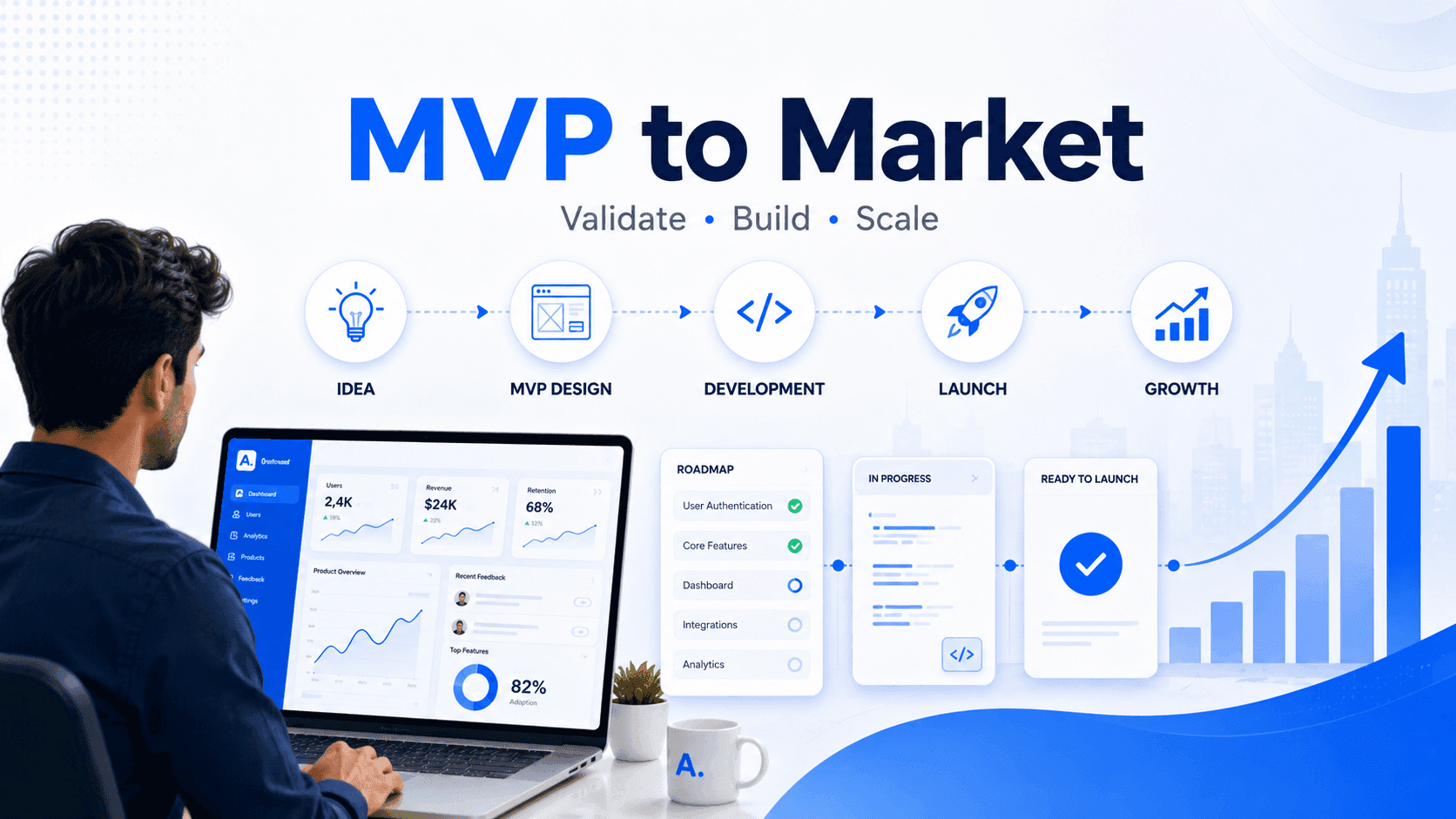
A successful MVP starts with discovery. Before development begins, the core problem, target users, business model, and must-have features must be clearly defined. This avoids confusion and prevents unnecessary development.
The next step is feature prioritization. Only the features directly connected to validation should be included in version one. Then comes UI/UX design, where user journeys are mapped simply and clearly.
After that, the development team builds the frontend, backend, admin panel, database, and APIs. Testing is done to ensure the application works properly across devices and user flows. Finally, the MVP is deployed, monitored, and improved based on early feedback.
For AI-based products, discovery becomes even more important. If you are planning an AI product, read this guide on AI MVP App and Software Product Discovery before development.
Validate Your Product Idea Before Investing In Full Development
MVP Development Cost in India
The cost of MVP development in India depends on features, technology stack, UI/UX complexity, backend logic, third-party integrations, mobile app requirements, cloud hosting, security, and AI functionality.
A simple web MVP may cost less than a mobile app MVP. A SaaS dashboard may cost differently from a marketplace platform. An AI MVP with chatbot, automation, document search, or recommendation engine may need additional planning and integration.
The best approach is not to ask, “How much does an app cost?” The better question is, “What is the smallest product we can build to validate the business model?”
This is exactly why ROI-driven planning matters. It protects your budget and ensures your first version is useful, not overloaded.
When You Need MVP Rescue
Sometimes, businesses already have an MVP, but it does not perform. It may have poor UI, weak architecture, bugs, slow performance, missing features, no user adoption, or AI-generated code that cannot scale.
In such cases, rebuilding from scratch is not always required. A proper audit can identify what to fix, what to remove, and what to rebuild. If your MVP is stuck, explore our Software and MVP Rescue Mission.
Why Choose Murmu Software Infotech?
Murmu Software Infotech provides MVP application development services in India for startups, businesses, and agencies that want fast, scalable, and ROI-focused product development.
Our team works across custom software, mobile apps, web platforms, AI integrations, backend APIs, admin dashboards, cloud deployment, and business automation. We do not treat MVP as just code delivery. We treat it as a business validation system.
You can also explore our Custom Software and MVP Software Development service if your project needs a custom product roadmap beyond a basic MVP.
Build Your MVP the Smart Way
A successful MVP is not about building everything. It is about building the right thing first.
If you are a founder, business owner, agency, or enterprise leader planning to launch a software product, start with a focused MVP that validates your idea, reduces risk, and creates a clear path to growth.
Book your free MVP strategy discussion with Murmu Software Infotech and discover the fastest route from idea to market-ready application.
Frequently Asked Questions
What are MVP application development services?
MVP application development services help startups and businesses plan, design, build, test, and launch a minimum viable product with the essential features needed to validate a business idea, collect real-user feedback, and reduce development risk before investing in a full product.
How much does MVP development cost in India?
MVP development cost in India depends on product complexity, features, UI/UX, technology stack, backend architecture, integrations, mobile requirements, cloud infrastructure, security, and AI functionality. A focused MVP generally costs less than a full-scale application because it prioritizes only the features required for validation.
How long does it take to build an MVP application?
A focused MVP can often be developed within a few weeks when the scope, user journey, and core features are clearly defined. The exact timeline depends on application complexity, platforms, integrations, design requirements, testing, and deployment.
Why should startups build an MVP before developing a full product?
Startups should build an MVP first to validate demand, test product-market fit, collect user feedback, reduce financial risk, and avoid spending heavily on features that customers may not need.
What features should a startup MVP include?
A startup MVP should include the core user journey, authentication, the main business workflow, database, APIs, essential security, an admin panel, basic reporting, and deployment. Additional features should be added after real-user validation.
What is the difference between an MVP and a full product?
An MVP contains only the essential features needed to solve a core problem and validate the business idea, while a full product typically includes advanced functionality, automation, integrations, analytics, multiple user roles, scalability features, and a more comprehensive user experience.
Can an MVP application be scaled into a full product?
Yes. A properly architected MVP can become the foundation for a full product. Using scalable databases, APIs, secure architecture, modular development, and cloud-ready infrastructure helps businesses add features and users without requiring an expensive rebuild.
What types of applications can be developed as an MVP?
MVPs can be developed for SaaS platforms, marketplaces, healthcare applications, billing and inventory systems, CRM platforms, AI chatbots, telemedicine apps, education platforms, financial dashboards, internal automation tools, and other custom software products.
Can you build an AI-powered MVP application?
Yes. An AI-powered MVP can include features such as AI chatbots, intelligent search, recommendations, document analysis, automation, AI assistants, or other AI workflows. AI functionality should be selected based on the core business problem and MVP validation goals.
Can Murmu Software Infotech develop an MVP in India?
Yes. Murmu Software Infotech provides MVP application development services in India for startups, businesses, agencies, and enterprises, including web applications, mobile apps, APIs, admin dashboards, AI integrations, custom software, deployment, and scalable MVP architecture.