AI MVP Planning Guide: From Use Case to Launch Criteria
In This Article
An AI MVP plan should make one product decision testable: whether AI helps a particular user complete a useful task. A convincing demonstration is a starting point, but it does not show how the system behaves with missing data, ambiguous requests or a failed dependency. Define those conditions before selecting an implementation.
This is the implementation-planning guide. If you are still deciding whether AI belongs in the product, read when to choose AI over a conventional MVP. For quotation and recurring-cost questions, use the AI MVP cost guide.
Specify one user task and its baseline
Write down the input, expected output and the action the user takes next. Compare the proposed result with the current process or a simpler non-AI alternative. A summarisation workflow might be useful when it reduces review effort; it needs testing to show whether the user can trust and efficiently correct the output.
Choose one workflow for the pilot. A search assistant, document processor and multi-step agent are different products, even if each calls a model. Specify which capability is necessary to learn from the first release and postpone the rest.

AI MVP Planning Guide: From Use Case to Launch Criteria
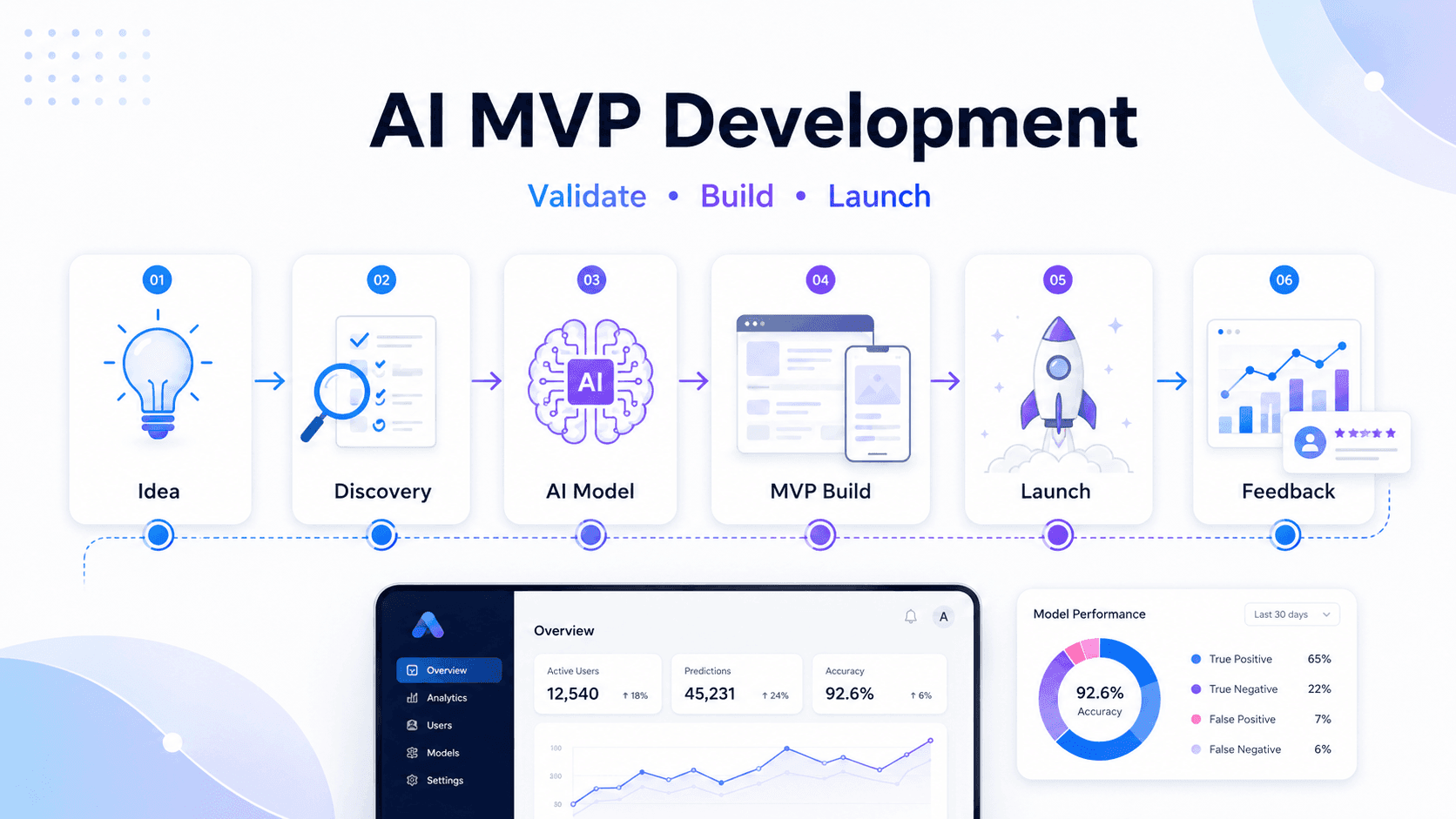
An AI MVP plan should define the user task, data access, an evaluation set, failure handling and operating budget before implementation. Launch acceptance must cover both application behaviour and the AI result, with human review appropriate to the task.
Check the data before expanding the feature list
Identify approved sources, their owners, update schedules and permission boundaries. Review sample records for quality and completeness. Decide how stale or missing information is handled and whether the system should ask for clarification, return no answer or send the task to a person.
- Name the source used for each output.
- Test whether users can access only permitted information.
- Record how imported or retrieved data is refreshed.
- Keep representative evaluation examples separate from demonstration examples.
- Decide who maintains the source material after launch.
Retrieval can supply context, but it does not automatically make an answer correct. Both retrieval and generation must be evaluated against the user's task.
Discuss the scope and responsibilities for your project
Evaluate before treating a demo as acceptance
Build a test set from ordinary requests, difficult inputs and failure cases. Record expected behaviour and the review needed for each example. Run the same tasks against a baseline so you can distinguish improvement from a change in presentation.
Evaluate useful task completion, unsupported statements, missed information, human corrections, response time and cost. Agree thresholds with the product owner. A model that performs well on one sample may still fail on another part of the workflow; monitor those differences instead of publishing an unsupported success percentage.
Define review and tool-action boundaries
Decide which outputs are drafts, which need approval and which actions the system may perform. Keep tool permissions limited to the workflow. If an action changes data or contacts a customer, specify the approval, retry and recovery behaviour before connecting it to production systems.
Test unavailable APIs, repeated requests and partial completion. Users need a clear indication of what happened and a route to recover or request help. Logging should support investigation while following the project's data-handling requirements.
Build the application around the AI task
The product still needs authentication where appropriate, access control, administration, integrations, deployment and measurement. Separate the model-facing component from ordinary business rules so either can be changed without rewriting the entire product.
Use existing services or simpler logic when they satisfy the task. An agent, retrieval system or custom-trained model should be justified by the evaluation rather than added as a default architecture. This keeps the MVP focused on the evidence the pilot is meant to collect.
Budget operation and name its owners
Estimate model usage, retrieval and storage, hosting, monitoring and support using realistic task volumes. Include retries and review effort. Agree who owns the accounts and spending limits, and how the workflow responds when a limit or dependency fails.
The build quotation and running budget should be distinguishable. The AI MVP development service is the owning engagement page; its approved package is not a promise that every AI use case or external service fits one allowance.
Agree launch criteria and a pilot review
Before release, check the complete user journey, permissions, evaluation results, failure handling, deployment and support ownership. Pilot with the intended users and record whether they complete the task, correct the output and return to use it. Decide in advance what evidence would justify expansion or a change of approach.
The ROI-driven MVP development service provides a related product-validation journey. If an existing prototype needs assessment, the software and MVP rescue service addresses recovery planning. Keep implementation, validation and recovery scopes clear when requesting a quotation.
Bring your brief and questions to the next discussion
Frequently Asked Questions
What should be decided before building an AI MVP?
Define the target user, task, baseline, data access, expected outputs, evaluation examples, human-review requirements, integrations and launch criteria.
How should an AI MVP be evaluated?
Use representative and difficult tasks to measure useful completion, unsupported answers, corrections, latency and cost. Agree acceptance thresholds for the actual workflow rather than inventing a universal accuracy percentage.
Does every AI MVP need an agent or custom-trained model?
No. Compare simpler rules, search and model-assisted workflows first. Add tool use or model training only when the task, data and evaluation justify the extra work.
What must be agreed about operating costs?
Identify who pays for model usage, hosting, retrieval infrastructure, logs and ongoing support. Record expected usage, spending controls, excluded services and failure behaviour.