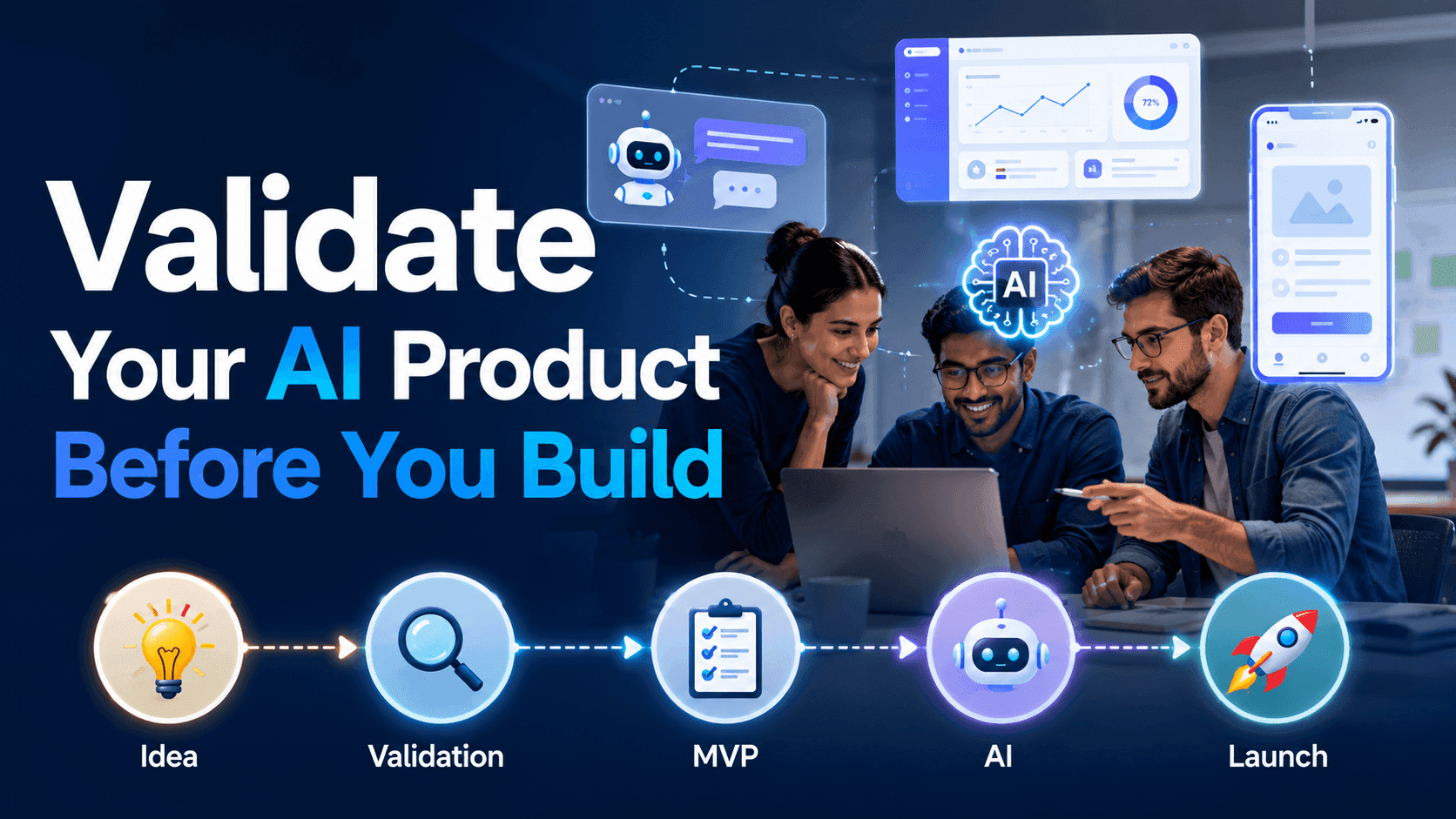
AI MVP App & Software Product Discovery: Validate Before You Build
In This Article
A strong product idea is not enough to guarantee a successful application.
Many startups and businesses invest too early in development, add too many features, choose the wrong architecture, or introduce AI without a clear use case. The result is often a costly product that takes too long to launch and fails to solve a problem customers will pay for.
AI MVP App & Software Product Discovery helps reduce that risk before full development begins.
It turns an early-stage app, SaaS, business software, or AI product idea into a practical plan covering customer needs, essential features, AI feasibility, scalable architecture, cost, timeline, monetization, and go-to-market priorities.
What Is AI MVP Product Discovery?
AI MVP product discovery is a structured process for defining the smallest valuable version of your product that can be launched, tested, and improved using real customer feedback.
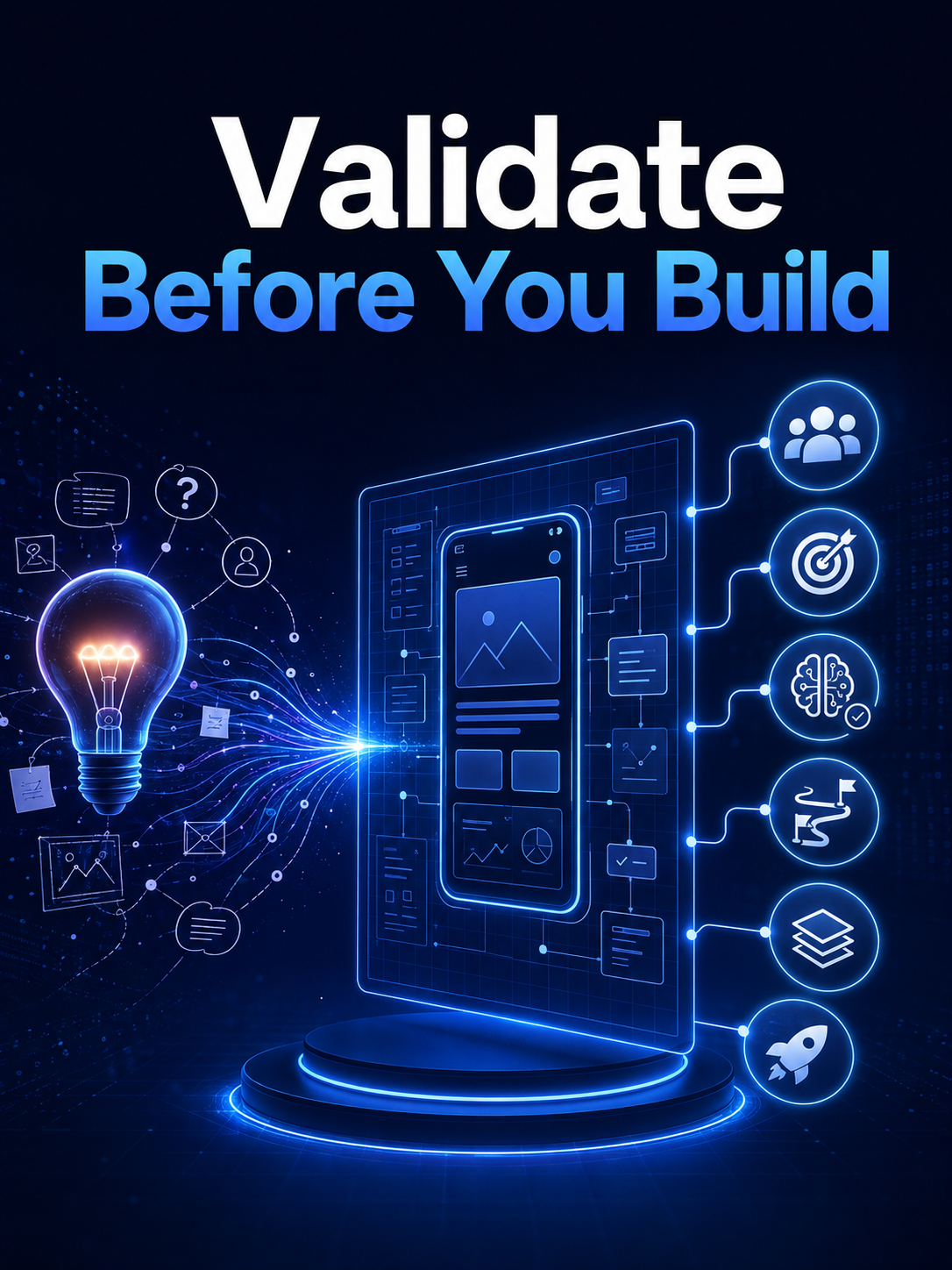
Validate Your MVP Before Building
Clarify users, core features, AI feasibility, architecture, cost, and launch priorities before committing significant time and development budget.
Instead of starting with a long list of features, discovery focuses on four questions:
- What customer problem are we solving?
- Who will pay for the solution?
- Which features are essential for validation?
- Where does AI create genuine value?
Competitor approaches consistently emphasize early product strategy, user research, feature prioritization, technical feasibility, data preparation, rapid prototyping, and iterative delivery. This helps teams validate demand without overbuilding and creates a stronger foundation for future scaling.
Validate Your App or Startup Idea
Before writing code, we help clarify your target users, business challenge, value proposition, competing alternatives, expected user journey, and success metrics.
Your initial concept may be promising, but discovery can reveal whether it should become:
- An AI-powered SaaS platform
- A mobile or web application
- An internal business automation tool
- A marketplace or subscription product
- An AI assistant or agent
- A CRM, ERP, healthcare, retail, or industry platform
The goal is not to prove every idea is right. The goal is to identify the version most likely to create customer value and reach the market successfully.
Define the Right MVP Scope
A successful MVP is not an incomplete product. It is a focused product that solves one important problem well enough to attract early users, validate assumptions, and generate useful evidence.
During discovery, we separate essential launch features from features that can wait. We define user roles, primary workflows, integrations, dashboards, administration, payments, security, analytics, and future phases.
This protects your budget, shortens development time, and prevents unnecessary complexity. Lean MVP strategies commonly use rapid prototyping, prioritization, and real-user validation to improve product-market fit before larger investment.
Turn Your Idea Into a Scalable, AI-Ready Product
Plan an AI-Ready, Scalable Architecture
AI should not be added simply because it is popular.
We assess whether your product genuinely needs generative AI, intelligent search, recommendations, prediction, document processing, automation, or agent-based workflows.
Depending on the use case, the architecture may include:
- OpenAI, Claude, Gemini, or other models
- RAG and vector-based knowledge retrieval
- MCP servers and controlled tool access
- AI agents for business workflow execution
- Human review and approval controls
- Secure APIs and third-party integrations
- Modular, headless, or multi-tenant architecture
- Cloud deployment, monitoring, and cost controls
Production-ready AI applications also require attention to retrieval quality, current data pipelines, observability, access control, privacy, latency, and operating cost—not only model integration. AWS highlights these as important capabilities when moving RAG applications from proof of concept toward scalable production.
Estimate Cost, Timeline, and Delivery Phases
Product discovery helps replace assumptions with an actionable development plan.
We define the recommended technology stack, product modules, AI dependencies, data requirements, team composition, delivery phases, estimated timeline, and cost range.
You receive clearer options for:
- Proof of concept
- Clickable prototype
- AI-enabled MVP
- Market-ready first release
- Phased product scaling
This makes it easier to align founders, investors, stakeholders, and development teams before major spending begins.
Build Early Monetization Into the MVP
Revenue should not be treated as a future feature.
We help evaluate practical monetization models such as subscriptions, free trials, tiered plans, commissions, usage-based pricing, paid features, business licensing, or transaction fees.
The MVP should test not only whether people use the product—but whether they understand its value and are willing to pay for it.
Start With a Free 30-Minute Product Discovery Call
Whether you have a startup idea, AI application concept, SaaS platform, mobile app, or business workflow that needs automation, the right first step is clarity.
In a free 30-minute call, we will discuss your idea, users, AI opportunities, essential MVP scope, architecture direction, potential risks, timeline, cost considerations, and early go-to-market path.
Frequently Asked Questions
What is AI MVP product discovery?
AI MVP product discovery is a structured pre-development process that validates a product idea, identifies target users, defines the core problem, prioritizes MVP features, evaluates AI feasibility, plans scalable architecture, estimates cost and timeline, and creates a roadmap for development and launch.
Why should I validate an AI product idea before development?
Validating an AI product idea before development reduces the risk of building unnecessary features, solving the wrong customer problem, choosing unsuitable technology or investing in AI that does not create meaningful business value. Discovery helps teams test assumptions before making a major engineering investment.
How do you validate an AI app or software idea?
AI product validation examines the target users, customer problem, current alternatives, value proposition, primary workflows, market demand, willingness to pay, AI opportunities, technical feasibility and success metrics. The goal is to determine the smallest valuable product worth building first.
What happens during an AI MVP product discovery process?
The process evaluates the product idea, target users, pain points, essential workflows, feature priorities, AI use cases, data requirements, integrations, architecture, technology stack, security, monetization, risks, estimated cost, timeline and delivery phases.
How do you decide whether AI should be included in an MVP?
AI should be included when it directly improves a measurable customer or business outcome. Discovery evaluates the use case, available data, required accuracy, model capabilities, operating cost, security, human review requirements and whether a simpler software solution could solve the problem more effectively.
What features should be included in an AI MVP?
An AI MVP should include only the features needed to solve the primary customer problem and validate the main product assumption. This may include one core workflow, essential AI functionality, required data or integrations, authentication, analytics, administration and a clear way to measure results.
What is the difference between product discovery, a prototype, a proof of concept and an MVP?
Product discovery determines what should be built and why. A prototype tests product design and user experience. A proof of concept validates whether a technical approach can work. An MVP is a functional product with enough features to test real customer demand and behavior.
How do you plan scalable architecture for an AI MVP?
AI MVP architecture planning considers product modules, APIs, data flows, AI models, RAG, MCP integrations, AI agents, security, access control, cloud infrastructure, monitoring, cost management, integrations and future scalability. The goal is to launch quickly without creating unnecessary technical limitations.
How much does AI MVP product discovery cost?
AI MVP product discovery cost depends on product complexity, research depth, number of user roles, AI requirements, integrations, architecture planning and prototyping needs. A focused discovery engagement can start from $499, while deeper research and technical validation are scoped according to the project.
Can product discovery help with MVP monetization and launch strategy?
Yes. Product discovery can evaluate monetization models such as subscriptions, free trials, paid tiers, usage-based pricing, commissions, transaction fees, licensing and premium features. It also helps define launch priorities so the MVP tests both product usage and willingness to pay.