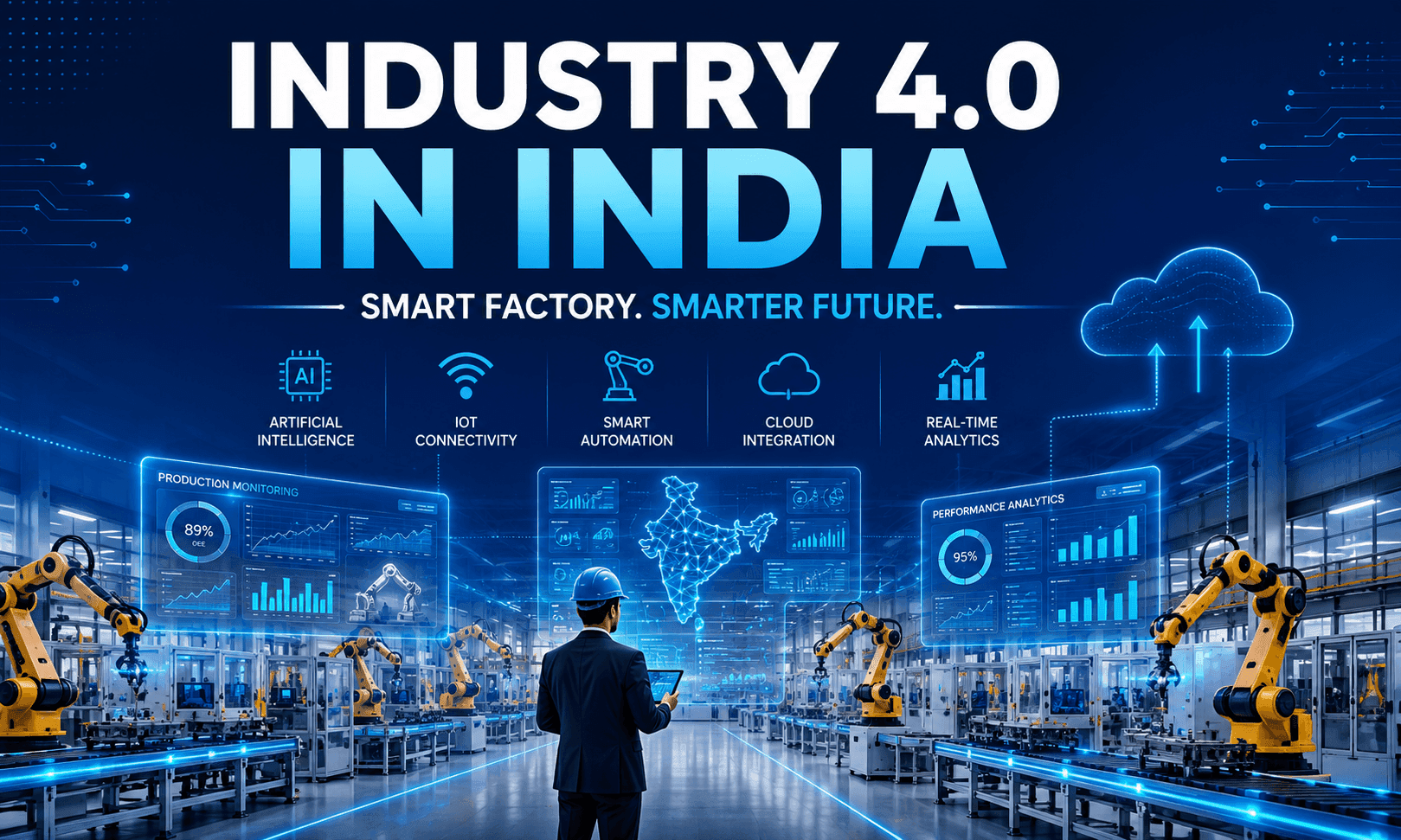
Industry 4.0 in India: Smart Factory Software & Automation Explained
In This Article
- How Indian Manufacturing is Evolving with AI, IoT, Automation & Smart Factory Technologies
- What is Industry 4.0?
- Why Industry 4.0 is Growing Rapidly in India
- What is Smart Factory Software?
- Key Technologies Driving Industry 4.0 in India
- 1. Industrial IoT (IIoT)
- 2. AI & Machine Learning
- 3. Smart Manufacturing ERP Systems
- 4. Robotics & Automation
- 5. Cloud Computing
- Benefits of Industry 4.0 for Manufacturing Companies
- Improved Operational Efficiency
- Real-Time Decision Making
- Predictive Maintenance
- Better Supply Chain Visibility
- Enhanced Product Quality
- Challenges in Industry 4.0 Adoption
- Industries Benefiting from Smart Factory Automation in India
- The Future of Smart Manufacturing in India
- Why Business Leaders Must Prioritize Industry 4.0 in 2026
- Final Thoughts
How Indian Manufacturing is Evolving with AI, IoT, Automation & Smart Factory Technologies
India’s manufacturing sector is undergoing a major digital transformation. As global competition intensifies and operational efficiency becomes a top priority, manufacturers are rapidly adopting Industry 4.0 technologies to modernize production processes, improve decision-making, and build future-ready smart factories.
From AI-powered automation and IoT-enabled machinery to cloud ERP systems and real-time analytics, Industry 4.0 in India is redefining how manufacturing companies operate in 2026 and beyond.
For CEOs, CTOs, Managing Directors, IT Heads, Co-Founders, Project Delivery Managers, and business leaders, Industry 4.0 is no longer a futuristic concept — it is a strategic business necessity.
Manufacturers that embrace smart factory software and industrial automation are gaining a competitive advantage through increased productivity, reduced operational costs, predictive maintenance, and data-driven decision-making.
In this article, we explain what Industry 4.0 means, why it matters for Indian businesses, and how smart factory software and automation technologies are transforming modern manufacturing operations.
What is Industry 4.0?
Industry 4.0 refers to the fourth industrial revolution, where digital technologies are integrated into manufacturing and industrial operations to create intelligent, connected, and automated production environments.
Unlike traditional manufacturing systems, Industry 4.0 enables machines, software, sensors, and systems to communicate with each other in real time.
Core technologies behind Industry 4.0 include:
- Artificial Intelligence (AI)
- Internet of Things (IoT)
- Smart Factory Software
- Industrial Automation
- Cloud Computing
- Big Data Analytics
- Robotics
- ERP Systems
- Digital Twins
- Machine Learning
- Predictive Maintenance
The goal is to build smart factories that operate more efficiently, intelligently, and autonomously.
Why Industry 4.0 is Growing Rapidly in India
Build a Future-Ready Smart Factory
India is becoming one of the fastest-growing digital manufacturing markets globally.
Several factors are driving Industry 4.0 adoption in India:
- Government initiatives like Make in India
- Rising labor and operational costs
- Increasing global manufacturing competition
- Demand for supply chain visibility
- Need for operational efficiency
- Growth of AI and cloud technologies
- Smart manufacturing investments
- Expansion of industrial automation
Indian manufacturers are realizing that traditional manufacturing systems can no longer support modern business demands.
To stay globally competitive, organizations must adopt smart factory software and digital manufacturing solutions.
What is Smart Factory Software?
Smart factory software is the digital backbone of Industry 4.0.
It connects machines, people, workflows, and business systems into one integrated ecosystem that enables real-time monitoring, automation, and intelligent decision-making.
Smart factory software typically includes:
- Manufacturing ERP systems
- Production monitoring tools
- Industrial IoT platforms
- Warehouse management systems
- Quality management software
- Predictive maintenance platforms
- Supply chain management software
- AI-powered analytics dashboards
These solutions help manufacturing leaders gain complete visibility into factory operations.
Key Technologies Driving Industry 4.0 in India
1. Industrial IoT (IIoT)
Industrial IoT allows machines and equipment to communicate through connected sensors and devices.
Manufacturers can monitor:
- Machine performance
- Equipment health
- Energy consumption
- Production output
- Operational downtime
Real-time monitoring helps businesses improve operational efficiency and reduce equipment failures.
For factory leaders and operations managers, IoT provides deeper visibility into manufacturing performance.
2. AI & Machine Learning
Artificial Intelligence is becoming a critical component of modern manufacturing.
AI-powered systems can:
- Predict machine failures
- Optimize production schedules
- Improve demand forecasting
- Detect quality defects
- Automate repetitive processes
Machine learning algorithms continuously improve operations based on real-time production data.
In 2026, AI-driven smart factories are expected to outperform traditional manufacturing facilities significantly.
3. Smart Manufacturing ERP Systems
ERP software plays a central role in Industry 4.0 transformation.
Modern manufacturing ERP solutions integrate:
- Production planning
- Inventory management
- Supply chain operations
- Procurement
- Finance
- CRM
- HR management
ERP systems centralize operations and enable seamless communication across departments.
You can also explore our:
- [Manufacturing ERP Solutions]
- [Industrial Automation Services]
4. Robotics & Automation
Industrial automation is helping manufacturers improve production speed, accuracy, and scalability.
Automation technologies include:
- Robotic assembly systems
- Automated material handling
- CNC machine automation
- Intelligent packaging systems
- Automated inspection systems
Automation reduces human error and increases operational consistency.
For large-scale manufacturing enterprises, robotics significantly improves production efficiency.
5. Cloud Computing
Cloud-based smart factory platforms provide:
- Remote monitoring
- Real-time analytics
- Centralized data management
- Scalable infrastructure
- Multi-location operations management
Cloud adoption is growing rapidly among Indian manufacturing companies due to lower infrastructure costs and improved scalability.
Benefits of Industry 4.0 for Manufacturing Companies
Improved Operational Efficiency
Smart factories use automation and real-time monitoring to streamline manufacturing operations.
This reduces:
- Production delays
- Equipment downtime
- Manual errors
- Resource wastage
Manufacturers can achieve higher productivity with fewer operational inefficiencies.
Real-Time Decision Making
Industry 4.0 technologies provide executives with real-time business intelligence.
Leadership teams can monitor:
- Production KPIs
- Inventory levels
- Machine performance
- Supply chain activity
- Workforce productivity
This enables faster and more informed strategic decisions.
Predictive Maintenance
Traditional maintenance models are reactive and costly.
Predictive maintenance uses AI and IoT data to identify potential equipment failures before they happen.
Benefits include:
- Reduced downtime
- Lower maintenance costs
- Improved equipment lifespan
- Better production continuity
Better Supply Chain Visibility
Smart factory software improves end-to-end supply chain management.
Businesses can track:
- Supplier performance
- Inventory movement
- Shipment status
- Procurement workflows
This improves operational planning and minimizes supply chain disruptions.
Enhanced Product Quality
AI-powered quality management systems help manufacturers detect production issues in real time.
Benefits include:
- Reduced defects
- Better compliance
- Higher customer satisfaction
- Improved brand reputation
Quality control becomes more proactive instead of reactive.
Challenges in Industry 4.0 Adoption
Despite its advantages, many manufacturers face challenges during digital transformation.
Common barriers include:
- High initial investment
- Legacy infrastructure
- Integration complexity
- Data security concerns
- Lack of digital expertise
- Resistance to operational change
However, organizations that adopt phased implementation strategies achieve better long-term ROI.
Working with experienced technology partners helps manufacturers transition smoothly into Industry 4.0 environments.
Industries Benefiting from Smart Factory Automation in India
| Industry | Industry 4.0 Use Cases |
|---|---|
| Automotive | Robotic assembly & predictive maintenance |
| Pharmaceuticals | Compliance automation & batch tracking |
| Electronics | Smart quality control |
| FMCG | Supply chain optimization |
| Textile | Production automation |
| Food Processing | Inventory & quality management |
| Heavy Engineering | Industrial IoT monitoring |
Indian enterprises across these sectors are increasingly investing in smart manufacturing software.
The Future of Smart Manufacturing in India
India is rapidly becoming a global hub for smart manufacturing and industrial innovation.
Future trends shaping Industry 4.0 include:
- AI-powered autonomous factories
- Digital twins
- Edge computing
- 5G-enabled manufacturing
- Hyperautomation
- Sustainable manufacturing technologies
- Human-machine collaboration
Manufacturers that embrace these technologies early will gain a significant competitive advantage.
Industry 4.0 is not just about technology adoption — it is about creating intelligent, agile, and scalable manufacturing ecosystems.
Why Business Leaders Must Prioritize Industry 4.0 in 2026
For CEOs, CTOs, Managing Directors, and IT leaders, Industry 4.0 is becoming a boardroom priority.
Businesses that delay digital transformation may struggle with:
- Rising operational costs
- Lower productivity
- Supply chain inefficiencies
- Competitive disadvantages
- Slower decision-making
Meanwhile, digitally mature manufacturers are building smarter operations with better scalability and profitability.
Industry 4.0 is now directly linked to business growth, operational resilience, and long-term sustainability.
Final Thoughts
Industry 4.0 in India is reshaping the future of manufacturing through smart factory software, automation, AI, and connected industrial systems.
As manufacturing becomes more data-driven and intelligent, businesses must modernize operations to stay competitive in the global market.
From predictive analytics and IoT-enabled machinery to ERP integration and robotic automation, Industry 4.0 technologies are helping manufacturers improve efficiency, reduce costs, and accelerate innovation.
For modern manufacturing leaders, investing in smart factory transformation is no longer optional — it is essential for long-term success.
Frequently Asked Questions
What is Industry 4.0 in India: Smart Factory Software & Automation Explained?
Discover how Industry 4.0 in India is transforming manufacturing with smart factory software, AI, IoT, ERP systems, and industrial automation. Learn how modern manufacturers improve efficiency, reduce costs, and scale operations with intelligent digital transformation solutions.