Hospital Software Company in Ranchi
In This Article
- Complete HMS, OPD, CRM, Telemedicine and AI Solutions
- What Should a Hospital Software Company Provide?
- Complete Hospital Management System
- OPD Token and Queue Management
- Healthcare CRM and Patient Engagement
- Telemedicine and Online Video Consultation
- LIMS, Pharmacy and Diagnostic Software
- Healthcare Website and Patient Growth Platform
- AI-Ready Hospital Software
- Custom Software or Ready-Made HMS?
- How Hospital Software Should Be Implemented
- Choosing the Best Hospital Software Company in Ranchi
- Build a Connected Digital Hospital in Ranchi
- Looking for a Hospital Software Company in Ranchi?
Complete HMS, OPD, CRM, Telemedicine and AI Solutions
Hospitals, clinics, nursing homes and diagnostic centres in Ranchi are moving beyond paper registers, spreadsheets and disconnected billing tools. As patient volumes increase, healthcare organisations need software that connects registration, appointments, OPD and IPD workflows, billing, pharmacy, laboratory operations, patient records and management reporting.
Choosing the right hospital software company in Ranchi is therefore not only a technology decision. It affects patient experience, staff productivity, billing control, doctor workflows and the hospital’s ability to scale.
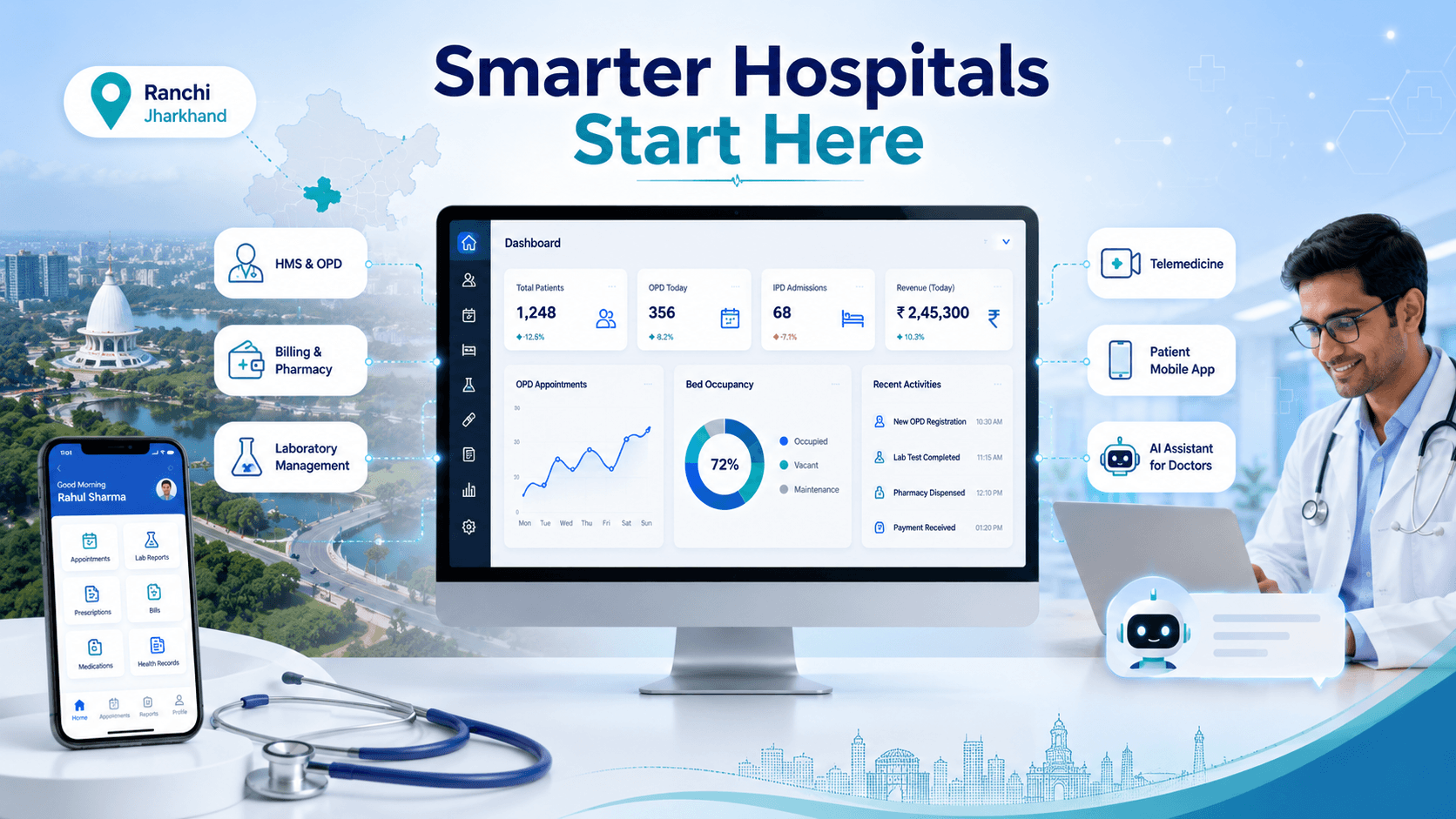
Murmu Software Infotech develops custom healthcare software for hospitals, clinics and medical businesses in Ranchi and across Jharkhand. Our solutions include Hospital Management Systems, OPD software, healthcare CRM, LIMS, telemedicine, healthcare websites, mobile apps and AI-assisted hospital workflows.
What Should a Hospital Software Company Provide?
A capable healthcare software provider should understand how different hospital departments work together.
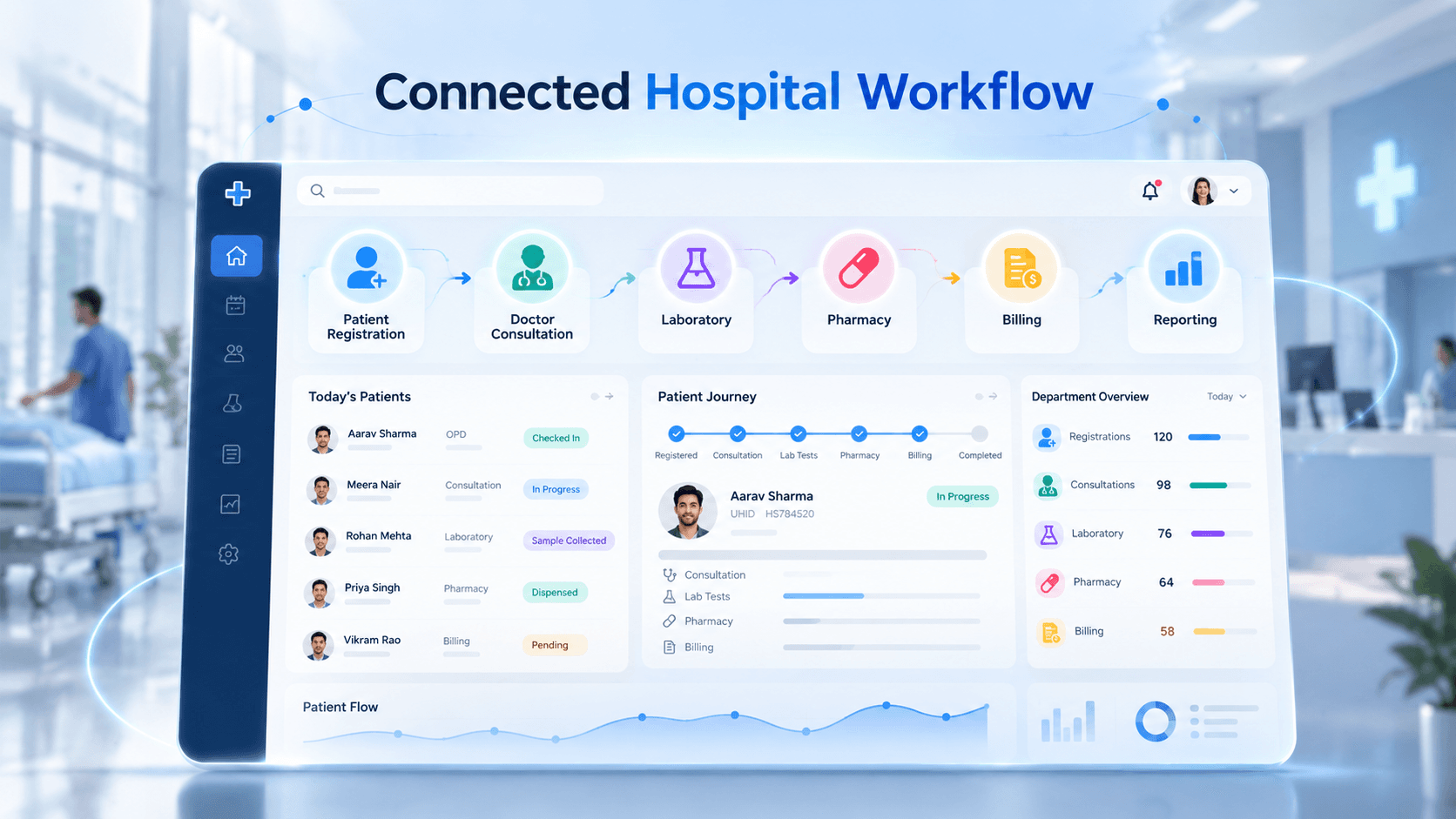
The software should connect the complete patient journey:
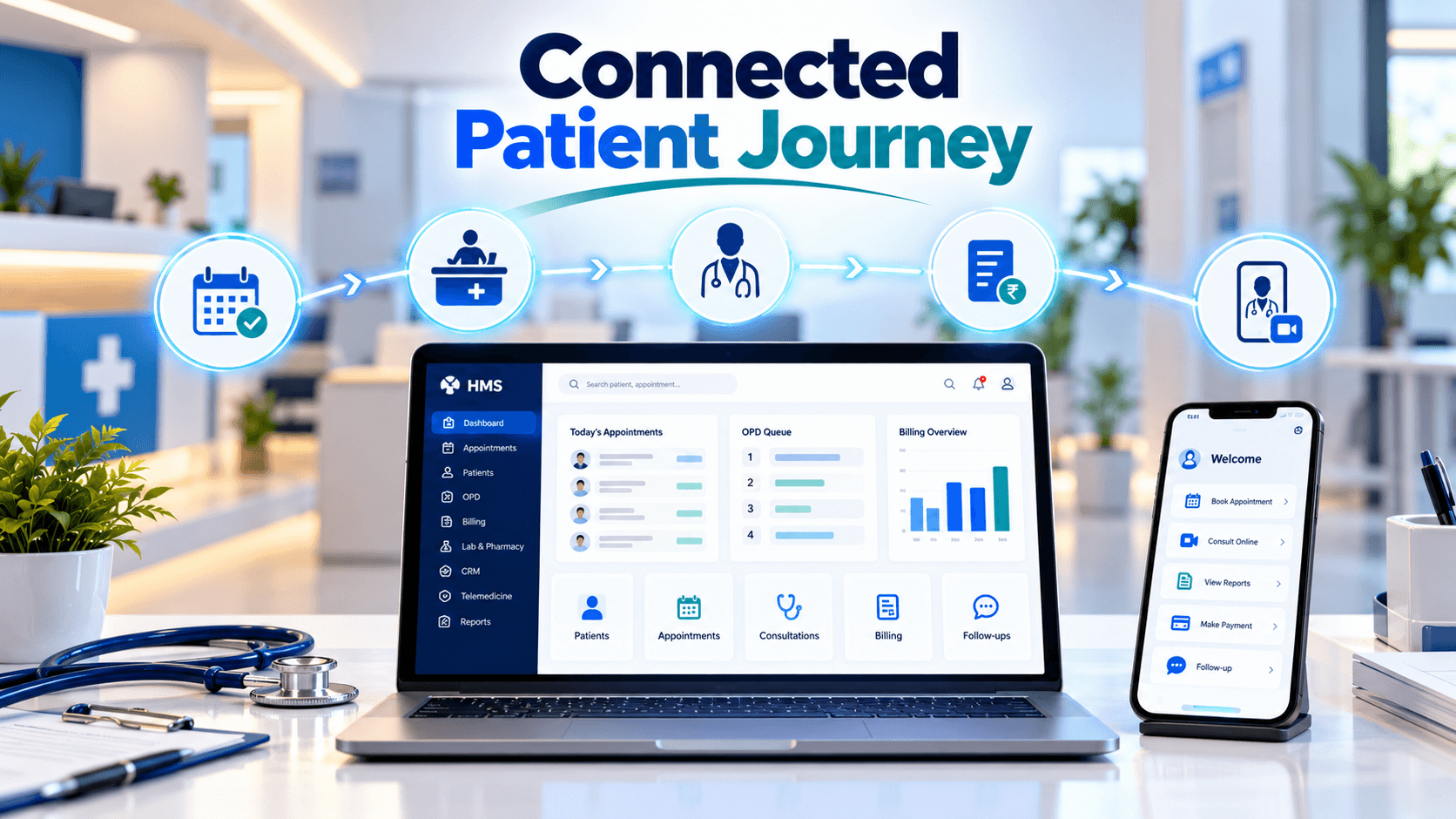
Registration → Appointment → OPD/IPD → Consultation → Lab/Pharmacy → Billing → Reports → Follow-Up
Hospital software providers operating in the Ranchi market commonly highlight patient management, appointment scheduling, billing, pharmacy, pathology, EMR/EHR and reporting as essential capabilities. Buyers also compare cloud, on-premise, hybrid and mobile deployments according to their infrastructure and operational requirements.
However, a modern hospital requires more than a collection of modules. The modules should share accurate data and support role-specific workflows for receptionists, doctors, nurses, billing teams, pharmacists, laboratory teams and administrators.
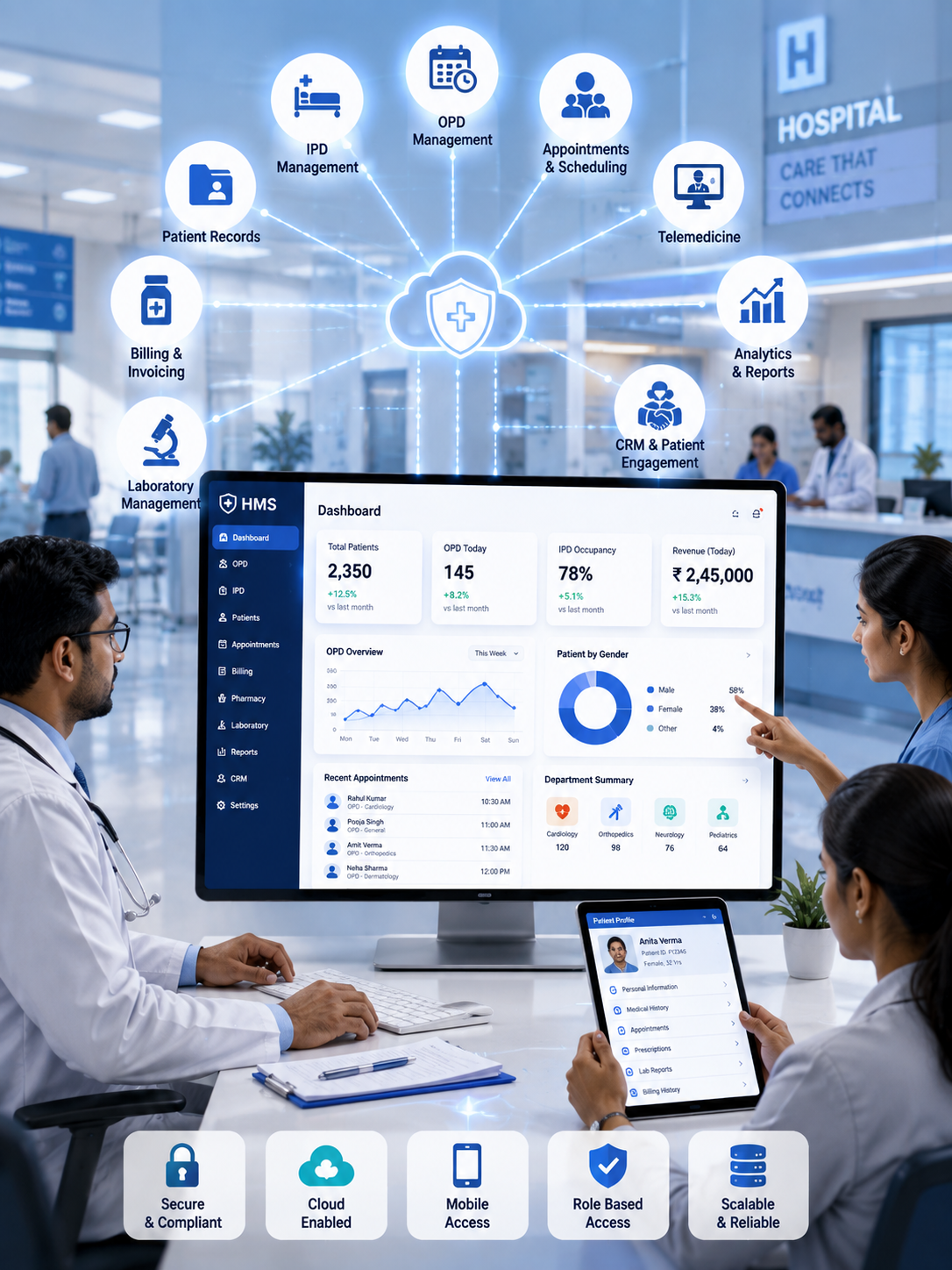
Build Smarter, Connected Hospital Operations
Digitize HMS, OPD, billing, pharmacy, CRM, telemedicine and AI workflows with scalable healthcare software designed around your hospital’s real needs.
Complete Hospital Management System
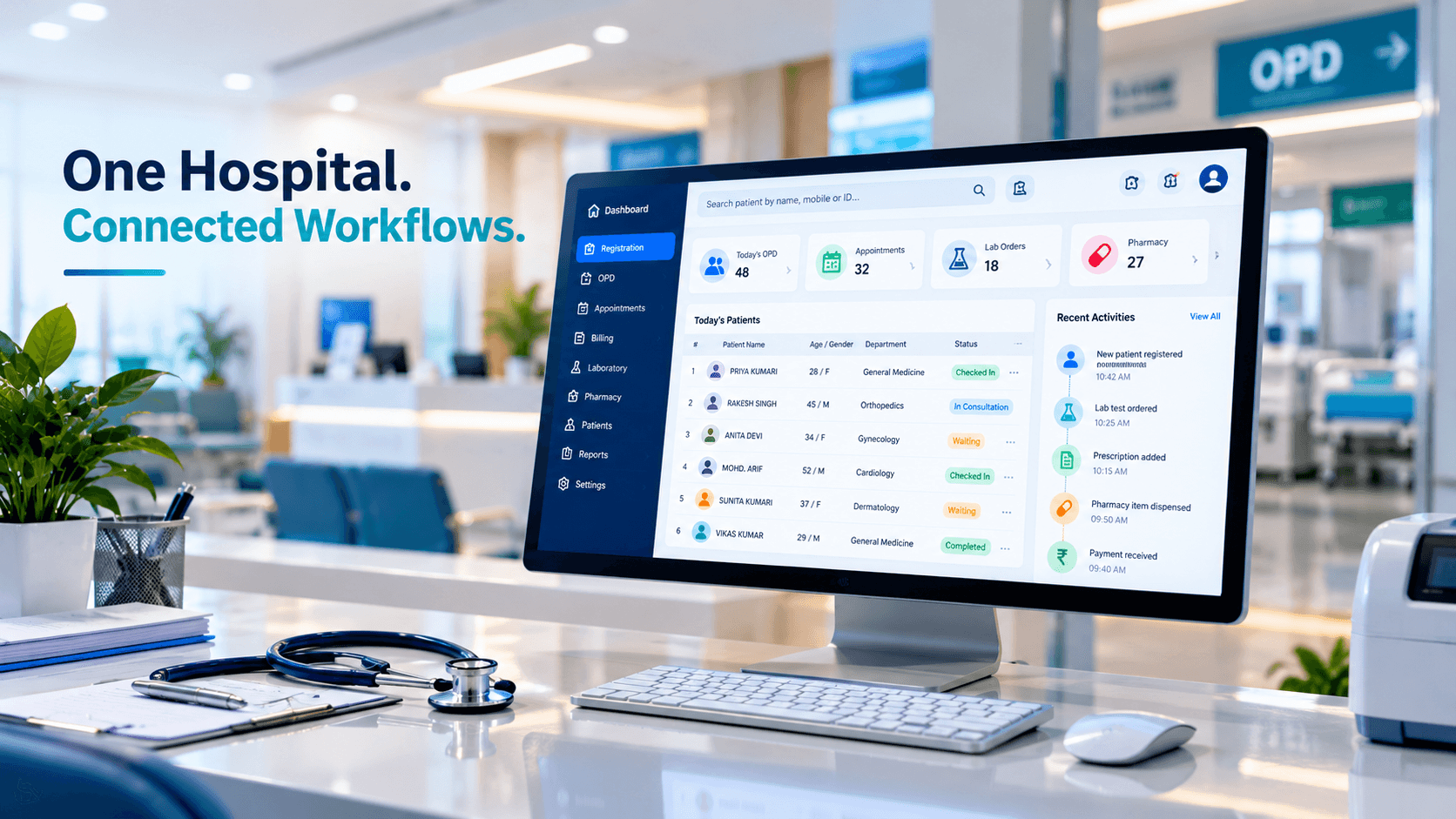
A custom Hospital Management System in Ranchi can centralise daily healthcare operations within one platform.
Core modules may include:
- Patient registration and unique patient ID
- Appointment and doctor scheduling
- OPD token and queue management
- IPD admission, bed and ward management
- Doctor consultation records
- Digital prescriptions
- Billing, payments, discounts and dues
- Pharmacy stock, batch and expiry tracking
- Laboratory test booking and reporting
- Electronic medical records
- Role-based staff access
- Management dashboards and analytics
Competitor platforms consistently organise HMS functionality around OPD, IPD, billing, pharmacy, pathology, EMR and appointment management. Some also extend the platform into finance, procurement, HR, payroll and multi-branch hospital ERP operations.
Our Hospital Management System case study shows how patient registration, appointments, doctor dashboards, billing, permissions and reports can be brought together within a central hospital platform.
Digitize Your Ranchi Hospital with Connected Healthcare Software
OPD Token and Queue Management
Long waiting times and unclear queues create pressure for patients, reception staff and doctors.
A digital OPD solution can manage:
- Walk-in and scheduled patients
- Department-wise token generation
- Doctor-wise patient queues
- Waiting-room display screens
- Consultation status
- Follow-up appointments
- SMS or WhatsApp notifications
- OPD reports
Role-based hospital systems commonly give reception teams access to registration and tokens while doctors receive patient history, consultation notes and follow-up tools. This makes the workflow easier to use than one complex screen for every staff member. (matrop.com)
Explore our OPD Token and Queue Management System case study for a practical digital patient-flow model.
Healthcare CRM and Patient Engagement
Hospital software should manage more than the patient’s visit inside the facility.
A healthcare CRM can help capture and manage:
- Website enquiries
- Appointment requests
- Missed appointments
- Follow-up consultations
- Health-package enquiries
- Patient feedback
- Preventive-care campaigns
- WhatsApp, SMS and email communication
- Communication history
When healthcare CRM is connected with the website, appointment system and HMS, the hospital can track the patient journey from the first enquiry through consultation and follow-up.
This helps hospitals reduce lost enquiries and provide more consistent communication without relying entirely on manual calls and spreadsheets.
Telemedicine and Online Video Consultation
Hospitals and specialist clinics can extend their services beyond their physical location through a connected telemedicine platform.
A complete virtual-care journey may include:
Doctor Discovery → Appointment → Payment → Video Consultation → Digital Prescription → Follow-Up
Important capabilities include doctor availability, secure consultation rooms, patient records, digital notes, prescriptions, payment tracking and patient portals.
Many modern hospital software products now include patient portals, telemedicine, online appointments and digital prescription capabilities alongside traditional HMS modules.
Our Telemedicine Software and Video Consultation Platform case study explains how hospitals can connect appointments, remote consultations, prescriptions and follow-up care.
LIMS, Pharmacy and Diagnostic Software
Hospitals and diagnostic centres require specialised workflows for samples, reports and medicine inventory.
A Laboratory Information Management System can support:
- Test booking
- Sample collection
- Barcode tracking
- Processing status
- Result entry
- Pathologist approval
- Digital report generation
- Patient and doctor delivery
- Billing integration
Pharmacy software can manage purchases, sales, batches, expiry dates, low-stock alerts, suppliers and prescription-linked billing.
Local hospital software competitors frequently position laboratory, pharmacy, billing and patient-record integration as essential parts of an all-in-one healthcare platform.
Healthcare Website and Patient Growth Platform
A hospital website should not be limited to displaying departments and contact information.
It can function as a patient-growth platform by helping visitors:
- Discover doctors and specialties
- Understand treatments
- Book appointments
- Request callbacks
- Access telemedicine
- Find locations
- Explore health packages
- Receive structured follow-up
Our Healthcare Website and Digital Marketing Platform case study demonstrates how doctor profiles, landing pages, appointment forms, WhatsApp integration, SEO content and analytics can support patient acquisition.
The strongest approach connects the healthcare website with CRM, appointment scheduling, telemedicine and HMS rather than maintaining each system separately.
AI-Ready Hospital Software
AI can help hospitals reduce repetitive administrative work and support doctors without taking control away from healthcare professionals.
Potential applications include:
- Patient-history summaries
- Voice-to-consultation notes
- Structured documentation drafts
- Appointment assistance
- Patient enquiry handling
- Follow-up automation
- Management analytics
- Operational alerts
Some newer Ranchi-focused EMR platforms already promote AI-assisted patient profiles, prescriptions, reminders and analytics as part of modern healthcare software.
Our AI Assistant for Doctors in HMS case study follows a responsible model: AI assists, while the doctor reviews and decides.
Custom Software or Ready-Made HMS?
Ready-made hospital software may work for a small clinic with standard requirements. Custom hospital software becomes more valuable when the organisation has unique departmental workflows, multiple branches, existing systems or specific integration requirements.
Choose custom development when you need:
- Workflow-specific modules
- Existing software integration
- Custom reports and dashboards
- Multi-location operations
- Patient and doctor mobile apps
- Telemedicine integration
- Healthcare CRM
- AI workflows
- Flexible ownership and deployment
Competitor comparisons also distinguish fixed-feature software from custom HMS based on workflow flexibility, data ownership, branch support, pricing model and integration capability.
Build Smarter Hospital Operations with Custom Software in Ranchi
How Hospital Software Should Be Implemented
A successful HMS project should follow a structured implementation process:
- Study current hospital workflows.
- Define required modules and integrations.
- Design user roles and interfaces.
- Deploy priority modules in phases.
- Migrate and validate existing data.
- Train doctors and hospital staff.
- Support go-live and optimisation.
Phased implementation is repeatedly recommended by providers because hospitals can begin with registration, appointments and OPD before introducing IPD, pharmacy, laboratory and advanced integrations. Onboarding should also include role configuration, staff training, backups and post-launch support.
Choosing the Best Hospital Software Company in Ranchi
Before selecting a provider, ask for:
- Relevant healthcare case studies
- A live platform demonstration
- Workflow-customisation capability
- Clear implementation scope
- Integration architecture
- Data migration support
- Role-based security
- Backup and recovery planning
- Staff training
- Post-launch maintenance
- Transparent development and support costs
Local directories list many software developers and dealers, but not every company shown has specialised healthcare-product experience. Hospitals should verify delivered projects, domain knowledge and long-term support rather than selecting a provider only through ratings or price listings.
Build a Connected Digital Hospital in Ranchi
Murmu Software Infotech provides complete healthcare technology solutions for hospitals, clinics, diagnostic centres and healthcare startups.
Our capabilities include HMS, OPD/IPD, healthcare CRM, LIMS, pharmacy, billing, telemedicine, patient apps, healthcare websites and AI-assisted workflows.
Explore our complete Digital Healthcare Management System, which connects patient-growth tools, hospital operations, remote care and intelligent automation. The platform covers HMS, OPD, CRM, telemedicine, patient services and AI-enabled healthcare workflows.
Watch the Digital Healthcare Management System demo or request a personalised demonstration for your hospital.
Looking for a Hospital Software Company in Ranchi?
Build software around your hospital’s real workflow—not around a generic feature list.
Book a live healthcare software demo and discuss your HMS, OPD, CRM, telemedicine, LIMS or AI requirements with Murmu Software Infotech.
Frequently Asked Questions
Which company provides hospital software development in Ranchi?
Murmu Software Infotech provides custom hospital and healthcare software development services from Ranchi, Jharkhand. Its solutions include HMS, OPD, IPD, billing, pharmacy, LIMS, healthcare CRM, telemedicine, patient applications, healthcare websites and AI-assisted workflows.
What is hospital management software?
Hospital management software is a digital platform that manages patient registration, appointments, OPD, IPD, consultations, billing, pharmacy, laboratory, staff access and hospital reporting through connected workflows.
What modules should an HMS include?
An HMS can include patient registration, appointment scheduling, OPD, IPD, bed management, billing, pharmacy, laboratory, digital prescriptions, electronic records, insurance workflows, staff permissions and management dashboards.
What is the cost of hospital software in Ranchi?
Hospital software cost depends on the required modules, number of users and locations, web and mobile applications, integrations, data migration, hosting, security controls and support requirements. A workflow assessment is required for an accurate quotation.
Can hospital management software be customised?
Yes. Custom hospital software can be designed around the hospital's departments, patient flow, billing rules, reports, staff permissions, integrations and multi-location requirements.
Can hospital software integrate with an existing system?
Yes. Hospital software can integrate with an existing HMS, EMR, EHR, CRM, LIMS, pharmacy, billing, payment gateway or third-party platform when suitable APIs, databases or integration methods are available.
What does OPD management software do?
OPD management software connects patient registration, appointments, token generation, doctor queues, consultation status, billing and follow-up care. It can also support display screens and patient notifications.
How does healthcare CRM help a hospital?
Healthcare CRM helps hospitals track enquiries, appointments, reminders, missed visits, follow-ups, campaigns, feedback and communication history. It connects patient acquisition with engagement and retention workflows.
Can telemedicine be integrated with HMS?
Yes. Telemedicine can be connected with HMS to support doctor availability, appointment booking, online payments, secure video consultations, consultation notes, digital prescriptions and patient follow-up.
What does a hospital LIMS manage?
A hospital LIMS manages test orders, sample collection, barcode tracking, processing status, result entry, pathologist approval, digital reports and integration with billing and patient records.
Can AI be used in hospital software?
Yes. AI can assist with patient-history summaries, voice-to-consultation notes, documentation drafts, appointment assistance, enquiry handling, operational alerts and management analytics. Clinical decisions should remain with qualified healthcare professionals.
Should a hospital choose cloud or on-premise software?
Cloud software may simplify remote access, deployment and centralised updates, while on-premise deployment can provide greater control over local infrastructure. The right choice depends on connectivity, security policies, integration requirements, budget and IT capabilities.
How long does hospital software development take?
The timeline depends on the number of modules, workflows, integrations, mobile applications, data migration and testing requirements. A focused HMS can be delivered faster than a complete multi-location healthcare ecosystem.
How should a hospital choose a software company in Ranchi?
Hospitals should evaluate healthcare domain experience, delivered case studies, customisation capabilities, integration architecture, security controls, implementation support, staff training, maintenance and transparent pricing.