Hospital Software Support Case Study: HMS Maintenance, Security & Performance Optimization
In This Article
- The Challenge: Healthcare Systems Could Not Afford Unplanned Disruption
- The Solution: From Reactive Fixes to Proactive Support
- HMS Application Support and Incident Management
- Performance and Database Optimization
- Integration Monitoring and Maintenance
- Security Hardening and Software Governance
- Cloud, Backup and Disaster-Recovery Readiness
- Continuous Enhancement, Not Maintenance Alone
- Business Impact
- Need a Long-Term Hospital Software Support Partner?
Hospital software does not stop being business-critical after implementation.
Once an HMS, patient portal, telemedicine platform, healthcare CRM, mobile application, laboratory system, or billing platform becomes part of daily care delivery, every slowdown, integration failure, software defect, or outage can affect staff productivity and patient experience.
A growing multi-specialty hospital network faced exactly this challenge.
Its healthcare technology ecosystem had expanded across multiple applications, but frequent technical issues, performance degradation, integration bottlenecks, security concerns, delayed updates, and limited internal IT capacity were making the environment increasingly difficult to operate.
Murmu Software Infotech was engaged to provide Hospital Software Support & Maintenance Services focused on improving application stability, security, performance, integration reliability, and long-term maintainability.

Keep Hospital Software Running Strong
Strengthen HMS reliability, security, integrations, performance, backups, and continuous improvements with proactive healthcare software support and maintenance.
The Challenge: Healthcare Systems Could Not Afford Unplanned Disruption
The hospital depended on software for patient registration, appointments, billing, diagnostics, telemedicine, internal administration, and customer communication.
Problems therefore extended beyond technical inconvenience.
A slow registration workflow could increase queues. A failed integration could interrupt lab or payment processes. Poor database performance could slow multiple departments simultaneously. Delayed software updates could leave both usability and security problems unresolved.
The environment experienced recurring challenges including:
- Application defects affecting daily workflows
- Slow performance during peak patient periods
- Database degradation
- Third-party integration failures
- Security concerns around healthcare data
- Limited internal IT support capacity
- Delayed feature improvements
- Poor user experience
- Unplanned downtime
The requirement was not another one-time redevelopment project.
The hospital needed a continuous software reliability model.
Keep Your Hospital Software Reliable, Secure, and Always Available
The Solution: From Reactive Fixes to Proactive Support
Murmu Software Infotech introduced a support and maintenance approach that combined incident resolution with preventive maintenance and continuous enhancement.
The objective was to move from:
Issue Occurs → Staff Reports Problem → Developer Investigates
toward:
Monitor → Detect → Prioritize → Resolve → Prevent Recurrence → Improve
That change is important for healthcare technology because the value of maintenance is not simply fixing broken software faster.
It is reducing the probability that critical workflows fail in the first place.
HMS Application Support and Incident Management
Ongoing HMS support focused on troubleshooting defects affecting registration, appointments, billing, administrative workflows, and other operational functions.
Issues can be classified by business impact so production outages and critical workflow failures receive higher priority than cosmetic or low-risk defects.
A mature support model should distinguish between incidents such as:
1 . Production unavailable or patient workflow blocked
2 . Critical module significantly degraded
3 . Standard functional defect
4 . Minor improvement or usability request
This gives hospital leadership clearer expectations and gives technical teams a structured response process.
Murmu Software Infotech’s broader managed-support offering similarly uses severity-based response models for production incidents.
Performance and Database Optimization
Healthcare systems accumulate data continuously.
Patient registrations, appointments, billing records, reports, audit history, integrations, and operational transactions can gradually expose database and application-performance problems.
The support engagement therefore included:
- Database tuning
- Query optimization
- Application-performance improvements
- Infrastructure optimization
- Bottleneck investigation
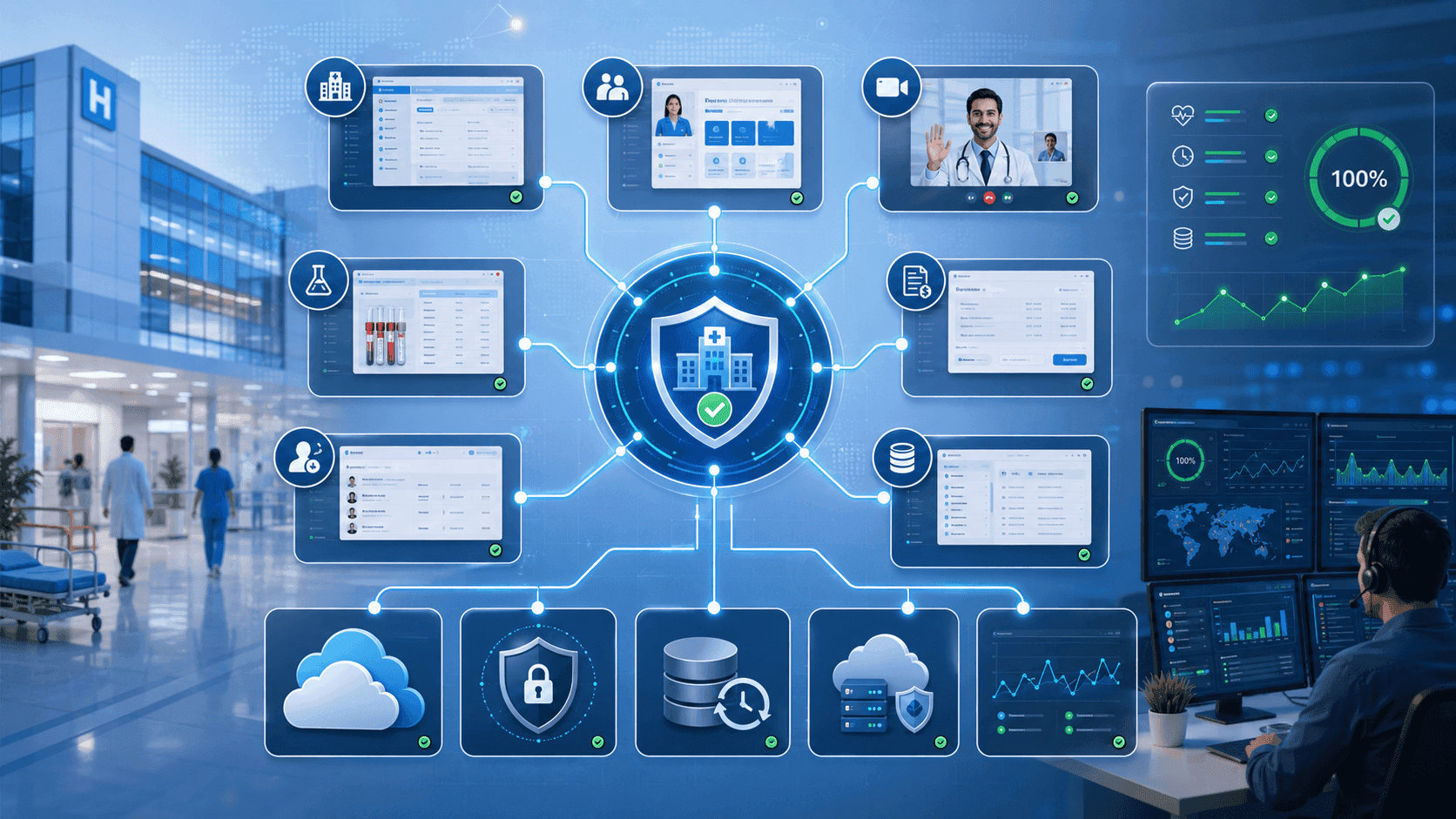
The live case study reports faster application response times and improved database performance after these interventions.
The broader objective was not only faster screens it was maintaining predictable performance during peak hospital activity.
Integration Monitoring and Maintenance
Modern hospitals rarely operate one isolated application.
The supported environment included integrations with:
- Laboratory Information Systems
- Payment gateways
- SMS and email services
- Telemedicine platforms
- Insurance claim systems
Each integration introduces dependencies outside the core HMS.
Support therefore needs to monitor not only whether the hospital application is online, but whether the complete business workflow still functions across connected systems.
For example, successful appointment creation is not enough if the related notification fails.
Security Hardening and Software Governance
Healthcare applications process sensitive operational and patient information, making routine security maintenance essential.
The engagement included access-control improvements, patch management, vulnerability monitoring, data-protection measures, and compliance-oriented enhancements.
A stronger maintenance strategy should continuously review:
authentication → authorization → dependencies → patches → logs → backups → vulnerabilities → recovery readiness
Security should therefore be treated as an ongoing operational responsibility rather than a checklist completed only during launch.
Reduce Downtime with Proactive Healthcare Software Support Services
Cloud, Backup and Disaster-Recovery Readiness
Application availability depends on infrastructure as much as application code.
The support scope included server monitoring, cloud optimization, backup management, and disaster-recovery planning.
This creates three separate reliability objectives:
Prevent outages.
Recover quickly when incidents occur.
Protect data if infrastructure fails.
The case study reports achieving 99.9% system availability during the engagement.
Where possible, the revised case study should strengthen this claim by specifying the measurement period and monitoring source.
Continuous Enhancement, Not Maintenance Alone
Hospital workflows continue evolving after software goes live.
Departments request improvements. Patient expectations change. Integrations need updates. Reporting requirements expand.
The engagement therefore included new modules, workflow improvements, and UI/UX refinements based on operational feedback.
This creates a healthier software lifecycle:
Stabilize → Optimize → Secure → Enhance → Modernize
Instead of allowing an HMS to gradually become legacy software, ongoing support keeps the platform aligned with hospital operations.
Business Impact
The case study reports improvements across system availability, application performance, database reliability, staff workflows, software incidents, security practices, and scalability.
For stronger conversion credibility, I recommend avoiding unsupported statements such as “higher patient satisfaction” or “lower operational costs” unless the hospital measured those outcomes directly.
The strongest evidence-based message is simpler:
more reliable software creates fewer interruptions between hospital staff and the digital workflows they depend on every day.
Need a Long-Term Hospital Software Support Partner?
Murmu Software Infotech supports Hospital Management Systems, healthcare CRMs, telemedicine platforms, mobile applications, healthcare websites, laboratory systems, APIs, databases, cloud infrastructure, security, performance optimization, and ongoing software enhancements.
Whether a hospital operates newly developed software or a complex legacy ecosystem, support should go beyond emergency fixes.
The goal is continuous operational reliability keeping healthcare software stable today while preparing it for tomorrow’s workflows, integrations, security requirements, and growth.
Frequently Asked Questions
What is hospital software support and maintenance?
Hospital software support and maintenance covers ongoing bug fixing, troubleshooting, performance optimization, security updates, database maintenance, integration support, infrastructure monitoring, backups, upgrades and continuous software improvements after deployment.
What does HMS maintenance include?
HMS maintenance can include resolving application defects, optimizing patient registration and billing workflows, improving database performance, maintaining integrations, applying security updates and enhancing existing modules as hospital requirements evolve.
Why do hospitals need ongoing software maintenance?
Hospitals depend on software for patient registration, appointments, billing, diagnostics, telemedicine and administrative workflows. Continuous maintenance helps reduce downtime, performance degradation, integration failures, security vulnerabilities and operational disruption.
Can an existing Hospital Management System be supported without rebuilding it?
Yes. An experienced support team can assess an existing HMS, stabilize critical issues, optimize performance, maintain integrations and implement incremental enhancements without requiring a complete platform rebuild.
Can hospital software integrations be maintained and monitored?
Yes. Support can cover integrations with laboratory systems, payment gateways, SMS and email services, telemedicine applications, insurance workflows and other third-party healthcare systems.
How can hospital software performance be improved?
Performance improvements can include database tuning, query optimization, application profiling, infrastructure optimization, caching improvements and investigation of bottlenecks affecting high-volume hospital workflows.
What security work is included in healthcare software maintenance?
Healthcare software maintenance can include access-control reviews, patch management, vulnerability monitoring, data-protection improvements, dependency updates, logging and compliance-oriented security enhancements.
Does hospital software support include backup and disaster recovery?
It can. The documented engagement included server monitoring, cloud infrastructure optimization, backup management and disaster-recovery planning as part of the software reliability strategy.
Can healthcare software be enhanced during maintenance?
Yes. Maintenance can evolve into continuous improvement through new modules, workflow enhancements, UI and UX improvements, integration updates and modernization based on operational feedback.
Who provides hospital software support and HMS maintenance services?
Murmu Software Infotech provides support for Hospital Management Systems, healthcare CRM, telemedicine platforms, mobile apps, healthcare websites, laboratory systems, databases, APIs, cloud infrastructure, security and application performance.