Hospital Software Company in Ranchi
In This Article
- Connected HMS, OPD, Billing & AI Solutions
- What Should Modern Hospital Software Manage?
- Hospital Workflow Diagram
- OPD to Billing Workflow
- Doctor, Patient & Admin Roles
- Patient Experience
- Doctor Workflow
- Hospital Admin & Management
- Core Hospital Software Modules
- Healthcare Software Services for Hospitals
- See Your Hospital Workflow Digitally
- What does hospital management software do?
- Can hospital software be customised?
- Can OPD software connect with billing?
- Can hospital software support multiple doctors and departments?
- Can telemedicine be integrated with hospital software?
- Can AI be added to hospital software?
- Is hospital software suitable for clinics?
- Can existing hospital software be integrated?
- Should hospitals choose custom or ready-made software?
- How should a hospital software project begin?
- Conclusion
Connected HMS, OPD, Billing & AI Solutions
Hospitals, clinics, nursing homes, and diagnostic centres in Ranchi are increasingly moving away from paper registers, disconnected billing tools, spreadsheets, and isolated software systems.
As patient volumes grow, healthcare organisations need a connected digital platform that brings together patient registration, appointments, OPD queues, doctor consultations, billing, pharmacy, laboratory workflows, reports, and follow-up care.
Murmu Software Infotech develops custom hospital and healthcare software for organisations in Ranchi and across Jharkhand. Our solutions are designed around real hospital workflows rather than isolated features.
Explore our Healthcare Software Development Services for connected hospital, clinic, telemedicine, AI, and patient-management solutions.
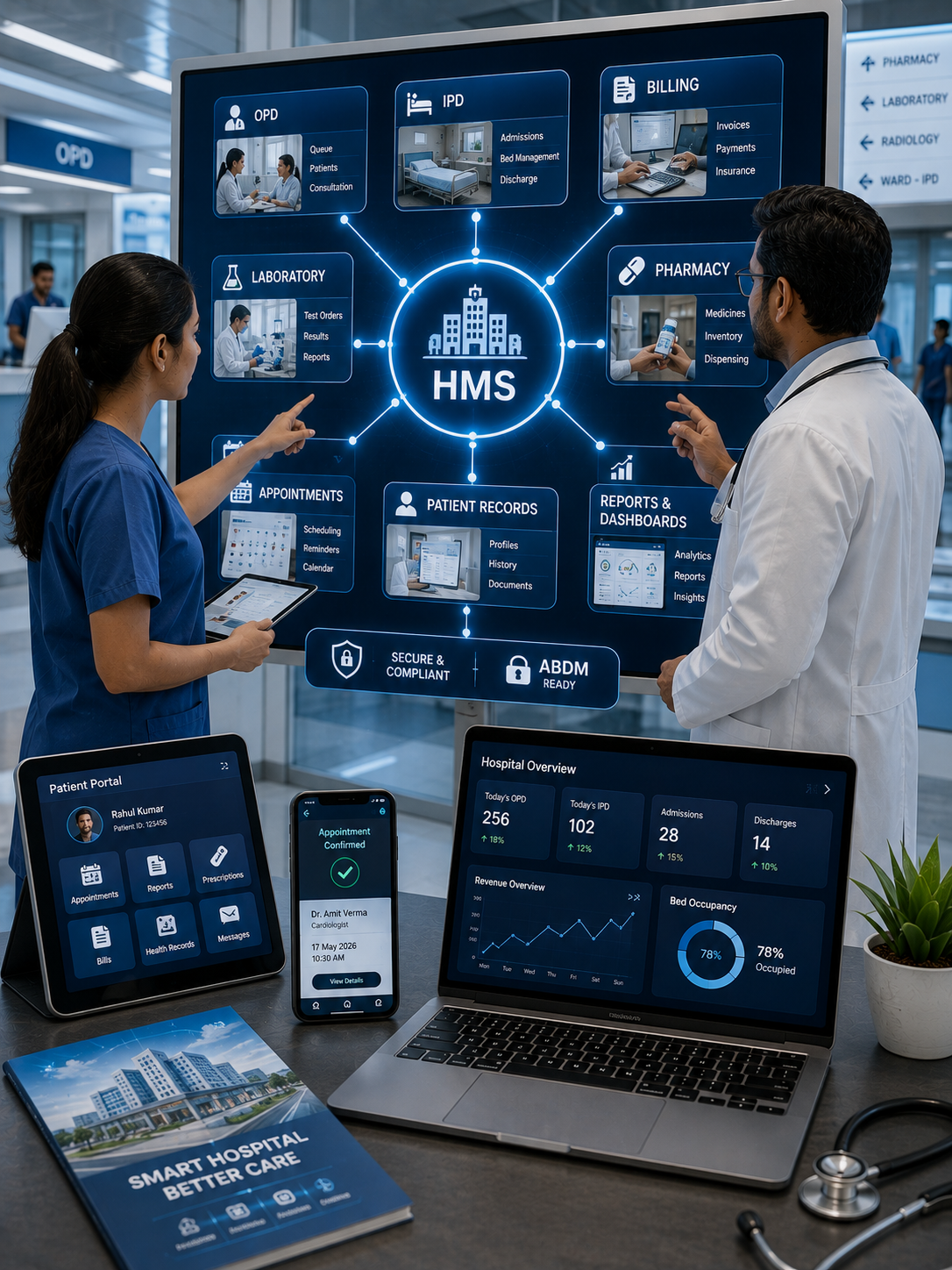
Transform Hospital Operations With Smart HMS
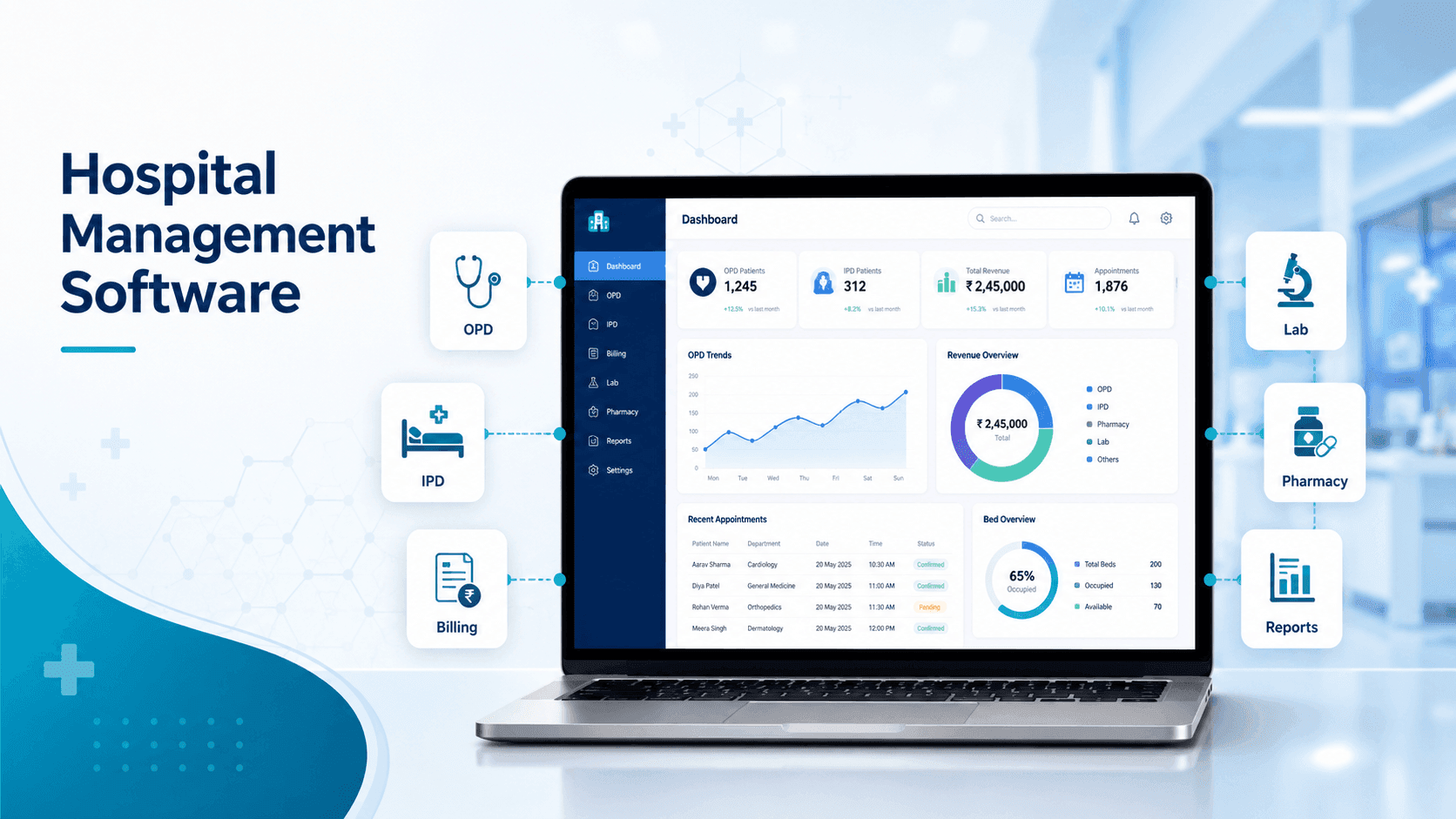
Connect OPD, IPD, billing, lab, pharmacy, appointments and patient records through secure, scalable hospital software built for smarter healthcare operations.
What Should Modern Hospital Software Manage?
A modern hospital system should connect the complete patient journey across departments.
A typical workflow is:
Patient Registration
↓
Appointment / Walk-In Check-In
↓
OPD Token Generation
↓
Doctor Consultation
↓
Prescription / Lab / Diagnostic Request
↓
Billing & Payment
↓
Pharmacy / Laboratory
↓
Reports & Follow-Up
The objective is not simply to digitise individual departments. Patient, clinical, billing, and operational data should move through one connected workflow so staff do not repeatedly enter the same information.
Hospital Workflow Diagram
A connected hospital management workflow can be structured as:
Patient Enquiry → Registration → Appointment → OPD Queue → Doctor Consultation → Lab / Pharmacy → Billing → Patient Records → Follow-Up → Management Analytics
This gives reception teams, doctors, billing staff, laboratory teams, pharmacists, and administrators visibility into the same patient journey while maintaining role-based access.
Hospitals looking for broader finance, operations, inventory, and departmental integration can also consider a Healthcare ERP Software Development approach.
Transform Your Hospital Digitally
OPD to Billing Workflow
OPD is one of the busiest areas of a hospital and often determines the overall patient experience.
A digital OPD workflow can begin when a patient registers or confirms an appointment. The system generates a token and assigns the patient to the appropriate department and doctor queue.
The workflow becomes:
Registration → Digital Token → Doctor Queue → Consultation → Services Ordered → Billing → Payment → Lab / Pharmacy → Follow-Up
Reception teams can monitor queue status while doctors view their assigned patients. After consultation, services such as laboratory tests, medicines, procedures, or follow-up appointments can move into billing without repeatedly recreating patient information.
Hospitals that want to streamline this process can explore our OPD Queue Management Software.
Doctor, Patient & Admin Roles
Patient Experience
Patients should receive a simpler and more transparent journey.
They can benefit from:
- Digital registration
- Appointment booking
- OPD token updates
- Queue visibility
- Digital prescriptions
- Billing information
- Lab reports
- Follow-up reminders
- Telemedicine access
For hospitals extending consultation beyond the physical facility, Telemedicine App Development Services can connect online appointments, video consultations, prescriptions, payments, and follow-ups.
Doctor Workflow
Doctors need a focused interface rather than access to every administrative module.
A doctor dashboard can support:
Patient Queue → Patient History → Consultation → Clinical Notes → Prescription → Lab Request → Follow-Up
AI can also assist doctors with structured documentation, consultation summaries, patient-history review, and workflow automation while clinical decisions remain with qualified healthcare professionals.
Learn more about AI for Doctors Software Development.
Hospital Admin & Management
Hospital administrators need operational visibility across departments.
A management dashboard can monitor:
- Daily patient registrations
- OPD volume
- Doctor workload
- Billing and collections
- Laboratory activity
- Pharmacy movement
- Department performance
- Pending follow-ups
- Operational trends
This helps management identify bottlenecks and make decisions using real-time hospital data.
Core Hospital Software Modules
A connected HMS can include patient registration, appointments, OPD and IPD management, doctor dashboards, billing and payments, pharmacy inventory, laboratory workflows, EMR, role-based access, reports, and analytics.
The right combination depends on hospital size, departments, number of doctors, locations, existing software, integration requirements, and operational priorities.
Healthcare Software Services for Hospitals
Build a Connected Digital Hospital
Murmu Software Infotech develops custom healthcare systems for hospitals, clinics, diagnostic centres, and healthcare organisations.
Solutions can include:
- Hospital Management Systems
- OPD and queue management
- Healthcare ERP
- Telemedicine platforms
- Doctor applications
- Patient portals
- Billing and payment systems
- Healthcare AI workflows
- Dashboards and analytics
- Healthcare websites and digital patient experiences
Our focus is on connecting workflows rather than creating disconnected software modules.
See Your Hospital Workflow Digitally
Every hospital works differently. A live workflow discussion helps identify which modules, roles, integrations, and automation features are most relevant.
Schedule a Hospital Software Demo to discuss OPD, billing, doctor workflows, patient management, telemedicine, AI, pharmacy, laboratory, and reporting requirements.
Build Smarter Hospital Workflows
What does hospital management software do?
Hospital management software connects registration, appointments, OPD, consultations, billing, pharmacy, laboratory, patient records, staff access, and reporting within a digital workflow.
Can hospital software be customised?
Yes. Custom healthcare software can be designed around specific departments, billing processes, doctor workflows, reports, user roles, integrations, and multi-location requirements.
Can OPD software connect with billing?
Yes. Patient registration and consultation data can flow into billing so approved services, tests, medicines, and procedures can be processed without unnecessary duplicate entry.
Can hospital software support multiple doctors and departments?
Yes. Role-based workflows can manage multiple doctors, specialties, departments, queues, and administrative teams.
Can telemedicine be integrated with hospital software?
Yes. Telemedicine can connect appointments, video consultations, payments, digital prescriptions, records, and follow-up workflows.
Can AI be added to hospital software?
AI can assist with documentation, patient-history summaries, workflow automation, enquiry handling, operational analytics, and other administrative tasks while healthcare professionals retain clinical decision-making responsibility.
Is hospital software suitable for clinics?
Yes. Clinics can use focused modules such as appointments, OPD, consultation records, billing, prescriptions, patient communication, and reporting.
Can existing hospital software be integrated?
Integration may be possible with existing HMS, billing, pharmacy, LIMS, CRM, payment, or third-party systems depending on available APIs and architecture.
Should hospitals choose custom or ready-made software?
Ready-made software may suit standard workflows, while custom software is useful when a hospital has specialised processes, integrations, reports, departments, or multi-location requirements.
How should a hospital software project begin?
A good implementation starts with workflow analysis, module prioritisation, role definition, integration planning, phased deployment, testing, staff training, and post-launch support.
Conclusion
Choosing a hospital software company in Ranchi should be based on more than a feature checklist.
The strongest healthcare systems connect the complete patient journey from registration and OPD to doctor consultation, billing, laboratory, pharmacy, follow-up, and management reporting.
A connected digital hospital gives patients a clearer experience, staff better workflow visibility, and management stronger operational control.
Frequently Asked Questions
Which company provides hospital software development in Ranchi?
Murmu Software Infotech provides custom hospital and healthcare software development in Ranchi, including HMS, OPD management, billing, telemedicine, healthcare ERP, patient portals, dashboards, integrations and AI-assisted workflows.
What is hospital management software?
Hospital management software is a digital platform that connects patient registration, appointments, OPD and IPD workflows, doctor consultations, billing, pharmacy, laboratory, records, staff access and management reporting.
What modules should hospital software include?
Common modules include patient registration, appointments, OPD queues, IPD, doctor dashboards, billing, pharmacy, laboratory, prescriptions, patient records, role-based access, reports and analytics.
Can hospital software be customised for my hospital?
Yes. Custom hospital software can be designed around your departments, patient flow, billing rules, doctor workflows, user roles, reports, integrations, locations and operational requirements.
Can OPD management software integrate with billing?
Yes. OPD workflows can connect patient registration, digital tokens, doctor consultation, services ordered, billing, payment, laboratory, pharmacy and follow-up within one patient journey.
Can hospital software manage multiple doctors and departments?
Yes. A role-based HMS can manage multiple doctors, specialties, departments, consultation queues, billing teams, laboratory staff, pharmacists and administrators.
Can telemedicine be integrated with hospital software?
Yes. Telemedicine can integrate doctor availability, online appointments, payments, video consultations, digital prescriptions, patient records and follow-up workflows.
Can AI be integrated into hospital management software?
Yes. AI can assist with documentation, patient-history summaries, workflow automation, enquiry handling, operational alerts and analytics while clinical decisions remain with qualified healthcare professionals.
How much does hospital software cost in Ranchi?
Hospital software cost depends on required modules, users, departments, locations, integrations, mobile applications, data migration, deployment, security requirements and ongoing support.
How should a hospital choose a software company in Ranchi?
Hospitals should evaluate healthcare domain experience, workflow customisation, integration capability, security, delivered projects, implementation approach, staff training, maintenance support and transparent project scope.