Ranchi Jharkhand
School ERP Software in Ranchi – Complete Guide for Schools & Colleges
PPrem Murmu6 Min Read
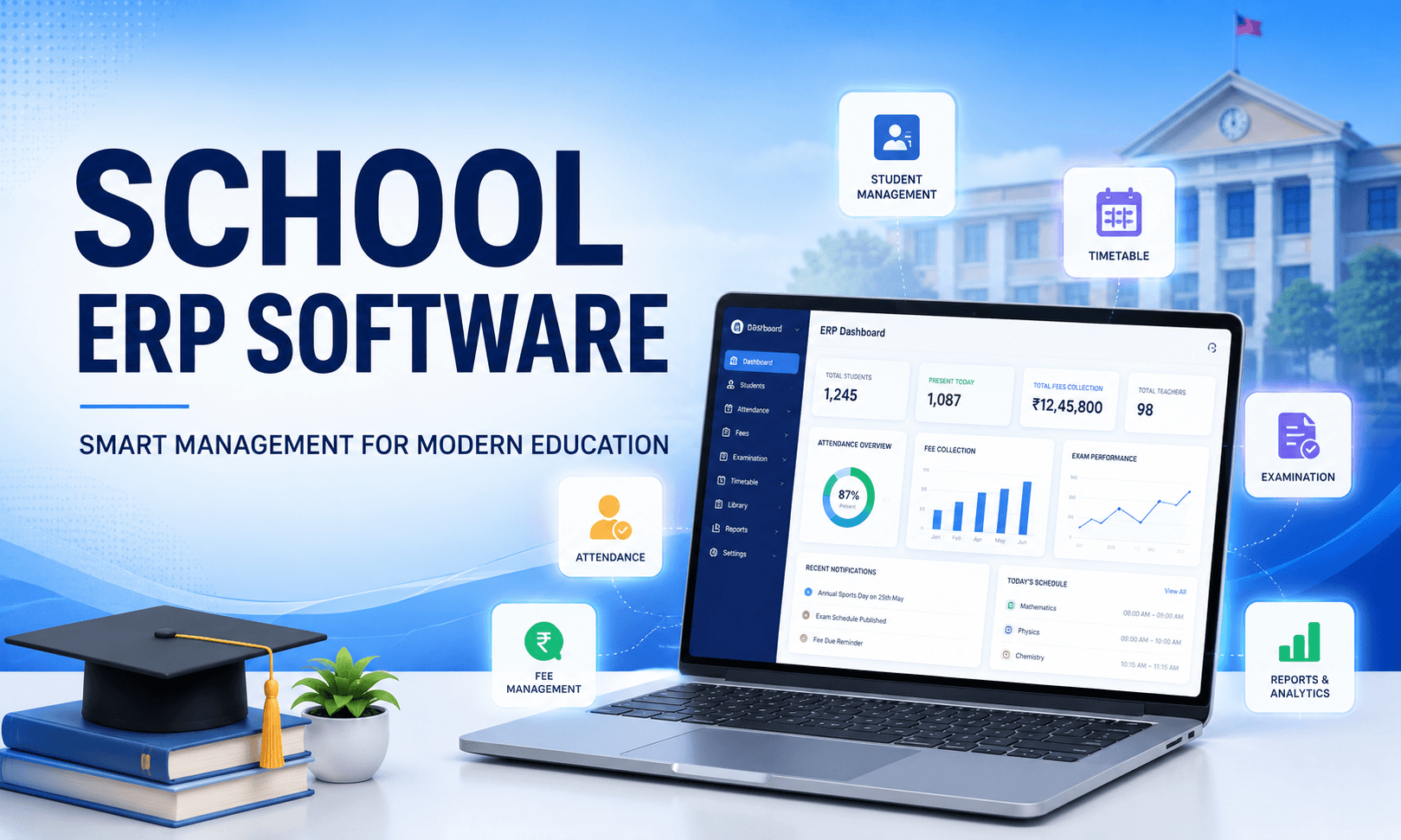
The education sector is rapidly embracing digital transformation, and educational institutions in Ranchi are no exception. Schools and colleges are increasingly looking for smarter ways to manage academics, administration, communication, fees, attendance, examinations, and overall campus operations efficiently.
Manual processes and disconnected systems are no longer sustainable in today’s fast-paced academic environment. Institutions need centralized platforms that improve operational efficiency, transparency, and communication while delivering a better experience for students, parents, teachers, and administrators.
This is where School ERP Software becomes a game-changing solution.
A modern School ERP Software helps educational institutions automate and streamline day-to-day operations through a centralized digital platform. From admissions and fee management to online classes and performance analytics, ERP systems are transforming how schools and colleges operate.
In this complete guide, we’ll explore:
School ERP Software is an integrated digital platform designed to manage and automate academic, administrative, and communication processes within educational institutions.
ERP stands for Enterprise Resource Planning, and in the education sector, it helps schools and colleges centralize multiple operations into one unified system.
A School ERP typically manages:
Instead of relying on multiple disconnected tools or manual spreadsheets, institutions can manage everything from a single dashboard.
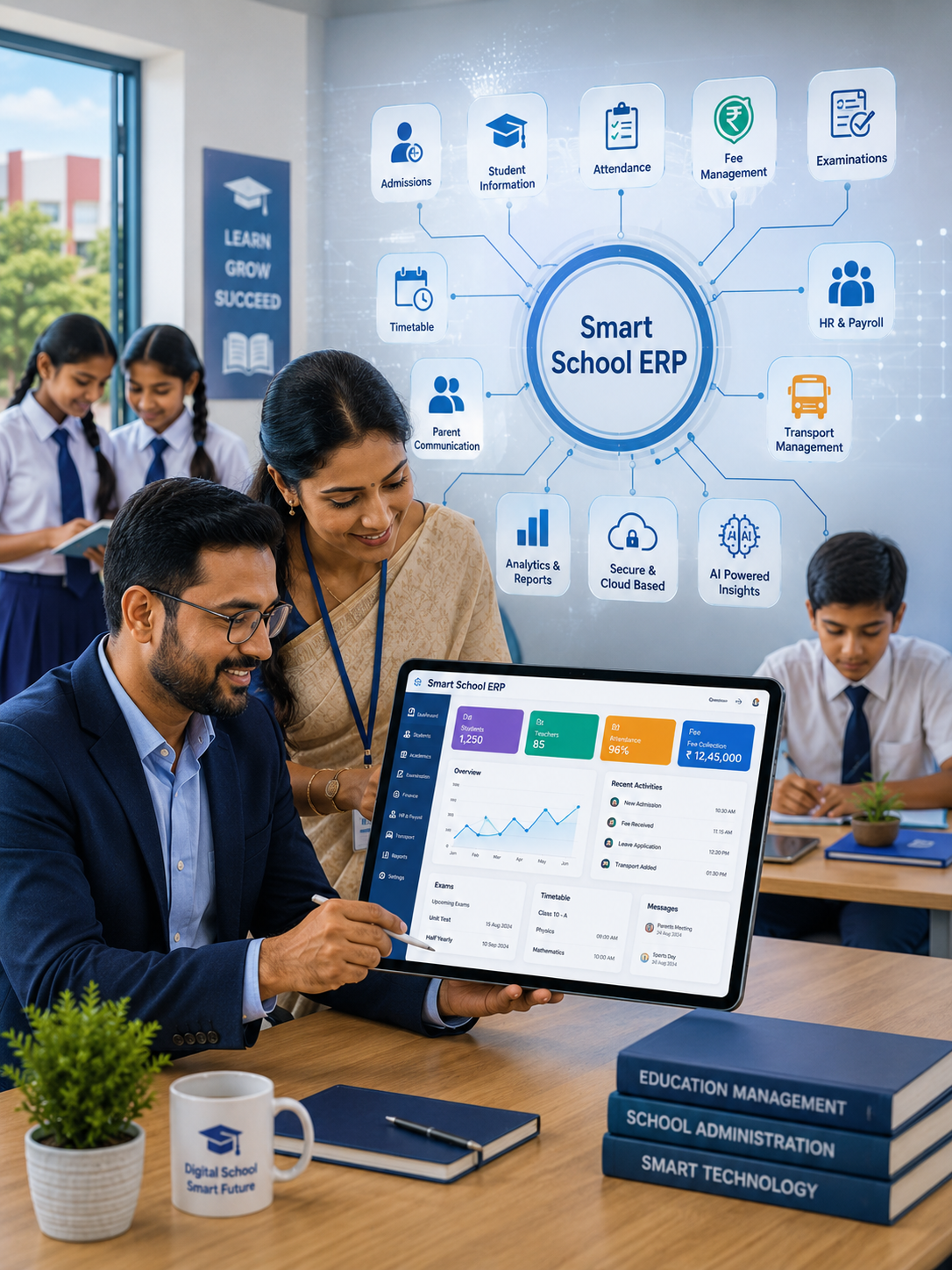
Centralize admissions, fees, attendance, academics, communication, and administration with a scalable ERP built for modern educational institutions.
Educational institutions in Ranchi are experiencing increasing competition, rising administrative workloads, and evolving expectations from parents and students.
Traditional management systems often create operational challenges such as:
A modern School ERP Software in Ranchi helps institutions overcome these challenges by digitizing and automating campus operations.
For school directors, principals, trustees, IT heads, and institutional decision-makers, ERP software is becoming a strategic investment rather than just an operational tool.
When evaluating ERP solutions, schools and colleges should prioritize features that improve operational efficiency, communication, and scalability.
Admission management is one of the most time-consuming administrative processes.
A School ERP automates:
This simplifies the admission process while improving transparency.
Attendance tracking becomes seamless with digital automation.
Key capabilities include:
Automated attendance improves monitoring and reduces manual errors.
Managing fee collections manually often leads to delays and reconciliation issues.
School ERP Software enables:
This improves cash flow management and convenience for parents.
Examination management can be complex for educational institutions.
ERP systems simplify:
Teachers and administrators save significant time through automation.
Effective communication is essential for modern educational institutions.
ERP platforms offer:
This strengthens engagement between schools and parents.
Automated scheduling eliminates conflicts and improves operational planning.
ERP software helps manage:
This improves administrative coordination.
Schools and colleges can automate staff management through ERP systems.
Features include:
This reduces HR administrative workload significantly.
For institutions offering transportation and hostel facilities, ERP systems provide:
This improves operational control and student safety.
A School ERP Software centralizes all operations into a single system, improving visibility and reducing dependency on multiple tools.
Automation minimizes repetitive tasks, paperwork, and manual data entry.
Administrative teams can focus more on institutional growth and student experience.
Parents can monitor attendance, fees, homework, and academic performance in real time through mobile applications and portals.
This improves transparency and trust.
Modern ERP systems provide secure cloud storage, role-based access control, and backup mechanisms to protect institutional data.
ERP dashboards provide real-time analytics and reports that help institutional leadership make informed decisions quickly.
As educational institutions expand, ERP software helps manage growing student volumes, multiple campuses, and operational complexity efficiently.
Cloud-based ERP solutions are becoming increasingly popular among schools and colleges due to their flexibility and cost efficiency.
For institutions looking to modernize quickly, cloud-based School ERP Software is often the preferred choice.
Selecting the right ERP system is a strategic decision for educational institutions.
Here are some critical evaluation factors:
The software should be user-friendly for administrators, teachers, students, and parents.
Every institution has unique workflows and academic structures.
Choose ERP solutions that support custom modules and flexible configurations.
Mobile apps for parents, teachers, and students are now essential for real-time communication and accessibility.
The ERP should integrate with:
Ensure the ERP platform follows strong cybersecurity practices and secure data handling standards.
Partner with technology providers that understand the education industry and provide reliable support and maintenance.
The education technology landscape is evolving rapidly.
Future-ready School ERP platforms are integrating:
Institutions adopting digital transformation early will gain operational and academic advantages in the long run.
As educational competition increases, schools and colleges need technology-driven systems to improve efficiency, communication, and student experiences.
For founders, directors, principals, trustees, and IT leaders, School ERP Software is not just an administrative tool — it is a long-term digital transformation strategy.
An efficient ERP platform helps institutions:
Digital transformation in education is no longer optional. Schools and colleges that continue relying on manual operations may struggle with scalability, efficiency, and stakeholder expectations.
A modern School ERP Software in Ranchi enables institutions to automate operations, improve communication, enhance academic management, and create better educational experiences.
For educational institutions aiming to modernize and scale effectively, investing in the right ERP solution can deliver long-term operational and strategic benefits.
School ERP Software is an integrated digital platform that centralizes and automates academic, administrative, financial, communication, and operational processes such as admissions, attendance, fees, examinations, timetables, HR, transport, and reporting.
A comprehensive School ERP should support student admissions, attendance, fee management, examinations, results, parent communication, timetables, HR and payroll, transport, hostel management, reports, analytics, mobile access, integrations, and secure data management.
School ERP software helps institutions in Ranchi centralize operations, reduce paperwork and manual work, improve fee and attendance tracking, strengthen parent communication, improve reporting, enhance data security, and support institutional growth.
School ERP pricing in Ranchi depends on the number of users, modules, customization, mobile applications, integrations, hosting, security requirements, implementation, and support. Institutions should compare the total cost against their required features and long-term needs.
Cloud-based School ERP can provide remote accessibility, faster deployment, automatic updates, scalability, lower infrastructure requirements, and improved disaster recovery, making it suitable for institutions seeking flexible digital operations.
Yes. School ERP systems can support automated fee generation, online payment integration, payment reminders, receipt generation, outstanding fee tracking, reconciliation workflows, and financial reporting.
Yes. School ERP can centralize attendance records and may support mobile attendance, biometric or RFID integrations, attendance reports, and parent notifications depending on the selected system and configuration.
Yes. School ERP platforms can provide mobile notifications, SMS or email alerts, homework updates, circulars, feedback modules, attendance information, fee updates, and academic performance communication.
Schools should evaluate ease of use, customization, mobile accessibility, integrations, security, data handling, scalability, vendor expertise, implementation support, maintenance, and the ERP provider's understanding of educational workflows.
Modern School ERP platforms can be designed for future technologies such as AI-powered student insights, predictive analytics, smart attendance, online examinations, virtual learning integrations, chatbots, and advanced analytics.