Healthcare Digital Transformation Consulting For US Hospitals

In This Article
- Cost, Software & Implementation Roadmap
- What Is Healthcare Digital Transformation Consulting?
- How Much Does Healthcare Digital Transformation Cost?
- Which Healthcare Software Should You Implement First?
- Hospital Management and Clinical Workflows
- Patient Engagement and CRM
- Telemedicine and Digital Access
- Interoperability Before More Applications
- Where Should AI Fit?
- A Practical Healthcare Digital Transformation Roadmap
- Phase 1 Assess
- Phase 2 Prioritize
- Phase 3 Build the Foundation
- Phase 4 Pilot One High-Value Workflow
- Phase 5 Scale What Works
- Technology Is Usually Not the Hardest Part
- How Should You Choose a Healthcare Digital Transformation Consultant?
- Start With a Roadmap, Not a Massive Transformation
- Planning Healthcare Digital Transformation?
Cost, Software & Implementation Roadmap
Hospitals rarely delay digital transformation because they doubt technology matters.
They delay because the decision feels too large.
Which software should we implement first? How much will transformation cost? Can new systems integrate with our existing HMS, EHR, laboratory and pharmacy platforms? Where does AI actually create value? How do we avoid disrupting patient care while implementing everything?
These are exactly the questions healthcare digital transformation consulting should answer.
The objective is not to replace every system at once.
It is to identify where digital investment can produce the greatest improvement in patient experience, clinical workflows, operational efficiency, staff productivity and financial performance, then implement that transformation in controlled phases.

Modernize Healthcare With a Clear Roadmap
Prioritize the right systems, integrations, AI opportunities, and implementation phases to improve patient experience, operations, and digital readiness.
What Is Healthcare Digital Transformation Consulting?
Healthcare digital transformation consulting evaluates how technology, data and workflows currently operate across a healthcare organization and creates a practical roadmap for improvement.
That can include:
- Digital maturity assessment
- Hospital workflow analysis
- HMS/EHR/EMR modernization
- Patient engagement
- Telemedicine
- Healthcare CRM
- Laboratory and pharmacy integration
- Interoperability
- Cloud modernization
- Data analytics
- AI and automation
- Cybersecurity
- Implementation planning
- Change management
Damo Consulting emphasizes assessing existing digital maturity before prioritizing investments, while Savvycom similarly describes consultants evaluating existing systems, identifying gaps and creating a roadmap aligned with strategic objectives.
That assessment-first approach matters.
Digital transformation should begin with the business and clinical problem—not with a software purchase.
How Much Does Healthcare Digital Transformation Cost?
There is no responsible universal price.
A 50-bed hospital optimizing appointments and billing has a fundamentally different requirement from a multi-location health system integrating EHRs, laboratories, imaging, telemedicine, patient apps, analytics and AI.
Cost is influenced by:
Organization size + existing systems + integrations + software scope + data migration + compliance + customization + infrastructure + training + ongoing support.
As one current vendor benchmark, TechAhead publishes ranges of approximately $50,000–$100,000 for focused initiatives, $100,000–$200,000 for broader programs, and $200,000–$500,000+ for enterprise transformation. These are TechAhead’s own planning estimates, not universal market prices.
A better approach is to divide the investment into phases.
Instead of approving one enormous digital transformation budget, ask:
What is our highest-value problem, and what is the smallest investment that can prove improvement?
That dramatically reduces decision risk.
Modernize Hospital Technology With Scalable Software Built For Healthcare
Which Healthcare Software Should You Implement First?
Do not begin by purchasing every available module.
Begin with your largest operational or patient-experience bottleneck.
Hospital Management and Clinical Workflows
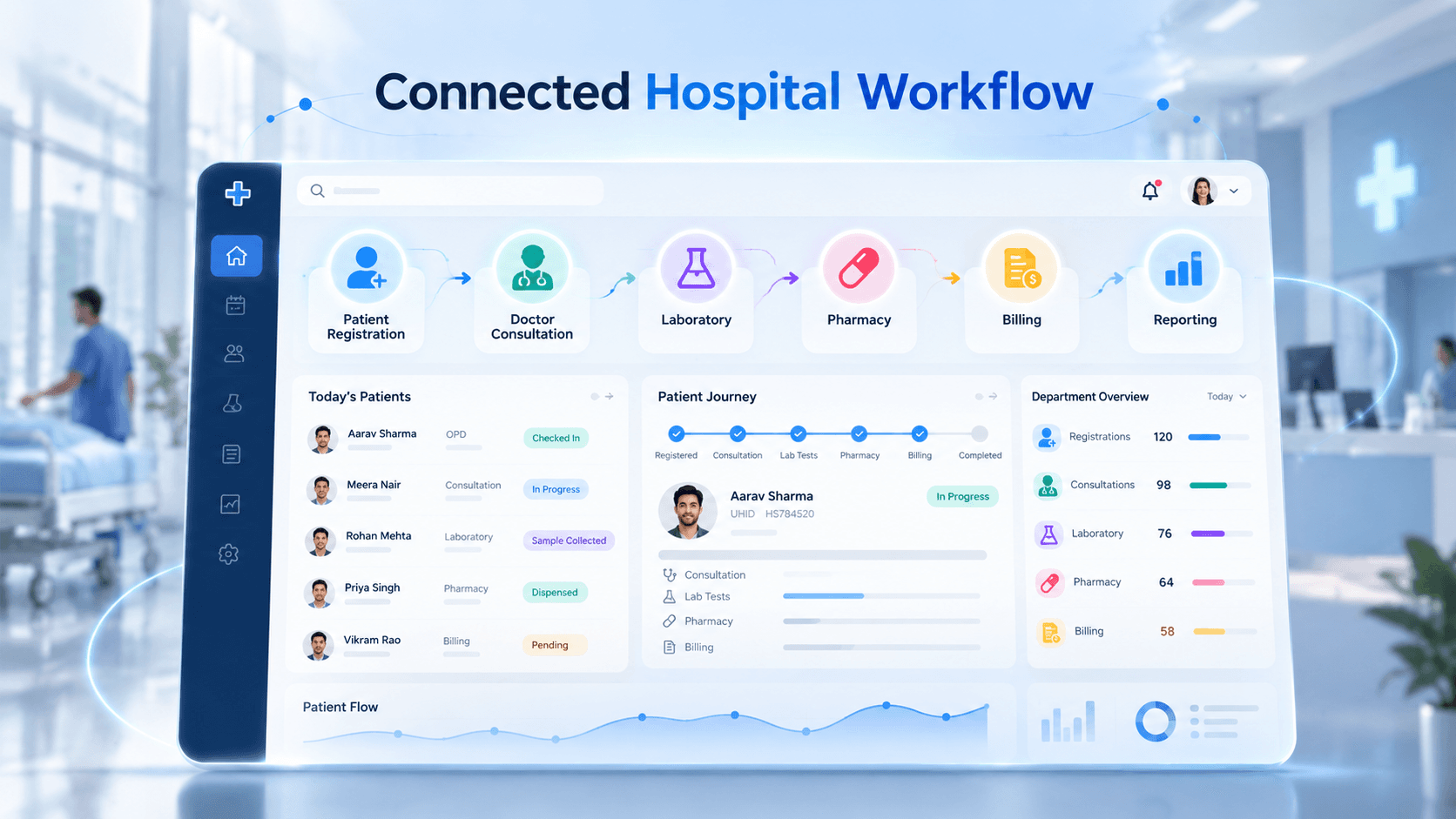
If registration, OPD/IPD, billing, pharmacy, laboratory and patient records operate across disconnected systems, creating a stronger core digital platform may be the priority.
A connected Digital Healthcare Management System can combine HMS, patient workflows, telemedicine, CRM, mobile access and AI-assisted operations into a broader digital healthcare ecosystem.
Patient Engagement and CRM
If missed appointments, poor follow-up and fragmented patient communication are causing revenue leakage, transformation may begin outside the clinical system.
A Healthcare CRM and Patient Engagement Platform can centralize inquiries, follow-ups, reminders, campaigns and patient lifecycle communication.
Telemedicine and Digital Access
If access and convenience are major patient priorities, digital consultation may offer a clearer early win.
JLL highlights telemedicine, patient portals, analytics and remote monitoring as important digital-health capabilities, while Deloitte describes virtual health as extending beyond video visits into remote monitoring, care management and broader patient experience.
A practical example is our Telemedicine & Online Video Consultation Platform.
Interoperability Before More Applications
One of the most expensive transformation mistakes is adding new software without connecting existing systems.
Hospitals may already operate:
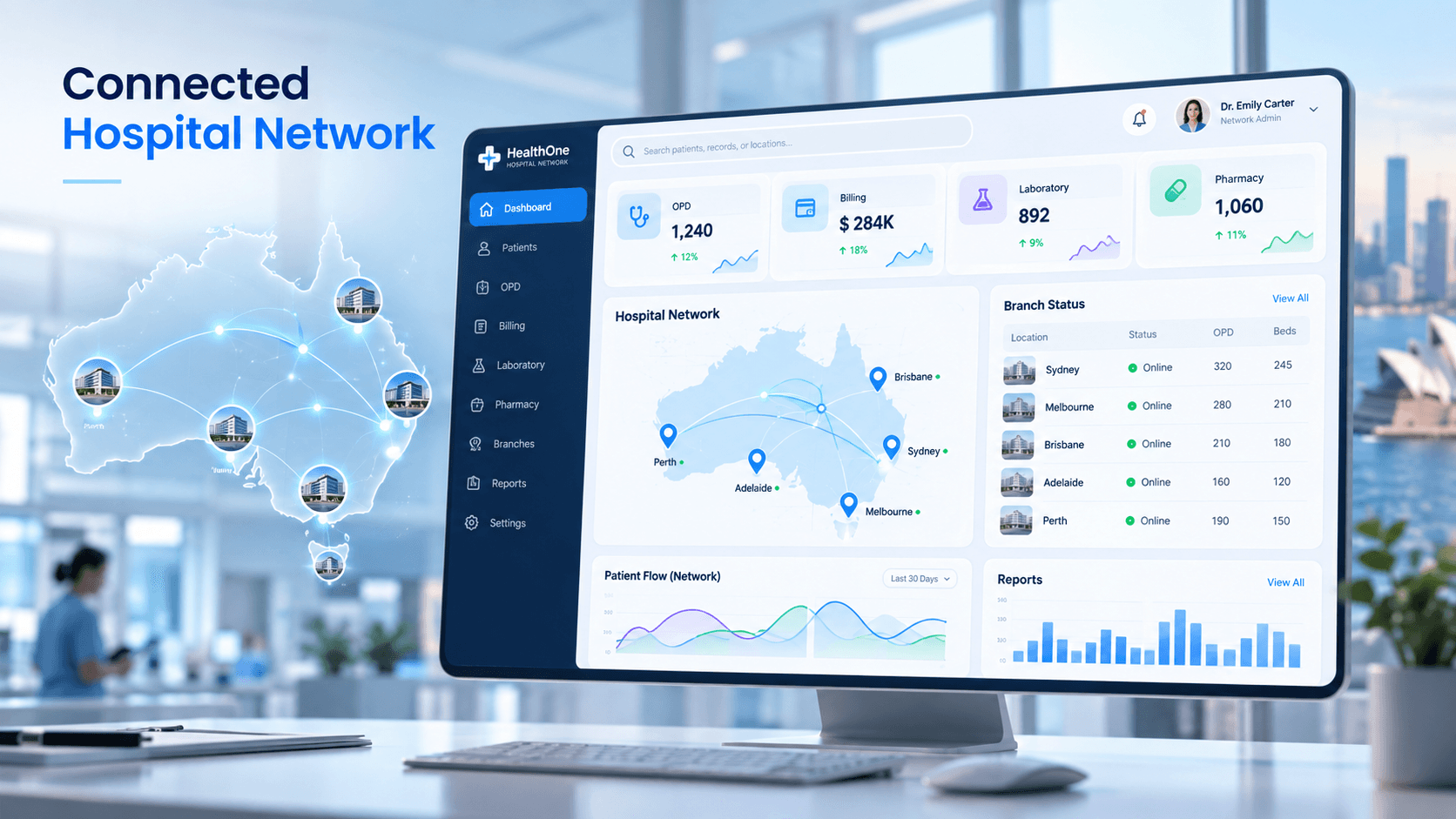
HMS + EHR/EMR + LIS + RIS/PACS + pharmacy + billing + CRM + patient portal + mobile app.
If each maintains separate patient and operational data, digitization can actually create more administrative work.
Grant Thornton’s 2026 research on Indian hospitals reports strong adoption of HIS, EMR and LIS but continuing gaps in interoperability and enterprise automation.
Modern healthcare architectures should therefore consider standards-based interoperability. HL7 defines FHIR as a standard for exchanging healthcare information electronically, and ABDM documentation specifies FHIR-formatted health records within its ecosystem.
Connected systems create transformation. More disconnected systems create complexity.
Where Should AI Fit?
AI should not be phase one simply because AI is currently receiving executive attention.
First establish:
Reliable data → connected systems → clear workflows → governance → measurable use case.
Then identify where AI can improve an outcome.
Potential opportunities include:
- Clinical documentation assistance
- Patient-query automation
- Appointment and scheduling optimization
- Knowledge assistants
- Revenue-cycle automation
- Predictive analytics
- Patient engagement
- Operational dashboards
- Inventory and resource planning
- Administrative workflow agents
Grant Thornton’s hospital research found strong interest in GenAI for reducing administrative and cognitive burden, while its respondents identified operational areas such as scheduling, patient flow, billing and supply-chain workflows as potential agentic-AI opportunities.
The correct question is not:
Where can we implement AI?
It is:
“Which workflow currently costs us enough time, money or patient satisfaction that AI could create measurable improvement?”
A Practical Healthcare Digital Transformation Roadmap
Phase 1 Assess
Map existing applications, workflows, integrations, infrastructure, security, patient journeys and operational bottlenecks.
Establish baseline metrics such as:
waiting time, billing turnaround, appointment conversion, staff workload, claim delays, patient satisfaction and operational cost.
Phase 2 Prioritize
Rank initiatives according to:
Business impact × patient impact × implementation difficulty × risk.
Do not attempt ten transformations simultaneously.
Damo advocates a phased roadmap based on digital maturity and investment priorities, while Deloitte notes that health systems use interim milestones to demonstrate value during longer transformation journeys.
Modernize Healthcare Systems Without Disrupting Patient Care Operations
Phase 3 Build the Foundation
Create the architecture required for integration, security, data governance and future scaling.
This may involve APIs, cloud infrastructure, identity management, interoperability and master data before adding sophisticated AI.
For US healthcare organizations subject to HIPAA, HHS requires appropriate administrative, physical and technical safeguards for electronic protected health information.
Phase 4 Pilot One High-Value Workflow
Choose one measurable initiative:
OPD automation.
Appointment and follow-up CRM.
Telemedicine.
Laboratory integration.
Digital patient journey.
Administrative AI automation.
Launch it with controlled users and measure the result.
Phase 5 Scale What Works
Once the pilot demonstrates measurable value, integrate additional departments, facilities and workflows.
TechAhead similarly describes a progression from digital maturity assessment through foundation building, pilot validation, phased rollout, training and post-implementation optimization.
Technology Is Usually Not the Hardest Part
Hospitals can purchase software relatively quickly.
Changing workflows is harder.
Grant Thornton identifies an important transformation gap: technology adoption can move faster than organizational readiness, with coordination, workflow redesign, incentives and continuing staff adoption affecting implementation depth.
That means every transformation roadmap should include:
Clinical stakeholders + administrators + IT + finance + operations + executive leadership.
Technology teams cannot redesign healthcare delivery alone.
How Should You Choose a Healthcare Digital Transformation Consultant?
Do not select a consulting partner because it has the longest technology list.
Ask:
Do they understand healthcare workflows?
Can they assess our existing systems before proposing replacements?
Can they integrate instead of rebuilding everything?
Do they understand interoperability and security?
Can they connect consulting with actual software implementation?
Will they define measurable business outcomes?
Can they support the platform after go-live?
CreateFuture makes a useful distinction here: healthcare transformation requires not only technical capability but also understanding of regulation, clinical realities, users and long-term organizational capability.
Start With a Roadmap, Not a Massive Transformation
Digital transformation does not require replacing your entire hospital technology environment this year.
Start with:
Current-state assessment → prioritized roadmap → one measurable pilot → integration → adoption → expansion.
Murmu Software Infotech provides healthcare software and digital transformation capabilities across HMS, OPD/IPD, telemedicine, healthcare CRM, LIMS, mobile applications, AI-assisted workflows and connected digital healthcare platforms. Our broader Healthcare Hospital Software Solutions illustrate how these capabilities can form one connected ecosystem rather than another collection of isolated applications.
The goal is not to become the hospital with the most software.
The goal is to make healthcare simpler for patients, clinicians, staff and management.
Planning Healthcare Digital Transformation?
Start by identifying where your hospital is losing the most time, efficiency, patient satisfaction or revenue.
Then build the transformation roadmap around measurable improvement.
Assess first. Prioritize. Pilot. Measure. Scale.
Frequently Asked Questions
What is healthcare digital transformation consulting?
Healthcare digital transformation consulting assesses existing clinical, operational and technology workflows and creates a practical roadmap for modernization. It can cover hospital software, patient engagement, interoperability, telemedicine, analytics, AI, cybersecurity, cloud infrastructure and implementation planning.
How much does healthcare digital transformation cost?
Cost depends on hospital size, existing systems, number of locations, integrations, data migration, software scope, security requirements, training and implementation complexity. A phased roadmap helps organizations avoid committing to a large transformation budget before validating priority initiatives.
Where should a hospital start digital transformation?
Start with a digital maturity and workflow assessment. Identify the largest patient, operational or financial bottlenecks, establish measurable baseline metrics and prioritize the initiatives that can create the highest impact with manageable implementation risk.
Which software should hospitals modernize first?
The priority depends on existing bottlenecks. Common starting points include HMS or EHR workflows, appointment management, billing, patient engagement, laboratory and pharmacy integration, telemedicine, CRM, interoperability and operational reporting.
Why is healthcare interoperability important in digital transformation?
Interoperability allows healthcare applications and departments to exchange data instead of maintaining isolated patient and operational records. Better integration can reduce duplicate entry, improve information availability and create a stronger foundation for analytics, automation and digital patient journeys.
What role does FHIR play in healthcare digital transformation?
FHIR provides a standardized approach for exchanging healthcare information electronically. It can help organizations design more interoperable architectures between EHR, hospital systems, patient applications, laboratory systems and other healthcare platforms.
Where should AI be used in healthcare digital transformation?
AI should target measurable workflows such as administrative automation, patient communication, knowledge retrieval, appointment optimization, document processing, operational analytics or decision support. Reliable data, governance and connected systems should normally come before complex AI initiatives.
How long does healthcare digital transformation take?
Healthcare transformation is usually a phased program rather than a single project. A focused pilot can be delivered relatively quickly, while enterprise modernization across systems, departments and locations may continue over many months or years.
How can hospitals reduce digital transformation risk?
Use a phased approach: assess current systems, prioritize high-value problems, establish architecture and governance, pilot one measurable workflow, track outcomes and scale only after the initiative demonstrates operational or patient value.
How do I choose a healthcare digital transformation consulting company?
Evaluate healthcare workflow expertise, integration capability, security knowledge, software implementation experience, interoperability skills, AI capability, post-launch support and whether the consultant defines measurable outcomes instead of simply recommending more technology.