Case Study Healthcare CRM Software for Hospitals & Clinics
In This Article
- Why Hospitals Need Healthcare CRM Software
- Hospital CRM Workflow Diagram
- OPD to Billing and CRM Workflow
- Doctor, Patient and Admin Roles
- Patient Experience
- Doctor Workflow
- Admin, Reception and CRM Teams
- Core Healthcare CRM Features
- Connected Healthcare Software Services
- Build a Complete Patient Engagement Ecosystem
- See Healthcare CRM in Action
- What is Healthcare CRM Software?
- How is Healthcare CRM different from HMS?
- Can Healthcare CRM reduce missed appointments?
- Can Healthcare CRM integrate with OPD software?
- Does Healthcare CRM support WhatsApp?
- Can Healthcare CRM manage doctor-wise follow-ups?
- Can CRM connect with hospital billing?
- Can Healthcare CRM improve patient retention?
- Is Healthcare CRM suitable for clinics?
- Can Healthcare CRM integrate with telemedicine?
- Conclusion
Modern hospitals and clinics manage patient relationships long before and long after a doctor consultation.
A patient may discover a healthcare service, submit an enquiry, book an appointment, receive reminders, visit the OPD, consult a doctor, complete diagnostic tests, make payments, return for follow-up, and continue treatment over several weeks or months.
When these interactions are managed through spreadsheets, manual calls, isolated WhatsApp conversations, and disconnected applications, hospitals can lose visibility into patient enquiries, missed appointments, follow-ups, and repeat consultations.
Murmu Software Infotech developed a Healthcare CRM Software platform for hospitals and clinics to centralize patient enquiries, appointments, follow-ups, communication, feedback, campaigns, retention workflows, and patient lifecycle management.
For organizations planning a wider digital healthcare ecosystem, explore our Healthcare Software Development Services.

Connect Every Patient Interaction
Centralize enquiries, appointments, doctor follow-ups, WhatsApp communication, feedback and patient retention through one connected healthcare CRM workflow.
Why Hospitals Need Healthcare CRM Software
Traditional CRM tools are often designed around generic sales pipelines. Healthcare organizations require workflows centered on patient engagement and continuity.
Common challenges include:
- Untracked patient enquiries
- Missed appointments
- Manual follow-up calls
- Scattered WhatsApp, SMS, and email communication
- Limited visibility into pending follow-ups
- Weak repeat-consultation engagement
- Unstructured patient feedback
- Poor appointment-conversion tracking
- No centralized patient-engagement dashboard
A healthcare CRM creates a structured relationship layer around the patient journey.
Transform Your Patient
Hospital CRM Workflow Diagram
A connected healthcare CRM workflow can look like this:
Patient Enquiry
↓
Lead Captured in CRM
↓
Appointment Scheduled
↓
Automated Reminder
↓
OPD Registration & Token
↓
Doctor Consultation
↓
Billing / Lab / Pharmacy
↓
Follow-Up Triggered
↓
Patient Feedback
↓
Repeat Consultation / Continuing Care
This approach connects patient acquisition with actual hospital workflows rather than treating CRM as an isolated marketing database.
OPD to Billing and CRM Workflow
Healthcare CRM becomes more valuable when it connects with operational systems.
When an appointment patient arrives, the CRM record can connect with OPD registration and the appropriate doctor queue. After consultation, the patient may move to billing, diagnostics, laboratory, pharmacy, or another department.
The complete flow becomes:
CRM Enquiry → Appointment → OPD Token → Consultation → Services Ordered → Billing → Treatment → Follow-Up → Retention
Hospitals that need dedicated patient-flow automation can connect this journey with OPD Queue Management Software.
Once a consultation is completed, CRM rules can trigger:
- Follow-up reminders
- Diagnostic follow-ups
- Missed appointment recovery
- Treatment reminders
- Feedback requests
- Repeat-consultation reminders
The CRM therefore supports the patient before, during, and after a hospital visit.
Doctor, Patient and Admin Roles
Patient Experience
Patients benefit from consistent communication throughout their healthcare journey.
A Healthcare CRM can support:
- Appointment confirmations
- WhatsApp, SMS, and email reminders
- Follow-up notifications
- Rescheduling communication
- Treatment reminders
- Patient feedback
- Repeat-consultation communication
Hospitals providing remote care can extend these workflows using Telemedicine App Development Services.
Doctor Workflow
Doctors can receive visibility into patients requiring consultation or follow-up without navigating every administrative CRM feature.
A doctor-oriented workflow can include:
Patient List → Consultation → Follow-Up Required → Reminder → Repeat Consultation
Doctor-wise engagement enables hospitals to maintain continuity between patients and their treating specialists.
Healthcare organizations can further extend doctor workflows through AI for Doctors Software Development, including structured documentation and intelligent workflow assistance.
Admin, Reception and CRM Teams
Administrative and patient-engagement teams need a centralized view of the complete funnel.
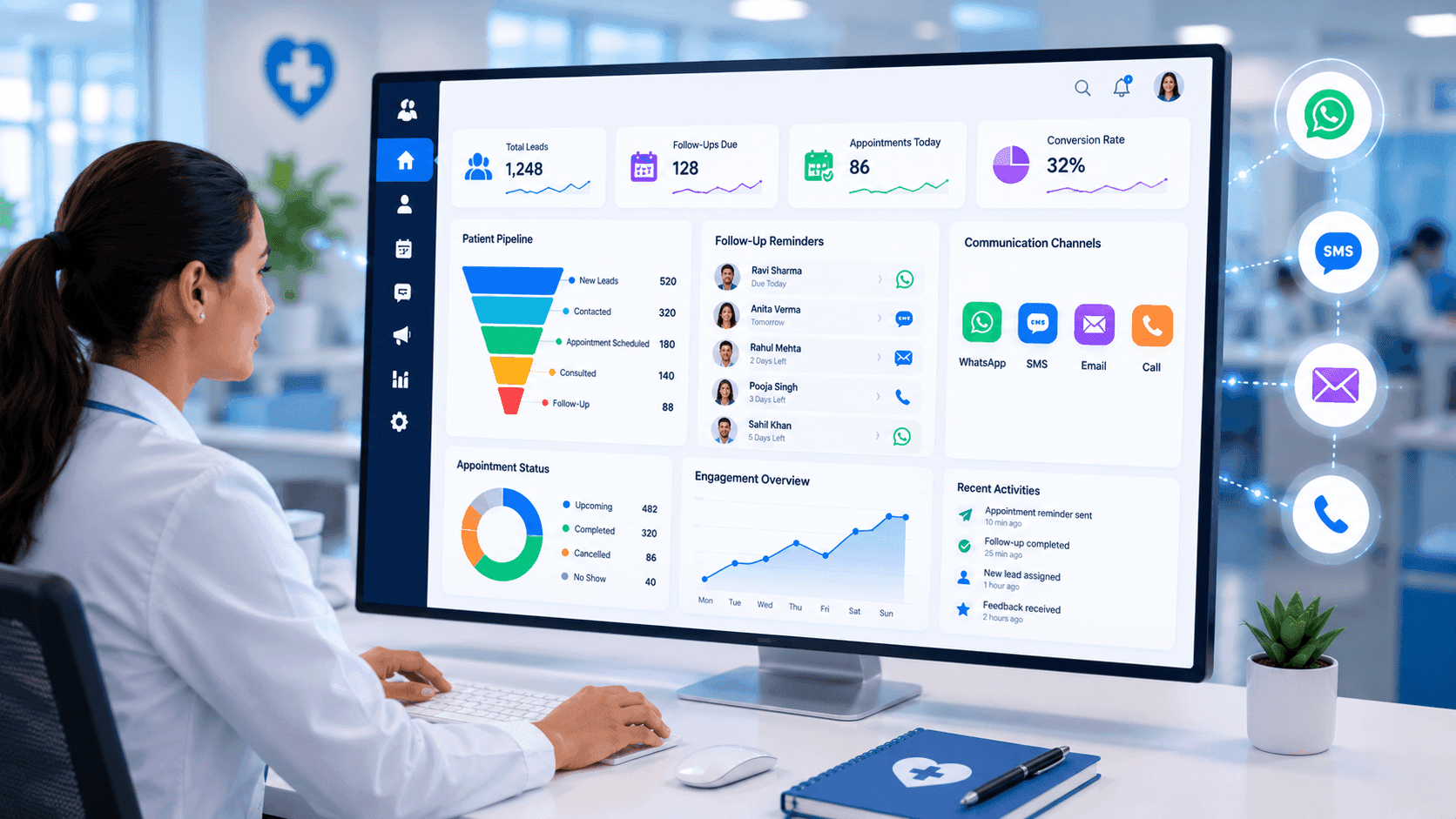
Dashboards can display:
- New patient enquiries
- Lead sources
- Appointments booked
- Upcoming consultations
- Pending follow-ups
- Missed appointments
- Rescheduling status
- Doctor-wise engagement
- Campaign activity
- Patient feedback
- Repeat consultations
- Retention trends
This provides stronger operational visibility than maintaining separate spreadsheets and communication records.
Core Healthcare CRM Features
A Healthcare CRM platform can combine:
Patient Lead Management - Capture enquiries, track their sources, assign teams, and monitor appointment conversion.
Appointment Follow-Up - Track scheduled consultations, pending actions, reminders, and staff responsibilities.
WhatsApp, SMS & Email Automation - Send appointment confirmations, reminders, treatment communication, and follow-up messages.
Missed Appointment Recovery - Identify missed consultations and trigger re-engagement or rescheduling.
Patient Feedback Management - Collect satisfaction feedback, complaints, and patient-experience data.
Doctor-Wise Engagement - Organize follow-up activities according to doctor or specialty.
Treatment Lifecycle Tracking - Maintain visibility across repeat consultations and longer treatment journeys.
CRM Analytics - Measure appointment conversion, follow-up status, campaign activity, engagement, and retention indicators.
Connected Healthcare Software Services
Build a Complete Patient Engagement Ecosystem
Murmu Software Infotech develops custom healthcare platforms for hospitals, clinics, diagnostic centres, and healthcare organizations.
Solutions can include Healthcare CRM, HMS, OPD systems, telemedicine, doctor applications, patient portals, dashboards, AI workflows, and system integrations.
Healthcare organizations that need to connect CRM with administration, finance, inventory, and multi-department operations can also explore Healthcare ERP Software Development.
Build Smarter Patient Relationships
See Healthcare CRM in Action
Every hospital has a different patient lifecycle.
A workflow-focused demo can help map your patient enquiry sources, appointments, OPD process, communication channels, follow-up rules, doctors, CRM users, integrations, and reporting requirements.
Schedule a Healthcare CRM Demo and discover how to turn disconnected patient communication into one measurable engagement workflow.
What is Healthcare CRM Software?
Healthcare CRM software helps hospitals and clinics manage patient enquiries, appointments, follow-ups, communication, feedback, campaigns, and ongoing engagement from a centralized platform.
How is Healthcare CRM different from HMS?
Healthcare CRM primarily focuses on patient relationships and engagement, while HMS manages broader hospital operations and clinical workflows. The systems can be integrated.
Can Healthcare CRM reduce missed appointments?
It can automate appointment reminders, identify missed consultations, and initiate rescheduling and re-engagement workflows.
Can Healthcare CRM integrate with OPD software?
Yes. CRM appointments can connect with registration, digital token generation, doctor queues, consultation status, and post-consultation follow-ups.
Does Healthcare CRM support WhatsApp?
Healthcare CRM can integrate WhatsApp, SMS, and email channels for reminders, confirmations, follow-ups, and patient communication.
Can Healthcare CRM manage doctor-wise follow-ups?
Yes. Follow-up workflows can be organized by doctor or specialty to improve continuity across consultation cycles.
Can CRM connect with hospital billing?
Depending on the hospital architecture and available integrations, CRM workflows can connect patient journeys with OPD, consultation, billing, and other hospital systems.
Can Healthcare CRM improve patient retention?
Structured reminders, follow-up workflows, treatment communication, feedback, and repeat-consultation engagement can support stronger patient continuity.
Is Healthcare CRM suitable for clinics?
Yes. Clinics can use Healthcare CRM for enquiries, appointments, reminders, patient communication, follow-ups, feedback, and retention workflows.
Can Healthcare CRM integrate with telemedicine?
Yes. CRM workflows can connect online appointments, remote consultations, follow-up communication, and ongoing patient engagement with telemedicine systems.
Conclusion
Healthcare CRM software is more than patient lead management.
When integrated with appointments, OPD, doctor consultations, billing, communication, follow-ups, feedback, and retention workflows, it becomes a patient engagement layer across the complete healthcare journey.
This gives hospitals and clinics better visibility into patient relationships while creating more structured communication, follow-up continuity, and long-term engagement.
Frequently Asked Questions
What is healthcare CRM software?
Healthcare CRM software is a patient relationship and engagement platform that helps hospitals and clinics manage enquiries, appointments, follow-ups, communication, feedback, campaigns and long-term patient engagement.
What is the best CRM for hospitals and clinics?
The right healthcare CRM depends on patient volume, workflows, communication channels, integrations and reporting requirements. A healthcare-specific CRM should support patient leads, appointments, follow-ups, reminders, doctor-wise engagement and analytics.
How is healthcare CRM different from hospital management software?
Hospital management software handles broader clinical and operational processes such as registration, OPD, billing, pharmacy and laboratory. Healthcare CRM focuses on patient enquiries, communication, follow-ups, retention and engagement. The two can work together.
Can healthcare CRM reduce missed appointments?
Healthcare CRM can send appointment reminders, identify missed consultations and trigger rescheduling or patient re-engagement workflows.
Can healthcare CRM integrate with WhatsApp?
Yes. Healthcare CRM can integrate WhatsApp, SMS and email for appointment confirmations, reminders, treatment communication and follow-up workflows.
Can healthcare CRM integrate with OPD software?
Yes. CRM appointments can connect with patient registration, digital token generation, doctor queues, consultation status and post-consultation follow-up.
How does healthcare CRM improve patient retention?
Healthcare CRM supports structured follow-ups, appointment reminders, treatment communication, feedback collection and repeat-consultation engagement throughout the patient lifecycle.
Can healthcare CRM manage doctor-wise patient follow-ups?
Yes. Patient engagement can be organized according to doctor or specialty, helping teams track consultation relationships, pending follow-ups and repeat visits.
Can healthcare CRM connect with billing and hospital systems?
Yes. Depending on APIs and system architecture, healthcare CRM can connect with HMS, OPD, billing, telemedicine, laboratory, pharmacy and other healthcare systems.
Who should use healthcare CRM software?
Healthcare CRM is suitable for hospitals, clinics, diagnostic centres, multi-specialty healthcare organizations and healthcare service providers that need structured patient enquiry, appointment, communication and retention workflows.