SaaS MVP Development: Features, Cost, Timeline and Launch Roadmap
In This Article
- What Should a SaaS MVP Actually Prove?
- Core Features to Build First
- 1. Authentication and User Roles
- 2. One Core Customer Workflow
- 3. User Dashboard
- 4. Admin Panel
- 5. Billing and Subscription Logic
- 6. Essential Integrations
- 7. Product Analytics
- SaaS MVP Development Cost
- How Long Does SaaS MVP Development Take?
- What Happens After Launch?
- Build Less, Learn Faster, Scale What Works
- Ready to Plan Your SaaS MVP?
A SaaS idea may appear simple in a pitch deck.
But the development process often becomes complicated: user accounts should be turned into roles and permissions, a pricing page transformed into subscriptions, trials, upgrades, and cancellations, a dashboard populated with data, integrations debugged for API errors, administrators get control panels, and users – onboarding, notifications, and support.
That is why successful SaaS MVP development begins with deciding what the first version should demonstrate not to build an entire product in an attempt to cover all features.
For founders and product owners, the objective of a SaaS MVP is clear:
launch the reduced version of the product that will solve a significant problem for a chosen audience, delight the first users, and provide evidence for the next funding decision.
A well-defined MVP application development strategy will help the founders turn their idea into an actual working SaaS application without spending the budget on features their users will never need.
What Should a SaaS MVP Actually Prove?
A SaaS MVP is not simply a smaller version of the final platform.
It should validate several important assumptions:
- Do customers have the problem?
- Does the core workflow solve it?
- Can users understand the product quickly?
- Will they return after the first session?
- Are they willing to pay?
- Which features actually influence adoption?
That means every MVP feature should connect to a measurable product or business outcome.
If a feature does not help users complete the core workflow or help the startup validate demand, it may belong in the post-MVP roadmap.
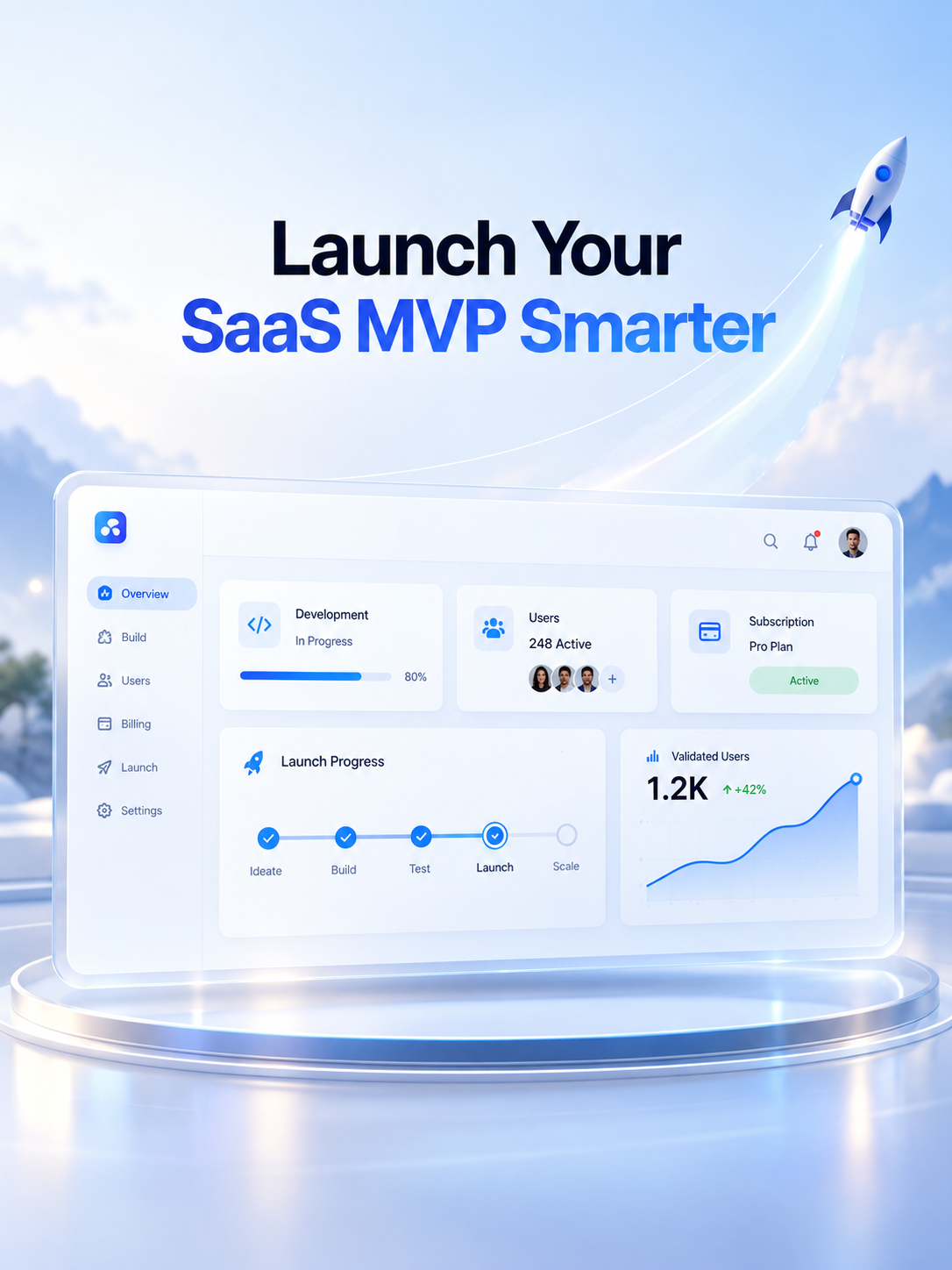
Launch Your SaaS MVP Smarter
Plan features, user roles, billing, integrations, launch scope, and validation before investing in a full-scale SaaS product.
Core Features to Build First
Although every SaaS product is different, most launch-ready MVPs need a common foundation.
1. Authentication and User Roles
Users need secure registration, login, password recovery and account management.
For B2B SaaS products, you may also need organizations, team invitations and role-based permissions such as owner, manager, employee or administrator.
More roles usually mean more screens, rules and testing, so keep the first permission model as simple as the business allows.
2. One Core Customer Workflow
This is the reason customers use the software.
For an invoicing SaaS, it might be:
Add client → Create invoice → Send invoice → Record payment
For a booking platform:
Create availability → Customer books → Confirm appointment
Build this journey well before adding secondary functionality.
Build Your SaaS MVP With Clear Scope and Costs
3. User Dashboard
The dashboard should help users understand what matters immediately.
Avoid filling the first version with dozens of reports. Show the information and actions users need to complete the primary workflow.
4. Admin Panel
Founders need operational visibility from launch.
A practical admin panel might include user management, account status, subscriptions, support actions, usage information and basic system controls.
5. Billing and Subscription Logic
Subscription billing can become surprisingly complex.
Plans may involve free trials, monthly or annual billing, upgrades, downgrades, failed payments, cancellations and feature limits.
Not every early B2B SaaS MVP needs fully automated billing. Pilot customers may initially be handled using manual invoices or payment links.
But if your acquisition model is self-service, subscription management should usually be part of the MVP.
6. Essential Integrations
Connect only the systems required to make the main customer journey work.
Examples include payment gateways, CRM platforms, email services, messaging APIs, accounting tools and identity providers.
Each integration adds development and testing effort, so “nice to have” integrations should wait.
7. Product Analytics
Your MVP needs to tell you what users are actually doing.
Track metrics such as:
Sign-ups → Onboarding completion → Core action → Repeat usage → Trial conversion → Paid conversion
Without analytics, founders can launch an MVP but still struggle to understand whether it is working.
SaaS MVP Development Cost
No reliable universal MVP development cost.
Depending on the source, focused SaaS MVP estimates vary from roughly $15,000–$50,000 across current industry guides, while broader B2B platforms incorporating multiple roles, billing, integrations or advanced workflows can extend to $50,000–$100,000+. Complex enterprise or AI-heavy MVPs can incur significantly greater costs.
The biggest cost drivers are usually:
Feature scope, user roles, UI/UX complexity, billing rules, integrations, security requirements, data migration, AI functionality and infrastructure.
Instead of asking, “How much does a SaaS app cost?” founders should calculate the cost of the specific first release.
You can use the software project cost calculator to estimate scope, development cost and timeline before committing to the build.
How Long Does SaaS MVP Development Take?
A practical SaaS MVP commonly takes around 10–16 weeks, although a very focused product can launch faster and a complex multi-role SaaS platform may require several months. Competitor guidance ranges from roughly 12-week delivery cycles to three-to-six-month projects depending on scope and technical risk.
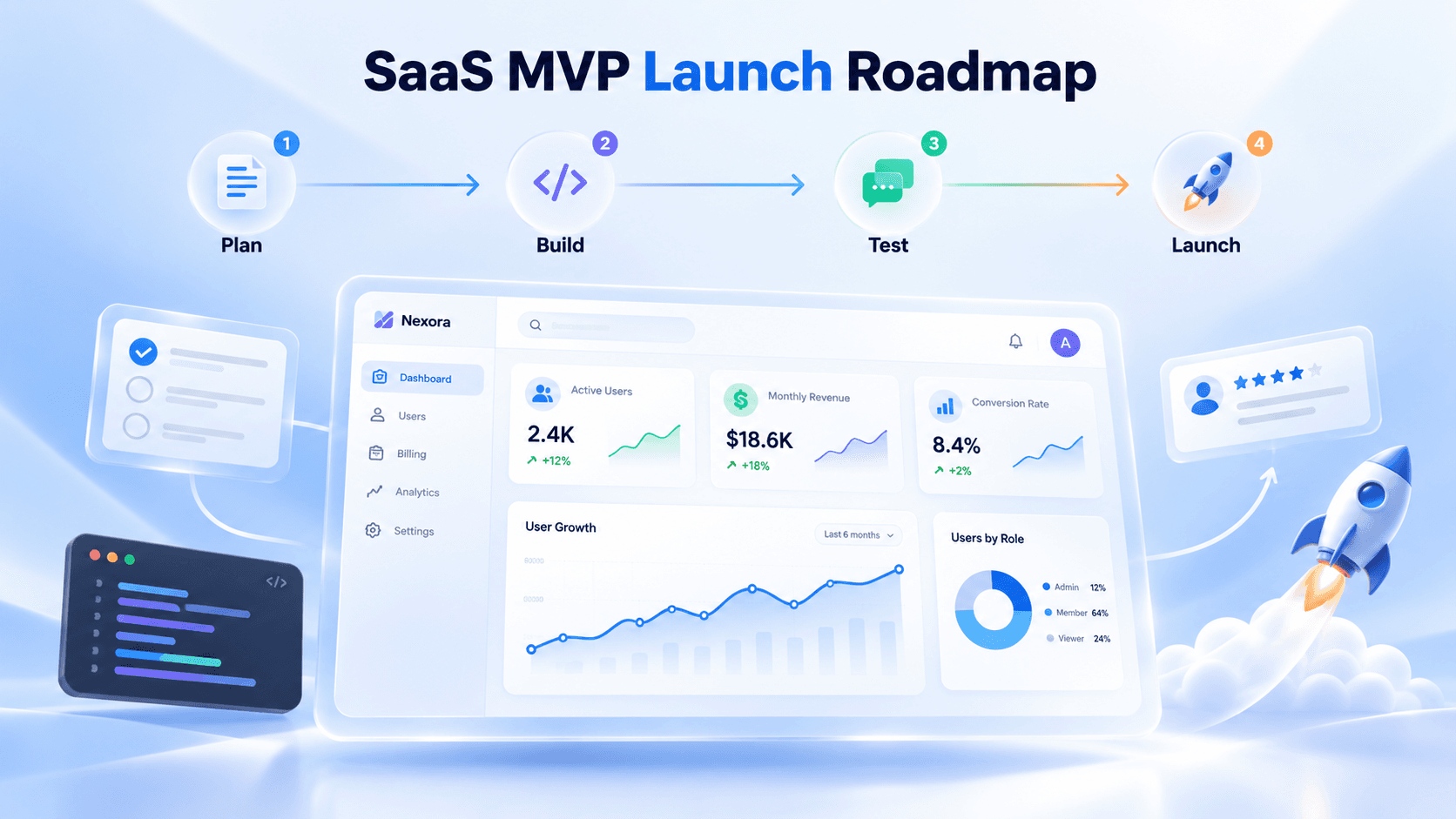
A useful roadmap looks like this:
Weeks 1–2: Product Discovery
Define target users, problem, core workflow, monetization and success metrics.
Weeks 2–4: UX and Technical Planning
Create user flows, wireframes, architecture and prioritized requirements.
Weeks 4–10: MVP Development
Build authentication, dashboard, core workflow, backend, admin controls, billing and essential integrations.
Weeks 10–12+: Testing and Launch Preparation
Test workflows, roles, permissions, billing states, integrations, responsive behavior and security.
A structured ROI-driven MVP approach helps keep each phase focused on validation rather than feature volume.
Plan Your SaaS MVP Before Full Product Investment
What Happens After Launch?
Launching is not the end of SaaS product development.
It is the beginning of evidence-based development.
Monitor which users activate, where onboarding fails, which workflows get repeated, why users cancel and what paying customers request most.
Then classify new ideas into:
Fix Now — bugs, usability problems and launch blockers.
Build Next — functionality supported by customer behavior or revenue opportunities.
Build Later — advanced reporting, additional integrations, mobile apps, automation and enterprise functionality.
If artificial intelligence is central to the product such as AI agents, RAG, copilots, automation or intelligent search the AI workflow should also be validated independently before scaling. A focused AI MVP development approach can help test AI feasibility and business value before adding it across the entire SaaS platform.
Build Less, Learn Faster, Scale What Works
The best SaaS MVP is not the one with the most features.
It's the one that produces the clearest evidence.
Start with the core workflow, provide secure access, and only add dashboard, administration, billing, integrations, and analytics necessary to make that core workflow useful and observable.
Launch.
Observe.
Invest in what the market demonstrates.
Ready to Plan Your SaaS MVP?
Define your core features, roles, billing, integrations, timeline and launch scope before development starts.
CTA: Get MVP Cost Estimate
Frequently Asked Questions
What is SaaS MVP development?
SaaS MVP development is the process of building the smallest usable version of a software-as-a-service product that can deliver its core customer value, test market demand and collect real user feedback before full-scale development.
What features should a SaaS MVP include?
A SaaS MVP should typically include the core customer workflow, authentication, user roles, onboarding, a dashboard, essential admin controls, required integrations and basic analytics. Subscription billing should also be included when payment validation is important to the business model.
How much does SaaS MVP development cost?
SaaS MVP development cost depends on workflow complexity, user roles, UI and UX requirements, billing logic, integrations, admin features, reporting, security, AI functionality and deployment requirements. A focused MVP reduces cost by postponing features that are not necessary for initial validation.
How long does it take to build a SaaS MVP?
A focused SaaS MVP may take several weeks to a few months depending on product complexity, design requirements, integrations, user roles, testing and deployment. Complex B2B SaaS platforms with advanced workflows may require additional development time.
How do you decide which features belong in a SaaS MVP?
Prioritize features that are essential to completing the product's main customer workflow, validating demand, generating revenue or reducing major technical risks. Features that do not directly support those goals can usually be moved to later releases.
Does a SaaS MVP need subscription billing?
Not always. Subscription billing should be included when the MVP needs to test willingness to pay or automate recurring revenue. Early B2B pilots can sometimes begin with manual contracts or payment links before full subscription automation is added.
Should a SaaS MVP include an admin panel?
Yes, most SaaS MVPs benefit from a lightweight admin panel. It allows the product team to manage users, review account activity, control access, monitor subscriptions, troubleshoot issues and operate the application after launch.
What should happen after a SaaS MVP launches?
After launch, founders should measure activation, onboarding completion, core feature usage, retention, trial-to-paid conversion, support requests, cancellations and customer feedback. These signals should determine the next product development priorities.
Can a SaaS MVP include AI features?
Yes. A SaaS MVP can include AI assistants, agents, intelligent search, recommendations, document analysis or workflow automation when AI is central to the product value. The initial version should focus on the AI capability required to validate customer outcomes.
What is the best roadmap for building a SaaS MVP?
A practical SaaS MVP roadmap includes product discovery, user journey and UX design, core development, billing and integrations, quality assurance, production deployment, analytics setup and post-launch validation with real users.