Custom Healthcare Software Case Study: HMS, Telemedicine, Mobile Apps & AI Integration
In This Article
- Healthcare organizations rarely operate through one simple workflow.
- The Challenge: Generic Software Did Not Match Healthcare Operations
- The Solution: Build Around the Healthcare Journey
- Custom HMS as the Operational Foundation
- Healthcare Web and Mobile Experiences
- Telemedicine as a Connected Care Channel
- Healthcare CRM and Patient Engagement
- Laboratory, Pharmacy and API Integration
- AI as an Assistance Layer
- Cloud Architecture and Long-Term Support
- Business Impact
- Building a Custom Healthcare Platform?
Healthcare organizations rarely operate through one simple workflow.
A patient may discover a hospital online, book an appointment, visit an OPD department, consult a doctor, complete laboratory tests, purchase medicines, receive follow-up communication, and later use telemedicine—all while administrators, finance teams, clinical staff, and management depend on different software systems behind the scenes.
When those systems are disconnected, digital healthcare becomes fragmented.
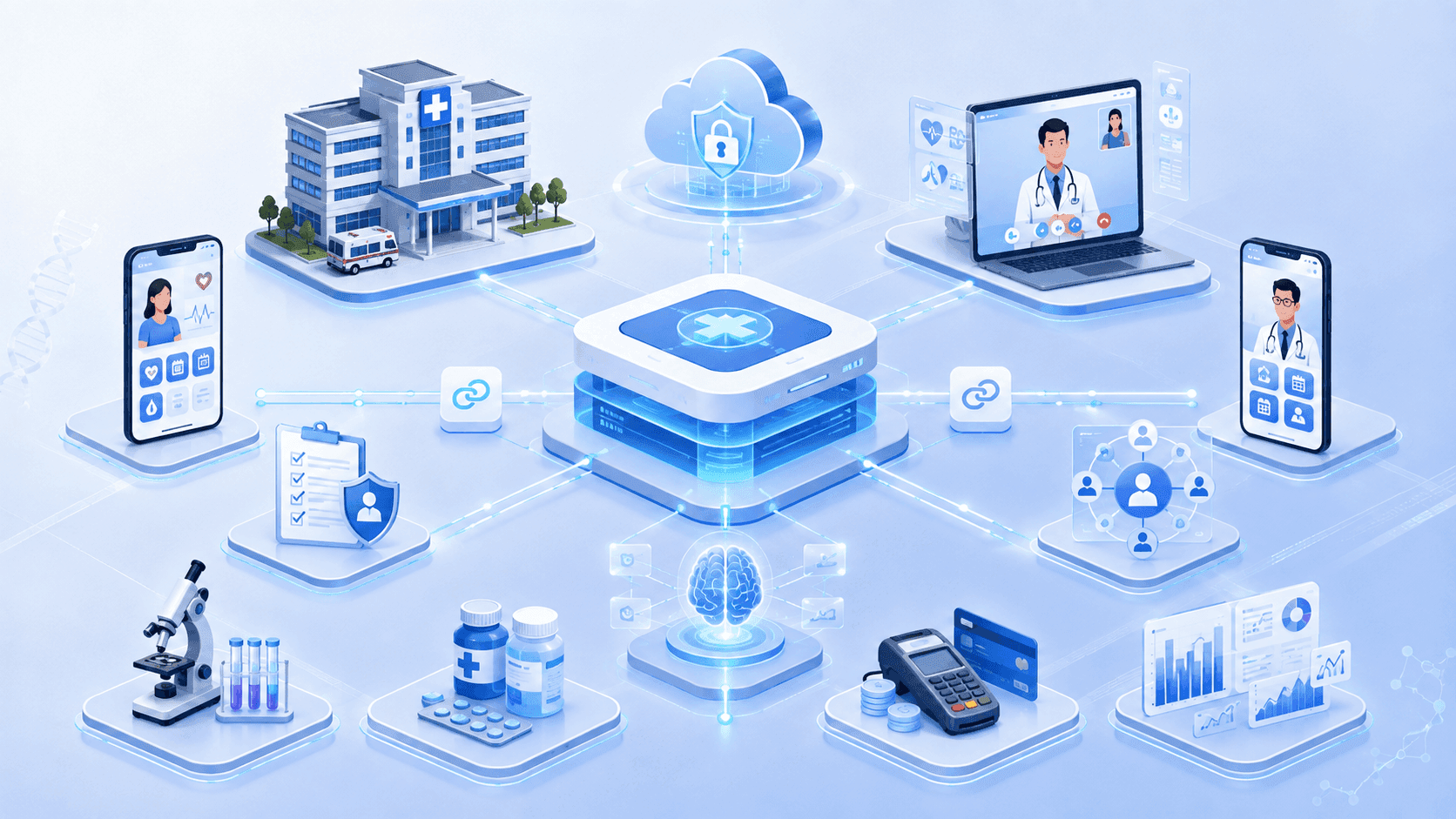
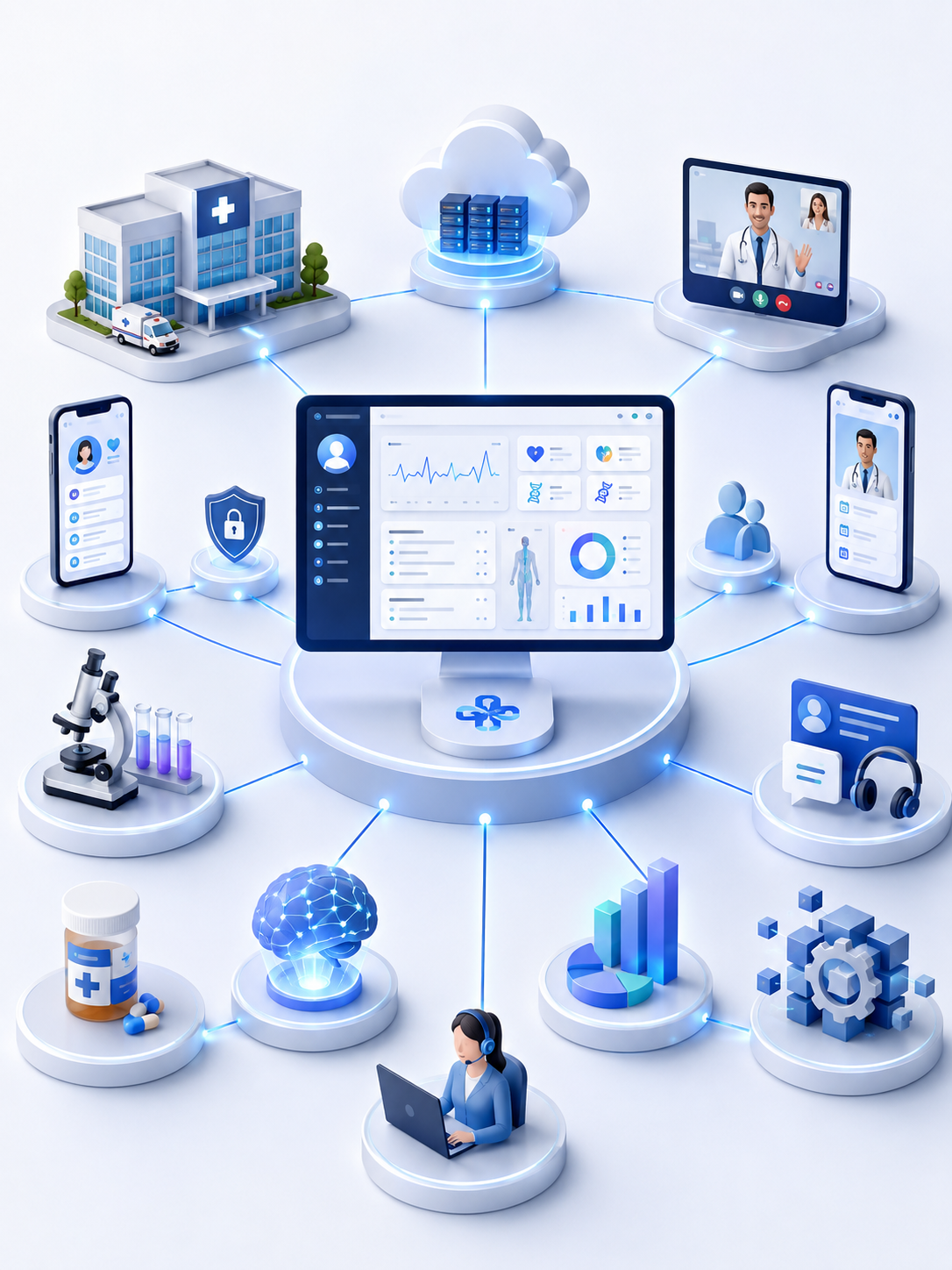
Murmu Software Infotech developed a custom healthcare software ecosystem designed to connect hospital operations, digital patient experiences, mobile applications, telemedicine, CRM automation, AI-assisted workflows, laboratory and pharmacy integrations, third-party APIs, cloud infrastructure, and ongoing software support.
The objective was not to install another generic healthcare product.
It was to create technology around the organization’s actual workflows, patient journey, operational structure, integration requirements, and future growth plans.
Build Connected Healthcare That Scales
Unify HMS, patient apps, telemedicine, CRM, AI workflows, integrations, and cloud services in one flexible healthcare technology ecosystem.
The Challenge: Generic Software Did Not Match Healthcare Operations
Healthcare organizations often inherit multiple systems over time.
Registration may operate in one application. Appointments in another. Laboratory reports may be separate. Patient communication may happen manually through calls or messaging. Telemedicine may exist outside the HMS, while administrators rely on spreadsheets for additional reporting.
The live case study identifies recurring problems including outdated systems, manual processes, disconnected healthcare workflows, poor patient engagement, limited automation, weak integration, scalability constraints, and limited customization.
The real issue was therefore not simply missing software.
It was missing connectivity between people, departments, workflows, and digital channels.
Build a Connected Healthcare Platform Around Your Operations
The Solution: Build Around the Healthcare Journey
The platform was designed as a connected ecosystem rather than a collection of isolated modules.
A simplified journey becomes:
Patient Access → Appointment → Consultation → Doctor Workflow → Lab/Pharmacy → Billing → CRM Follow-Up → Digital Engagement → Analytics
Supporting that journey are cloud services, APIs, mobile applications, automation, security controls, and support operations.
This creates a more valuable architectural principle:
one healthcare journey supported by multiple connected digital capabilities.
Custom HMS as the Operational Foundation
The Hospital Management System forms the operational core.
The documented solution supports department-specific modules, patient workflows, appointments, billing, and operational dashboards.
Rather than forcing staff to adapt to rigid software, custom development allows workflows to reflect how the hospital actually operates.
That can become particularly important for healthcare groups with specialized departments, approval processes, unique patient journeys, or existing applications that must remain integrated.
The stronger value proposition is therefore not “more HMS features.”
It is better alignment between software and hospital operations.
Healthcare Web and Mobile Experiences
Healthcare does not begin when the patient enters the hospital.
The platform also includes responsive web experiences, doctor and patient dashboards, appointment workflows, service management, patient mobile applications, doctor workflow apps, and access to relevant healthcare information.
This enables healthcare organizations to connect physical and digital experiences:
Website → Mobile → Appointment → Hospital → Follow-Up
A patient should not feel as though each channel belongs to a different organization.
Telemedicine as a Connected Care Channel
The solution includes video consultations, online appointments, remote patient engagement, and secure telemedicine infrastructure.
The important architectural improvement is integration.
Telemedicine works best when it connects with appointments, patient history, doctor availability, communication, payments, and follow-up rather than existing as a standalone video-call application.
That creates a more complete digital-care workflow:
Doctor Discovery → Booking → Consultation → Records → Follow-Up
Healthcare CRM and Patient Engagement
Clinical software manages care delivery.
CRM manages the relationship around care.
The platform includes follow-up workflows, patient communication automation, lead management, and CRM integrations.
This allows healthcare providers to better coordinate enquiries, appointment reminders, missed-appointment follow-ups, preventive-care campaigns, and continuing communication.
The broader commercial opportunity is significant:
turn patient acquisition and patient operations into one connected journey rather than two disconnected systems.
Laboratory, Pharmacy and API Integration
Healthcare platforms generate more value when important operational systems communicate.
The solution connects diagnostic systems, pharmacy workflows, inventory, reporting, payment gateways, external healthcare APIs, cloud services, and multi-platform integrations.
Instead of manually moving information between systems, APIs create a structured exchange layer.
For future enterprise implementations, I would also recommend considering standards-based interoperability such as appropriate FHIR-compatible interfaces where the client’s environment and regulatory requirements demand it.
Transform Disconnected Healthcare Workflows Into One Scalable Ecosystem
AI as an Assistance Layer
The current case study includes AI chatbots, healthcare analytics, and automation workflows.
The strongest positioning is:
AI assists healthcare operations; it does not replace qualified clinical judgement.
Good initial AI use cases include:
- Patient enquiry automation
- Administrative assistance
- Search and knowledge retrieval
- Appointment support
- Operational analytics
- Workflow recommendations
- Staff productivity assistance
Clinical decision-support functionality should be described separately and subjected to the appropriate validation, governance, and regulatory review.
Cloud Architecture and Long-Term Support
The ecosystem also includes scalable cloud deployment, multi-location accessibility, monitoring, maintenance, upgrades, and technical support.
That creates a healthier software lifecycle:
Design → Build → Integrate → Launch → Monitor → Improve → Scale
Healthcare transformation does not end at go-live.
The platform must continue evolving as workflows, regulations, integrations, patient expectations, and business requirements change.
Business Impact
The strongest defensible outcomes from the project are better workflow connectivity, reduced manual dependency, improved operational visibility, more accessible digital patient journeys, scalable infrastructure, and stronger readiness for future integrations and automation.
That is more credible than implying custom software automatically increases revenue or patient satisfaction.
The transformation can be summarized simply:
Disconnected Healthcare Tools → Connected Digital Healthcare Ecosystem
Building a Custom Healthcare Platform?
Murmu Software Infotech develops custom HMS platforms, healthcare web and mobile applications, telemedicine software, healthcare CRM, AI-assisted solutions, laboratory and pharmacy integrations, APIs, cloud healthcare platforms, analytics, and ongoing software support.
Frequently Asked Questions
What is custom healthcare software development?
Custom healthcare software development creates digital platforms around a healthcare organization's specific workflows, departments, patient journeys, integrations and growth requirements instead of forcing teams to adapt to generic software.
What software can be developed for hospitals?
Custom hospital software can include Hospital Management Systems, patient and doctor portals, mobile apps, telemedicine platforms, healthcare CRM, appointment systems, billing workflows, laboratory and pharmacy integrations, analytics and automation.
What is the difference between custom HMS and off-the-shelf hospital software?
Off-the-shelf hospital software provides predefined workflows, while a custom HMS can be designed around department-specific processes, patient journeys, billing rules, integrations, dashboards and operational requirements.
Can healthcare software include patient and doctor mobile apps?
Yes. The documented solution includes patient mobile applications, doctor workflow apps, appointment booking and medical-record access alongside web-based hospital platforms.
Can telemedicine be integrated with hospital software?
Yes. Telemedicine can connect video consultations, online appointments, doctor availability, patient workflows and follow-up processes with the wider healthcare platform.
How can healthcare CRM improve patient engagement?
Healthcare CRM can support lead management, patient communication, appointment follow-ups, reminders and engagement automation so acquisition and ongoing patient communication are managed more consistently.
Can custom healthcare software integrate laboratories and pharmacies?
Yes. Diagnostic systems, pharmacy workflows, inventory connectivity and report synchronization can be integrated with the wider hospital software ecosystem.
How is AI used in custom healthcare software?
AI can assist with patient enquiries, workflow automation, healthcare analytics, administrative support and operational intelligence. Clinical decision-support capabilities require appropriate validation, governance and regulatory review.
Can custom healthcare software support multiple hospital locations?
Yes. Cloud-based healthcare platforms can support multi-location access, centralized services and scalable infrastructure for growing hospital groups and healthcare businesses.
Who develops custom healthcare software for hospitals?
Murmu Software Infotech develops custom HMS platforms, healthcare web and mobile apps, telemedicine software, healthcare CRM, AI-assisted solutions, integrations, cloud platforms and ongoing healthcare software support.