AI Agent Development Services
In This Article
- Build AI Agents That Automate Real Business Workflows
- What Is an AI Agent?
- Why Businesses Need Custom AI Agents
- AI Agent Development Services We Provide
- 1. Custom AI Agent Development
- 2. AI Sales Agents and AI SDR Systems
- 3. AI Customer Support Agents
- 4. MCP-Powered AI Agents
- 5. Generative AI Agents
- Real AI Agent Use Cases
- How We Build AI Agents
- Technologies Used for AI Agent Development
- Why Choose Murmu Software Infotech?
- Final Thoughts
Build AI Agents That Automate Real Business Workflows
AI is moving beyond basic chatbots, simple prompts, and generic automation tools. Businesses now need AI systems that can understand intent, use tools, connect with APIs, access company knowledge, apply rules, and complete business workflows with human oversight when needed.
That is where AI agent development services become important.
An AI agent is not just a chatbot that answers questions. A well-built AI agent can reason through a task, choose the right tool, retrieve data, follow business rules, trigger actions, and return a structured outcome. For enterprises, startups, SaaS companies, healthcare businesses, financial platforms, digital agencies, and growing businesses, AI agents can become a powerful automation layer across sales, support, operations, reporting, content, research, and customer experience.
At Murmu Software Infotech, we build Agentic AI Systems, AI-Powered Applications, Custom AI Chatbots, and MCP Server Solutions that help businesses convert AI conversations into real business actions.
What Is an AI Agent?
An AI agent is a software system powered by artificial intelligence that can understand a goal, decide what steps are needed, call tools or APIs, process data, and produce an output.
A simple chatbot works like this:
User Prompt → AI Response
An AI agent works more like this:
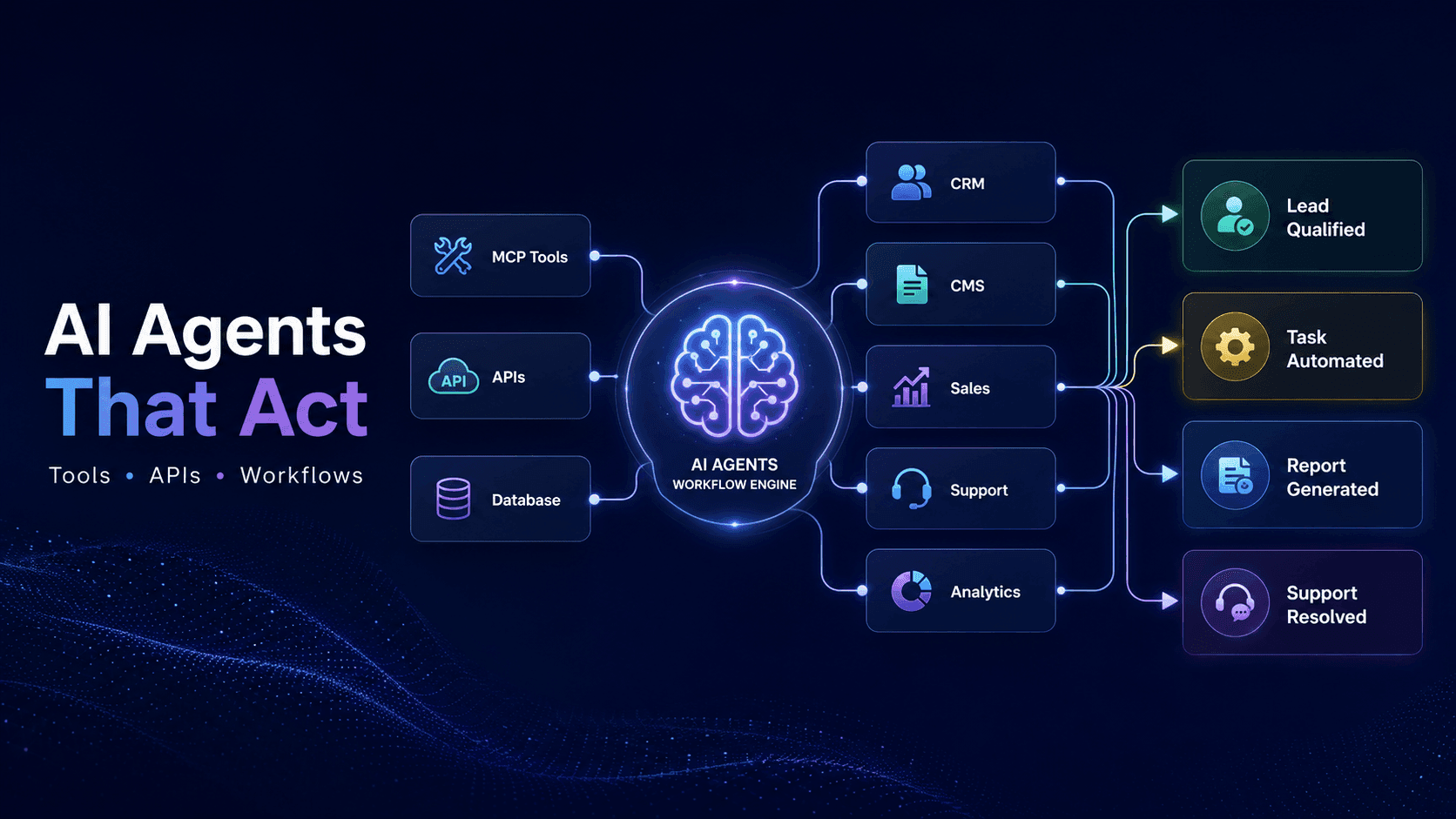
User Prompt → Intent Detection → Planning → Tools / APIs / Database → Business Rules → Action / Insight
This makes AI agents useful for real workflows such as qualifying leads, booking meetings, analyzing financial data, searching company documents, generating reports, updating CRM records, assisting doctors, automating CMS content, or supporting customer service teams.
Competitor platforms are also moving in this direction. Kore.ai describes its agent platform as a way for enterprises to develop, deploy, and manage AI-powered business applications with autonomous AI agents that understand context and take actions.
Why Businesses Need Custom AI Agents
Generic AI tools are useful, but they are not designed around your business. They may not understand your services, customers, workflows, data sources, rules, approval processes, or internal systems.
Custom AI agents solve this problem by connecting AI with your actual business operations.
A custom AI agent can:
- Answer customer questions
- Qualify leads automatically
- Book meetings
- Search internal knowledge
- Connect with CRM, CMS, ERP, and APIs
- Generate reports
- Analyze business or financial data
- Support human teams
- Trigger backend workflows
- Follow company-specific rules
- Escalate complex cases to humans
This is why enterprises are moving from generic AI tools to workflow-connected AI systems. N-iX highlights that AI agent development should integrate with enterprise IT ecosystems including ERP, CRM, data platforms, and proprietary software.
AI Agent Development Services We Provide
1. Custom AI Agent Development
We design and build AI agents for specific business use cases such as sales, support, finance, healthcare, content operations, internal knowledge search, product recommendations, and workflow automation.
Each AI agent is developed around the workflow it needs to support. This includes prompt design, tool selection, backend logic, API integration, response formatting, security rules, and human handoff.
2. AI Sales Agents and AI SDR Systems
AI sales agents can help businesses engage website visitors, answer service questions, qualify leads, collect requirements, recommend the right service, and schedule meetings.
This is more powerful than a normal website chatbot because the AI agent can work with sales workflows and human sales engineers. We implemented this approach in our Custom AI Chatbot with Gemini + OpenAI for Website & Customer Engagement.
Build AI Agents That Automate Real Business Workflows
3. AI Customer Support Agents
AI support agents can reduce repetitive support workload by answering FAQs, searching knowledge bases, checking user context, creating support tickets, and routing unresolved issues to the right team.
For businesses with high inquiry volume, AI support agents can improve response speed and customer experience.
4. MCP-Powered AI Agents
MCP, or Model Context Protocol, allows AI agents to connect with business tools, APIs, databases, and backend services in a structured way.
Without MCP, AI may only generate text. With MCP tools, AI can call functions, retrieve approved data, run workflows, and return structured outputs.
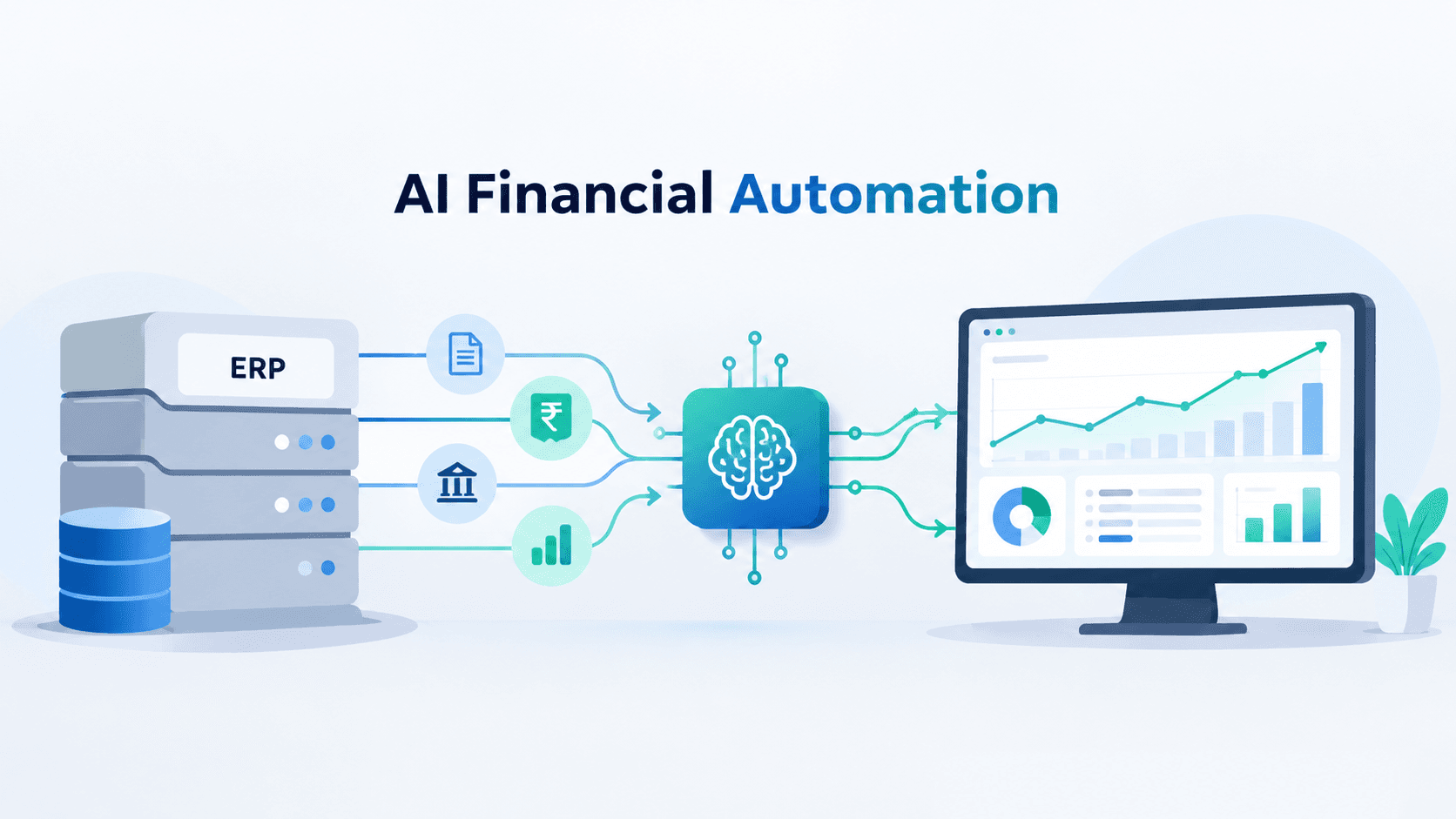
For example, in our AI-Powered Stock Research & Analysis Platform Case Study, the system uses AI, MCP-style tools, financial APIs, Claude AI, OpenAI, and backend rules to analyze Indian stocks, sectors, portfolio risk, and trade setup conditions.
5. Generative AI Agents
Generative AI agents help businesses automate content, summaries, reports, proposals, marketing copy, product descriptions, multilingual content, and knowledge-based outputs.
For CMS and marketing teams, this becomes powerful when connected to a headless CMS. In our AI-powered Sanity + Next.js website case study, AI content agents, multilingual workflows, SEO/GEO/AEO summaries, and content automation helped transform a website into an AI-native content platform.
Explore our Generative AI Solutions for business content, automation, and intelligent application development.
Real AI Agent Use Cases
AI agents can support many business areas:
- Sales lead qualification
- Customer support automation
- AI chatbot with human handoff
- Healthcare assistant for doctors
- Financial research and stock analysis
- AI-powered CMS automation
- AI matchmaking and recommendation systems
- Billing and inventory insights
- Internal knowledge search
- Report generation
- Workflow automation
- AI MVP product development
For healthcare, we developed an AI Assistant for Doctors in Hospital Management System. For AI-powered matchmaking, we built TribalShaadi.ai — AI-Powered Matrimony Platform. These examples show that AI agents can be applied across industries when they are connected with real product workflows.
How We Build AI Agents
A successful AI agent project needs more than selecting an LLM model. It needs architecture, workflow design, guardrails, testing, and integration.
Our AI agent development process includes:
- Use-case discovery
We identify the business problem, users, data sources, tools, risks, and expected outcome. - Agent workflow design
We define what the agent should understand, what actions it can take, what tools it can use, and where human approval is required. - LLM and tool integration
We integrate OpenAI, Claude, Gemini, MCP tools, APIs, databases, CRM, CMS, or third-party platforms. - Prompt engineering and rules
We create prompts, output schemas, fallback flows, validation logic, and business-specific instructions. - Testing and optimization
AI agents must be tested for accuracy, relevance, latency, security, hallucination risk, and workflow reliability. Competitors like N-iX also emphasize monitoring, updates, and optimization after deployment.
For businesses exploring AI ideas, our AI workshop video explains where AI can create practical business value: Thinking About AI for Your Business?. For AI product validation, watch: AI MVP Product Discovery.
Turn Business Processes Into Intelligent Agentic AI Systems
Technologies Used for AI Agent Development
Depending on the project, we use:
- OpenAI
- Claude AI
- Gemini
- MCP Server
- MCP Tools
- Python FastAPI
- Node.js
- Next.js
- React
- PostgreSQL
- Vector databases
- RAG pipelines
- REST APIs
- CRM/CMS integrations
- Cloud hosting
- Prompt engineering
- Agentic workflow orchestration
Appinventiv also positions AI agent development as enterprise deployment with minimal setup, while Rishabh Software highlights capabilities such as prompt engineering, guardrails, reasoning loops, and multi-channel integration. These are important, but the real success comes from connecting those capabilities to specific business outcomes.
Why Choose Murmu Software Infotech?
Murmu Software Infotech builds practical AI systems that connect with real business workflows.
We are not only building AI demos. We build AI agents, AI applications, MCP servers, AI chatbots, generative AI systems, and custom software platforms that help businesses sell, support, automate, analyze, and scale.
Our strength is combining AI engineering with full-stack development, API integration, enterprise CMS experience, custom software architecture, and business workflow understanding.
Explore our core AI service here: AI Solutions Development.
Final Thoughts
AI agent development is the next step in business automation.
The future is not just AI that talks. The future is AI that understands intent, uses tools, applies rules, works with data, supports teams, and helps businesses execute faster.
If you are planning to build an AI sales agent, AI support agent, AI copilot, MCP-powered assistant, AI-powered application, or agentic workflow automation system, now is the right time to start.
Build AI agents that do more than answer. Build AI agents that act, automate, and deliver business outcomes.
Frequently Asked Questions
What are AI agent development services?
AI agent development services involve designing and building AI-powered systems that can understand intent, plan tasks, call tools, connect with APIs, retrieve data, apply business rules, automate workflows, and generate structured outcomes for business use cases.
Does Murmu Software Infotech build custom AI agents?
Yes. Murmu Software Infotech builds custom AI agents, agentic AI systems, AI copilots, AI sales agents, AI support agents, MCP-powered agents, and AI-powered business automation platforms for startups, enterprises, agencies, and SaaS companies.
How are AI agents different from AI chatbots?
A basic AI chatbot usually answers questions. An AI agent can go further by understanding goals, selecting tools, calling APIs, accessing databases, applying rules, triggering workflows, and returning structured business outcomes.
What is agentic AI development?
Agentic AI development is the process of building AI systems that can reason through tasks, use tools, follow workflow steps, make context-aware decisions, and assist with business processes such as sales, support, research, reporting, and operations.
What are MCP-powered AI agents?
MCP-powered AI agents use Model Context Protocol servers and tools to connect AI models with business systems, APIs, databases, CRM, CMS, ERP, knowledge bases, and backend services in a structured and secure way.
Can AI agents support sales teams?
Yes. AI sales agents can answer customer questions, qualify leads, capture requirements, recommend services, book meetings, follow up with prospects, and hand over high-value or complex conversations to human sales teams.
Can AI agents automate customer support?
Yes. AI customer support agents can answer FAQs, search knowledge bases, summarize issues, create support tickets, check user context, route unresolved problems, and reduce repetitive manual work for support teams.
Which technologies are used for AI agent development?
AI agents can be built using OpenAI, Claude, Gemini, MCP servers, MCP tools, Python FastAPI, Node.js, Next.js, React, PostgreSQL, vector databases, APIs, RAG pipelines, cloud hosting, and secure authentication systems.
What industries can use AI agents?
AI agents can be used in SaaS, healthcare, finance, e-commerce, education, customer support, sales, enterprise CMS, content operations, HR, internal knowledge management, matchmaking platforms, and custom business automation workflows.
Why choose Murmu Software Infotech for AI agent development?
Murmu Software Infotech combines AI engineering, MCP server development, full-stack software development, API integrations, enterprise CMS expertise, and business workflow understanding to build practical AI agents that automate real business operations.