Sitecore Support What Sitecore Covers, What It Doesn't, and Who Fills the Gap
In This Article
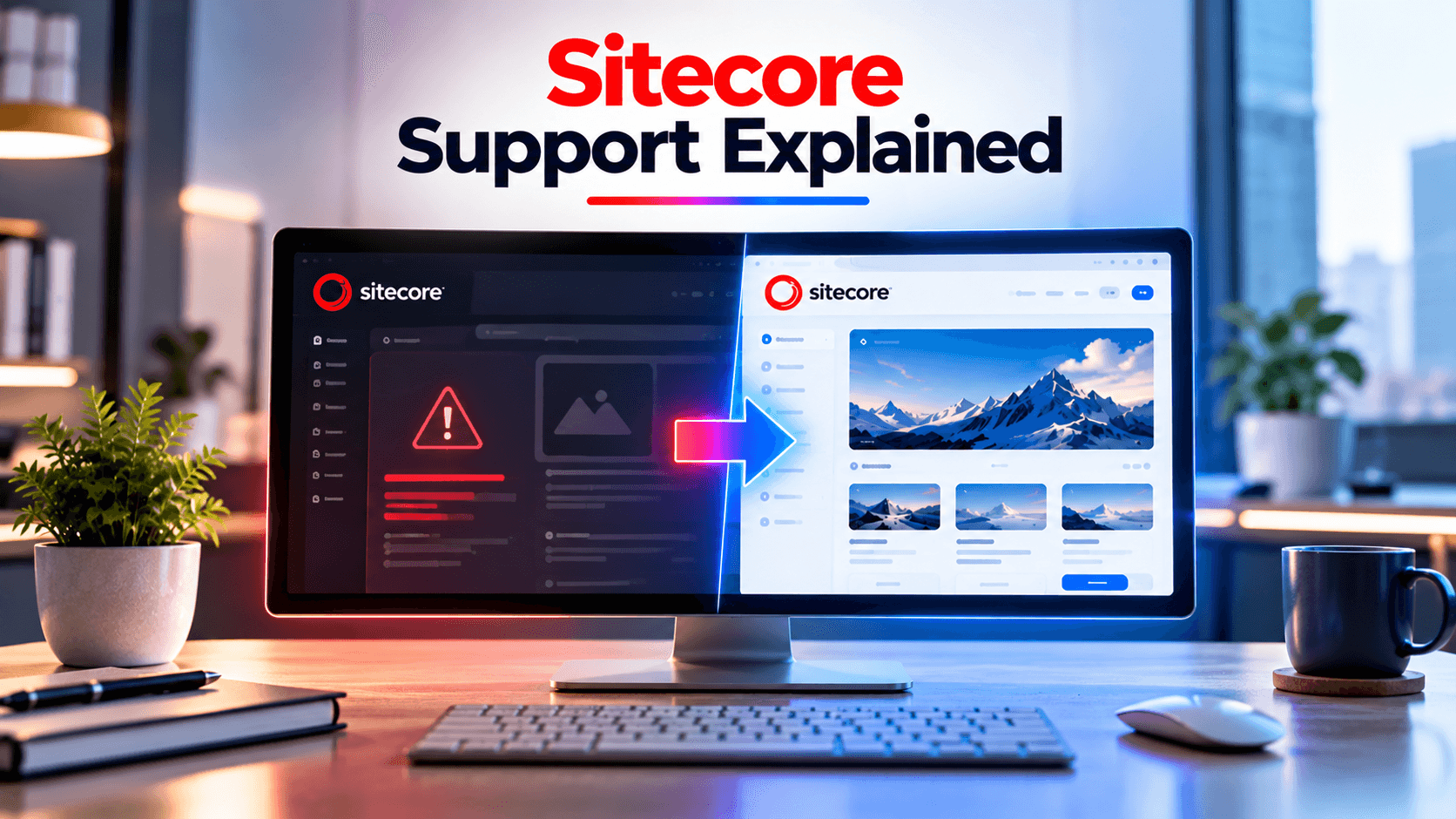
Your Sitecore site goes down on a Monday morning. You raise a ticket with Sitecore, and the reply asks you to prove the issue exists in a clean, unmodified installation. Meanwhile, your homepage is still broken.
This is the moment most businesses realize that Sitecore support means two very different things.
Sitecore's Own Support Has a Narrow Scope
Sitecore offers two support levels: Standard Support and 24x7 Premium Support. Sitecore defines support as investigating and resolving difficulties with its products, documentation, and services, and it explicitly excludes consulting and training.
In practice, Sitecore helps when the product itself misbehaves. It won't debug the custom component your previous agency built, fix a broken CRM integration, or speed up a slow page caused by your own code. On most enterprise sites, that custom layer is where most issues actually live.
That's why many companies use a Sitecore partner for day-to-day support alongside the vendor.
Your Version Decides How Much Help You Get
Support also depends on your version. Sitecore supports each version for up to 8 years across three phases. Right now:
- · Sitecore 9.0 to 9.3: support has effectively ended
- · Sitecore 10.0 and 10.1: Extended Support ends December 31, 2026
- · Sitecore 10.4: the only version in Mainstream Support
If you're on an older version, a support partner isn't optional. You'll need someone to patch, stabilize, and plan your next move, whether that's upgrading to 10.4 or migrating to XM Cloud.
Keep Sitecore Stable and Performing
Get expert support for Sitecore code, integrations, performance, publishing, maintenance, upgrades and critical platform issues when problems arise.
What Good Partner Support Actually Includes
A solid Sitecore support plan usually covers:
- · Bug fixes in custom code: renderings, templates, pipelines, and integrations
- · Performance tuning: caching, slow queries, and Core Web Vitals
- · Security patching: applying Sitecore hotfixes and keeping dependencies current
- · Publishing and workflow issues: the "why isn't my page live?" tickets
- · Small enhancements: new components, form changes, and content model tweaks
- · Upgrade and migration planning: so you're not surprised by end-of-support dates
A Typical Example
A UK retailer runs Sitecore 10.1 with a custom product feed and Salesforce integration. After a Salesforce API update, product pages stop showing stock levels. Sitecore's vendor support can't help, because the product itself isn't faulty. The fix is in custom integration code.
With a partner on a support retainer, a developer who already knows the codebase traces the issue, deploys a fix, and the pages are back the same day. Without one, the retailer starts searching for a Sitecore developer while losing sales.
That's the real value of support: speed, because someone already knows your system.
Fix Sitecore Search Gaps Before Rankings Start Falling
What to Check Before Signing a Sitecore Support Contract
- 1. Response vs resolution time. A 30-minute response means little if fixes take a week.
- 2. Severity levels. Is "site down" treated differently from "typo on a page"?
- 3. Coverage hours. Do you need 24x7, or do business hours in your time zone work?
- 4. Version coverage. Can they support XP, XM, and XM Cloud?
- 5. Unused hours. Do they roll over or disappear?
- 6. Documentation. Will they document fixes, so you're not locked in?
How Murmu Software Infotech Supports Sitecore Sites
Murmu Software Infotech provides Sitecore development and support for businesses and agencies, with hands-on experience across .NET, React, Next.js, and Sitecore tools including SXA, JSS, Helix/Habitat, and Sitecore MVC. That means we can support both traditional MVC builds and newer headless setups.
With Murmu Software Infotech, you get:
- · Developers who learn your codebase, not a generic helpdesk
- · Flexible support: monthly retainers, dedicated developers, or on-demand help
- · Fixes, enhancements, and performance work in one place
- · Upgrade and XM Cloud migration planning when your version nears end of support
White-label support for agencies in the US, UK, and UAE
Frequently Asked Questions
What does Sitecore support cover?
Sitecore vendor support primarily addresses supported Sitecore product, service and documentation issues. Custom implementation problems often require a Sitecore development support partner.
What does Sitecore vendor support not cover?
Vendor support generally does not provide ongoing development for custom components, third-party integrations, bespoke frontend code, business-specific functionality or implementation-level enhancements.
Why does an enterprise need a Sitecore support partner?
Enterprise Sitecore websites usually contain custom code, integrations and workflows. A specialist partner can maintain and troubleshoot this implementation layer in addition to supporting platform improvements.
Can a Sitecore support partner fix custom integrations?
Yes. A Sitecore development partner can troubleshoot custom CRM, ERP, search, product-feed and other third-party integrations when the problem exists outside the core Sitecore product.
Can Sitecore support improve website performance?
Yes. Technical support can investigate caching, slow queries, APIs, renderings, JavaScript, images and third-party dependencies that affect performance and Core Web Vitals.
Who fixes Sitecore publishing and workflow problems?
A Sitecore development support team can troubleshoot publishing configuration, workflow, templates, renderings and custom code that prevents content from appearing correctly.
What should a Sitecore support SLA include?
A support SLA should clearly define severity levels, response targets, resolution expectations, coverage hours, escalation procedures, supported versions and documentation requirements.
How should older Sitecore versions be supported?
Older Sitecore environments may need additional patching, security maintenance, technical stabilization and a clear upgrade or migration roadmap.
Can Sitecore support include XM Cloud migration planning?
Yes. A support partner can audit dependencies, technical debt, integrations and custom functionality and help prepare an XM Cloud migration roadmap.
Can agencies use white-label Sitecore support services?
Yes. Digital agencies can use white-label Sitecore development and support teams to maintain client websites while keeping delivery under the agency's own brand.