.NET Monolithic vs Modular Monolith vs Microservices Architecture: The Strategic Decision Every Enterprise Must Get Right in 2026
In This Article
- Architecture is a Business Decision, Not Just Technology
- Understanding the Three Architectural Models
- 1. Monolithic Architecture (Traditional Model)
- ✔ Strengths:
- ✔ Limitations:
- 2. Modular Monolith (The Modern Middle Ground)
- ✔ Strengths:
- ✔ Limitations:
- 3. Microservices Architecture (Distributed Model)
- ✔ Strengths:
- ✔ Challenges:
- .NET in 2026: A Unified Platform for All Architectures
- Business Comparison: What Leaders Must Understand
- The Strategic Insight: There is No “One Best Architecture”
- When to Choose What
- ✔ Choose Monolith if:
- ✔ Choose Modular Monolith if:
- ✔ Choose Microservices if:
- The Real Risk: Overengineering Too Early
- Why Murmu Software Infotech
- Key Trends in 2026
- ➤ Modular Monolith Adoption Rising
- ➤ Microservices for Enterprise Scale
- ➤ Cloud-Native .NET Development
- Final Thought
- Build the Right Architecture for Your Business
Architecture is a Business Decision, Not Just Technology
In 2026, enterprise success is no longer defined by the tools you use—but by the architecture decisions you make.
The choice between .NET monolithic vs modular monolith vs microservices architecture is not just a technical preference.
➜ It directly impacts:
- Business agility
- Cost efficiency
- Speed of innovation
- Long-term scalability
Organizations that treat architecture as a strategic decision outperform those that treat it as an implementation detail.
Understanding the Three Architectural Models
1. Monolithic Architecture (Traditional Model)
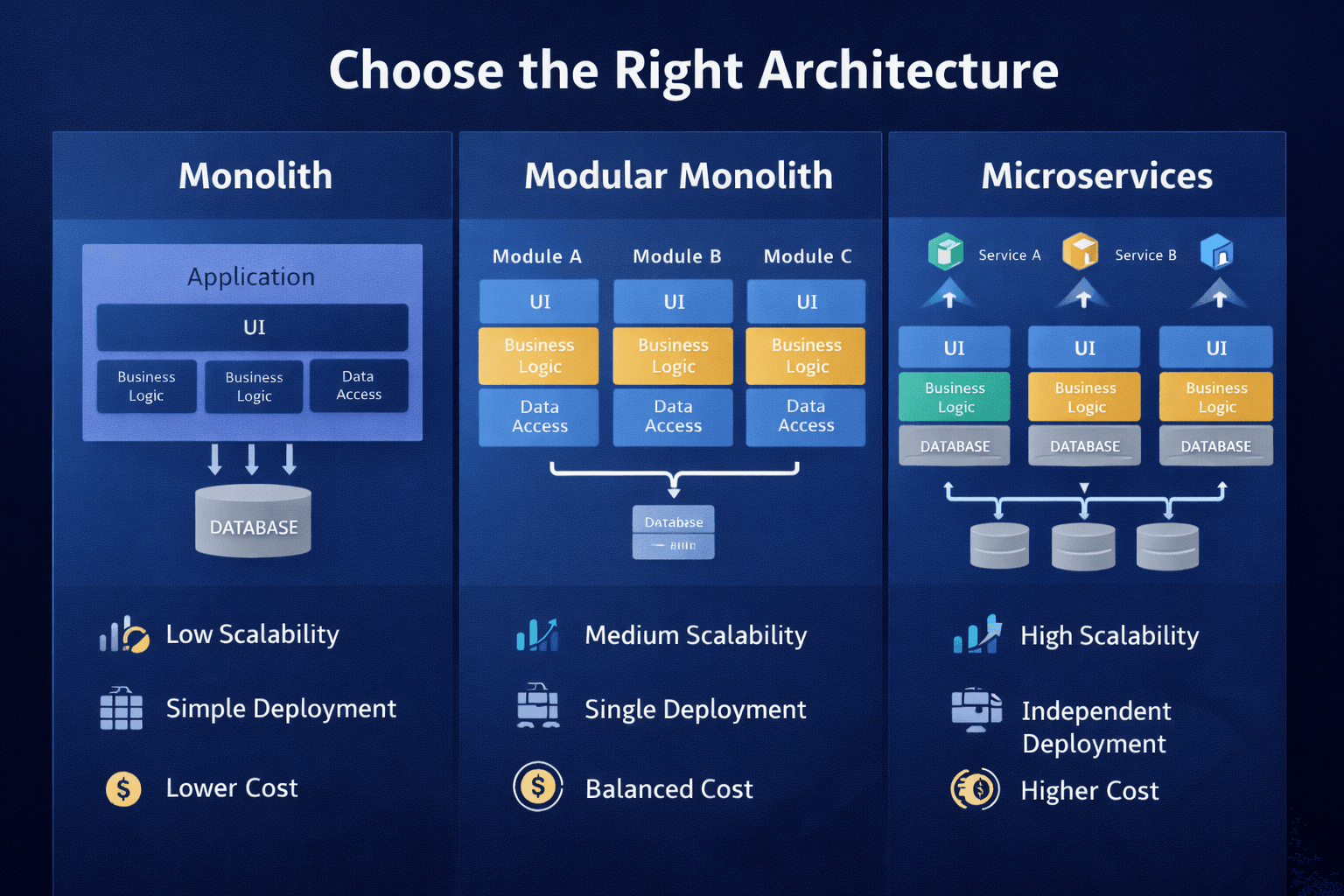
A monolithic architecture is a single, unified application where all components are tightly coupled.
✔ Strengths:
- Simple to build and deploy
- Lower initial cost
- Faster early-stage development
✔ Limitations:
- Hard to scale
- Slower updates
- Increased risk of system-wide failures
➜ Business Impact:
Works well for early-stage systems but becomes a bottleneck at scale.
2. Modular Monolith (The Modern Middle Ground)
Reduce Complexity. Increase Scalability. Optimize Costs.
A modular monolith combines structured modularity within a single deployment unit.
➜ Think of it as:
- One application
- Multiple well-defined modules
✔ Strengths:
- Clear separation of concerns
- Easier scalability than monolith
- Lower operational complexity than microservices
✔ Limitations:
- Requires strong architectural discipline
- Not fully independent deployment
➜ Business Impact:
Offers a balance between simplicity and scalability.
3. Microservices Architecture (Distributed Model)
Microservices break applications into independent services.
Each service:
- Has its own logic
- Can be deployed independently
- Scales independently
✔ Strengths:
- High scalability
- Independent deployments
- Faster innovation cycles
✔ Challenges:
- Operational complexity
- Higher infrastructure cost
- Requires DevOps maturity
➜ Business Impact:
Ideal for large-scale, complex enterprise ecosystems.
.NET in 2026: A Unified Platform for All Architectures
Modern .NET supports:
- Monolithic systems
- Modular monoliths
- Microservices
With:
- .NET Core / .NET 8+
- Cloud-native capabilities
- API-first architecture
➜ This makes .NET a strategic platform for enterprise architecture evolution
Business Comparison: What Leaders Must Understand
| Factor | Monolith | Modular Monolith | Microservices |
|---|---|---|---|
| Speed (Initial) | High | Medium | Low |
| Scalability | Low | Medium | High |
| Complexity | Low | Medium | High |
| Cost | Low | Medium | High |
| Flexibility | Low | Medium | High |
The Strategic Insight: There is No “One Best Architecture”
The biggest mistake enterprises make:
➜ Trying to choose the “best” architecture
Instead of:
➜ Choosing the right architecture for their business stage
When to Choose What
✔ Choose Monolith if:
- You are in early-stage development
- Speed matters more than scale
✔ Choose Modular Monolith if:
- You need scalability with simplicity
- You want future transition flexibility
✔ Choose Microservices if:
- You operate at enterprise scale
- You need independent deployments
- You have DevOps maturity
The Real Risk: Overengineering Too Early
Many organizations jump to microservices too soon.
➜ Result:
- Increased cost
- Slower delivery
- Complex operations
Why Murmu Software Infotech
At Murmu Software Infotech, we help enterprises:
➜ Choose the right architecture
➜ Build scalable .NET systems
➜ Transition from monolith to microservices
- Enterprise .NET Development Services
- Cloud & Microservices Solutions
Key Trends in 2026
➤ Modular Monolith Adoption Rising
Balance between simplicity and scalability
➤ Microservices for Enterprise Scale
Large organizations adopting distributed systems
➤ Cloud-Native .NET Development
Azure-first architectures
Final Thought
Architecture decisions define business outcomes.
The shift from monolith to microservices is not mandatory—
➜ The shift toward scalable, strategic architecture is
Build the Right Architecture for Your Business
Partner with experts to design and implement scalable .NET architectures aligned with your growth goals.
➜ Reduce complexity
➜ Scale efficiently
➜ Accelerate innovation
Frequently Asked Questions
What is .NET Monolithic vs Modular Monolith vs Microservices Architecture: The Strategic Decision Every Enterprise Must Get Right in 2026?
Compare .NET monolith, modular monolith, and microservices architecture. Choose the right scalable, cost-efficient approach for enterprise growth in 2026.