eCommerce App Development: Building Mobile-First Retail, D2C and Marketplace Platforms
In This Article
- 1. Why Mobile App Development Matters for Modern Commerce
- 2. Why Manual Commerce Tools Limit Business Growth
- 3. Essential Features of an eCommerce Mobile App
- 4. Marketplace App Development: Connecting Buyers, Sellers and Services
- 5. D2C eCommerce Platform Development for Growing Brands
- Ready to Build Your Mobile Commerce Platform?
- 6. React Native App Development and Custom Commerce Architecture
- 7. eCommerce App Development Use Cases and Project Examples
- 8. eCommerce App Development Cost and Timeline Factors
- 9. Business Benefits of Custom eCommerce Development
- 10. Build Your Mobile Commerce App With MSI
- Frequently Asked Questions
- 1. How much does eCommerce app development cost?
- 2. How long does it take to develop an eCommerce mobile app?
- 3. Is React Native suitable for eCommerce app development?
- 4. What is the difference between a D2C platform and a marketplace?
- 5. Can an eCommerce app integrate with POS, ERP and inventory software?
Customers want to research products, compare prices, shop, pay securely, and track orders from their mobile phones. However, for many retailers, D2C brands, and service providers, websites, spreadsheets, messaging tools, and order processing remain disconnected, resulting in missed orders, inventory inaccuracies, slower fulfilment, and poor consumer insights.
Modern eCommerce app development bridges the gap between the customer experience and the supply chain by building mobile apps, commerce platforms, payment gateways, delivery tools, and management systems.
This is a great opportunity for businesses in India, the UAE, and Southeast Asia to design mobile commerce ecosystems that scale with customer expectations.
1. Why Mobile App Development Matters for Modern Commerce
Customers increasingly expect a convenient buying journey across mobile devices.
A well-designed mobile commerce app can provide:
- Faster product discovery and ordering
- Secure, convenient payment options
- Personalized offers and notifications
- Order history and repeat purchasing
- Delivery updates and customer support
- A direct digital relationship with customers
However, launching an app without connecting inventory, payments and order management creates new operational problems.
That is why businesses should evaluate mobile app, eCommerce and marketplace development as an integrated business investment rather than a standalone application.
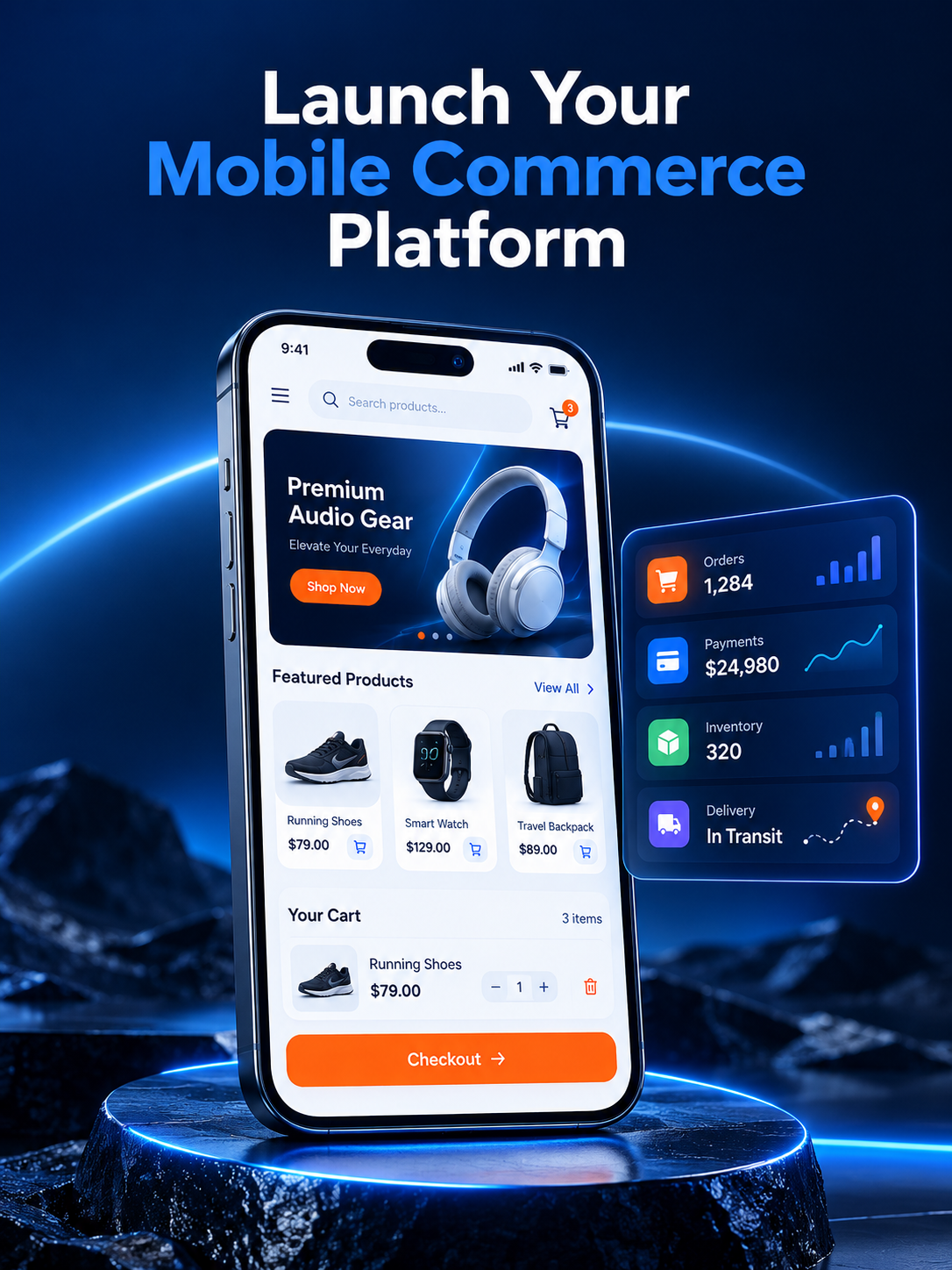
Launch Your Mobile Commerce Platform
Build scalable eCommerce apps, D2C stores, and marketplaces with seamless payments, smart inventory, delivery tracking, and connected business operations.
2. Why Manual Commerce Tools Limit Business Growth
Consider a grocery retailer receiving orders through messages, maintaining inventory in spreadsheets and assigning deliveries through phone calls.
This approach may work initially.
But as orders increase, common challenges emerge:
- Products are displayed despite being out of stock.
- Customers receive inconsistent pricing.
- Staff manually update order statuses.
- Delivery coordination becomes difficult.
- Business owners cannot easily track profitability.
A connected platform reduces repeated data entry and provides a more reliable workflow.
The goal is not simply digitization. It is operational visibility and control.
3. Essential Features of an eCommerce Mobile App
Connected customer-facing and administrative modules are key to successful development of an eCommerce mobile app.
Customer application
Catalogues, powerful search, filters, wishlists, shopping carts, checkout, payments, offers and order tracking.
Business administration
Product management, pricing, inventory, order management, refunds, customer relations, promotions and reporting dashboards.
Delivery and fulfilment
Order assignment, shipment status, pickup options, serviceable areas and customer notifications.
Marketplace management
Vendor registrations, dashboards, product approvals, commission rules, payouts and dispute management.
For growing businesses, connecting all these modules with a shared backend will make day to day operations significantly simpler.
Turn Your Commerce Idea Into a Scalable Mobile Platform
4. Marketplace App Development: Connecting Buyers, Sellers and Services
A marketplace differs from a traditional online store because multiple sellers or service providers operate through one platform.
There are several possible business models:
Multi-vendor marketplace: Multiple merchants manage listings and receive orders through one platform.
Local commerce marketplace: Customers discover nearby sellers, products or second-hand goods.
Service marketplace: Customers find providers, compare availability, make bookings and manage service requests.
Grocery marketplace: Stores offer inventory-based ordering, delivery slots and location-specific fulfilment.
A reliable retail and eCommerce platform should reflect the selected revenue model, vendor responsibilities and customer journey.
5. D2C eCommerce Platform Development for Growing Brands
A D2C eCommerce platform allows brands to sell directly to consumers through their own website or mobile application.
Unlike a marketplace-led strategy, D2C gives brands greater control over product presentation, customer experiences and first-party customer relationships.
Important capabilities include:
- Brand-focused storefront design
- Customer accounts and loyalty programs
- Discount campaigns and personalized offers
- Subscription or repeat-order workflows
- Inventory, payment and shipping integrations
- Sales analytics and customer segmentation
A strong D2C strategy focuses on both customer acquisition and repeat purchasing.
Ready to Build Your Mobile Commerce Platform?
Murmu Software Infotech helps founders, retailers and growing businesses develop connected eCommerce applications, D2C platforms and marketplace solutions.
6. React Native App Development and Custom Commerce Architecture
Technology decisions should reflect business requirements, budgets and long-term scalability.
React Native app development can support Android and iOS applications through a shared development approach, while custom APIs connect mobile experiences with backend systems.
A commerce architecture may include:
- React Native mobile application
- Web storefront and administrative dashboard
- Secure backend APIs and databases
- Payment gateway integrations
- Inventory, CRM and ERP connections
- Notifications, analytics and monitoring
Businesses with unique operational workflows may also benefit from custom software development.
The right architecture should prioritize security, reliability, maintainability and business flexibility.
7. eCommerce App Development Use Cases and Project Examples
Different industries require different commerce workflows.
Retail businesses: Product catalogues, POS integration, stock synchronization and customer loyalty.
Grocery businesses: Local delivery zones, substitutions, delivery scheduling and inventory availability.
D2C brands: Brand-owned storefronts, promotions, customer retention and fulfilment integrations.
Service businesses: Provider profiles, scheduling, bookings, payments and service tracking.
Multi-vendor platforms: Seller onboarding, listing moderation, commissions and centralized administration.
Practical project examples demonstrate how these models translate into software.
The GAXA local marketplace project illustrates location-based discovery, buyer-seller communication, verification and marketplace administration.
Another example is the multi-vendor eCommerce marketplace platform, which demonstrates the value of connected seller and commerce workflows.
For brand-owned selling, the D2C commerce platform case study provides further context.
8. eCommerce App Development Cost and Timeline Factors
How much does it cost to build an eCommerce app?
There is no universal price because project scope varies considerably.
The largest cost drivers include:
- Android-only versus Android and iOS development
- Standard storefront versus multi-vendor marketplace
- Product catalogue and checkout complexity
- Payment, shipping and inventory integrations
- Custom dashboards and seller management
- Security, testing and post-launch maintenance
An MVP with core shopping features generally requires less development effort than a marketplace with multiple applications and advanced integrations.
A practical approach is to launch essential workflows first, validate demand and introduce additional capabilities based on customer feedback.
9. Business Benefits of Custom eCommerce Development
When implemented properly, custom eCommerce development can help businesses:
- Reduce manual order-processing work
- Improve catalogue and inventory consistency
- Make repeat purchasing more convenient
- Gain visibility into sales and operations
- Support new locations, vendors or service categories
- Build more direct customer relationships
The real value comes from integrating technology with measurable business objectives.
10. Build Your Mobile Commerce App With MSI
Murmu Software Infotech caters to the app design and development needs of the founders, retailers, D2C brands and service businesses looking to build their presence in the digital world.
From ideation to execution, the company works on a strategic approach to develop an application, eCommerce storefront, marketplaces and connected commerce systems.
It starts with understanding the business requirements, customer journeys and key processes, followed by the architectural design, development, integration, testing and launch strategies.
Planning to design and develop an eCommerce app, grocery marketplace, D2C storefront or multi-vendor marketplace solution? Let's build an application that is focused on your customers, operations and growth strategy.
Ready to Launch Your eCommerce App or Marketplace Faster?
Frequently Asked Questions
1. How much does eCommerce app development cost?
Cost depends on application features, supported platforms, integrations, design requirements, backend complexity and maintenance needs. A detailed requirements assessment is needed for a reliable estimate.
2. How long does it take to develop an eCommerce mobile app?
A focused MVP may take a few months, while complex marketplaces can require significantly longer. The timeline depends on features, integrations, testing and approvals.
3. Is React Native suitable for eCommerce app development?
Yes. React Native can support Android and iOS commerce applications using shared development code, with platform-specific implementations where necessary.
4. What is the difference between a D2C platform and a marketplace?
A D2C platform enables a brand to sell directly to consumers. A marketplace connects multiple sellers or service providers through one digital platform.
5. Can an eCommerce app integrate with POS, ERP and inventory software?
Yes. APIs and integration services can connect eCommerce applications with inventory management, payment gateways, POS systems, ERP, CRM and logistics platforms.
Frequently Asked Questions
How much does eCommerce mobile app development cost?
eCommerce mobile app development costs depend on app complexity, UI/UX design, product catalogue, payment integrations, inventory management, delivery tracking, backend architecture and target platforms. A basic MVP generally costs less than an advanced, multi-vendor commerce platform. MSI can help businesses define features and estimate costs based on their requirements.
How long does it take to develop an eCommerce mobile app?
An eCommerce mobile app can take several weeks to several months depending on features, integrations, design complexity, testing and deployment requirements. A focused MVP can launch sooner than a large marketplace with seller dashboards, inventory synchronization and custom delivery workflows.
What is the difference between an eCommerce app and a marketplace app?
An eCommerce app typically enables one retailer or brand to sell products directly to customers. A marketplace app connects multiple sellers or service providers with buyers through one platform. Marketplaces often require vendor onboarding, commissions, seller dashboards, payouts, moderation and centralized administration.
What features should a modern eCommerce mobile app include?
Essential eCommerce app features include user registration, product catalogues, search, filters, shopping carts, secure checkout, payment integration, order tracking, offers, notifications and customer support. Growing businesses may also need inventory synchronization, seller management, CRM integrations and sales analytics.
Can React Native be used to develop eCommerce apps for Android and iOS?
Yes. React Native supports cross-platform development for Android and iOS using a shared codebase. It can integrate with commerce APIs, payment gateways, inventory systems and administrative dashboards. The technology choice should account for performance, native functionality, long-term maintenance and project requirements.
How do I build a multi-vendor marketplace app?
Building a multi-vendor marketplace starts with selecting a business model, defining buyer and seller journeys, and planning core features. Typical modules include seller registration, product listings, search, cart, payments, commissions, orders, administration and dispute management. An MVP-first approach can help validate the marketplace before expanding functionality.
Can an eCommerce app integrate with existing POS, ERP and inventory software?
Yes. eCommerce applications can connect with POS, ERP, CRM, warehouse and inventory systems through APIs or integration services. These integrations can synchronize product availability, orders, pricing and customer information, depending on the capabilities of existing software.
What is the best approach to building a D2C eCommerce platform?
A D2C eCommerce platform should prioritize brand identity, mobile shopping, product discovery, checkout simplicity, customer retention and fulfillment operations. Businesses should evaluate catalogue requirements, payments, inventory, CRM and analytics before selecting the architecture. A custom platform can support specialized workflows when standard solutions are insufficient.
Can a mobile commerce platform support grocery delivery and service booking?
Yes. Mobile commerce platforms can be designed for grocery ordering, hyperlocal delivery, appointment booking and service marketplaces. Grocery applications may need delivery slots, stock availability and substitutions, while service platforms may require provider profiles, availability calendars, booking confirmation and service status tracking.
How do I choose an eCommerce app development company in India or the UAE?
Evaluate relevant project experience, technical capabilities, development methodology, UX design, integration expertise, security practices, support arrangements and communication. Ask for a clearly defined scope, delivery milestones and cost breakdown. MSI provides custom mobile commerce, D2C and marketplace development services for businesses targeting India, the Middle East and Southeast Asia.