Unified Commerce Retail Software for India, UAE, Saudi Arabia and Singapore Retailers
In This Article
- What Is Unified Commerce Software?
- Why Traditional Multi-Channel Retail Creates Problems
- Connect POS Billing With Online Commerce
- Make Inventory Available Across Every Sales Channel
- Turn WhatsApp Into a Connected Commerce Channel
- Build One Customer View Across Store and Digital Channels
- Centralize Orders and Fulfillment
- One Retail Platform Can Still Support Regional Differences
- Unified Commerce Is Ultimately About Business Control
- Build Unified Retail Software
- Build Unified Retail Software
Retail is no longer divided into “offline” and “online.”
A customer may discover a product on Instagram, ask about availability through WhatsApp, compare it on a website, purchase through a mobile app, collect it from a physical store and later request an exchange at another branch.
For retailers operating across India, UAE, Saudi Arabia and Singapore, managing these journeys through disconnected systems creates a serious operational problem.
The POS has one stock number. The website has another. Marketplace orders arrive separately. WhatsApp sales require manual entries. Customer information is scattered across channels. Management reports do not show the complete business.
This is where unified commerce software becomes important.
Instead of adding another sales channel, unified commerce connects the channels retailers already use around common inventory, orders, customers and business data.
What Is Unified Commerce Software?
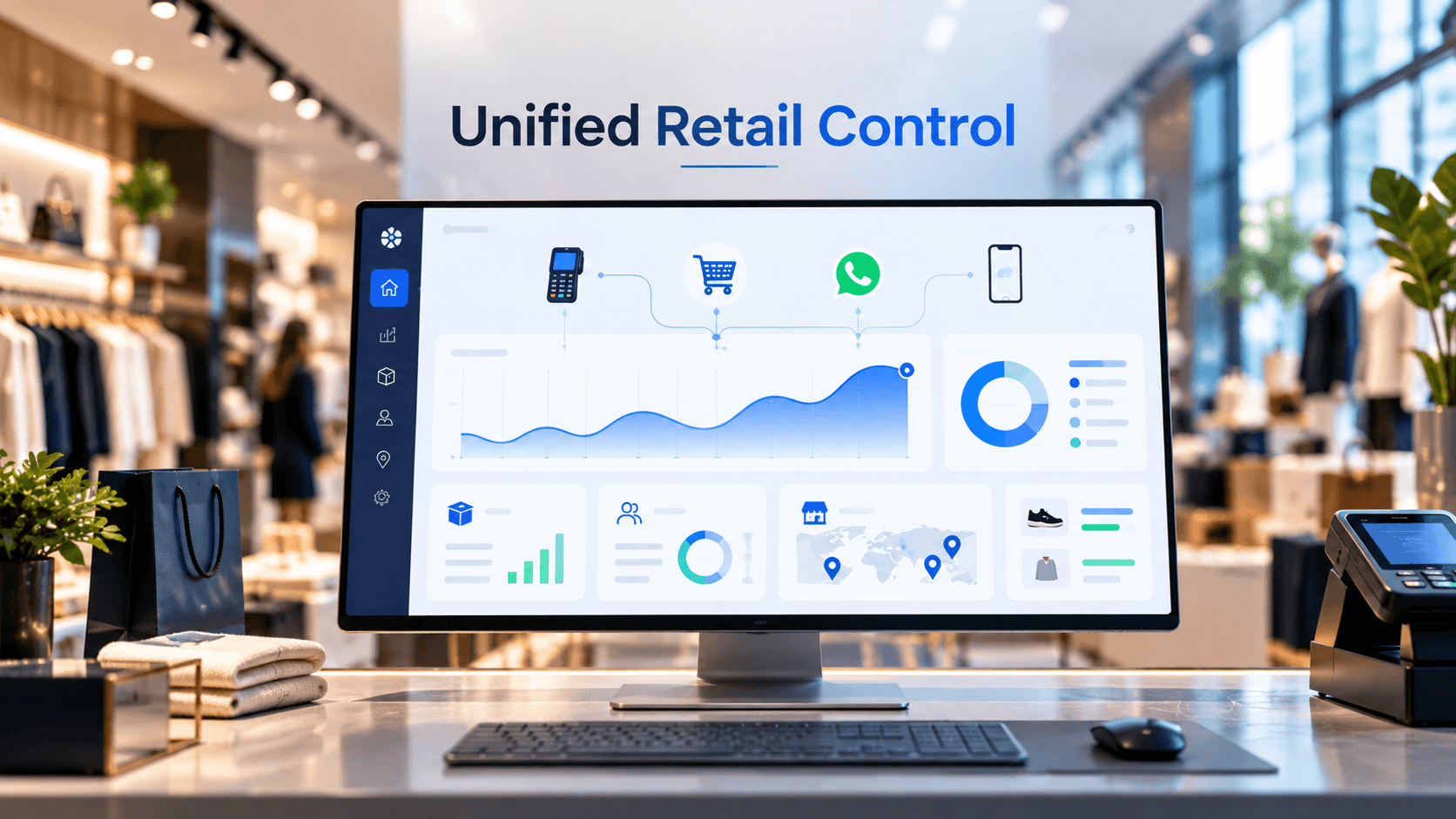
Unified commerce software connects physical stores, eCommerce websites, marketplaces, WhatsApp commerce, mobile applications, inventory, customer data, payments and reporting through one integrated retail ecosystem.
The objective is not simply to let customers shop through more channels.
The objective is to ensure that every channel works with the same operational truth.
A product sold at a store should affect available inventory online. An online order should become visible to fulfillment teams. A WhatsApp customer should not become an isolated record. Store managers and head-office teams should see consistent sales and inventory information.
A connected retail billing, ERP and inventory platform provides the operational foundation for bringing billing, stock, purchases, customers and multi-store management together.

Unify Every Retail Sales Channel
Connect stores, eCommerce, WhatsApp, inventory, customers and orders through one unified commerce platform built for scalable retail growth.
Why Traditional Multi-Channel Retail Creates Problems
Many growing retailers already sell through multiple channels.
But being multi-channel does not automatically mean being unified.
A retailer might operate:
- Physical POS counters
- An eCommerce website
- Mobile shopping apps
- WhatsApp ordering
- Online marketplaces
- Multiple warehouses and retail branches
- Loyalty and customer engagement systems
If each operates separately, employees spend more time reconciling information between systems.
Inventory becomes especially difficult.
A product may be sold in a store while the website still shows it as available. Marketplace orders may reduce inventory later than POS transactions. Staff may manually confirm stock before accepting WhatsApp orders.
Unified commerce aims to replace this fragmented model with connected inventory and order visibility.
Connect POS Billing With Online Commerce
The retail POS remains one of the most important parts of the commerce ecosystem.
It records purchases, payments, discounts, returns and customer interactions inside physical stores.
But modern retail POS software should not operate as an isolated cash register.
When POS and eCommerce systems are integrated, store transactions and digital transactions can contribute to the same operational data layer.
That makes it possible to design workflows around centralized product information, inventory synchronization, customer history, pricing, promotions and reporting.
Retailers planning broader digital expansion can also build a dedicated retail and eCommerce commerce platform connecting web stores, mobile applications, marketplaces, payments, logistics and retail operations.
Connect Every Retail Channel With One Unified Commerce Platform
Make Inventory Available Across Every Sales Channel
Inventory is one of the strongest reasons to invest in unified commerce software.
Customers do not care which internal system owns the stock record.
They simply want to know whether the product is available.
A unified inventory model can help retailers understand stock across stores, warehouses and digital channels while coordinating sales and fulfillment.
This opens the door to more advanced retail journeys such as store pickup, ship-from-store, warehouse fulfillment, inter-store transfers and centralized replenishment.
The result is more than better stock reporting.
Inventory becomes a shared service supporting every commerce channel.
Turn WhatsApp Into a Connected Commerce Channel
WhatsApp is already part of the buying journey for many retailers across India, the Middle East and Southeast Asia.
Customers use it to ask about products, prices, availability, payments, delivery and support.
The problem begins when those conversations remain disconnected from POS and commerce operations.
A connected model can turn WhatsApp into a structured sales channel supporting product catalogs, ordering, payment links, invoices, customer engagement and POS synchronization.
The WhatsApp Commerce and POS integration case study demonstrates how conversational ordering, payments, billing, customer communication and retail operations can work together rather than remaining separate manual processes.
For retailers with high WhatsApp engagement, this can become an important part of the broader unified commerce architecture.
Build One Customer View Across Store and Digital Channels
Unified commerce is also about customers.
Without connected systems, the same customer can appear as several different identities: an in-store shopper, website account, mobile-app user, marketplace buyer or WhatsApp contact.
Connecting customer information makes it easier to build a more consistent retail experience.
Retailers can design systems around purchase history, loyalty, offers, preferences, returns and engagement across channels.
For D2C brands, customer ownership becomes even more important.
A scalable D2C commerce platform can combine high-performance storefronts, mobile commerce, loyalty, customer accounts, CMS integrations and engagement capabilities while keeping the brand closer to its customer relationship.
Centralize Orders and Fulfillment
Unified commerce should answer a simple operational question:
Where is every order, and what needs to happen next?
Orders may originate from stores, websites, marketplaces, mobile applications or WhatsApp.
A connected order workflow can route those transactions into a centralized process for payment confirmation, inventory allocation, packing, shipping, store collection, delivery updates, cancellations and returns.
This becomes especially valuable as retailers expand to more stores, cities or countries.
Instead of managing every channel independently, teams can manage the lifecycle of the order.
Plan Your Unified Commerce Strategy With Our Retail Experts
One Retail Platform Can Still Support Regional Differences
A retailer expanding across India, UAE, Saudi Arabia and Singapore does not need every market to operate identically.
The stronger approach is to build a common commerce architecture that remains configurable by region.
That can include local currencies, payment gateways, taxation configurations, languages, branch structures, pricing rules, customer workflows, reporting requirements and third-party integrations.
Businesses expanding through Singapore and Southeast Asia can also explore enterprise software solutions for Singapore and Malaysia for retail omnichannel systems, enterprise integrations and regional software requirements.
The goal is centralized technology without removing necessary local flexibility.
Unified Commerce Is Ultimately About Business Control
Retailers do not need more disconnected dashboards.
They need one clearer view of what is happening across the business.
Store sales.
Online orders.
Inventory.
Customers.
WhatsApp commerce.
Marketplaces.
Payments.
Fulfillment.
Returns.
Reports.
When these workflows share connected data, management can make decisions using the whole business instead of individual channel snapshots.
That is the real opportunity behind retail ERP eCommerce integration and modern multi-channel retail software.
Build Unified Retail Software
The future of retail is not choosing between physical stores and digital commerce.
It is connecting them.
For retailers in India, UAE, Saudi Arabia and Singapore, a well-designed unified commerce platform can connect POS billing, inventory, eCommerce, mobile apps, WhatsApp, marketplaces, customers, orders and reporting into one scalable retail ecosystem.
If your business is growing across channels or locations, the next step may not be another standalone tool.
It may be creating the architecture that connects everything you already use.
Build Unified Retail Software
Connect your stores, eCommerce, inventory, orders, customers and digital commerce channels through one retail platform designed around your operations.
Frequently Asked Questions
What is unified commerce software?
Unified commerce software connects physical stores, POS systems, eCommerce websites, mobile apps, marketplaces, WhatsApp commerce, inventory, customer data and order management through one integrated retail platform.
What is the difference between omnichannel and unified commerce?
Omnichannel retail provides customers with multiple shopping channels, while unified commerce connects those channels to shared inventory, orders, customer data, payments and operational systems through a common commerce architecture.
How does unified commerce connect POS and eCommerce?
Unified commerce connects store POS and eCommerce systems so sales, inventory, products, customers, orders and reporting can share synchronized data across physical and digital channels.
Can unified commerce software connect WhatsApp with retail POS?
Yes. WhatsApp commerce can be integrated with POS, inventory, customer records, payment workflows and order management so conversational sales become part of the wider retail operation.
Can unified commerce software manage inventory across stores and websites?
Yes. Unified commerce platforms can provide shared inventory visibility across retail stores, warehouses, websites and other sales channels, helping businesses coordinate availability, transfers and fulfillment.
What channels can a unified retail platform connect?
A unified retail platform can connect physical stores, POS counters, eCommerce websites, mobile apps, WhatsApp commerce, marketplaces, warehouses, customer databases and fulfillment workflows.
Can unified commerce support retailers operating in multiple countries?
Yes. Unified commerce platforms can be designed with configurable currencies, payment gateways, tax settings, languages, pricing rules, branch structures and regional integrations for different markets.
What is retail ERP eCommerce integration?
Retail ERP eCommerce integration connects online orders and digital commerce with inventory, purchasing, suppliers, customers, stores, warehouses, reporting and other retail ERP workflows.
When should a retailer build a custom unified commerce platform?
A custom unified commerce platform is useful when standard software cannot support specialized POS workflows, regional requirements, marketplace integrations, WhatsApp commerce, custom inventory logic or complex multi-store operations.
How does unified commerce improve retail reporting?
Unified commerce combines data from stores and digital channels so management can analyze sales, inventory, customers, orders, locations and channel performance from a more complete business view.